
 100% FREE ACCESS
11th Standard Syllabus & Materials
11th Standard
TN 11th Tamil இயற்கை வேளாண்மை,சுற்றுச்சூழல் -செய்யுள் - மனோன்மணீயம் Important Questions And Answers Study Material - QB365 Set A
NEW11th Standard
TN 11th Tamil என்னுயிர் என்பேன் -துணைப்பாடம் - இசைத்தமிழர் இருவர் Important Questions And Answers Study Material - QB365 Set A
NEW11th Standard
TN 11th Tamil மொழி கலை -செய்யுள் - ஒவ்வொரு புல்லையும் Important Questions And Answers Study Material - QB365 Set A
NEW11th Standard
TN 11th Tamil பீடு பெற நில் - இலக்கணம் - பகுபத உறுப்புகள் Important Questions And Answers Study Material - QB365 Set A
NEW11th Standard
TN 11th Tamil பீடு பெற நில் - துணைப்பாடம் - வாடிவாசல் Important Questions And Answers Study Material - QB365 Set A
NEW11th Standard
TN 11th Tamil பீடு பெற நில் - செய்யுள் - குறுந்தொகை Important Questions And Answers Study Material - QB365 Set A

Published on: 13/03/2019
+1 Public Exam March 2019 Important Creative Questions and Answers
Download Tamil Nadu 11th Standard Chemistry question papers, model tests, one-mark questions, important questions, and public exam papers in PDF format. Free study materials and answer keys for TN State Board students.
Questions + Answers key
Take MCQ Chemistry Test
1.
What is the tolerable limit of fluoride ions in drinking water ? What happens if it exceeds 10 ppm ?
2.
Define particulate pollutants.
3.
\(C{ H }_{ 2 }=\overset { - }{ C } H\) is more basic than \(HC\equiv { C }^{ - }\) . Explain why ?
4.
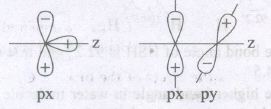
The type of overlap given below do not involve in bond formation - Why?
5.
For the reaction,\({ A }_{ \left( g \right) }+{ B }_{ \left( s \right) }\rightleftharpoons { C }_{ \left( g \right) }+{ D }_{ \left( g \right) }\) Kc = 50 mol lit-1at 127°C. Calculate Kp.
6.
What are the number of bond pairs and lone pairs of electrons on N-atom in N\({ O }_{ 3}^{ - }\) ?
7.
Define Walden inversion
8.
State Raoult's law
9.
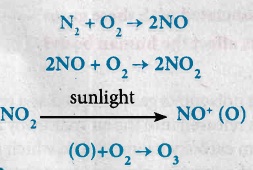
From where does ozone come in the photo chemical smog ?
10.
Complete the following reactions
i) CH3 - CH = CH2 + HBr \(\overset { Peroxide }{ \longrightarrow } \)
ii) CH3 - CH2 - Br + NaSH \(\overset { alcohol }{ \underset { { H }_{ 2 }O }{ \longrightarrow } } \)
iii) C6H5Cl + Mg \(\overset { \Delta }{ \longrightarrow } \)
v) CCl4 + H2O \(\overset { \Delta }{ \longrightarrow } \)
11.
Why is it necessary to avoid even traces of moisture during the use of Grignard reagent?
12.
Classify the following compounds in the form of alkyl, allylic, vinyl, benzylic halides
(i) CH3 – CH = CH – Cl
(ii) C6H5CH2I
(iii) \({ CH }_{ 3 }-\underset { \overset { | }{ Br } }{ CH } -{ CH }_{ 3 }\)
(iv) CH2 = CH – Cl
13.
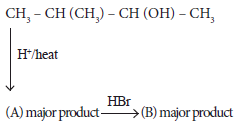
Identify A and B.
14.
Explain Markow nikoff's rule with suitable example.
15.
What is a pi bond ?
16.
Define the term ‘isotonic solution’.
17.
What is the mass of glucose (C6 H12O6) in it one litre solution which is isotonic with 6 g L-1 of urea (NH2 CO NH2) ?
18.
What is entropy of Vapourisation?
19.
Define matter. What are the types of matter?
20.
Define valency. How is it determined?
21.
State Mendeleev's periodic law.
22.
State the Newland's law of octaves.
23.
How many electrons can be accommodated in the main shell I,m and n?
24.
For the equilibrium PCI5(s) ⇌ PCl3(g) + CI2(g) at 25°C kc = 1.8 x 10⁻⁷ R = 8.314 Jk-1 mol-1 Calculate ΔGo for the reaction.
25.
What is the equivalence factor (n) for K2Cr2O7
26.
3 grams of hydrogen reacts with 29 g of O, to yield H2O. Which is the limiting reagent ?
27.
Give examples for the following redox reaction "Metal displacement reaction".
28.
Explain Zeroth law of thermodynamics.
29.
Calculate the screening constant in Zinc for
(i) 4s electron
(ii) for a 3d electron.
The electronic configuration of Zinc (30) is (ls)2 (2s, 2p)8 (3s,3p)8 (3d10) (4s)2
30.
Explain why noble gases are inert?
31.
Mention the uses of calcium oxide (CaO).
32.
Mention the characteristics of 'p' block elements
33.
Give Mosley's relationship.
34.
At what distance is the radial probability maximum for 1s orbital? What is this distance called?
35.
Mention the uses of sodium hydroxide.
36.
Alkali metals give a characteristics colour for a bunsen flame. Explain why?
37.
Balance the following equations by oxidation number method - \({ KMn }O_{ 4 }+{ H }_{ 2 }{ C }_{ 2 }{ O }_{ 4 }+{ H }_{ 2 }{ SO }_{ 4 }\longrightarrow { K }_{ 2 }{ SO }_{ 4 }+{ MnSO }_{ 4 }+{ CO }_{ 2 }+{ H }_{ 2 }O\)
38.
What are the defects of Rutherford's model?
39.
At room temperature, Hydrogen reacts very slowly. Explain
40.
What is lattice energy?
41.
Define enthalpy of combustion.
42.
What is the usual definition of entropy? What is the unit of entropy?
43.
State the first law of thermodynamics.
44.
Why sodium hydroxide is much more water soluble than chloride ?
45.
Consider the following electronic arrangements for the d5 configuration.
(a)
| \(\upharpoonleft \downharpoonright \) | \(\upharpoonleft \downharpoonright \) | \(\upharpoonleft \) |
(b)
| \(\upharpoonleft \) | \(\upharpoonleft \) | \(\upharpoonleft \) | \(\upharpoonleft \downharpoonright \) |
(c)
| \(\upharpoonleft \) | \(\upharpoonleft \) | \(\upharpoonleft \) | \(\upharpoonleft \) | \(\upharpoonleft \) |
which of these represents the ground state
46.
Explain what is meant by efflorescence.
47.
How many orbitals are possible for n = 4?
48.
Give the general electronic configuration of lanthanides and actinides.
49.
What do you understand by the term oxidation number ?
50.
51.
Define electro negativity.
52.
What are isoelectronic ions? Give examples.
53.
What happens when isobutylene is treated with acidified potassium permanganate?
54.
Explain electromeric effect.
55.
Describe optical isomerism with suitable example.
56.
0.284 g of an organic substance gave 0.287 g AgCl in a carius method for the estimation of halogen. Find the Percentage of Cl in the compound.
57.
Write all the possible isomers of molecular formula C4H10O and identify the isomerisms found in them.
58.
What is dipole moment ?
59.
State Raoult law and obtain expression for lowering of vapour pressure when nonvolatile solute is dissolved in solvent.
60.
What volume of 4M HCl and 2M HCl should be mixed to get 500 mL of 2.5 M HCl ?
61.
Explain how will you predict the direction of a equilibrium reaction.
62.
What is the relation between KP and KC. Give one example for which KP is equal to KC.
63.
For an equilibrium reaction Kp = 0.0260 at 25° C ΔH= 32.4 kJmol-1, calculate Kp at 37° C
64.
How many moles of hydrogen is required to produce 10 moles of ammonia ?
65.
Identify the type of redox reaction taking place in the following
\(\overset { +5 }{ { Y }_{ 2 } } \overset { -2 }{ { O }_{ 5(s) } } +5\overset { 0 }{ { Ca }_{ (s) } } \longrightarrow \overset { 0 }{ 2 } { V }_{ (s) }+\overset { +2 }{ 5 } \overset { -2 }{ { CaO }_{ (s) } } \)
66.
Calculate the equivalent mass of potassium dichromate in acid medium
[K2Cr2O7 + 4H2SO4 )\(\rightarrow\)K2SO4 + Cr2(SO4)3 +4H2O + 3(O) 3 x 16 = 48 294 g]
67.
Why is water molecule polar?
68.
One million silver atoms weigh 1.79 x 10⁻¹⁶ g. Calculate the atomic mass of silver.
69.
What are spontaneous reactions? What are the conditions for the spontaneity of a process
70.
Explain the shapes of p orbitals
71.
Calculate the uncertainty in position of an electron, if Δv = 0.1% and \(\upsilon \) = 2.2 x 10⁶ ms-1.
72.
How would you know whether a redox reaction is taking place in an acidic, alkaline or neutral medium?
73.
Why alkaline earth metals are harder than alkali metals.
74.
Which of the following gases would you expect to deviate from ideal behaviour under conditions of low temperature F2, Cl2 or Br2? Explain.
75.
How fast must a 54g tennis ball travel in order to have a de Broglie wavelength that is equal to that of a photon of green light 5400\(\overset { 0 }{ A } \) ?
76.
Beryllium halides are Covalent whereas magnesium halides are ionic why ?
77.
Name two items that can serve as a model for Gay Lussac's law and explain.
78.
In what period and group will an element with Z = 118 will be present?
79.
Predict which of the following hydrides is a gas on a solid
(a) BCI
(b) NaH
Give your reason.
80.
Explain why hydrogen is not placed with the halogen in the periodic table.
81.
Explain how oxygen deficiency is caused by carbon monoxide in our blood ? Give its effect
82.
Describe the classification of organic compounds based on their structure.
83.
Explain VSEPR theory. Applying this theory to predict the shapes of IF7, and SF6.
84.
Explain the bond formation in BeCl2 and MgCl2.
85.
Derive the relation between KP and KC.
86.
Balance the following equations by ion electron method
\({ C }_{ 2 }{ O }_{ 4 }^{ 2- }+{ Cr }_{ 2 }{ O }_{ 7 }^{ 2- }\longrightarrow { Cr }^{ 3+ }+{ CO }_{ 2 }\) (in acid medium)
87.
Mass of one atom of an element is 6.645 x 10⁻²³g. How many moles of element are there in 0.320 kg.
88.
Distinguish between diffusion and effusion.
89.
NH3 has exceptionally high melting point and boiling point as compared to those of the hydrides of the remaining element of group 15. Explain.
1.
1. The tolerable limit of fluoride ions in drinking water is one ppm or 1 mg dm-3
2. Higher concentration is harmful to bones and teeth.
2.
Particulate pollutants are small solid particles and liquid droplets suspended in air. Many of particulate pollutants are hazardous.
Examples : dust, pollen, smoke, soot and liquid droplets (aerosols) etc,.
3.
\(C{ H }_{ 2 }=\overset { { sp }^{ 2 } }{ C{ H }^{ - } } \) \(HC\equiv \overset { sp }{ { C }^{ - } } \)
(i) Since sp carbon is more electronegative than sp2 carbon.
(ii) ∴ \(CH\equiv \overset { - }{ C } \) is less interested in donating a pair of electrons than \(C{ H }_{ 2 }=\overset { - }{ C } H\) .
4.
In figure I the net overlap becomes zero, since ++ overlap is equal to + - overlap.
In figure II no overlap occurs due to different symmetry.
5.
\(\Delta n=2-1=1\)
\({ K }_{ P }=\left( RT \right) ^{ \Delta n }\)
Kp . 50 x 0.082 x 400K
Kp = 1640 atms
6.
No. of valence electrons in N-atom = 5 + 1 (negative charge) = 6
One O-atom forms a double bond.
Other two O-atoms shared with two electrons of N-atom.
\(\therefore\)No. of bond pairs = 4
No. of lone pairs = No. of valence electron - Bonding pairs
= 4 - 4 = 0
\(\therefore\) No. of lone pairs = 0
7.
The attack of nucleophile occurs from the back side (i.e opposite to the side in which the halogen is attacked). The carbon at which substitution occurs has inverted configuration during the course of reaction just as an umbrella has tendency to invert in a wind storm. This inversion of configuration is called Walden inversion.
8.
This law states that "in the case of a solution of volatile liquids, the partial vapour pressure of each component (A & B) of the solution is directly proportional to its mole fraction".
According to Raoult's law,
PA \(\alpha\) XA
PA = K XA
when XA = 1, K p p0
where p0 A is the vapour pressure of pure component 'A' at the same temperature.
Therefore, pA = \({ p }_{ A }^{ 0 }x_{ A }\)
9.
Ozone is formed by a series of reactions that occur from the sun shines
10.
i) The addition of HBr to an alkene in the presence of organic peroxide, gives the anti Markovniko's product is effect is called peroxide effect.
\(\underset { Bromoethane }{ { C }H_{ 3 }-CH={ CH }_{ 2 }+HBr\overset { peroside }{ \underset { { ({ C }_{ 6 }{ H }_{ 5 }Co) }_{ 2 }{ O }_{ 2 } }{ \longrightarrow } } } \underset { 1-bromopropane }{ { CH }_{ 3 }{ -CH }_{ 2 }-{ CH }_{ 2 }-Br } \)
ii) Haloalkanes react with sodium or potassium hydrogen sulphide to form thio alcohols.
\(\underset { Bromoethane }{ { C }H_{ 3 }{ CH }_{ 2 }Br+NaSH\overset { alcohol/{ H }_{ 2 }O }{ \underset { \triangle }{ \longrightarrow } } } \underset { Ethanethiol }{ { CH }_{ 3 }{ CH }_{ 2 }SH+NaBr } \)
iii) Chloroform reacts with nitric acid to form chloropicrin.(Trichloro nitro methane)
\(\underset { Chloroform }{ { CH }_{ 3 }{ Cl }_{ 3 }+HN{ O }_{ 3 }\overset { \triangle }{ \longrightarrow } } \underset { Chloropicrin }{ { CCl }_{ 3 }N{ O }_{ 2 }+{ H }_{ 2 }O } \)
iv) Carbon tetrachloride reacts with hot water or with hot water vapour producing the poisonous gas, phosgene.
\(\underset { carbontetrachloride }{ C{ Cl }_{ 3 }+H_{ 2 }O(g)\overset { \triangle }{ \longrightarrow } } \underset { Phosgene }{ { COCl }_{ 2 }+{ 2H }_{ 2 }O } \)
11.
If moisture is present, the Grignard reagent will react with water to give alkanes.
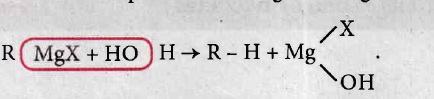
So. moisture should not be present
12.
(i) CH3 - CH = CH-Cl
(ii) C6H5I - Benzyl iodide ⟶ Benzylic Halides
(iii)\({ CH }_{ 3 }-\underset { \overset { | }{ Br } }{ CH } -{ CH }_{ 3 }\) - 2 - bromo propane ⟶alkyl
(iv) CH2 = CH - Cl - Vinyl chloride ⟶ Vinyl
13.
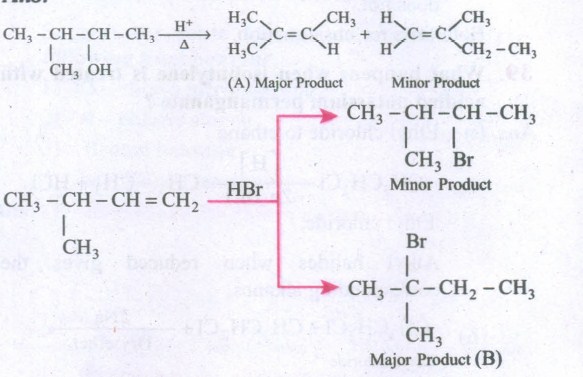
14.
Markovnikoff's rule: "When an unsymmetrical alkene reacts with hydrogen halide, the hydrogen adds to the carbon that has more number of hydrogen and halogen add to the carbon having fewer hydrogen".
Eg: Addition HBr to unsymmetrical alkene: In the addition of hydrogen halide to an unsymmetrical alkene, two products are obtained.
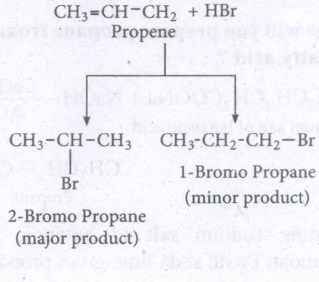
15.
When two atomic orbitals overlaps sideways, the resultant covalent bond is called a pi (\(\pi\)) bond.
16.
Two solutions having same osmotic pressure at a given temperature are called isotonic solutions.
17.
Osmotic pressure of urea solution (\(\pi_1\)) = CRT
\(={W_2\over M_2V}RT\)
\(={6\over 60\times 1}\times RT\)
Osmotic pressure of glucose solution \((\pi_2)={W_2\over 180\times 1}\times RT\) For isotonic solution,
\(\pi_1=\pi_2\)
\({6\over 60}RT={W_2\over 180}RT\)
\(\Rightarrow W_2={6\over 60}\times 180\)
\(W_2=18\ g\)
18.
When one mole of liquid is boiled at its boiling point reversibly, the heat absorbed is called as molar heat of vapourisation. The entropy change is given by
\(\Delta S_v=\frac{\Delta H_v}{T_b}\)
Where \(\Delta H_v\) is molar heat of transition and Tb = transition temperature.
19.
A matter is anything which has mass and occupies space. Matters exist in all three states such as solid, liquid and gas.
20.
The valency of an element may be defined as the combining capacities of elements. The electrons present in the outermost shell are called valence electrons and these electrons determine the valency of the atom.
21.
This law states that "The physical and chemical properties of elements are a periodic function of their atomic weights."
22.
The Law of octaves states that, "when elements are arranged in the order of increasing atomic weights, the properties of the eighth element are a repetition of the properties of the first element".
23.
| Main shell | l | m | n |
| Principal quantum number | 2 | 3 | 4 |
| Number of electrons in the main shell 2n2 | 2(2)2 = 8 | 2(3)2 = 18 | 2(4)2 = 32 |
24.
ΔG0 = - 2.303 RT log kc
= - 2.303 x 8.314 x 298 log (1.8 x 10⁻⁷)
= - 38484 J mol-1
= - 38.484 kJ mol-1
25.
Molar mass of K2Cr2O7 = 2 x 39 + 2 x 52 + 7 x 16
= 78 + 104 + 112 = 294
In acid medium Cr2O7-2 is reduced to Cr+3
Cr2O7 -2 + 6e + 14H + \(\rightarrow\) 2cr+3 + 7H2O
equivalent mass of K2Cr2O7 = \({Molar \ mass \over No, \ of \ electrons \ taken \ Up }\)
\(={294\over6}=49\)
\(\therefore\) 'n' factor \(={294\over49}=6 eq.mol^{-1}\)
26.
\(\underset { 2\quad mol }{ { 2H }_{ 2 } } +\underset { 1\quad mol }{ { { O }_{ 2 } } } \rightarrow \underset { 2\quad mol }{ { 2H }_{ 2 }O } \)
Number of mole of H2 taken = \(\frac{3}{2}\) = 1.5
Number of mole of O2 taken = \(\frac{29}{32}\) = 0.9062
\(\therefore\) 2 mole of H2 react with 1 mole of O2
\(\therefore\) 1.5 mol of H2 will react with = \(\frac{1}{2}\times \) 1.5 = 0.75 mole of O2
Available mole of O2 (0.9062) > required mol of O2 (0.75)
Thus, O2 is in excess and therefore, H2 will be the limiting reagent.
27.
.png)
28.
According to this law, if systems Band C separately are in thermal equilibrium with another system A, then systems Band C will also be in thermal equilibrium with each other. This is also the principle by which thermometers are used.
29.
(i) \(\sigma \) = 1 x 0.35 + 18 x 0.85 + 10 x 1 = 25.65
(ii) \(\sigma \) = 9 x 0.35 +18 x 1.0 = 21.15
30.
The noble gases having completely filled electronic configuration neither accept nor lose their electron readily and hence they are chemically inert in nature
31.
(I) To manufacture cement, mortar and glass.
(ii) In the manufacture of sodium carbonate and slaked lime.
(iii) In the purification of sugar.
(iv) As a drying agent.
32.
The elements of p-block have high negative electron gain enthalpies. The ionisation energies are higher than that of s-block elements. They form mostly covalent compounds and shows more than one oxidation states in their compounds
33.
There exists a linear correlation between the atomic number and frequency of X-ray emitted by an element. \(\sqrt { v } \) = a(Z- b)
v = frequency of X-ray emitted by the element with atomic number Z, a, b are constants. This relationship is known as Mosley's relationship.
34.
0.529 \(\overset { o }{ A } \), Bohr radius.
35.
(i) Sodium hydroxide is used as a laboratory reagent.
(ii) It is also used in the purification of bauxite and petroleum refining.
(iii) It is used in the textile industries for mercerising cotton fabrics.
(iv) It is used in the manufacture of soap, paper, artificial silk and a number of chemicals.
36.
The heat in the flame excites the valence electron to a higher energy-level. When it drops back to its actual energy level, the excess energy is emitted as light, whose wavelength is in the visible region. This appears as a characteristic colour to the particular metal.
37.
(iv) \({ K }\overset { +7 }{ \underset { \underset { 2\times { 3e }^{ - } }{ \downarrow } }{ M } } n{ O }_{ 4 }+{ H }_{ 2 }\overset { -1 }{ \underset { { 1e }^{ - } }{ \underset { \uparrow }{ C_{ 2 } } } } { O }_{ 4 }+{ H }_{ 2 }{ SO }_{ 4 }\longrightarrow { K }_{ 2 }{ SO }_{ 4 }+\overset { +2 }{ M } n{ SO }_{ 4 }+\overset { +4 }{ C } { O }_{ 2 }+{ H }_{ 2 }O\)
2KMnO4 + 5H2C2O4 + H2S04 \(\longrightarrow \) Mn02 + Na2S04 + KOH
2KMnO4+ 5H2C2O4 + H2S04 \(\longrightarrow \) K2SO4 + 2MnSO4 + 10CO2 + H2O
2KMnO4 + 5H2C2O4 + 3H2S04 \(\longrightarrow \) K2S04 + 2MnS04 + lOC02 + 8H20
38.
According to J. C. Maxwell, whenever an electron is subjected to acceleration, it emits radiation and loses energy. As a result of this, its orbit should become smaller and smaller and finally it should drop into the nucleus by following a spiral path. This means that atom would collapse and thus Rutherford's model failed to explain stability of atoms. Another drawback of the Rutherford's model is that it gives no information about the electronic structure of an atom.
39.
In elementary state, Hydrogen exists as a diatomic molecule. The bond between two hydrogen atoms H-H is covalent. The bond dissociation energy is very high (435.9 Klmol-1 ). So bond cleavage is extremely difficult, so hydrogen is less reactive at room temperature.
40.
Lattice energy is defined as "The amount of energy required to completely remove the constituent ions from its crystal lattice to an infinite distance." It is also referred as lattice enthalpy
41.
The heat of combustion of a substance is defined as "The change in enthalpy of a system when one mole of the substance is completely burnt in excess of air or oxygen". It is denoted by ΔHC
42.
(i) Entropy is a measure of the molecular disorderliness (randomness) of a system. dS = dqrev/T
(ii) The entropy (S) is equal to heat energy exchanged (q) divided by the temperature (T) at which the exchange takes place. Therefore, The SI unit of entropy is JK-1
43.
The first law of thermodynamics, also known as the law of conservation of energy, states that "The total energy of an isolated system remains constant though it may change from one form to another."
The mathematical statement of the First Law is: ΔU=q+w
Where q - the amount of heat supplied to the system; w - work done on the system
44.
The solubility product of NaCl is lower than that of NaOH. The more soluble a substance is, the higher the Ksp value it has In aqueous solution NaOH gives OH- ions. It can be solvated by establishing H-bonds with water molecules. So it is more water soluble.
45.
(i) ground state :
| \(\upharpoonleft \) | \(\upharpoonleft \) | \(\upharpoonleft \) | \(\upharpoonleft \) | \(\upharpoonleft \) |
This type of electronic configuration have ten possible arrangement (i.e. Half filled configuration is More).
46.
Efflorescence is the spontaneous loss of water by a hydrated salt, which occurs when the aqueous vapor pressure of the hydrate is greater than the partial pressure of the water vapour in the air. This is the property of salts
Ex: Glauber's salt- Na2SO4·10H2O
Epsom salt - MgSO4·7H2O
47.
| n | l | m | orbitals | Total no of orbitals |
| 0 | 0 | 1 | (1- 4s +3 - 4P orbital +5 - 4d orbital +7 - 4f orbital) =16 |
|
| 4 | 1 | -1 0 +1 |
3 | |
| 2 |
-2 |
5 | ||
| 3 |
-3 |
7 |
48.
Lanthanides: [54Xe] 4f1-14 5d1 6s2
Actinides : [86Rn] 5f0-146d0-2 7s2
49.
It is defined as the imaginary charge left on the atom when all other atoms of the compound have been removed in their usual oxidation states that are assigned according to set of rules.
50.
51.
It is defined as the relative tendency of an element present in a covalently bonded molecule, to attract the shared pair of electrons towards itself.
52.
Ions of different elements having the same number of electrons are called isoelectronic ions.
| Ions of different elements | Na+ | Mg+2 | Al+3 | F- | O2- | N3- |
| No. of electrons | 10 | 10 | 10 | 10 | 10 | 10 |
53.
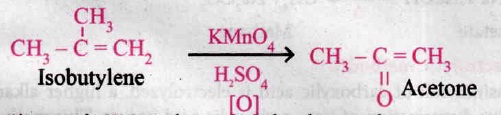
The purple KMnO4 becomes colourless producing acetone.
54.
Electromeric is a temporary effect which operates in unsaturated compounds (containing >C = C <, > C = O, etc...) in the presence of an attacking reagent.
Let us consider two different compounds
(i) Compounds containing carbonyl group (> C = O) and
(ii) Unsaturated compounds such as alkenes (> C = C <).
When a nucleophile approaches the carbonyl compound, the \(\pi\) electrons between C and O is instantaneously shifted to the more electronegative oxygen. This makes the carbon electron deficient and thus facilitating the formation of a new bond between the incoming nucleophile and the carbonyl carbon atom.
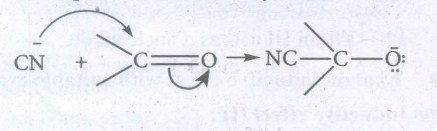
On the other hand When an electrophile such as H+ approaches an alkene molecule, the π electrons are instantaneously shified to the electrophile and a new bond is formed between carbon and hydrogen. is makes the other carbon electron decient and hence it acquires a positive charge.
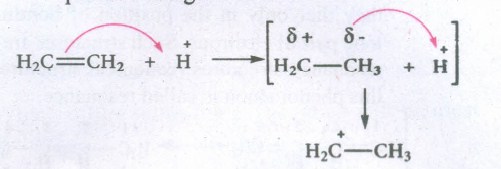
The electromeric effect, is denoted as E effect. Like the inductive effect, the electromeric effect is also classified as +E and -E based on the direction in which the pair of electron is transfered to form a new bond with the attacking agent.
When the π electron is transfer red towards the attacking reagent, it is called + E (positive electromeric) effect.
The addition of H+ to alkene as shown above is an example of +E effect.
When the π electron is transfered away from the attacking reagent, it is called, -E (negativc electromeric) effect.
The attack of CN- on a carbonyl carbon, as shown above, is an example of -E effect.
55.
Optical isomerism:
Compounds having same physical and chemical property but differ only in the rotation of plane of the polarized light are known as optical isomers and the phenomenon is known as optical isomerism.
Some organic compounds such as glucose have the ability to rotate the plane of the plane polarized light and they are said to be optically active compounds and this property of a compound is called optical activity. The optical isomer, which rotates the plane of
the plane polarised light to the right or in cloclauisl direction is said to be dextrorotary (dexter means right) denoted by the sign (+), whereas the compound which rotates to the left or anticloclanrise is said to be leavo rotatory (leanues mean left) denoted by sign(-).
Dextrorotatory compounds are represented as 'd' or by sign (+) and lavorotatory compounds are ( - ) represented as 'l' or by sign (-).
Enantiomerism and optical activity: An optically active substance may exist in two or more isomeric forms which have same physical and chemical properties but differ in terms of direction of rotation of plane polarized light, such optical isomers which rotate the plane of polarized light with equal angle but in opposite direction are known as enantiomers and the phenomenon is knovrrn as enantiomerism. Isomers which are non-super impossible mirror images of each other are called enantiomers.
conditions for enantiomerism or optical isomerism:
A carbon atom whose tetra vaiency is satisfied by four different substituents (atoms or groups) is called a symmetric carbon or chiral carbon. It is indicated by an asterisk as C*. A molecule Possessing chiral carbon atom and non-super impossible to its own mirror image is said to be a chiral molecule or asymmetric, and the pioperty is called chirality or dissymmetry.
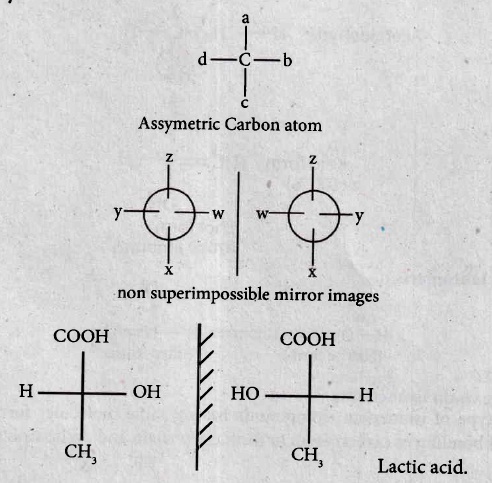
56.
Weight of the organic substance = 0.284 g
Weight of AgCl is = 0.287 g = a
\( \% \mathrm{Cl} =\frac{35.5}{143.5} \times \frac{\mathrm{a}}{\mathrm{w}} \times 100 \)
\(=\frac{35.5}{143.5} \times \frac{0.287}{0.284} \times 100=24.98 \% \)
57.
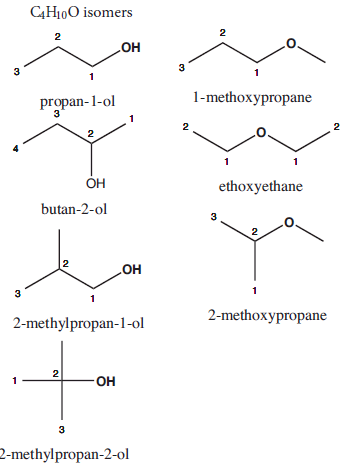
i) Butan.- I - ol & Butan - 2 -ol are position isomers. - Position isomerism
ii) Butan -I -ol & 2-methyl propan - I - ol are chain isomers - Chainisomerism
iii) Butan -I - ol and I - methoxy propane are functional isomers - Functional isomerism
iv) 1 - methoxy Propane and ethoxy ethane and 2 - methoxy Propane are metamers - Metamerism
58.
Dipole moment :
The polarity of a covalent bond can be measured in terms of dipole moment which is defined as \(\mu=q \times 2d\)
Where \(\mu\) is the dipole moment, q is the charge and 2d is the distance between the two charges.
Where p is the dipole moment, q is the charge and 2d is the distance between the two charges. The dipole moment is a vector and the direction of the dipole moment vector points from the negative charge to positive charge.
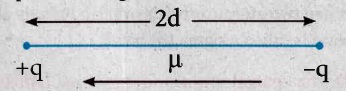
The unit for dipole moment is columb meter (C m). It is usually expressed in Debye unit (D). The conversion factor is 1 Debye = 3.336 x 10⁻³⁰ C m.
59.
Raoult law states that. "in the case of a solution of volatile liquids, the partial vapour pressure of each component (A & B) of the solution is directly proportional to its mole fraction.
According to Raoult's law,
PA \(\alpha\) XA
pA = K XA
When xA = 1, k = \({ p }_{ A }^{ 0 }\)
Where \({ p }_{ A }^{ 0 }\) is the vapour pressure of pure component 'A' at the same temperature
"The relative lowering of vapour pressure of an ideal solution containing the nonvolatile solute is equal to the mole fraction of the solute at a given temperature".
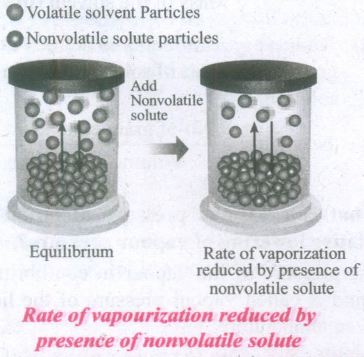
Derivation:
when sodium chloride is added to the water, the vapour pressure of the salt solution is lowered. The vapour Pressure of the solution is determined by the number of molecules of the solvent present in the surface at any time and is proportional to the mole fraction of the solvent.
Psolution \(\infty \) XA
Where XA is the mole fraction of the solvent
Psolution = K XA
When XA = 1, K = P0 solvent
\({ P }_{ solvent }^{ 0 }\) is the partial pressure of pure solvent
Psolution = \({ P }_{ solvent }^{ 0 }\) XA
\(\frac { { P }_{ solution } }{ { P }_{ solvent }^{ 0 } } ={ X }_{ A }\)
\(1-\frac { { P }_{ solution } }{ { P }_{ solvent }^{ 0 } } 1-{ X }_{ A }\)
\(\frac { { P }_{ solvent }^{ 0 }-{ P }_{ solution } }{ { P }_{ solvent }^{ 0 } } ={ x }_{ B }\)
Where XB the mole fraction of the solute
( \(\because\) XA + AB = 1, XB = 1 - XA)
The above expression gives the relative lowering of vapour pressure. Based on this expression, Raoult's law can also be stated as "the relative lowering of vapour pressure of an ideal solution containing, the nonvolatile solute is equal to the mole fraction of the solute at a given temperature".
60.
Let the volume of 4M HCl required to prepare 500 mL of 2.5 MHCl = x mL
Therefore, the required volume of 2M HCl = (500 - x) mL
We know from the equation
C1V1+ C2V2 = C3V3
(4x) + 2(500 - x) = 2.5 x 500
4x + 1000 - 2x = 1250
2x = 1250 - 1000
\(x={250\over 2}\)
= 125 ml
Hence, volume of 4M HCl required = 125 mL
Volume of 2M HCl required = (500 - 125) mL = 375 mL.
61.
If we know the value of kc and Q, the reaction quotient, we can predict the direction of a reaction
If Q = Kc; the reaction is in equilibrium state.
If Q > Kc: the reaction will proceed in the reverse direction i.e., formation of reactants.
If Q < Kc: the reaction will proceed in the forward direction i.e., formation of products.
62.
i) \(K_{p}=K_{c}(R T)^{\Delta n_{g}}\)
Kp = Equilibrium constant in term of partial Pressures.
Kc = Equilibrium constant in term of concentration.
R = Gas constant; T = Temperature
\(\Delta \mathrm{n}_{\mathrm{g}}\) = Difference between the sum of number of moles of products and the sum of number of moles of reactants in gas phases.
ii) Synthesis of HI:
\( \mathrm{H}_{2(\mathrm{~g})}+\mathrm{I}_{2(\mathrm{~g})} \rightleftharpoons 2 \mathrm{HI}_{(\mathrm{g})} \)
\(\Delta n_{g}=0 \therefore K_{p}=K_{c}(R T) \Delta n_{g}\)
\(K_{p}=K_{c}(R T)^{\circ} \)
\(K_{p}=K_{c} \text {. }\)
63.
T1 = 25 + 273 = 298 K
T2 = 37 + 273 = 310 K
ΔH = 32.4 KJmol-1 = 32400 Jmol-1
R = 8.314 JK-1 mol-1
KP1 = 0.0260
Kp2 = ?
\(\log {K_2\over K_1}={\Delta H^o\over 2.303R}[{T_2-T_1\over T_2T_1}]\)
\(\log {K_2\over K_1}={32400\over 2.303\times 8.314}({310-298\over 310\times 298})\)
\(={32400\times 10\over 2.303\times 8.314\times 310\times 298}\)
= 0.2198
\({K_2\over K_1}=\) antilog 0.2198 = 1.6588
K2 = 1.6588 x 0.026 = 0.0431
64.
The balanced stoichiometric equation for the formation of ammonia is
N2(g) + 3H2 (g) \(\rightarrow\) 2NH3 (g)
As per the stoichiometric equation,
To produce 2 moles of ammonia, 3 moles of hydrogen are required.
\(\therefore\) to produce 10 moles of ammonia,
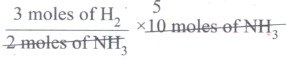
= 15 moles of hydrogen are required.
65.
Displacement reaction
66.
48 parts by mass of oxygen are made available from 294 parts by mass of K2Cr2O7
∴ 8 parts by mass of oxygen will be furnished by =\(\frac{294\times8}{48}=49\)
Equivalent mass of K2Cr2O7 = 49 g equiv-1
67.
Water (H2O) is polar because of the bent shape of the molecule.
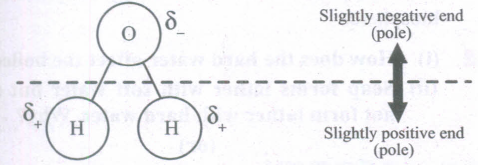
The shape means most of the negative charge from the oxygen is on one side of the molecule and the positive charge of the hydrogen atoms is on the other side of the molecule. This is an example of polar covalent chemical bonding.
68.
No. of silver atoms = 1 million = 1 x 10⁶
Mass of one million Ag atoms = 1.79 x 10⁻¹⁶g
Mass of 6.023 x 10²³atoms of silver
= \(\frac { 1.79\times { 10 }^{ -16 }g }{ 1\times { 10 }^{ 6 } } \times 6.023\times { 10 }^{ 23 }\)
= 107.8 g.
Atomic mass of silver = 6.023 x 10²³ atoms of Ag
\(\therefore\) The atomic mass of Ag = 107.8 g
69.
(i) spontaneous reaction: A reaction that occurs under the given set of conditions without any external driving force is called a spontaneous reaction.
(ii) Criteria for spontaneity of a process: The spontaneity of any process depends on three different factors.
ΔH = -ve, ΔS = +ve, ΔG = -ve.
70.
p-orbitals :
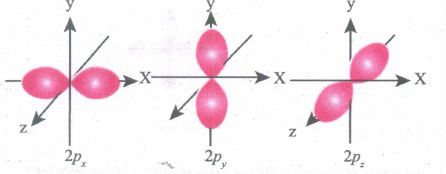
(a) For p orbitals l = 1 and the corresponding m values are -1,0 and + 1. The angular distribution functions are quite complex
(b) The three different m values indicates that there are three different orientations possible for p orbitals. These orbitals are designated as px,py and pz and the angular distribution for these orbitals shows that the lobes are along the x, y and z axis respectively.
(c) The 2p orbitals have one nodal plane
71.
\(\triangle x.\triangle p\ge \frac { h }{ 4\pi } \)
\(\triangle x.\triangle p\ge 5.28 \times{ 10 }^{ -35 }Kg{ m }^{ 2 }{ s }^{ -1 }\)
\(\triangle x.(m\triangle v)\ge 5.28 \times{ 10 }^{ -35 }Kg{ m }^{ 2 }{ s }^{ -1 }\)
Given \(\triangle\)v = 0.1%
v = 2.2 x 10⁶ ms-1
m = 9.1 x 10⁻³¹Kg
\(\triangle\)v = \(\frac{0.1}{100}\times2.2\times{10}^{6}ms^{-1}\)
= \(2.2\times{10}^{6}ms^{-1}\)
\(\therefore \triangle x\ge \frac { { 5.28\times 10 }^{ -35 }{ Kgm }^{ 2 }{ s }^{ -1 } }{ 9.1\times { 10 }^{ -31 }Kg\times 2.2\times { 10 }^{ 3 }m{ s }^{ -1 } } \)
\(\\ \triangle x\ge 2.64\times { 10 }^{ -8 }m\)
72.
1. If H+ any acid appears on either side of the chemical equation, the reaction occurs in acidic solution.
2. If OH- or any base appears on either side of the chemical equation, the reaction occurs in basic solution.
3. If neither H+, OH- nor any acid or base is present in the chemical equation, the solution is neutral.
73.
Alkali metals have one eo in their outer most shell. Alkaline earth metals have 2 eo in their outer most shell. More valence electrons and more positively charged nucleii leads to greater opportunity for metallic bonding.
74.
The larger the size of the molecule, the greater will be Van der Waals' attraction. Therefore greater the deviation from ideal behaviour. So bromine will deviate more from ideal behaviour because it has bigger atoms.
75.
De Broglie wavelength of the tennis ball equal to 5400 \(\overset { 0 }{ A } \).
m = 54 g
V = ?
\(\lambda=\frac{h}{mV}\)
\(V=\frac{h}{m\lambda}\)
\(\mathrm{v}=\frac{6.626 \times 10^{-34} \mathrm{JS}}{54 \times 10^{-3} \mathrm{~kg} \times 5400 \times 10^{-10} \mathrm{~m}}=2.27 \times 10^{-26} \mathrm{~ms}^{-1}\)
76.
This is due to the smaller size and relatively high charge as Be2+ ion. Moreover Beryllium is a non - metal. But Magnesium is a metal. In the case of beryllium the ionisation energy and electronegativity of the halides are almost similar; but there is a vast difference in IE and electronegativity between Mg and halides.
77.
The following table gives the pressure of a gas with increasing temperature at constant volume for two cylinders.
| ToC | 32oC | 69oC | 94oC | 130oC |
| P (atm) 50 L container |
0.51 | 0.56 | 0.6 | 0.66 |
| P (atm) 75 L container |
0.34 | 0.37 | 0.40 | 0.44 |
Both the models explain Gay - Lussac's Law. P \(\propto\) T are constant V & n
For 50 L container:
The pressure increases with rise in temperature (at constant volume)
For 75 L container:
The pressure increases with rise in temperature (at constant volume)
78.
Z = 118; [86Rn] 5f14 6d10 7s2 7p6
In the periodic table the element with Z = 118 is located in p-block,
Period no = 7 (as n = 7 for valence shell)
Group no. = 18 (group no = 10+ ns electrons + np electrons) (n - outer most shell)
79.
a) HCl is a gas. It is an electron rich covalent hydride. It is a covalent molecule with strong covalent bond. However the forces between the molecules are not as strong.
b) NaH is a solid. It is an ionic hydride of group I sodium metal. It is an insoluble hydride
80.
Hydrogen has electronic configuration 1s1. So it resembles ns1 general valence shell configuration of alkali metals.
Its similarity with alkali metals are:
1. Form uni positive (H+) ions like Na+, K+, Cs+
2. Form halides, (HX), oxides (H2O) peroxides (H2O2) and sulphides (H2S) like (Nax, Na2O, Na2O2, Na2S)
3. Acts as reducing agent.
4. Has +1 oxidation state.
5. If it is placed in the halogen family it should be the most electro negative element which is not true.
81.
It binds with haemoglobin and form carboxy haemoglobin which impairs normal oxygen transport by blood and hence the oxygen carrying capacity of blood is reduced. This oxygen deficiency results in headache, dizziness, tension, Loss of consciousness, blurring of eye sight and cardiac arrest.
82.
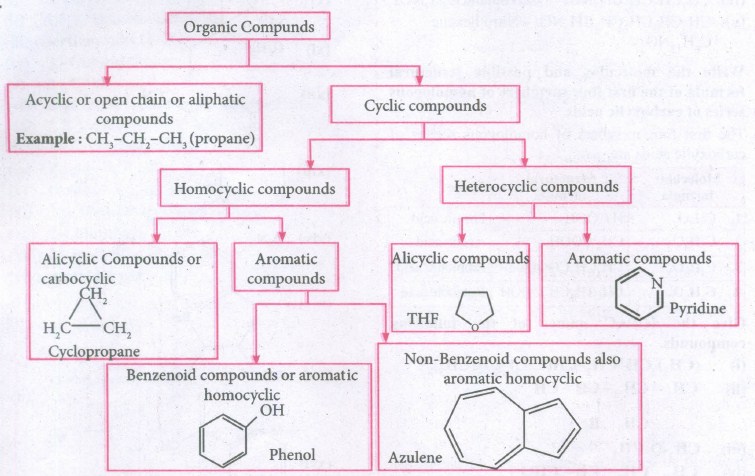
83.
Important principles of VSEPR Theory are as follows:
1. The shape of the molecules depends on the number of valence shell electron pair around the central atom.
2. There are two types of electron pairs namely bond pairs and lone pairs. The bond pair of electrons are those shared between two atoms, while the lone pairs are the valence electron pairs that are not involved in bonding.
3. Each pair of valence electrons around the central atom repels each other and hence, they are located as far away as possible in three dimensional space to minimize the repulsion between them.
4. The repulsive interaction between the different types of electron pairs is in the following order.
lp - lp > lp - bp > bp - bp
lp - lone pair; bp - bond pair
The lone pair of electrons are localised only on the central atom and interacts with only one nucleus whereas the bond pairs are shared between two'atoms and they interact with two nuclei. Because of this the ione pairs occupy more space and have greater repulsive Power than the bond Pairs in a molecule.
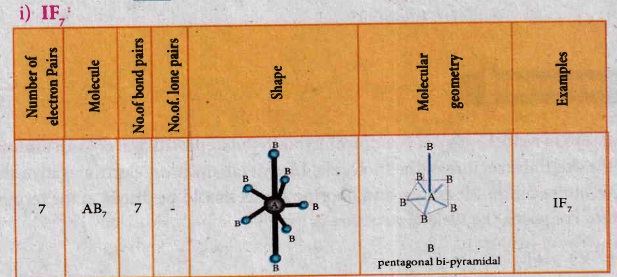
.jpg)
84.
i) BeCI2
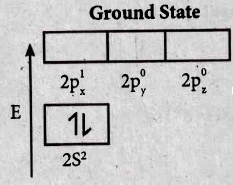
The valence shell electronic configuration of ber-yllium in the ground state is shown in the figure
In BeCI2 both the Be-CI bonds are equivalent and it was observed that the molecule is linear. VB theory explain this observed behaviour by sp hybridisation. one of the paired electrons in the 2s orbital gets excited to 2p orbital and the electronic configuration at'the encited state.
Now, the 2s and 2p orbitals hybridise and produce two equivalent sp hytridised orbitals which have 50 % s-character aird 50 % p-character. These sp hybridised orbitals are oriented in opposite direction.
.jpg)
overlap with orbital of chlorine Each of the sp hybridized orbitals linearly bverlap with pz orbital of the chlorine to form a covalent bont between Be and Cl as shown in the Figure.
.jpg)
ii) MgCl2.
Mg + Cl + Cl = MgCl2
Magnesium atom donates one electron each to, each of the chlorine atoms. In total, Mg atom donates 2 electrons. So Mg becomes Mg2+ cation attaining stable Neon configuration. The two Cl atoms gain are each and forms Cl- anion with stable configuration of Argon.
Mg2+ and 2 Cl- ions combine to form an ionic crystal in which they are held together by electrostatic attractive force.
85.
Let us consider the general reaction in which all reactants and products are ideal gases
\(xA+yB\rightleftharpoons IC+mD\)
The equilibrium constant, Kc is
\({ K }_{ c }=\cfrac { \left[ C \right] ^{ I }\left[ D \right] ^{ m } }{ \left[ A \right] ^{ x }\left[ B \right] ^{ y } } \) .......(1)
and Kp is
\({ K }_{ p }=\cfrac { { p }_{ c }^{ I }\times { p }_{ D }^{ m } }{ { p }_{ a }^{ x }\times { p }_{ B }^{ y } } \) ..........(2)
The ideal gas equation is
PY = nRT
or
\(P=\cfrac { n }{ V } RT\)
Since Active mass = molar concentration = n/V
p = active mass\(\times\)RT
Based on the above expression the partial pressure of the reactants and products can be expressed as,
\({ p }_{ A }^{ x }=\left[ A \right] ^{ x }\left[ RT \right] ^{ x }\)
\({ p }_{ B }^{ y }=\left[ B \right] ^{ y }\left[ RT \right] ^{ y }\)
\({ p }_{ C }^{ 1 }=\left[ C \right] ^{ I }\left[ RT \right] ^{ 1 }\)
\({ p }_{ D }^{ m }=\left[ D \right] ^{ m }\left[ RT \right] ^{ m }\)
On substitution in eqn. 2,
\({ K }_{ p }=\cfrac { { \left[ C \right] }^{ 1 }{ \left[ RT \right] }^{ 1 }{ \left[ D \right] }^{ m }{ \left[ RT \right] }^{ m } }{ { \left[ A \right] }^{ x }{ \left[ RT \right] }^{ x }{ \left[ B \right] }^{ y }{ \left[ RT \right] }^{ y } } \) .........(3)
\({ K }_{ p }=\cfrac { { \left[ C \right] }^{ 1 }{ \left[ D \right] }^{ m }{ \left[ RT \right] }^{ I+m } }{ { \left[ A\quad \right] }^{ x }{ \left[ B \right] }^{ y }{ \left[ RT \right] }^{ x+y } } \)
\({ K }_{ p }=\cfrac { { \left[ C \right] }^{ I }{ \left[ D \right] }^{ m } }{ { \left[ A \right] }^{ x }{ \left[ B \right] }^{ y } } \left[ RT \right] ^{ \left( 1+m \right) -\left( x+y \right) }\) ...........(4)
Sub (1) in (4)
\({ K }_{ p }={ K }_{ C }\left( RT \right) ^{ \left( \Delta { n }_{ g } \right) }\)
where,
\({ \Delta n }_{ g }\) is the difference between the sum of number of moles of products and the sum of number of moles of reactants in the gas phase.
86.
\(\overset { +3 }{ C } _{ 2 }{ O }_{ 4 }^{ 2- }\longrightarrow \overset { +4 }{ C } { O }_{ 2 }\)
\(\overset { +6 }{ Cr } _{ 2 }{ O }_{ 7 }^{ 2- }\longrightarrow { Cr }^{ 3+ }\)
(1) \(\Rightarrow \) \({ C }_{ 2 }{ O }_{ 4 }^{ 2- }\longrightarrow { 2CO }_{ 2 }+{ 2e }^{ - }\)
\({ Cr }_{ 2 }{ O }_{ 7 }^{ 2- }\longrightarrow { 2Cr }^{ 3+ }+{ 7H }^{ 2 }O\)
.png)
87.
mass of one atom = 6.645 x 10⁻²³ g
\(\therefore\) mass of 1 mole of an atom = 6.645 x 10-23 g x 6.022 x 1023 = 40 g
\(\therefore\) number of moles of element in 0.320 kg = \(\frac { 1\quad mole }{ 40g } \times 0.320kg\)
= \(\frac { 1mol\times 320g }{ 40g } \)
= 8 mol
88.
| S.NO | diffusion | effusion |
| 1 | It is the spreading of molecules of a substance throughout a space or second substance | It is the escape of the gas molecules through a very small hole (orifice) in a membrane into an evacuated area. |
| 2 | It is typically used to describe statistical properties of a gas at length scales that are much larger than mean free path. | The diameter of the hole should be smaller than mean free path of the molecules. |
| 3 | It is the spreading of gases. | It is the pouring out of gases. |
89.
(i) Due to small size of Nitrogen atom.
(ii) Due to polar nature of N-H bond.
(iii) Due to inter molecular H- bonding which are stronger than London forces present in other hydrides. Other hydrides lack H - bonding

11th Standard Syllabus & Materials
11th Standard
TN 11th Tamil பீடு பெற நில் - செய்யுள் - காவடிச்சிந்து Important Questions And Answers Study Material - QB365 Set A
NEW11th Standard
TN 11th Tamil பீடு பெற நில் - உரைநடை - மலை இடப்பெயர்கள் : ஓர் ஆய்வு Important Questions And Answers Study Material - QB365 Set A
NEW11th Standard
TN 11th Tamil மாமழை போற்றுதும் - துணைப்பாடம் - யானை டாக்டர் Important Questions And Answers Study Material - QB365 Set A
NEW11th Standard
TN 11th Tamil மாமழை போற்றுதும் - செய்யுள் - ஐங்குறுநூறு Important Questions And Answers Study Material - QB365 Set A



Tamilnadu Stateboard 11th Standard Subjects

Maths

Commerce

Economics

Biology

Business Maths and Statistics

Accountancy

Computer Science

Physics
Chemistry
Maths
Biology
Economics
Physics
Chemistry

History
Business Maths and Statistics

Computer Science
Accountancy

Computer Applications
History
Computer Technology
Commerce
Computer Applications
Computer Technology

Tamil

English

French
Tamilnadu Stateboard Standards
