
 100% FREE ACCESS
11th Standard Syllabus & Materials
11th Standard
TN 11th Tamil இயற்கை வேளாண்மை,சுற்றுச்சூழல் -செய்யுள் - மனோன்மணீயம் Important Questions And Answers Study Material - QB365 Set A
NEW11th Standard
TN 11th Tamil என்னுயிர் என்பேன் -துணைப்பாடம் - இசைத்தமிழர் இருவர் Important Questions And Answers Study Material - QB365 Set A
NEW11th Standard
TN 11th Tamil மொழி கலை -செய்யுள் - ஒவ்வொரு புல்லையும் Important Questions And Answers Study Material - QB365 Set A
NEW11th Standard
TN 11th Tamil பீடு பெற நில் - இலக்கணம் - பகுபத உறுப்புகள் Important Questions And Answers Study Material - QB365 Set A
NEW11th Standard
TN 11th Tamil பீடு பெற நில் - துணைப்பாடம் - வாடிவாசல் Important Questions And Answers Study Material - QB365 Set A
NEW11th Standard
TN 11th Tamil பீடு பெற நில் - செய்யுள் - குறுந்தொகை Important Questions And Answers Study Material - QB365 Set A

Published on: 04/03/2019
11th Public Exam March 2019 Model Question
Download Tamil Nadu 11th Standard Chemistry question papers, model tests, one-mark questions, important questions, and public exam papers in PDF format. Free study materials and answer keys for TN State Board students.
Questions + Answers key
Take MCQ Chemistry Test
1.
For the reaction \(A+3B\rightleftharpoons 2C+D\) initial mole of A is twice that of B.1f at equilibrium moles of B and C are equal, then percent of B reacted is ____________
10%
20%
40%
60%
2.
________________is used in the treatment of goitre
Halothane
Benzoquinone
Chloromycetin
Thyroxine
3.
In the commercial gasonlines, the type of hydrocarbons which are more desirable is ___________
Linear unsaturated hydrocarbon
Toluene
Branched hydrocarbon
Straight-chain hydrocarbon
4.
H2O is polar, whereas BeF2 is not It is because ___________
The electronegativity of F is greater than that of O.
H2O involves hydrogen bonding whereas BeF2 is a discrete molecule
H2O is linear and BeF2 is angular
H2O is angular and BeF2 is linear
5.
Which of the group has highest +I effect ?
CH3-
CH3 - CH2 -
(CH3)2 - CH-
(CH3)3 - C-
6.
In an organic compound, phosphorus is estimated as ____________
Mg2P2O7
Mg3(PO4)2
H3PO4
P2O5
7.
Which of the following concentration terms is/are independent of temperature _____________
molality
molarity
mole fraction
(a) and (c)
8.
22 g of CO2 contains ____________ molecules of CO2.
6.023 x 10⁻²³
6.023 x 10²³
3.0115 x 10²³
3.0115 x 10⁻²³
9.
Ionic radii vary in:
(1) inverse proportion to the effective nuclear charge
(2) inverse proportion to the square of the effective nuclear charge.
(3) direct proportion to the screening effect.
(4) direct proportion to the square of screening effect
1,2
1,3
2,3
2,4
10.
The correct thermodynamic conditions for the spontaneous reaction at all temperature is ______________
ΔH < 0 and ΔS > 0
ΔH < 0 and ΔS < 0
ΔH > 0 and ΔS = 0
ΔH > 0 and ΔS > 0
11.
12.
Gases deviate from ideal behavior at high pressure. Which of the following statement(s) is correct for non-ideality?
at high pressure the collision between the gas molecule become enormous
at high pressure the gas molecules move only in one direction
at high pressure, the volume of gas become insignificant
at high pressure the intermolecular interactions become significant
13.
For d-electron, the orbital angular momentum is ___________
\(\frac { \sqrt { 2 } h }{ 2\pi } \)
\(\\ \frac { \sqrt { 2h } }{ 2\pi } \)
\(\frac { \sqrt { 2\times 4 } h }{ 2\pi } \)
\(\frac { \sqrt { 6 } h }{ 2\pi } \)
14.
Tritium nucleus contains _____________
1 p+0 n
2 p+1 n
1 p + 2 n
none of these
15.
Describe tautomerism with relevant examples.
16.
Give a detailed account on the different mechanisms followed in elimination reaction.
17.
The equilibrium constant at 298 K for a reaction is 100.
A + B \(\rightleftharpoons \) C + D
If the initial concentration of all the four species is 1 M, the equilibrium concentration of D (in mol lit-1) will be
18.
Balance the following equation by oxidation number method:
P + HNO3 \(\rightarrow\)H3PO4 + NO2 + H2O
19.
An element (A) belonging to group number 1 and period number 3 react with dihydrogen to form anhydride (B). The element (A) reacts with the universal solvent to give a strong base (C). Identify A, B, and C.
20.
Find the pressure of 5 mole CI2 gas filled in a 2 litre vessel at 27 °C temperature.
21.
List the characteristics of Gibbs free energy
22.
23.
Why the first ionisation enthalpy of sodium is lower than that of magnesium while its second ionisation enthalpy is higher than that of magnesium.
24.
Does H2O and H2S possess same bond, angle ? Explain
25.
Write short notes on
(i) +E effect and
(ii) -E effect
26.
How does classical smog differ from photochemical smog ?
27.
Mention any three methods of preparation of haloalkanes from alcohols.
28.
Identify the elements that are in gaseous state under normal atmospheric conditions.
29.
Would you expect the first ionization enthalpies of two isotopes of the same element to be the same or different? Justify your answer.
30.
3 grams of hydrogen reacts with 29g of O, to yield H2O. Calculate the amount of one of the reactants which remains unreacted.
31.
Do you think that heavy water can be used for drinking purposes?
32.
How many radial nodes for 2s, 4p, 5d and 4f orbitals exhibit? How many angular nodes
33.
Explain the molecular orbirtal structure of benzene.
34.
What is the difference between distillation, distillation under reduced pressure and steam distillation?
35.
Even though the use of pesticides increases the crop production, they adversely affect the living organisms. Explain the function and the adverse effects of the pesticides.
36.
Write the molecular formula of the first six members of homologous series of nitro alkanes.
37.
An aqueous solution of 2% nonvolatile solute exerts a pressure of 1.004 bar at the boiling point of the solvent. What is the molar mass of the solute when PA is 1.013 bar ?
38.
For a gaseous homogeneous reaction at equilibrium, number of moles of products are greater than the number of moles of reactants. Is KC is larger or smaller than KP.
39.
What are the reasons behind the Moseley's attempt in finding atomic number?
40.
Show that \(\Delta\)U = nCv (T2 - T1) and \(\Delta\)H = nCp(T2 - T1).
41.
When the driver of an automobile applies brake, the passengers are pushed toward the front of the car but a helium balloon is pushed toward back of the car. Upon forward acceleration the passengers are pushed toward the front of the car. Why?
42.
What is the difference between molecular mass and molar mass ? Calculate the molecular mass and molar mass for carbon monoxide.
43.
Assertion (A) : Oxygen plays a key role in the troposphere
Reason (R) : Troposphere is not responsible for all biological activities
i) Both (A) and R are correct and (R) is the correct explanation of (A)
ii) Both (A) and R are correct and (R) is not the correct explanation of (A)
iii) Both (A) and R are not correct
iv) (A) is correct but( R) is not correct
Both (A) and R are correct and (R) is the correct explanation of (A)
Both (A) and R are correct and (R) is not the correct explanation of (A)
Both (A) and R are not correct
(A) is correct but( R) is not correct
1.
(d)
60%
2.
(d)
Thyroxine
3.
(c)
Branched hydrocarbon
4.
(c)
H2O is linear and BeF2 is angular
5.
(d)
(CH3)3 - C-
6.
(a)
Mg2P2O7
7.
(d)
(a) and (c)
8.
(c)
3.0115 x 10²³
9.
(b)
1,3
10.
(a)
ΔH < 0 and ΔS > 0
11.
(c)
12.
(d)
at high pressure the intermolecular interactions become significant
13.
(d)
\(\frac { \sqrt { 6 } h }{ 2\pi } \)
14.
(c)
1 p + 2 n
15.
Tautomerism: It is a special type of functional isomerism in which a single compound exists in two readily inter convertible structures that differ markedly in the relative position of atleast one atomic nucleus, generally hydrogen. The two different structures are known as tautomers. ere are several types of tautomerism and the two important types are dyad and triad systems.
(a) Dyad system: In this system hydrogen atom oscillates between two directly linked polyvalent atoms.
In this example hydrogen atom oscillates between carbon and nitrogen atom
\(\underset { (hydrogencyanide) }{ H } -C\equiv N\longleftrightarrow \underset { (hydrogenisocyanide }{ H } -N\overset { \rightarrow }{ = } C\)
(b) Triad system: In this 'system hydrogen atom oscillates between three polyvalent atoms. It involves 1,3 migration of hydrogen atom from one polyvalent atom to other within the molecule. e most important type of triad system is keto-enol tautomerism and the two groups of tautomers are ketoform and enol-form. The polyvalent atoms involved are one oxygen and two carbon atoms. Enolisation is a process in which keto-form is converted to enol form. Both tautomeric forms are not equally stable. The less stable form is known as lable form
Example:
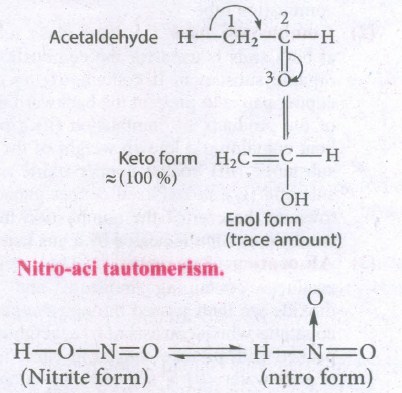
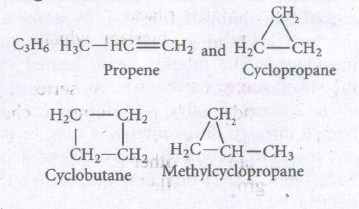
(c) Ring chain isomerism: In this type of isomerism, compounds having same molecular formula but differ in terms of bonding of carbon atom to form open chain and cyclic structures for eg:
16.
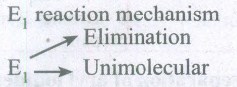
Elimination reactions may proceed through two different mechanisms namely E1 and E2
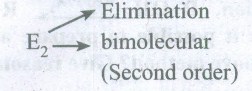
(i) The rate of E2 reaction depends on the concentration of alkyl halide and base Rate = k [alkyl halide] [base]
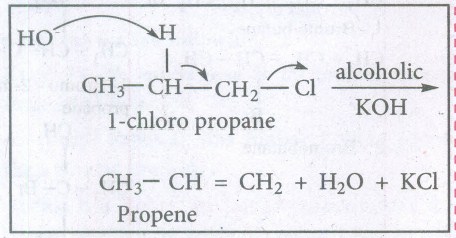
(ii) It is therefore, a second order reaction. Generally primary alkyl halide undergoes this reaction in the presence of alcoholic KOH. It is a one step process in which the abstraction of the proton from the . p carbon and expulsion of halide from the a carbon occur simultaneously. The mechanism is shown below.
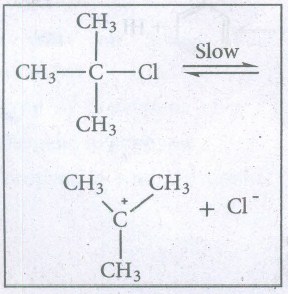
(iii) Generally, tertiary alkyl halide which undergoes elimination reaction by this mechanism in the presence of alcoholic KOH. It follows first order kinetics. Let us. consider the following elimination reaction.
Step - 1: Heterolytic fission to yield a carbocation
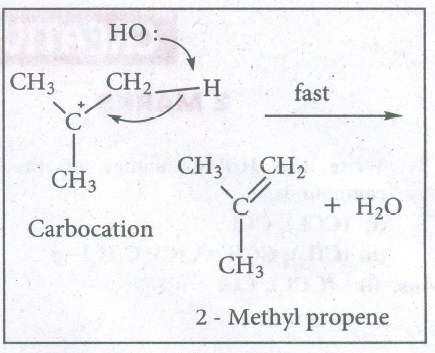
Step - 2 Elimination of a proton from the \(\beta\)- carbon to produce an alkene.
17.
Given data:
[A] = [B] = [C]= [D] =1 M
Kc = 100
[D]eq = ?
Solution:
Let x be the no moles of reactants reacted
| A | B | C | D | |
|---|---|---|---|---|
| Initial concentration | 1 | 1 | 1 | 1 |
| At equilibrium (as per reaction stoichiometry) |
1-x | 1-x | 1-x | 1-x |
\(K_c={[C][D]\over [A][B]}\)
\(100={(1+x)(1+x)\over (1-x)(1-x)}\)
\(\sqrt{100}=\sqrt{{(1+x)(1+x)\over (1-x)(1-x)}}\)
\(10={1+x\over 1-x}\)
10(1 - x) = 1 + x
10 - 10x - 1 - x = 0
9 - 11x = 0
11x = 9
\(x={9\over 11}=0.818\)
[D]eq = 1+x = 1 + 0.818 = 1.818M.
18.
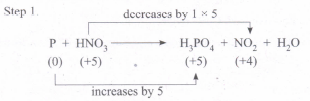
Step 2. P + 5HNO3 \(\rightarrow\)H3PO4 +5 NO2 + H2O
19.
(i) An element (A) belonging to group number 1 and period number 3 is sodium (A).
(ii) Sodium reacts with hydrogen to form sodium hydride (B)
2Na + H2 ➝ 2NaH
(A) (B) (C)
(iii) Sodium reacts with water to form sodium hydroxide (C).
2Na + 2H2O ➝ 2NaOH + H2
(A) (C)
| A | Na | Sodium |
| B | NaH | Sodium hydride |
| C | NaOH | Sodium hydroxide |
20.
n = 5; V = 2 Iitre;T= 27 + 273 = 300 K
\(P=\frac { nRT }{ V } [\because PV=nRT]\)
\(P=\frac { 5\times 8.314\times 300 }{ 2 } =62.355\quad bar\)
\(\therefore\) The pressure of CI2 gas will be 62.355 bar.
21.
(i) Free energy is defined as G = H - TS. 'G' is a state function.
(ii) G- Extensive property; ΔG - intensive property. When mass remains constant between initial and final states of system.
(iii) 'G' has a single value for the thermodynamic state of the system.
(iv) G and ΔG values correspond to the system only.
| Process | Spontaneous | Equilibrium | Non-Spontaneous |
| ΔG | -Ve | Zero | +Ve |
(v) Gibbs free energy and the net work done by the system:
For any system at constant pressure and temperature
ΔG = ΔH - TΔS .....(1)
We know that,
ΔH = ΔU + PΔV
ΔG =ΔU + PΔV-TΔS
from first law of thermodynamics
ΔU = q +w
from second law of thermodynamics
Δ S=\(\frac{q}{T}\) Δ G=q+w+PΔ V-T\((\frac{q}{T}) \)
Δ G = w+PΔV
-ΔG = -w - PΔV ......(2)
But -PΔV represents the work done due to expansion against a constant external pressure.
22.
23.
The electronic configuration of Sodium (Z = 11) Is22s22p63s1.
Magnesium (Z = 12) 1s22s22p63s2
Magnesium atom has a smaller radius and higher nuclear charge than a sodium atom, thus more energy will be required to remove the electron from the same orbital (3s), making the first ionisation energy of magnesium higher than that of sodium.
However, the second ionization enthalpy of sodium is higher than that of magnesium. This is because after losing 1 electron, sodium attains the stable noble gas configuration of neon (1s22s22p6). On the other hand, magnesium, after losing 1 electron still has one electron in the 3s-orbital(1s22s22p63s1). In order to attain the stable noble gas configuration, Thus, the energy required to remove the second electron in case of sodium is much higher than that required in case of magnesium. Hence, the second ionization enthalpy of sodium is higher than that of magnesium.
24.
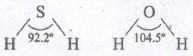
'The bond angle of HSH is 92.2° and that of H20 is 104.5°
The higher bond angle in water molecule is due to the higher electronegativity of oxygen (in H20) than sulphur (in H2S).
25.
When the π electron is transferred toward the attacking reagent, it is called +E (positive electromeric) effect.
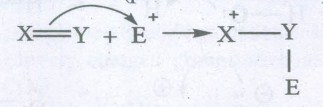
The addition of H+ to alkene as shown above is an example of +E effect.
When the electron is transfered away from the attacking reagent, it is called, -E (negative electromeric) effect.
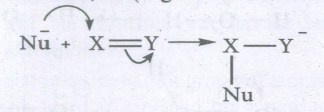
The attack of CN- on a carbonyl carbon, as shown above, is an example of -E effect
26.
| S.No | Classical somg (london smog) | Photochemical smog (Los Angels smog) |
|---|---|---|
| 1 | It was first observed in London in Dec. 1952 | It was first observed in Los Angels in 1950. |
| 2 | It occurs in cool, humid climate | It occurs in warm, dry and sunn climate |
| 3 | It consists of coal smoke and fog | It is formed by the combination of smoke dust and fog with air pollutants like N2 and hydrocarbons in presence of light. |
| 4 | It generally occurs in the morning and becomes worse when the sunshines | It forms when the sunshines and becomes worse in the afternoon. |
| 5 | This is mainly due to the induced oxidation of SO2 to SO3, which reacts with water yielding sulphuric acid aerosol. | This is mainly due to the induced oxidation of N2 to NO, NO2 and [O] + O2 to O3 NO and O3 are strong oxidising agents and can react with unburnt hydrocarbons in polluted air to form HCHO, Acrolein and PAN. |
| 6 | Chemically it is reducing in nature because of high concentration of SO2. | Chemically it is oxidising in nature because of high concentrations of oxidising agents like NO2 and O2 |
| 7 | It is called reducing smog | It is called oxidising smog |
| 8 | Responsible for acid rain, causes poor visibility, affects air and road transport and causes bronchial irritation. | Causes irritation to nose, throat, eyes, skin and lungs, increases asthma, causes chest pain, uncomfortable breathing, PAN attacks young leaves, causes corrosion of metals, stones painted surfaces, etc., |
27.
Alcoholscanbeconvertedintohaloalkenesbyreactingit withanyoneofthefollowingreagent
1.hydrogen halide
2. Phosphorous halides
3. Thionyl chloride
a) Reaction with hydrogen halide:
\(\underset { Ethanol }{ { CH }_{ 3 }{ CH }_{ 2 }OH+HCl } \overset { Anhydrous\\ ZN{ Cl }_{ 2 } }{ \underset { \triangle }{ \longrightarrow } } \underset { Chloroethane }{ { CH }_{ 3 }{ CH }_{ 2 }Cl+{ H }_{ 2 }O } \)
Mixture of con.HCI and anhydrous ZnCl2 is called Lucas reagent
b) Reaction with phosphorous halides :
Alcohols react with PX5 or PX3 to form haloalkane. PBr3 and PI3 are usually generated in situ (produced in the reaction mixture) by the reaction of red phosphorus with bromine and iodine, respectively.
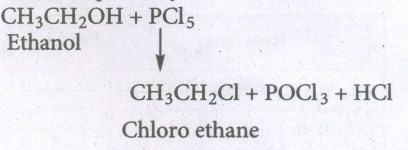
c)Reaction with thionyl chloride :
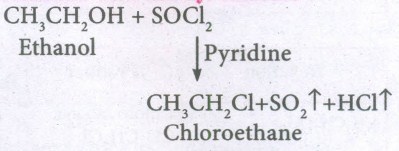
This reaction is known as Darzen's halogenation
28.
(i) Hydrogen, nitrogen, oxygen, fluorine and chlorine exist as gaseous diatomic molecules.
(ii) Another form of oxygen namely ozone triatomic molecule exists as a gas at room temperature.
(iii) Noble gases namely helium, neon, argon, krypton, xenon and radon are monoatomic gases.
29.
Ionization enthalpy, among other things, depends upon the electronic configuration (number of electrons) and nuclear charge (number of protons). Since isotopes of an element have the same electronic configuration and same nuclear charge, they have same ionization enthalpy.
30.
2 mole of H2 react with 1mole of O2.
1.5 mole of H react with 0.75 mole of O2.
Excess O2 = 0.9062 - 0.75 = 0.1562 mol.
31.
Heavy water is toxic when taken in large quantities. Heavy water is not radioactive. The deuterium in it is stable; it does not decay. Nobody will be in danger at all from radiation. It is heavier than plain water. D2O performs little different from H2O in chemical reactions. One has to drink a lot of D2O to kill him.
32.
| Orbital | n | 1 | Radial node n-1-1 | Angular node 1 |
| 2s | 2 | 0 | 1 | 0 |
| 4p | 4 | 1 | 2 | 1 |
| 5d | 5 | 2 | 2 | 2 |
| 4f | 4 | 3 | 0 | 3 |
33.
The structure of benzene is best described in terms of the molecular orbital theory. All the six carbon atoms of benzene are sp2 hybridized. Six sp2 hybrid orbitals of carbon linearly overlap with six one is orbitals of hydrogen atoms to form six C - H sigma bonds. Overlap between the remaining Sp2 hybrid orbitals of carbon forms six C-C sigma bonds
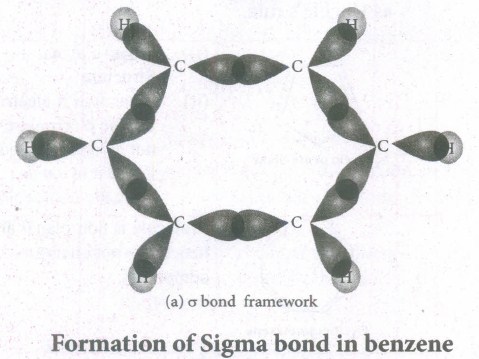
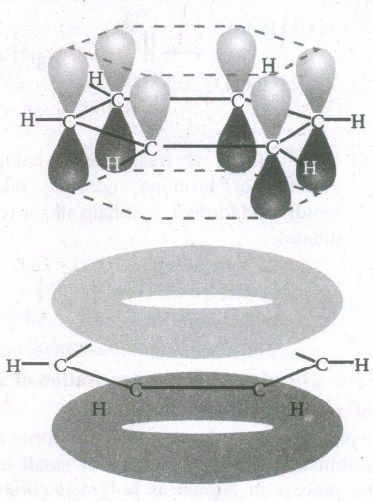
All the bonds in benzene lie in one plane with bond angle 120°. Each carbon atom in benzene possess an un hybridized p-orbital containing one electron. The lateral overlap of their p-orbital produces 3 \(\pi\)-bond The six electrons of the p-orbitals cover all the six carbon atoms and are said to be delocalised. Due to delocalization, strong -bond is formed which makes the molecule stable. Hence unlike alkenes and alkynes benzene undergoes substitution reactions rather addition reactions under normal conditions.
34.
| Distillation | DistillationUnder ReducedPressure | Steam Distillation |
| It involves conversion of liquidinto vapourbyheating followed by the condensation of vapours by cooling | It is applicable for purification of liquids with high boiling points and those which decompose at a temperature lower than its boiling point. | It is used for separation and purification of organic compounds from non - volatile impurities. |
| It is suitable for liquids which possess stable boiling points and contain non - volatile impurities. | A liquid boils when its vapour pressure becomes equal to the external pressure, obviously the liquid will boil at a lower temperature, if the pressure on it is reduced. Since the liquid boils at a temperature below its boiling point it does not undergo decomposition. | This method is applicable to all those compounds which are volatile in steam, insoluble in water, possess a high vapour pressure and contain non -volatile impurities. |
35.
Pesticides are the chemicals that are used to kill or stop the growth of unwanted organisms. But these pesticides can affect the health of human beings. These are further classified as
a. Insecticides:
Insecticides like DDT ,BHC ,aldrin etc. can stay in soil for long period of time and are absorbed by soil . Th.y contaminate root crops like carrot, raddish, etc.
b. Fungicide :
Organo mercury compeunds are used as most common fungicide. They dissociate in soil to produce mercury which is highly toxic.
c. Herbicides :
Herbicides are the chemical compounds used to control unwanted plants. They are otherwise known as weed killers. Example sodium chlorate (NaClO3) and sodium arsenite (Na3 As O3). Most of the herbicides are toxic to mammals.
36.
The first six members of nitro alkanes are
(i) CH2-NO2 - Nitromethane
(ii) CH2-CH2-NO2 - Nitroethane
(iii) CH3-CH2-CH2-NO2 - 1- nitropropane'
(iv) CH3-CH2-CH2-CH2-NO2 - 1- nitrobutane
(v) CH3-CH2-CH2-CH2-CH2-NO2 - 1- nitropentane
(vi) CH2-CH2-CH2-CH2-CH2-CH2 - NO2 - 1- nitrohexane
37.
\({\Delta P\over P_A^o}={W_B\times M_A\over M_B\times W_A}\)
In a 2 % solution weight of the solute is 2g and solvent is 98g
ΔP = PA - Psolution = 1.013 - 1.004 bar = 0.009 bar
\(M_B={P_A^o\times W_B\times M_A\over \Delta P\times W_A}\)
MB = 2 x 18 x 1.013/(98 x 0.009)
= 41.3 g mol-1.
38.
\(\Delta n_{g}=\sum n p_{(g)}-\sum n R_{(g)}\)
As \(\Delta n_{p}(g)\) is greater \(\Delta n_{g}=+v e\)
\( \therefore K_{p}=K_{c}(R T)^{+v e} \)
\(\therefore K_{p}>K_{c} \)
So K is smaller than Kp.
39.
(i) The number of electrons increases by the same number as the increase in the atomic number.
(ii) As the number of electrons increases, the electronic structure of the atom changes.
(iii) Electrons in the outermost shell of an atom (valence shell electrons) determine the chemical properties of the elements.
40.
For one mole of an ideal gas, we have
\({ C }_{ v }=\frac { dU }{ dT } \)
dU=Cv dT
For a finite change, we have
\(\Delta U={ C }_{ v }\Delta T\)
\(\Delta U={ C }_{ v }({ T }_{ 2 }-{ T }_{ 1 })\)
and for n moles of an ideal gas we get \(\Delta U=n{ C }_{ v }({ T }_{ 2 }-{ T }_{ 1 })\) .....(1)
Similarly for n moles of an ideal gas we get \(\Delta H=n{ C }_{ p }({ T }_{ 2 }-{ T }_{ 1 })....(2)\)
41.
The passenger in a moving bus falls in the forward direction, when brakes are applied suddenly is in accordance with Newton's first law of motion.
When breaks are applied, the automobile comes to rest but the passenger due to inertia of motion tend to continue to move in forward direction hence fall forward.
The movement of helium balloon in the opposite direction is due to the difference in the density of surrounding air. When the car stops suddenly, the air moves forward due to inertia of motion.
As a result the air in the front of the car is more dense that at the rear of the car creating more pressure on the front side of the balloon. This causes the balloon move towards the rear of the car where air is less dense.
The body is at rest but the car is forward motion, due to inertia the passengers are pushed toward the front of the car on forward acceleration.
42.
1) The unit of molecular mass is atomic mass unit [amu]. The unit of molar mass is gram per mole.
2) Molecular mass is the mass of one molecule while molar mass is the mass of one mole of molecules (6.022 x 10²³)
(i) Molecular mass of CO2 = 1(C) + 2(0) = 12 + 32 = 44 amu
or 7.304 x 10⁻²³ g
(ii) Molar mass of CO2 = 44 g mol-1.
43.
iv) (A) is correct but( R) is not correct

11th Standard Syllabus & Materials
11th Standard
TN 11th Tamil பீடு பெற நில் - செய்யுள் - காவடிச்சிந்து Important Questions And Answers Study Material - QB365 Set A
NEW11th Standard
TN 11th Tamil பீடு பெற நில் - உரைநடை - மலை இடப்பெயர்கள் : ஓர் ஆய்வு Important Questions And Answers Study Material - QB365 Set A
NEW11th Standard
TN 11th Tamil மாமழை போற்றுதும் - துணைப்பாடம் - யானை டாக்டர் Important Questions And Answers Study Material - QB365 Set A
NEW11th Standard
TN 11th Tamil மாமழை போற்றுதும் - செய்யுள் - ஐங்குறுநூறு Important Questions And Answers Study Material - QB365 Set A



Tamilnadu Stateboard 11th Standard Subjects

Maths

Commerce

Economics

Biology

Business Maths and Statistics

Accountancy

Computer Science

Physics
Chemistry
Maths
Biology
Economics
Physics
Chemistry

History
Business Maths and Statistics

Computer Science
Accountancy

Computer Applications
History
Computer Technology
Commerce
Computer Applications
Computer Technology

Tamil

English

French
Tamilnadu Stateboard Standards
