
 100% FREE ACCESS
11th Standard Syllabus & Materials
11th Standard
TN 11th Tamil இயற்கை வேளாண்மை,சுற்றுச்சூழல் -செய்யுள் - மனோன்மணீயம் Important Questions And Answers Study Material - QB365 Set A
NEW11th Standard
TN 11th Tamil என்னுயிர் என்பேன் -துணைப்பாடம் - இசைத்தமிழர் இருவர் Important Questions And Answers Study Material - QB365 Set A
NEW11th Standard
TN 11th Tamil மொழி கலை -செய்யுள் - ஒவ்வொரு புல்லையும் Important Questions And Answers Study Material - QB365 Set A
NEW11th Standard
TN 11th Tamil பீடு பெற நில் - இலக்கணம் - பகுபத உறுப்புகள் Important Questions And Answers Study Material - QB365 Set A
NEW11th Standard
TN 11th Tamil பீடு பெற நில் - துணைப்பாடம் - வாடிவாசல் Important Questions And Answers Study Material - QB365 Set A
NEW11th Standard
TN 11th Tamil பீடு பெற நில் - செய்யுள் - குறுந்தொகை Important Questions And Answers Study Material - QB365 Set A

Published on: 31/08/2019
Quantum Mechanical Model of Atom
Download Tamil Nadu 11th Standard Chemistry question papers, model tests, one-mark questions, important questions, and public exam papers in PDF format. Free study materials and answer keys for TN State Board students.
Questions + Answers key
Take MCQ Chemistry Test
1.
If n = 6, the correct sequence for filling of electrons will be __________
ns \(\rightarrow\) (n-2)f \(\rightarrow\) (n - 1)d \(\rightarrow\) np
ns \(\rightarrow\) (n - 1) d \(\rightarrow\) (n - 2) f \(\rightarrow\) np
ns \(\rightarrow\) (n-2)f \(\rightarrow\)np \(\rightarrow\) (n-1)d
none of these are correct
2.
What is the maximum numbers of electrons that can be associated with the following set of quantum numbers? n = 3, I = 1 and m =-1
4
6
2
= 10
3.
For d-electron, the orbital angular momentum is ___________
\(\frac { \sqrt { 2 } h }{ 2\pi } \)
\(\\ \frac { \sqrt { 2h } }{ 2\pi } \)
\(\frac { \sqrt { 2\times 4 } h }{ 2\pi } \)
\(\frac { \sqrt { 6 } h }{ 2\pi } \)
4.
Two electrons occupying the same orbital are distinguished by ___________
azimuthal quantum number
spin quantum number
magnetic quantum number
orbital quantum number
5.
The energies E1and E2 of two radiations are 25 eV and 50 eV respectively. The relation between their wavelengths ie \(\lambda \)1 and\(\lambda \)2 will be ___________
\(\frac { { \lambda }_{ 1 } }{ { \lambda }_{ 2 } } =1\)
\({ \lambda }_{ 1 }=2{ \lambda }_{ 2 }\)
\({ \lambda }_{ 1 }=\sqrt { 25\times 50{ \lambda }_{ 2 } } \)
\(2{ \lambda }_{ 1 }={ \lambda }_{ 2 }\)
6.
An atom of an element contains 35 electrons and 45 neutrons. Deduce
(i) the number of protons
(ii) the electronic configuration for the element
(iii) All the four quantum numbers for the last electron
7.
State and explain pauli exclusion principle.
8.
Which quantum number reveal information about the shape, energy, orientation and size of orbitals?
9.
How many orbitals are possible for n = 4?
10.
Suppose that the uncertainty in determining the position of an electron in an orbit is 0.6 \(\mathring{A}\) . What is the uncertainty in its momentum
11.
Protons can be accelerated in particle accelerators. Calculate the wavelength (in Å) of such accelerated proton moving at 2.85 x 10⁸ ms-1 (the mass of proton is 1.673 x 10⁻²⁷ Kg).
12.
Determine the values of all the four quantum numbers of the 8th electron in O- atom and 15th electron in Cl atom.
13.
Calculate the uncertainty in position of an electron, if Δv = 0.1% and \(\upsilon \) = 2.2 x 10⁶ ms-1.
1.
(a)
ns \(\rightarrow\) (n-2)f \(\rightarrow\) (n - 1)d \(\rightarrow\) np
2.
(c)
2
3.
(d)
\(\frac { \sqrt { 6 } h }{ 2\pi } \)
4.
(b)
spin quantum number
5.
(b)
\({ \lambda }_{ 1 }=2{ \lambda }_{ 2 }\)
6.
(i) no. of electrons: 35 (given)
no. of protons : 35
(ii) Electronic configuration
1s2 2S2 2p6 3s2 3p6 4s2 3d10 4p5
(iii) Last electron:
| \(\downharpoonleft\upharpoonright\) | \(\upharpoonleft\downharpoonright\) | \(\upharpoonleft\) |
4Px 4Py 4pz
last electron present in 4Py orbital y
n = 4, l = 1 m1 = either + 1 or -1 and s = -1/2
7.
Statement : "No two electrons in an atom can have the same set of values of all four quantum numbers"
Explanation : It means that, each electron must have unique values for the four quantum numbers (n, l, m and s).
For the lone electron present in hydrogen atom, the four quantum numbers are: n = 1; l = 0; m = 0 and s = +1/2. For the two electrons present in helium, one electron has the quantum numbers same as the electron of hydrogen atom, n = 1.
l = 0, m = 0 and s = +1/2. For other electron, the fourth quantum number is different i.e., n = 1, l = 0, m = 0 and s = -1/2.
As we know that the spin quantum number can have only two values +1/2 and - 1/2, only two electrons can be accommodated in a given orbital in accordance with pauli exclusion principle.
| Atom | e- | n | l | m | s |
| Helium | First | 1 | 0 | 0 | +1/2 |
| Second | 1 | 0 | 0 | +1/2 |
8.
a) Principal quantum number defines energy and size of an orbital.
b) Azimuthal quantum number defines shape of an orbital
c) Magnetic quantum number defines spatial orientation (direction) of an orbital.
9.
| n | l | m | orbitals | Total no of orbitals |
| 0 | 0 | 1 | (1- 4s +3 - 4P orbital +5 - 4d orbital +7 - 4f orbital) =16 |
|
| 4 | 1 | -1 0 +1 |
3 | |
| 2 |
-2 |
5 | ||
| 3 |
-3 |
7 |
10.
\(\triangle\)x = 0.6\(\mathring{A}\) = 0.6 x 10⁻¹⁰m
\(\triangle p\) = ?
\(\triangle x.\triangle p\ge\frac{h}{4\pi}\)
\(\triangle x.\triangle p\ge5.28\times10^{-35}kgm^{2}s^{-1}\)
\((0.6 \times10^{-10}) \triangle p \ge5.28\times10^{-35}\)
\(\Rightarrow \triangle \ge \frac{5.28\times10^{-35}kgm^{2}s^{-1}}{0.6510^{-1}m}\)
\(\triangle p \ge8.8\times10^{-25}kgms^{-1}\)
11.
v = 2.85 x 10⁸ ms-1
mp = 1.673 x 10⁻²⁷Kg
\(\lambda=\frac{h}{mv}\)
\(=\frac{6.626\times10^{-34}kgm^{2}s^{-1}}{1.673\times10^{-27}kg\times\times2.85\times10^{8}ms^{-1}}\)
\(\lambda=1.389\times10^{-15}\Rightarrow\lambda=1.389\times10^{-15}A\) \([\because \mathring{A}={10}^{-10}m]\)
12.
Electronic configuration of oxygen
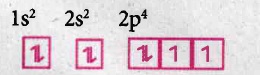
ஃ 8th electron present in 2px orbital and the quantum numbers are
n = 2,l = 1,m1 = either + 1 or -1 and s = -1/2
Electronic configuration of chlorine
.png)
15th electron present in 3Pz orbital and the quantum numbers are n = 3, l = 1, m1 = either +1 or -1 and ms = +1/2
13.
\(\triangle x.\triangle p\ge \frac { h }{ 4\pi } \)
\(\triangle x.\triangle p\ge 5.28 \times{ 10 }^{ -35 }Kg{ m }^{ 2 }{ s }^{ -1 }\)
\(\triangle x.(m\triangle v)\ge 5.28 \times{ 10 }^{ -35 }Kg{ m }^{ 2 }{ s }^{ -1 }\)
Given \(\triangle\)v = 0.1%
v = 2.2 x 10⁶ ms-1
m = 9.1 x 10⁻³¹Kg
\(\triangle\)v = \(\frac{0.1}{100}\times2.2\times{10}^{6}ms^{-1}\)
= \(2.2\times{10}^{6}ms^{-1}\)
\(\therefore \triangle x\ge \frac { { 5.28\times 10 }^{ -35 }{ Kgm }^{ 2 }{ s }^{ -1 } }{ 9.1\times { 10 }^{ -31 }Kg\times 2.2\times { 10 }^{ 3 }m{ s }^{ -1 } } \)
\(\\ \triangle x\ge 2.64\times { 10 }^{ -8 }m\)

11th Standard Syllabus & Materials
11th Standard
TN 11th Tamil பீடு பெற நில் - செய்யுள் - காவடிச்சிந்து Important Questions And Answers Study Material - QB365 Set A
NEW11th Standard
TN 11th Tamil பீடு பெற நில் - உரைநடை - மலை இடப்பெயர்கள் : ஓர் ஆய்வு Important Questions And Answers Study Material - QB365 Set A
NEW11th Standard
TN 11th Tamil மாமழை போற்றுதும் - துணைப்பாடம் - யானை டாக்டர் Important Questions And Answers Study Material - QB365 Set A
NEW11th Standard
TN 11th Tamil மாமழை போற்றுதும் - செய்யுள் - ஐங்குறுநூறு Important Questions And Answers Study Material - QB365 Set A



Tamilnadu Stateboard 11th Standard Subjects

Maths

Commerce

Economics

Biology

Business Maths and Statistics

Accountancy

Computer Science

Physics
Chemistry
Maths
Biology
Economics
Physics
Chemistry

History
Business Maths and Statistics

Computer Science
Accountancy

Computer Applications
History
Computer Technology
Commerce
Computer Applications
Computer Technology

Tamil

English

French
Tamilnadu Stateboard Standards
