
 100% FREE ACCESS
11th Standard Syllabus & Materials
11th Standard
TN 11th Tamil இயற்கை வேளாண்மை,சுற்றுச்சூழல் -செய்யுள் - மனோன்மணீயம் Important Questions And Answers Study Material - QB365 Set A
NEW11th Standard
TN 11th Tamil என்னுயிர் என்பேன் -துணைப்பாடம் - இசைத்தமிழர் இருவர் Important Questions And Answers Study Material - QB365 Set A
NEW11th Standard
TN 11th Tamil மொழி கலை -செய்யுள் - ஒவ்வொரு புல்லையும் Important Questions And Answers Study Material - QB365 Set A
NEW11th Standard
TN 11th Tamil பீடு பெற நில் - இலக்கணம் - பகுபத உறுப்புகள் Important Questions And Answers Study Material - QB365 Set A
NEW11th Standard
TN 11th Tamil பீடு பெற நில் - துணைப்பாடம் - வாடிவாசல் Important Questions And Answers Study Material - QB365 Set A
NEW11th Standard
TN 11th Tamil பீடு பெற நில் - செய்யுள் - குறுந்தொகை Important Questions And Answers Study Material - QB365 Set A

Published on: 30/10/2019
Download Tamil Nadu 11th Standard Chemistry question papers, model tests, one-mark questions, important questions, and public exam papers in PDF format. Free study materials and answer keys for TN State Board students.
Questions + Answers key
Take MCQ Chemistry Test
1.
Which of the following can be used as the halide component for friedal - crafts reaction?
Chloro benzene
Bromo benzene
chloro ethene
isopropyl chloride
2.
An alkyl bromide (A) reacts with sodium in ether to form 4, 5– diethyloctane, the compound (A) is _________
CH3 (CH2)3 Br
CH3(CH2)5 Br
CH3(CH2)3 CH(Br)CH3
\({ CH }_{ 3 }-{ \left( { CH }_{ 2 } \right) }_{ 2 }-CH\left( Br \right) -\underset { \overset { { | } }{ { CH }_{ 3 } } }{ { CH }_{ 2 } } \)
3.
Which of the following species does not acts as a nucleophile ?
ROH
ROR
PCl3
BF3
4.
What is the hybridisation state of benzyl carbonium ion ?
sp2
spd2
sp3
sp2d
5.
In an organic compound, phosphorus is estimated as ____________
Mg2P2O7
Mg3(PO4)2
H3PO4
P2O5
6.
In a closed room of 1000 m3 a perfume bottle is opened up. The room develops smell. This is due to which property of gases _____________
Viscosity
Density
Diffusion
None
7.
In an adiabatic expansion of an ideal gas ____________
w = -ΔU
w = ΔU + ΔH
ΔU = 0
w = 0
8.
9.
The temperatures at which real gases obey the ideal gas laws over a wide range of pressure is called ____________
Critical temperature
Boyle temperature
Inversion temperature
Reduced temperature
10.
Water is a ___________
basic oxide
acidic oxide
amphoteric oxide
none of these
11.
Zeolite used to soften hardness of water is hydrated _____________
Sodium aluminium silicate
Calcium aluminium silicate
Zinc aluminium borate
Lithium aluminium hydride
12.
Ionic hydrides are formed by _____________
halogens
halogens
inert gases
group one elements
13.
What would be the IUPAC name for an element with atomic number 222?
bibibium
bididium
didibium
bibibium
14.
Carbon forms two oxides, namely carbon monoxide and carbon dioxide. The equivalent mass of which element remains constant ?
Carbon
Oxygen
Both carbon and oxygen
Neither carbon nor oxygen
15.
Splitting of spectral lines in an electric field is called _____________
Zeeman effect
Shielding effect
Compton effect
Stark effect
16.
Give IUPAC names for the following compounds
CH3 – CH = CH – CH = CH – C ≡ C – CH3
17.
State the first law of thermodynamics.
18.
How many orbitals are possible for n = 4?
19.
Define equivalent mass.
20.
Define electronegativity.
21.
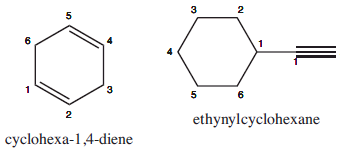
Write structural formula for the following compounds
(i) Cyclohexa-1, 4-diene
(ii) Ethynyl cyclohexane.
22.
What is dipole moment ?
23.
The value of Kc for the reaction
N2O2(g) \(\rightleftharpoons \) 2NO2(g)
24.
What are state and path functions? Give two examples
25.
Explain preparation of hydrogen using electrolysis.
26.
Give the uses of gypsum.
27.
Mention the uses of plaster of paris
28.
State Boyle's law.
29.
30.
List the characteristics of internal energy.
31.
Distinguish between diffusion and effusion.
32.
Explain the diagonal relationship.
1.
(d)
isopropyl chloride
2.
(d)
\({ CH }_{ 3 }-{ \left( { CH }_{ 2 } \right) }_{ 2 }-CH\left( Br \right) -\underset { \overset { { | } }{ { CH }_{ 3 } } }{ { CH }_{ 2 } } \)
3.
(d)
BF3
4.
(a)
sp2
5.
(a)
Mg2P2O7
6.
(c)
Diffusion
7.
(a)
w = -ΔU
8.
(c)
9.
(b)
Boyle temperature
10.
(c)
amphoteric oxide
11.
(a)
Sodium aluminium silicate
12.
(d)
group one elements
13.
(d)
bibibium
14.
(b)
Oxygen
15.
(d)
Stark effect
16.

17.
The first law of thermodynamics, also known as the law of conservation of energy, states that "The total energy of an isolated system remains constant though it may change from one form to another."
The mathematical statement of the First Law is: ΔU=q+w
Where q - the amount of heat supplied to the system; w - work done on the system
18.
| n | l | m | orbitals | Total number of orbitals |
| 0 | 0 | 1 | (1- 4s +3 - 4p orbital +5 - 4d orbital +7 - 4f orbital) =16 |
|
| 4 | 1 | -1 0 +1 |
3 | |
| 2 |
-2 |
5 | ||
| 3 |
-3 |
7 |
19.
Gram equivalent mass of an element, compound or ion is the mass that combines or displaces 1.008 g hydrogen or 8 g oxygen or 35.5 g chlorine.
20.
It is defined as the relative tendency of an element present in a covalently bonded molecule, to attract the shared pair of electrons towards itself.
21.
22.
Dipole moment :
The polarity of a covalent bond can be measured in terms of dipole moment which is defined as \(\mu=q \times 2d\)
Where \(\mu\) is the dipole moment, q is the charge and 2d is the distance between the two charges.
Where p is the dipole moment, q is the charge and 2d is the distance between the two charges. The dipole moment is a vector and the direction of the dipole moment vector points from the negative charge to positive charge.
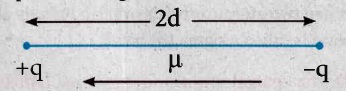
The unit for dipole moment is columb meter (C m). It is usually expressed in Debye unit (D). The conversion factor is 1 Debye = 3.336 x 10⁻³⁰ C m.
23.
N2O2(g) \(\rightleftharpoons \) 2NO2(g)
Kc = 0.21 at 373 K. The concentrations N2O4 and NO2 are found to be 0.125 mol dm-3 and 0.5 mol dm-3 respectively at a given time. From the above information we can predict the direction of reaction as follows.
\(Q={[NO_2]^2\over [N_2O_4]}={0.5\times 0.5\over 0.125}=2\)
The Q value is greater than Kc. Hence, the reaction will proceed in the reverse direction until the Q value reaches 0.21.
24.
(i) State function: A state function is a thermodynamic property of a system, which has a specific value for a given state and does not depend on the path (or manner) by which the particular state is reached.
Example: Pressure (P), Volume (V), Temperature (T)
(ii) Path functions: A path function is a thermodynamic property of the system whose value depends on the path by which the system changes from its initial to final states.
Example: Work (w), Heat (q).
25.
High purity hydrogen (> 99.9%) is obtained by the electrolysis of water containing traces of acid or alkali or the electrolysis of aqueous solution of sodium hydroxide or potassium hydroxide using a nickel anode and iron cathode. However, this process is not economical for large-scale production.
At anode: 2OH- ➝ H2O + 1/2O2 + 2e-
At cathode: 2H2O + 2e- ➝ 2OH- + H2
Overall reaction: H2O ➝ H2 + 1/2O2
26.
1. Gypsum is used in making drywalls or plaster boards.
2. Another important use of gypsum is the production of plaster of Paris. Gypsum is heated to about 300 degree Fahrenheit to produce plaster of paris, which is also known as gypsum plaster. It is mainly used as a sculpting material.
3. Gypsum is used in making surgical and orthopedic casts, such as surgical splints and casting moulds.
4. Gypsum plays an important role in agriculture as a soil additive, conditioner, and fertilizer. It helps loosen up compact or clay soil, and provides calcium and sulphur, which are essential for the healthy growth of a plant.
5. Gypsum is used in toothpastes, shampoos, and hair products.
6. Gypsum is a component of portland cement, where it acts as a hardening retarder to control the speed at which concrete sets.
27.
The largest use of plaster of paris is in the building industry as well as plasters. It is used for immobilising the affected part of organ where there is a bone fracture or sprain. It is also employed in dentistry, in ornamental work and for making casts of statues and busts.
28.
At a given temperature the volume occupied by a fixed mass of a gas is inversely proportional to its pressure.
\(V\alpha \frac { 1 }{ P }\) at constant T& n.
Mathematical form: P1V1 = P2 V2 = K
29.
30.
Characteristics of internal energy (U) :
31.
| S. NO | diffusion | effusion |
| 1 | It is the spreading of molecules of a substance throughout a space or second substance | It is the escape of the gas molecules through a very small hole (orifice) in a membrane into an evacuated area. |
| 2 | It is typically used to describe statistical properties of a gas at length scales that are much larger than mean free path. | The diameter of the hole should be smaller than mean free path of the molecules. |
| 3 | It is the spreading of gases. | It is the pouring out of gases. |
32.
On moving diagonally across the periodic table, the second and third period elements show certain similarities. It is quite pronounced in the following pair of elements.

The similarity in properties existing between the diagonally placed elements is called diagonal relationship.

11th Standard Syllabus & Materials
11th Standard
TN 11th Tamil பீடு பெற நில் - செய்யுள் - காவடிச்சிந்து Important Questions And Answers Study Material - QB365 Set A
NEW11th Standard
TN 11th Tamil பீடு பெற நில் - உரைநடை - மலை இடப்பெயர்கள் : ஓர் ஆய்வு Important Questions And Answers Study Material - QB365 Set A
NEW11th Standard
TN 11th Tamil மாமழை போற்றுதும் - துணைப்பாடம் - யானை டாக்டர் Important Questions And Answers Study Material - QB365 Set A
NEW11th Standard
TN 11th Tamil மாமழை போற்றுதும் - செய்யுள் - ஐங்குறுநூறு Important Questions And Answers Study Material - QB365 Set A



Tamilnadu Stateboard 11th Standard Subjects

Maths

Commerce

Economics

Biology

Business Maths and Statistics

Accountancy

Computer Science

Physics
Chemistry
Maths
Biology
Economics
Physics
Chemistry

History
Business Maths and Statistics

Computer Science
Accountancy

Computer Applications
History
Computer Technology
Commerce
Computer Applications
Computer Technology

Tamil

English

French
Tamilnadu Stateboard Standards
