
 100% FREE ACCESS
11th Standard Syllabus & Materials
11th Standard
TN 11th Tamil இயற்கை வேளாண்மை,சுற்றுச்சூழல் -செய்யுள் - மனோன்மணீயம் Important Questions And Answers Study Material - QB365 Set A
NEW11th Standard
TN 11th Tamil என்னுயிர் என்பேன் -துணைப்பாடம் - இசைத்தமிழர் இருவர் Important Questions And Answers Study Material - QB365 Set A
NEW11th Standard
TN 11th Tamil மொழி கலை -செய்யுள் - ஒவ்வொரு புல்லையும் Important Questions And Answers Study Material - QB365 Set A
NEW11th Standard
TN 11th Tamil பீடு பெற நில் - இலக்கணம் - பகுபத உறுப்புகள் Important Questions And Answers Study Material - QB365 Set A
NEW11th Standard
TN 11th Tamil பீடு பெற நில் - துணைப்பாடம் - வாடிவாசல் Important Questions And Answers Study Material - QB365 Set A
NEW11th Standard
TN 11th Tamil பீடு பெற நில் - செய்யுள் - குறுந்தொகை Important Questions And Answers Study Material - QB365 Set A

Published on: 12/03/2019
+1 Public Exam March 2019 Important Creative Questions and Answers
Download Tamil Nadu 11th Standard Commerce question papers, model tests, one-mark questions, important questions, and public exam papers in PDF format. Free study materials and answer keys for TN State Board students.
Questions + Answers key
Take MCQ Commerce Test1.
What are the departments of Reserve Bank of India?
2.
Define 'Business Ethics'.
3.
What are the disadvantages of FDI.
4.
What are the Responsibility of Suppliers?
5.
What are the nature of business risks?
6.
How warehousing facilitates business finance?
7.
How can we establish state enterprises?
8.
What are the important requisites of a cheque?
9.
Give the example of Development Banks.
10.
Give examples of co-operative society.
11.
List the advantages of MNC's.
12.
List out any five demerits of sole trading concern.
13.
What is express authority?
14.
Is partnership interest is transferable?
15.
What is Quinary service?
16.
What is Commercial Paper (CP)?
17.
What is Objective clause?
18.
What is tertiary industry?
19.
What do you mean by Overdraft?
20.
What are Domestic Flights?
21.
What is meant of Articles of Association?
22.
What do you mean by EXIM bank?
23.
What do you mean by In Transit Mixing?
24.
What is the meaning of Ancestral Property?
25.
Expand NABARD.
26.
What is the other name for sole proprietorship?
27.
What are Joint Enterprises?
28.
What was advocated by Kautilya in Arthasasthra with regard to trade?
29.
What are the classification of Tertiary industries?
30.
What is Joint-Venture?
31.
State two ways by which ethics influences behaviour.
32.
What is International Trade?
33.
What is re-insurance?
34.
What is meant by Entrepot Trade?
35.
What do you mean by Goods and Services Tax?
36.
Define Balance of payments
37.
Write a note on - ECS.
38.
39.
What is meant by Limited liability?
40.
What is health insurance?
41.
42.
Give any two differences between GATT and WTO.
43.
What is meant by previous year?
44.
Who are called stakeholders?
45.
Classify the following activities into economic or non-economic activities?
46.
What is Instalment System?
47.
What is Quantum meruit?
48.
What is the basic feature of a Departmental undertaking?
49.
What do you mean by Industrial Development Banks?
50.
Name any four types of Land transport.
51.
What are the types of Franchising?
52.
What is Factoring?
53.
State the meaning of multiple shops.
54.
Write any two advantages of MNC's.
55.
State any two services rendered by transports.
56.
57.
Write a note on Profession.
58.
Name the business which do not have any middleman.
59.
What is hindrance of finance?
60.
List out the functions of RBI.
61.
Who is called a Partner?
62.
What are the benefits of KPO?
63.
Why should one know law?
64.
Who is a factor?
65.
List the various types of Warehouses.
66.
Define Retailer.
67.
Why do sole traders lose the economies of large-scale production?
68.
What do you mean by Co-operative organization?
69.
Write any two export promotion institutions.
70.
Write the meaning of 'Bank'.
71.
What is meant by Nalangadi?
72.
What are the Corporate enterprises?
73.
Give a not on SWC.
74.
Name the type of business enterprise which operates in more than one country.
1.
(a) Banking Department: The bank has seven offices of Banking Department
(i) Public Accounts Department
(ii) the Public Debit Office
(iii) Deposit Accounts Department
(iv) Securities Department.
(b) Issue Department:
(i) General Department,
(ii) Cash Department.
(c) Central Policy Department:
(i) Credit Planning Cell
(ii) Personal PolicyDepartment.
(iii) Administration Department.
2.
According to Thomas Adams, "It deals with the values of what is right and wrong, good and bad and moral and non-moral in business relationship."
3.
(i) Exploiting Natural Resources
(ii) Heavy outflow of Capital
(iii) Not transferring Technology
(iv) Exploiting cheap labour
(v) Creating Monopolistic Environment
4.
The responsibility of suppliers are:
(a) Giving regular orders for purchase of goods.
(b) Dealing on fair terms and conditions.
(c) Availing reasonable credit period.
(d) Timely payment of dues.
5.
The nature of Business Risks are:
(i) Business Risks arise.due to uncertainties
(ii) Risk is an essential part of every business
(iii) Degree of risk depends mainly upon the nature and size of business
(iv) Profit is the reward for risk taking
6.
There is a gap between production and consumption. So, the businessmen have to store goods for a long-time. They deposit their goods ina warehouse. He can get finance from bank and other financial institutions by showing the warehouse keeper's receipt of goods. Thus, warehousing helps people to get monetary help from banks and continue their business with interruption.
7.
The government can establish state enterprises in two ways. They are:
(i) By starting a new unit.
(ii) By taking over an existing industrial or commercial unit owned by private persons.
8.
The important requisites of a cheque are;
(i) According to law a cheque must be in writing.
(ii) It is an order to pay the amount without any condition.
(iii) The amount of money to be paid must be certain and specified both in words and, figures in the cheque and
(iv) A cheque is valid if it bears the signature of the drawer.
9.
The examples of Development Banks are:
(i) Industrial Finance Corporation of India - IFCI
(ii) Small Industries Development Bank of India -SIDBI
(iii) MUDRA bank (for the development of micro industries)
10.
Examples of co-operative society:
(i) Indian Coffee House .
(ii) Mother Dairy
(iii) Shri Mahila Griha Udyog Lijjat Papad
(iv) Indian Farmers Fertilizers Cooperative Limited
(v) The Indian Airlines (Cargo) C.G.H.S. Ltd.
11.
(i) Low cost labour
(ii) Microsoft Corporation
12.
Demerits of sole trading concern are:
(i) Limited capital
(ii) Limited managerial ability
(iii) Unlimited liability
(iv) Short life and
(v) Hasty decision.
13.
Where the authority to a partner is expressly conferred by an agreement, it is called express authority. The firm is liable for all the acts done by such partners, within such authority only.
14.
No partner can transfer his interest or sell his share to any other person without the consent of all other partners. This is based on the principle that a partner, being an agent himself, cannot further delegate his authority unilaterally to others.
15.
Quinary service:
New ideas are generated, new technologies are evolved, new policies are implemented by selected individual experts. Their decisions influence nations, international institutions, etc., i.e., Inventors.
16.
Commercial paper (CP) is an unsecured money market instrument in the form of a promissory note. It was introduced in India in 1990 under Section 45W of the Reserve Bank of India Act.
17.
The objective clause requires you to summarize the main objectives for establishing the company with reference to the requirements for shareholding and use of financial resources. You also need to state ancillary objectives; that is, those objectives that are required to facilitate the achievement of the main objectives.
18.
They do not produce goods. These industries produce utility services and sell them at a profit. They help trade, industry and commerce. This term also includes auxiliaries to trade like banking, insurance, warehouse, advertisement etc.
19.
It is a credit facility extended to the current account holding business community customers.The customers are allowed to overdraw (when there is no balance money in the account) up to certain amount usually for 3 months period. It is an unsecured credit.
20.
Flights from one point to another within the same country are called domestic flights.
21.
The Articles of association (AOA) is a document that contains the purpose of the company as well as the duties and responsibilities of its members. It is an important document which needs to be filed with the Registrar of Companies.
22.
Export and Import Bank is one the specialized financial institutions wholly owned by Government of India was set up in the year 1982 for financing, facilitating and promoting foreign trade of India.
23.
It refers to a function in which warehouse receives products from different plants and mix and repack them as per client's requirement.
24.
Property inherited upto 4 generations of male lineage(i.e., father; grandfather etc.) is called ancestral property. The right to a share in such a property accrues by birth itself.
25.
National Bank for Agriculture and Rural Development.
26.
Sole proprietorship is also called as Entrepreneurship.
27.
When an enterprise is owned, managed and controlled by Government and private entrepreneurs, it is known joint enterprises.E.g. Maruti Suzuki.
28.
In Arthasasthra Kautilya advocated the maintenance of perfect balance between State management and people's welfare through trading activities.
29.
Tertiary industries are :
a) Personalised service
b) Public service
c) Distributive service
d) Financial service
e) Quaternary service
f) Quinary service
30.
A Joint-Venture is a business agreement wherein parties agree to develop a new entity and asset subscribing to equity shares and thereby exercising control over enterprise, and sharing revenue, expenses, and assets.
31.
1. To keep proper books of accounts and records.
2. To pay taxes regularly
32.
International trade is a trade between a seller and buyer of different countries. It involves the exchange of goods and services of one country with another country.
33.
(i) It is a contract of insurance, in which an insurer enters into a contract with another insurer to insure the whole or a part of risk covered by the first insurer.
(ii) It happens when an insurance company feels that it cannot bear the entire risk alone by itself.
(iii) In such case, it transfers a part of the risk to other insurance companies.
34.
When the firm of a country imports goods for the purpose of exporting the same goods to the firms of some other country with or without making any change in the goods meant for export it is known as entrepot trade.
35.
(i) Goods and Services Tax (GST) is the tax imposed on the supply (consumption) of goods and services.
(ii) It is a destination based consumption tax and collected on those value-added at each stage of the supply chain.
36.
According to International Monetary Fund "The balance of payments for given period is a systematic record of all economic transactions taken place during the period between resident of the reporting countries".
(or)
In the words of Dominick Salvatore "The Balance of payment is a summary statement in which principal of all the records of the resident of a nation with the resident of all other nations are recorded during a particular period of time, usually a calendar year."
37.
ECS (Electronic Clearing Services) was launched by the RBI in 1995. It is an electronic method of fund transfer from a bank to another bank.
38.
39.
1. The liability of the members of the company is limited to contribution to the assets of the company up to the face value of shares held by him.
2. A member is liable to pay only the uncalled money due on shares held by him.
40.
Health insurance policy is a contract between an insurer and an individual or group, in which the insurer agrees to provide specified health insurance at an agreed upon price (premium).
41.
42.
| GATT | WTO |
| The GATT is the predecessor of the WTO | The WTO is the successor of the GATT |
| The GATT was just a set of rules and multinational agreements with no institutional foundation. | The WTO is a permanent institution. |
| The GATT deals with an international agreement on trade in goods. | The WTO deals with international agreements on trade in services and trade-related aspects of intellectual property rights. |
43.
The year in which income is earned is called "previous year".
44.
A business organisation is a coalition of several interest groups or stakeholders like shareholders, customers, employees, suppliers, etc.
45.
(i) Bala cooking food for her family.
(ii) A person selling cool drinks in the bus stand.
(iii) A student praying in temple for scoring high marks in the Examination.
(iv) A person teaching his daughter for her public exams.
46.
(i) Instalment system is a type of purchase in which the price amount of the product is not paid initially but in instalments. It is also called as the deferred payment system.
(ii) Under this system, title or ownership of articles, as well as possession, is passed on to the buyer as soon as the first instalment is paid.
47.
The meaning of the phrase quantum meruit is 'as much as earned'.
48.
A departmental undertaking is established either as a separate full-fledged ministry or as a major sub-division of a ministry (i.e. department) of the Government.
49.
Huge finance is required for investment, expansion and modernisation of big industries and others are granted by a separate type of banks called development Banks. They are also called industrial banks.
50.
(i) Pack animals
(ii) Bullock carts
(iii) Motor lorries and Buses
(iv) Railways
51.
There are primarily two types of franchising:
(i) Product / Trade Name Franchising
(ii) Business Format Franchising
52.
(i) Factoring is one of the methods of raising business finance through sale or mortgage of book debts.
(ii) Under this method, business concerns sell the accounts receivable to a Finance Company called a factor at a discount.
53.
A number of identical retail shops with similar appearance normally deal in standardised and branded consumer products established in different localities owned and operated by manufacturers or intermediaries are called as chain stores or multiple shops.
54.
Improvement in Balance of Payment Position:
i. MNCs help the host countries to increase their exports.
ii. As such, they help the host country to improve upon its Balance of Payment position
Improvement in Standard of Living:
By providing super quality products and services, MNCs help to improve the standard of living of people of host countries.
55.
Railways, shipping
56.
57.
(i) Professions are those occupations which involve rendering of personal services of a special and expert nature.
(ii) It includes professional activities.
(iii) People engaged in a profession are known as Professionals.
For Example: Lawyers, Doctors, Engineers and Chartered Accountants.
58.
(i) Company's own showrooms
(ii) Mail order business
(iii) E-Commerce
59.
(i) Producers and traders may not have the required funds at the time of their need.
(ii) The problem of finance affects the producer, trader and the consumer.
(iii) This Hindrance is known as Hindrance of Finance.
60.
The functions of RBI can be grouped under three heads
(i) Leadership and supervisory functions.
(ii) Traditional functions.
(iii) Promotional functions.
61.
The Person who enters into the partnership are individually called Partners and collectively known as 'Firm'.
62.
1. Usage of Best skills.
2. Ultimate use of knowledge.
3. Finding solution to complex problems.
4. Reduction of Expenditure
5. Special focus on principal functions.
6. Outsources reduces the risk.
63.
One should know the law to which he is subjected to because ignorance of law is no excuse.
64.
The factor is an agent who buys the accounts receivables (Debtors and Bills Receivables) of a firm and provides finance to a firm to meet its working capital requirements.
65.
Warehouses are classified as follows:
(i) On the basis of ownership :
(1) Private Warehouses
(2) Government Warehouses
(3) Public Warehouses
(4) Co-operative Warehouses
(5) Bonded Warehouses
(6) Institutional Warehouses
(7) Distribution Centre Warehouses
(ii) On the Basis of Commodities Stored :
(1) General Warehouses
(2) Special Commodity Warehouses
(3) Cold Storages or Refrigerated Warehouses
(4) Climate Controlled Warehouses.
66.
According to S. Evelyn Thomas "the retailer is the last of the many links in the economic chain whereby the consumer's wants are satisfied smoothly and efficiently by retailers".
(or)
According to Cundiff and Still "a retailer is a merchant or occasionally an agent whose main business is selling directly to the ultimate consumers".
(or)
A retailer has been defined as "a trading intermediary engaged in the distribution of goods to the ultimate consumer".
67.
Because of limited capital and skill, the sole traders have to work on a small scale basis. thus he is deprived of the economies of large-scale operation.
68.
A cooperative is a form of business organisation that is owned and controlled by the people who use its products, supplies or services. Although cooperatives vary in type and membership size, all were formed to meet the specific objectives of members, and are structured to adapt to member's changing needs.
69.
(i) Export Promotion Council (EPC)
(ii) State Trading Corporation (STC)
70.
"Banking means the accepting for the purpose of lending or investment of deposits of money from the public, repayable on demand or otherwise and withdrawable by cheque, draft, pay order or otherwise".
71.
Day market was called as Nalangadi.
72.
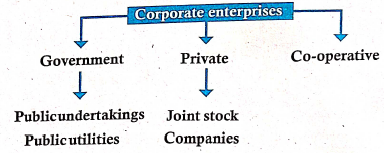
73.
State Warehousing Corporation (SWC): Every state government is given power to establisl its own Warehousing Corporation after getting approval from the CWC. 50% of the capital is contributed by the CWC and the balance 50% contributed by State Government.
74.
Multinational Company is an enterprise operating in several countries but managed from one country.

11th Standard Syllabus & Materials
11th Standard
TN 11th Tamil பீடு பெற நில் - செய்யுள் - காவடிச்சிந்து Important Questions And Answers Study Material - QB365 Set A
NEW11th Standard
TN 11th Tamil பீடு பெற நில் - உரைநடை - மலை இடப்பெயர்கள் : ஓர் ஆய்வு Important Questions And Answers Study Material - QB365 Set A
NEW11th Standard
TN 11th Tamil மாமழை போற்றுதும் - துணைப்பாடம் - யானை டாக்டர் Important Questions And Answers Study Material - QB365 Set A
NEW11th Standard
TN 11th Tamil மாமழை போற்றுதும் - செய்யுள் - ஐங்குறுநூறு Important Questions And Answers Study Material - QB365 Set A



Tamilnadu Stateboard 11th Standard Subjects

Maths
Commerce

Economics

Biology

Business Maths and Statistics

Accountancy

Computer Science

Physics

Chemistry
Maths
Biology
Economics
Physics
Chemistry

History
Business Maths and Statistics

Computer Science
Accountancy

Computer Applications
History
Computer Technology
Commerce
Computer Applications
Computer Technology

Tamil

English

French
Tamilnadu Stateboard Standards

