
 100% FREE ACCESS
11th Standard Syllabus & Materials
11th Standard
TN 11th Tamil இயற்கை வேளாண்மை,சுற்றுச்சூழல் -செய்யுள் - மனோன்மணீயம் Important Questions And Answers Study Material - QB365 Set A
NEW11th Standard
TN 11th Tamil என்னுயிர் என்பேன் -துணைப்பாடம் - இசைத்தமிழர் இருவர் Important Questions And Answers Study Material - QB365 Set A
NEW11th Standard
TN 11th Tamil மொழி கலை -செய்யுள் - ஒவ்வொரு புல்லையும் Important Questions And Answers Study Material - QB365 Set A
NEW11th Standard
TN 11th Tamil பீடு பெற நில் - இலக்கணம் - பகுபத உறுப்புகள் Important Questions And Answers Study Material - QB365 Set A
NEW11th Standard
TN 11th Tamil பீடு பெற நில் - துணைப்பாடம் - வாடிவாசல் Important Questions And Answers Study Material - QB365 Set A
NEW11th Standard
TN 11th Tamil பீடு பெற நில் - செய்யுள் - குறுந்தொகை Important Questions And Answers Study Material - QB365 Set A

Published on: 26/02/2019
11th Third Revision Test Question Answer 2019
Download Tamil Nadu 11th Standard Computer Science question papers, model tests, one-mark questions, important questions, and public exam papers in PDF format. Free study materials and answer keys for TN State Board students.
Questions + Answers key
Take MCQ Computer Science Test
1.
How many times the following loop with execute? for (int i=0; i<10; i++).
0
10
9
11
2.
The inner class is also known as _______.
container class
nested class
enclosing class
inline class
3.
Which of the following Tamil keyboard layout not used by Android OS?
NHM Wirter
E-Kalappai
Lippikar
Ponmadal
4.
int age[]={6,90,20,18,2}; How many elements are there in this array?
2
5
6
4
5.
6.
Which of the following function should be called explicitly using its name?
built-in function
derived function
user-defined function
pre-defined function
7.
Which of the following provides flexibility of creating multiple type of objects for a class?
function overloading
operator overloading
constructor overloading
object overloading
8.
The paradigm which aims more at procedures.
Object Oriented Programming
Procedural programming
Modular programming
Structural programming
9.
Which of the following are possible in c++?
Polymorphism
Encapsulation
Inheritance
All of these
10.
Which of the following is not an invariant of the assignment? m, n := m+2, n+3
m mod 2
n mod 3
3 x m - 2 x n
2 x m - 3 x n
11.
Match the following.
| (i) Tablet OS | (1) Linux |
| (ii) Desktop OS | (2) Android |
| (iii) Smart phone OS | (3) ios |
| (iv) OS used in super computer | (4) Windows 7 |
| i) | ii) | iii) | iv) |
| 1 | 4 | 3 | 2 |
| i) | ii) | iii) | iv) |
| 1 | 2 | 4 | 3 |
| i) | ii) | iii) | iv) |
| 4 | 3 | 1 | 2 |
| i) | ii) | iii) | iv) |
| 3 | 4 | 2 | 1 |
12.
What are the two symbols used in Binary number system?
0,1
+, -
2,4
20,21
13.
14.
Which of the following Operating system are support Mobile Devices?
Windows 7
Linux
BOSS
iOS
15.
How many bits constitute a word?
8
16
32
determined by the processor used.
16.
What are the forms asymmetric encryption used?
17.
Write the two types of function used in C++?
18.
Why it is considered as a good practice to define a constructor though compiler can automatically generate a constructor?
19.
20.
Does testing the loop condition affect the loop invariant? Why?
21.
Distinguish between a condition and a statement.
22.
What is Bus?
23.
List out any two uses of Operating System?
24.
25.
Why do you need for inheritance?
26.
Discuss the benefits of constructor overloading?
27.
What do you mean by modularization and software reuse?
28.
Define an Array? What are the types?
29.
Write a short program to print following series:
(a) 1 4 7 10...... 40
30.
Explain conditional statement.
31.
Write the usage of operating system.
32.
Write the truth table of fundamental gates
33.
34.
Write the output of the following program.
#include < iostream >
using namespcae std;
class simple
{
private:
int a,b;
public:
simple(int m, int n)
{
a=m;
b=n;
cout << "\nParameterized Constructor of classsimple" << endl;
}
void putdata( )
{
cout << "\nThe two integers are ..." << a <<"\t << b << endl;
cout << "\nThe sum of the variables " << a << " + " << b << "=" << a+b;
}
};
int main( )
{
simple s1(10,20),s2(30,45);//Created two objects with different values created
cout << "\n\t\tObject 1\n";
s 1.putdata( );
cout << "\n\t\tObject 2\n";
s2.putdata( );
return 0;
}
35.
Consider the following and answer the questions given below:
class MNC
{
char Cname[25] ; //Company name
protected:
char Hoffice[25]; // Head office
public:
MNC( ) ;
char Country [25];
void EnterData ( ) ;
void DisplayData ( ) ;
};
class Branch: public MNC
}
long NOE [Number of employees
\\country char Ctry [25];
protected:
void Association ( ) ;
public:
Branch ( ) ;
void add ( ) ;
void Show ( ) ;
};
class Outlet: public Branch
char State [25];
public:
Outlet ( ) ;
void Enter ( ) ;
void Output ( ) ;
};
(i) Which class constructor will be called first at the time of decla~ation of an object Outlet?
(ii) How many types of on object belonging to class output require?
(iii) Name the number functional which are accessed from the objects of class Outlet.
(iv) Name the data numerical, which are accessible from the object(s) of class Outlet.
36.
Answer the question (i) to (v) after going through the following class.
classBook
{
intBookCode ; char Bookname[20];float fees;
public:
Book( ) //Function 1
{
fees=1000;
BookCode=1;
strcpy (Bookname,"C++");
}
void display(float C) //Function 2
{ cout<<BookCode<<":"<<Bookname<<":"<<fees<<endl; }
{ cout<<"End of Book Object"<<endl; }
Book (intSC,char S[ ],float F) ; //Function 4
};
(i) In the above program, what are Function 1 and Function 4 combined together referred as?
(ii) Which concept is illustrated by Function3? When is this function called/ invoked?
(iii) What is the use of Function3?
(iv) Write the statements in main to invoke function1 and function2
(v) Write the definition for Function4.
37.
Write a C++ program to find the difference between two matrix.
38.
What is Recursion? Write a program to find the factorial of the given number using recursion.
39.
Explain control statement with suitable example.
40.
How will you copying files and folders to removable disk?
41.
Exchange the contents: Given two glasses marked A and B. Glass A is full of apple drink and glass B is full of grape drink. Write the specification for exchanging the contents of glasses A and B, and write a sequence of assignments to satisfy the specification.
42.
Explain in detail the different types of Mouse.
43.
1.
(b)
10
2.
(b)
nested class
3.
(d)
Ponmadal
4.
(b)
5
5.
(a)
6.
(c)
user-defined function
7.
(c)
constructor overloading
8.
(b)
Procedural programming
9.
(d)
All of these
10.
(d)
2 x m - 3 x n
11.
(d)
| i) | ii) | iii) | iv) |
| 3 | 4 | 2 | 1 |
12.
(a)
0,1
13.
(b)
14.
(d)
iOS
15.
(d)
determined by the processor used.
16.
In the form of
(i) Digital certificates
(ii) Digital signature
17.
Functions can be classified into two types.
(i) Pre-defined or Built-in or Library Functions
(ii) User-defined Function.
18.
Declaring a constructor with arguments hides the compiler generated constructor. After this we cannot invoke the compiler generated constructor.
19.
20.
No, the loop condition do not affect the loop invariant. Because the loop invariant is true at four points.
(i) at the start of loop
(ii) at the start of each iteration
(iii) at the end of each iteration
(iv) at the end of the loop
21.
| statement | condition |
| A statement is a phrase that commands the computer to do an action. | A condition is a phrase that describes a test of the state. |
| In flow chart rectangular box is used | In flow chart diamond box is used |
| Ex. x: = 5 | Ex. If C SI else S2 |
22.
A bus is a collection of wires used for communication between the internal components of a computer.
23.
(i) Keeping track of which portion of memory are currently being used and who is using them.
(ii) Determining which processes (or parts of processes) and data to move in and out of memory.
(iii) Allocation and de-allocation of memory blocks as needed by the program in main memory. (Garbage Collection).
24.
25.
(i) Inheritance is an important feature of object oriented programming used for code reusability. It is a process of creating new classes called derived classes, from the existing or base classes.
(ii) Inheritance allows us to inherit all the code (except declared as private) of one class to another class. The class to be inherited is called base class or parent class and the class which inherits the other class is called derived class or child class.
(iii) The derived class is a power packed class, as it can add additional attributes and methods and thus enhan e its functionality.
26.
Function overloading can be applied for constructors, as constructors are special functions of classes. A class can have more than one constructor with different signature. Constructor overloading provides flexibility of creating multiple type of objects for a class.
1. Memory is allocated for the objects.
2. Initialisation for the objects.
27.
Modularization: where the program can be decomposed into modules.
Software re-use: where a program can be composed from existing and new modules.
28.
"An array is a collection of variables of the same type that are referenced by a common name".
An array is also a derived datatype in C++.
There are different types of arrays used in C++. They are:
1. One-dimensional arrays
2. Two-dimensional arrays
3. Multi-dimensional arrays
29.
#include <iostream>
using namespace std;
int main()
{
cout<<"\n PRINT SERIES";
for (int i=1;i< 40; i=i+3)
cout << i << "1+";
cin.get():
return ();
}
30.
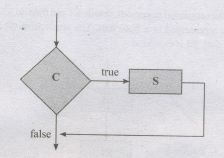
Conditional statement: Sometimes we need to execute a statement only if a condition is true and do nothing if the condition is false. This is equivalent to the alternative statement in which the elseclause is empty. This variant of alternative statement is called a conditional statement. If C is a condition and S is a statement, then
if C
S
is a statement, called a conditional statement, that describes the following action:
1. Test whether C is true or false.
2. If C is true then do S; otherwise do nothing.
The conditional control flow is depicted in the flowchart.
31.
(i) Easy interaction between the human and computer.
(ii) Starting computer operation automatically when power in turned on (Booting).
(iii) Controlling input & output devices.
(iv) Managing the utilization of main memory.
(v) Providing security to user program.
32.
a) AND gate truth table
| A | B | C |
| 0 | 0 | 0 |
| 0 | 1 | 0 |
| 1 | 0 | 0 |
| 1 | 1 | 1 |
b) OR Gate Truth table
| A | B | C |
| 0 | 0 | 0 |
| 0 | 1 | 1 |
| 1 | 0 | 1 |
| 1 | 1 | 1 |
c) Not Gate Truth Table
| A | A |
| 0 | 1 |
| 1 | 0 |
33.
34.
Output:
Parameterized Constructor of class-simple
Parameterized Constructor of class-simple
Object 1
The two integers are ..10 20
The sum of the variables 10 + 20 = 30
Object 2
The two integers are ..30 45
The sum of the variables 30 + 45 = 75
35.
(i) First of all constructor of class MNC will be called then of Branch and then at last of Outlet.
(ii) 129
(iii) MNC : EnterData(); MNC : : DisplayData 0,
Branch: :AddQ Branch: : show Outlet Enter 0.
Outlet: : Output ( ).
(iv) MNC: Country
36.
(i) Constructor overloading (function 1 and function 4 are constructors with different signatures in the class book)
(ii) Function 3 is destructor of the class. Function 3 is executed when the object of the class book goes out of scope.
(iii) Function 3 is destructor of the class.
1. Destructor (function3) will free resources if any that the object may have acquired during its lifetime
2. Destructor function removes the memory of an object which was allocated by the constructor at the time of creating an object. Thus frees the unused memory.
(iv) book b;
b.display (4.5);
(v) Book: :Book (int sc.char.s[], float, F) // Function 4
{
Book Code SC
strcpy (Book name, S);
fees-F;
}
37.
#include<iostream>
#include<conio.h>
using namespace std;
int main()
{
int arr1[3][3], arr2[3][3], arr3[3][3], sub, i, j;
cout<<"Enter 3*3 Array 1 Elements:";
for(i=0; i<3; i++)
{
for(j=0; j<3; j++)
{
cin>>arr1[i][j];
}
}
cout<<"Enter 3*3 Array 2 Elements:";
for(i=0; i<3; i++)
{
for(j=0; j<3; j++)
{
cin>>arr2[i][j];
}
}
cout<<"Subtracting array (array l-array2)..."<<endl;
for(i=0; i<3; i++)
{
for(j=0; j<3; j++)
{
arr3[i][j]-arr1[i][j]-arr2[i][j];
}
}
cout<<"Result of Array 1 - Array2 is:"<<endl;
for(i=0; i<3; i++)
{
for(j=0; j<3; j++)
{
cout<<arr3[i][i]<<"\";
}
}
return 0;
}
Output
Enter 3*3 Array 1 Elements:
10 11 12
13 14 15
16 17 18
Enter 3*3 Array 2 Elements:
123
456
789
Subtracting array(array1-array2)
Result of Array 1 - Array 2 is:
9 9 9
9 9 9
9 9 9
38.
A function that calls itself is known as recursive function. And, this technique is known as recursion.
#include
int factorial(int);//Function prototype//
int main ()
{
int no;
cout <<"\nEnter a number to find its factorial;";
cin>>no;
cout <<"\nFactorial of Number" < return 0;
}
int factorial(int m)
{
if (m>1)
{
return m*factorial(m-1);
}
else
{
return 1;
}
}
Output:
Enter a number to find its factorial: 5
Factorial of Number 5 = 120
39.
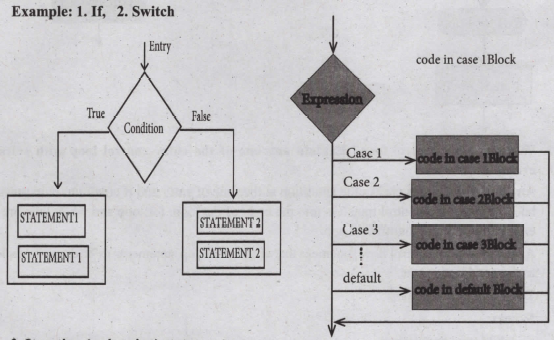
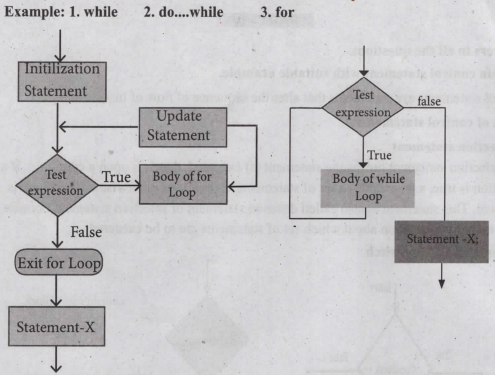
Control statements are statements that alter the sequence of flow of instructions.
Types of control statements:
1. Selection statement
The selection statement means the statement (s) executed, depends upon a condition. If a condition is true, a true block (a set of statements) is executed otherwise a false block is executed. This statement is also called decision statement or selection statement because it helps in making decision about which set of statements are to be executed.
2. Iteration (or looping) statement
An iteration (or loop) is a sequence of one or more statements that are repeatedly executed until a condition is satisfied. These statements are also called as control flow statements. It is used to reduce the length of code to reduce the time to execute program and takes less memory space.
40.
Copying Files and Folders to removable disk:
There are several methods of transferring files to or from a removable disk:
(i) Copy and Paste
(ii) Send To
METHOD I - Copy and Paste
(i) Plug the USB flash drive directly into an available USB port.
(ii) If the USB flash drive or external drive folder does NOT open automatically, follow these steps:
(iii) Click → Start Computer.
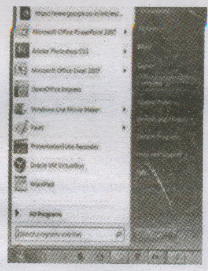
(iv) Double-click on the Removable Disk associated with the USB flash drive.
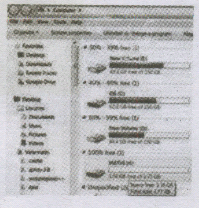
(v) Navigate to the -folders in your computer containing files you want to transfer. Right-click on the file you want to copy, then select Copy.
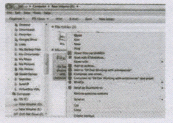
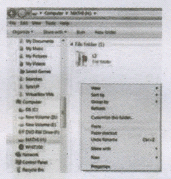
(iv) Return to the Removable Disk window, right-click within the window, then select Paste.
METHOD II - Send To
(i) Plug the USB flash drive directly into an available USB port.
(ii) Navigate to the folders in your computer containing files you want to transfer.
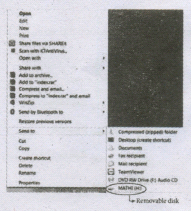
(iii) Right-click on the file you want to transfer to your removable disk.
(iv) Click Send To and select the Removable Disk associated with the USB flash drive.
41.
Let the variables a, b, c represent Glass A, Glass B and Glass C and a, b, c can store values APPLE, GRAPE or EMPTY.
Specification:
1 exchange (a, b)
2-inputs: a, b: APPLE, GRAPE
3-outputs: a, b: = GRAPE, APPLE
Algorithm:
1. exchange (a, b)
2. a, b, c :- APPLE, GRAPE, EMPTY.
3. c:=b
4. -- a, b, c :- APPLE, EMPTY, GRAPE,
5. b:= a
6. --a, b, c = EMPTY, APPLE, GRAPE
7. a: = c
8. --a, b, c = GRAPE, APPLE, EMPTY
42.
| S.No | Type of Mouse | Mechanism | Developed and Introduced |
| 1 | 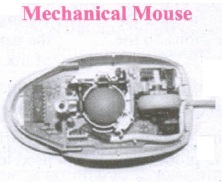 |
1. A small ball is kept inside and touches the pad through a hole at the bottom of the mouse. |
Telefunken, German Company, 0211011968 |
| 2 | 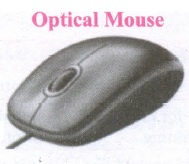 |
1. Measures the motion and acceleration of pointer. |
In 1988, Richard Lyon, Steve Krish independently invented different versions of Optical Mouse. |
| 3 | 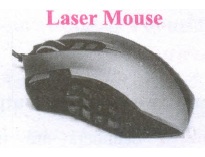 |
1. Measures the motion and acceleration of pointer. |
43.

11th Standard Syllabus & Materials
11th Standard
TN 11th Tamil பீடு பெற நில் - செய்யுள் - காவடிச்சிந்து Important Questions And Answers Study Material - QB365 Set A
NEW11th Standard
TN 11th Tamil பீடு பெற நில் - உரைநடை - மலை இடப்பெயர்கள் : ஓர் ஆய்வு Important Questions And Answers Study Material - QB365 Set A
NEW11th Standard
TN 11th Tamil மாமழை போற்றுதும் - துணைப்பாடம் - யானை டாக்டர் Important Questions And Answers Study Material - QB365 Set A
NEW11th Standard
TN 11th Tamil மாமழை போற்றுதும் - செய்யுள் - ஐங்குறுநூறு Important Questions And Answers Study Material - QB365 Set A



Tamilnadu Stateboard 11th Standard Subjects

Maths

Commerce

Economics

Biology

Business Maths and Statistics

Accountancy
Computer Science

Physics

Chemistry
Maths
Biology
Economics
Physics
Chemistry

History
Business Maths and Statistics

Computer Science
Accountancy

Computer Applications
History
Computer Technology
Commerce
Computer Applications
Computer Technology

Tamil

English

French
Tamilnadu Stateboard Standards
