
 100% FREE ACCESS
11th Standard Syllabus & Materials
11th Standard
TN 11th Tamil இயற்கை வேளாண்மை,சுற்றுச்சூழல் -செய்யுள் - மனோன்மணீயம் Important Questions And Answers Study Material - QB365 Set A
NEW11th Standard
TN 11th Tamil என்னுயிர் என்பேன் -துணைப்பாடம் - இசைத்தமிழர் இருவர் Important Questions And Answers Study Material - QB365 Set A
NEW11th Standard
TN 11th Tamil மொழி கலை -செய்யுள் - ஒவ்வொரு புல்லையும் Important Questions And Answers Study Material - QB365 Set A
NEW11th Standard
TN 11th Tamil பீடு பெற நில் - இலக்கணம் - பகுபத உறுப்புகள் Important Questions And Answers Study Material - QB365 Set A
NEW11th Standard
TN 11th Tamil பீடு பெற நில் - துணைப்பாடம் - வாடிவாசல் Important Questions And Answers Study Material - QB365 Set A
NEW11th Standard
TN 11th Tamil பீடு பெற நில் - செய்யுள் - குறுந்தொகை Important Questions And Answers Study Material - QB365 Set A

Published on: 02/09/2019
Computer Organization
Download Tamil Nadu 11th Standard Computer Science question papers, model tests, one-mark questions, important questions, and public exam papers in PDF format. Free study materials and answer keys for TN State Board students.
Questions + Answers key
Take MCQ Computer Science Test
1.
2.
What is the smallest size of data represented in a CD?
blocks
sectors
pits
tracks
3.
How many memory locations are identified by a processor with 8 bits address bus at a time?
28
1024
256
8000
4.
How many bits constitute a word?
8
16
32
determined by the processor used.
5.
Which of the following is said to be the brain of a computer?
Input devices
Output devices
Memory device
Microprocessor
6.
7.
8.
What are the parameters which influence the characteristics of a microprocessor?
9.
How will you differentiate a flash memory and an EEPROM?
10.
Differentiate PROM and EPROM
11.
Differentiate Computer Organization from Computer Architecture.
12.
Explain the types of ROM.
13.
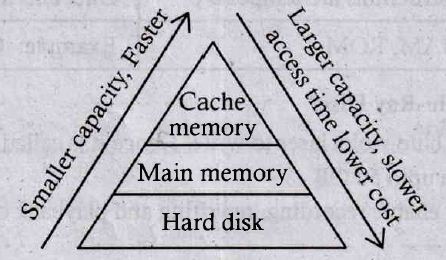
Arrange the memory devices in ascending order based on the access time.
1.
(d)
2.
(c)
pits
3.
(c)
256
4.
(d)
determined by the processor used.
5.
(d)
Microprocessor
6.
7.
8.
It depends on
(a) Clock speed
(b) Instruction set
(c) Word size
9.
| Flash memory | EEPROM |
| It is faster | It is slower |
| Flash memory is read/write memory | EEPROM is read only memory |
| Flash memory can store 4GB to 2TB of data | EEPROM can store only less data |
| Flash memory is used in PDA'S, Digital camera to store data. | It is used to store critical programs. |
10.
| PROM | EPROM |
| Can be Programmed only once. | It is reusable and can be programmed multiple times. |
| This has Permanent memory. | EPROMs memory can be erased using UV light. |
| Enclosed in plastic package so that not visible to UV light. | EPROMs are fused with quartz window. |
| Uses high Voltage. | Also use high Voltage but not enough to alter the semiconductor layer permanently. |
11.
Differences between computer organisation and Computer Architecture:
| Computer Organisation | Computer Architecture |
| Often called micro architecture (low level) | Computer architecture (a bit higher level) |
| Transparent from programmer (ex. a programmer does not worry much how addition is implemented in hardware) |
Programmer view (i.e. Programmer has to be aware of which instruction set used) |
| Physical components (Circuit design, Adders, Signals, Peripherals) | Logic (Instruction set, Addressing modes,Data types, Cache optimization) |
12.
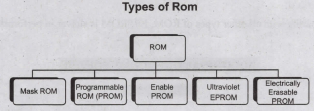
Read-only memory (ROM):
1. Read only memory refers to special memory in a computer with pre-recorded data at manufacturing time which cannot be modified.
2. The stored programs that start the computer and perform diagnostics are available in ROMs. ROM stores critical programs such as the program that boots the computer.
3. Once the data has been written onto a ROM chip, it cannot be modified or removed and can only be read.
4. ROM retains its contents even when the computer is. turned off. So, ROM is called as a non-volatile memory.
Programmable Read-Only Memory (PROM):
1. Programmable read-only memory is also a nonvolatile memory on which data can be written only once. Once a program has been written onto a PROM, it remains there forever.
2. Unlike the main memory, PROMs retain their contents even when the computer is turned off.
3. The PROM differs from ROM. PROM is manufactured as a blank memory, whereas a ROM is programmed during the manufacturing process itself.
4. PROM programmer or a PROM burner is used to write data to a PROM chip. The process of programming a PROM is called burning the PROM.
Erasable Programmable Read-Only Memory (EPROM):
1. Erasable Programmable Read Only Memory is a special type of memory which serves as a PROM, but the content can be erased using ultraviolet rays.
2. EPROM retains its contents until it is exposed to ultraviolet light. The ultraviolet light clears its contents, making it possible to reprogram the memory.
3. An EPROM differs from a PROM, PROM can be written only once and cannot be erased.
4. EPROMs are used widely in personal computers because they enable the manufacturer to change the contents of the PROM to replace with updated versions or erase the contents before the computer is delivered.
Electrically Erasable Programmable Read Only Memory (EEPROM)
1. Electrically Erasable Programmable Read Only Memory is a special type of PROM that can be erased by exposing it to an electrical charge.
2. Like other types of PROM, EEPROM retains its contents even when the power is turned off.
3. Comparing with all other types of ROM, EEPROM is slower in performance.
13.
A memory is just like a human brain. It is used to store data and instructions. Computer memory is the storage space in the computer, where data and instructions are stored. There are two types of accessing methods to access (read or write) the memory. They are sequential access and random access. In sequential access, the memory is accessed in an orderly manner from starting to end. But, in random access, any byte of memory can be accessed directly without navigating through previous bytes. Different memory devices are arranged according to the capacity.

11th Standard Syllabus & Materials
11th Standard
TN 11th Tamil பீடு பெற நில் - செய்யுள் - காவடிச்சிந்து Important Questions And Answers Study Material - QB365 Set A
NEW11th Standard
TN 11th Tamil பீடு பெற நில் - உரைநடை - மலை இடப்பெயர்கள் : ஓர் ஆய்வு Important Questions And Answers Study Material - QB365 Set A
NEW11th Standard
TN 11th Tamil மாமழை போற்றுதும் - துணைப்பாடம் - யானை டாக்டர் Important Questions And Answers Study Material - QB365 Set A
NEW11th Standard
TN 11th Tamil மாமழை போற்றுதும் - செய்யுள் - ஐங்குறுநூறு Important Questions And Answers Study Material - QB365 Set A



Tamilnadu Stateboard 11th Standard Subjects

Maths

Commerce

Economics

Biology

Business Maths and Statistics

Accountancy
Computer Science

Physics

Chemistry
Maths
Biology
Economics
Physics
Chemistry

History
Business Maths and Statistics

Computer Science
Accountancy

Computer Applications
History
Computer Technology
Commerce
Computer Applications
Computer Technology

Tamil

English

French
Tamilnadu Stateboard Standards
