
 100% FREE ACCESS
11th Standard Syllabus & Materials
11th Standard
TN 11th Tamil இயற்கை வேளாண்மை,சுற்றுச்சூழல் -செய்யுள் - மனோன்மணீயம் Important Questions And Answers Study Material - QB365 Set A
NEW11th Standard
TN 11th Tamil என்னுயிர் என்பேன் -துணைப்பாடம் - இசைத்தமிழர் இருவர் Important Questions And Answers Study Material - QB365 Set A
NEW11th Standard
TN 11th Tamil மொழி கலை -செய்யுள் - ஒவ்வொரு புல்லையும் Important Questions And Answers Study Material - QB365 Set A
NEW11th Standard
TN 11th Tamil பீடு பெற நில் - இலக்கணம் - பகுபத உறுப்புகள் Important Questions And Answers Study Material - QB365 Set A
NEW11th Standard
TN 11th Tamil பீடு பெற நில் - துணைப்பாடம் - வாடிவாசல் Important Questions And Answers Study Material - QB365 Set A
NEW11th Standard
TN 11th Tamil பீடு பெற நில் - செய்யுள் - குறுந்தொகை Important Questions And Answers Study Material - QB365 Set A

Published on: 04/03/2019
11th Public Official Model Question 2019
Download Tamil Nadu 11th Standard Computer Science question papers, model tests, one-mark questions, important questions, and public exam papers in PDF format. Free study materials and answer keys for TN State Board students.
Questions + Answers key
Take MCQ Computer Science Test
1.
How many times the following loop with execute? for (int i=0; i<10; i++).
0
10
9
11
2.
The inner class is also known as _______.
container class
nested class
enclosing class
inline class
3.
Which of the following input can not be accepted by cin object?
integer
character
string with space
string without space
4.
Which of the following cannot be a structure member?
Another structure
Function
Array
variable of double datatype
5.
Which of the following coding systems specially designed for Indian languages?
ASCII
TSCII
ISCII
EBCDIC
6.
How many main() function allowed in a C++ program?
2
3
many
only one
7.
Which of the following is not a modifier?
Signe
long
Short
int
8.
Which of the following statement is true or false?
(i) Function overloading cannot be applied. for constructors
(ii) Function overloading cannot be applied for destructor
(iii) Constructor argument should also be passed while creating an object
(iv) Overloaded operators can have default arguments
i-false, ii-false, iii-true, iv-true
i-true, ii-false, iii-true, iv-false
i-false, ii-true, iii-true, iv-false
i-true, ii-false, iii-false, iv-true
9.
Which of the following supports the transitive nature of data?
Inheritance
Encapsulation
Polymorphism
Abstraction
10.
If Fibonacci number is defined recursively as
\(F(n)= \begin{cases}0 \ \mathrm{n}=0 \\ 1 \ \mathrm{n}=1 \\ \mathrm{~F}(\mathrm{n}-1)+\mathrm{F}(\mathrm{n}-2) \text { otherwise }\end{cases}\)
to evaluate F(4), how many times F() is applied?
3
4
8
9
11.
'My Computer' icon present in windows version ______.
XP
7
8
10
12.
4 bits =................
Bit
Byte
Nibble
Word
13.
Ensuring the input-output relation is
the responsibility of the algorithm and the right of the user.
the responsibility of the user and the right of the algorithm.
the responsibility of the algorithm but not the right of the user.
the responsibility of both the user and the algorithm.
14.
Android is a ________
Mobile Operating system
Open Source
Developed by Google
All the above
15.
How many memory locations are identified by a processor with 8 bits address bus at a time?
28
1024
256
8000
16.
What is Malware?
17.
Write a note on?
(i) isupper()
(ii) toupper'()
(iii) strupn()
18.
Differentiate structure and class though both are user defined data type.
19.
Determine which of the following are valid constant? And specify their type.
(i) 0.5
(ii) ‘Name’
(iii) ‘\t’
(iv) 27,822
20.
How do we refine a statement?
21.
What is the relationship between loop invariant, loop condition and the input-output recursively?
22.
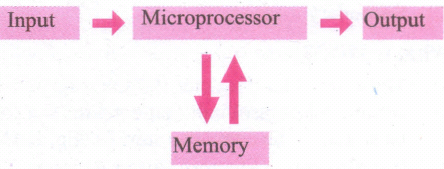
Draw the block diagram of a microprocessor based system.
23.
What is multi-user Operating system?
24.
25.
Explain the uses of private, protected and public inheritance.
26.
What is operator overloading? Give some example of operators which can be overloaded.
27.
What do you mean by modularization and software reuse?
28.
Write a C++ program to accept and print your name?
29.
Write a short program to print following series:
(a) 1 4 7 10...... 40
30.
Describe alternative statement.
31.
How is virtual memory is implemented?
32.
Write a short note on XNOR gate.
33.
How is state represented in algorithms?
34.
What is containership write a C++ program to illustrate the containership
35.
Answer the questions (i) to (iv) on the following
code:
class Dolls
{
char DCode[5];
protected :
float Price;
void CalcPrice (float);
public:
Dolls ();
void DInput ( ) ;
void DShow ( ); .
};
class SoftDolls : public Dolls
}
char SDName[20];
float Weight;
public:
SoftDolls ( ) ;
void SDInput ( ) ;
void SDShow ( ) ;
};
class ElectronicDolls : public Dolls
}
char EDName [20];
char BatteryType[10];
int Batteries ;
public: .
Electronic Dolls ( );
void EDInput ( ) ;
void EDShow ( ) ;
};
(i) Which type of Inheritance is shown in the above example?
(ii) How many bytes will be rreqiured by an object of the class ElectronicDolls?
(iii) Write name of all the data memebrs accessible from member functions of the class softDolls.
(iv) Write name of all the member functions accessible by· an object of the class ElectronicDolls.
36.
Write the output of the following program
include < iostream >
using namespace std;
class Seminar
{
int Time;
public:
Seminar()
{
Time=30;cout << "Seminar starts now"<
void Lecture()
{
cout << "Lectures in the seminar on"<
Seminar(int Duration)
{
Time=Duration;cout << "Welcome to Seminar "<<endl; }
Seminar(Seminar &D)
{
Time=D.Time;cout << "Recap of Previous Seminar Content "<<endl; }
~Seminar()
{
cout << "Vote of thanks"<
};
int main()
{
Seminar s1,s2(2),s3(s2);
s1.Lecture();
return 0;
}
37.
What are the rules for operator overloading?
38.
Explain scope of variable with example.
39.
Write a program to find sum of the series
S = 1 + x + x2 +..... + xn
40.
Explain the methods followed while copying files and folders to removable disk.
41.
Exchange the contents: Given two glasses marked A and B. Glass A is full of apple drink and glass B is full of grape drink. Write the specification for exchanging the contents of glasses A and B, and write a sequence of assignments to satisfy the specification.
42.
Explain any two input and output devices.
43.
Explain the types of ROM.
1.
(b)
10
2.
(b)
nested class
3.
(c)
string with space
4.
(b)
Function
5.
(c)
ISCII
6.
(a)
2
7.
(d)
int
8.
(c)
i-false, ii-true, iii-true, iv-false
9.
(a)
Inheritance
10.
(a)
3
11.
(a)
XP
12.
(a)
Bit
13.
(d)
the responsibility of both the user and the algorithm.
14.
(a)
Mobile Operating system
15.
(c)
256
16.
Malicious programs that can perform a variety of functions including stealing, encrypting or deleting sensitive data, altering or hijacking core computing functions and monitoring user's computer activity without their permission.
17.
(i) Checks whether the given character is m uppercase or not
(ii) Convert the given charter in to upper case
(iii) Convert the given string in to upper case
18.
The only difference between structure and class is the members of structure are by default public where as it is private in class.
19.
(i) 0.5-is a valid constant. It is a decimal
(ii) 'Name' - Invalid constant as single quote is not allowed.
(iii) \t'- Escape sequence (or) non-graphical character (horizontal tab)
(iv) 27,822 - Invalid constant. Comma is not allowed
20.
In refinement, each statement is repeatedly expanded into more detailed statements in the subsequent levels.
21.
A loop invariant is a condition [among program variables] that is necessarily true immediately before and immediately after, each iteration of a loop. A loop invariant is some condition that holds for every iteration of the loop.
22.
23.
A Multi-user Operating system is a computer operating system (OS) that allows multiple users on different computers or terminals to access a single system with one OS on it.
24.
25.
(i) Private inheritance should be used when you want the features of the base class to be available to the derived class but not to the classes that are derived from the derived class.
(ii) Protected inheritance should be used when features of base class to be available only to the derived class members but not to the outside world.
(iii) Public inheritance can be used when features of base class to be available the derived class members and also to the outside world.
26.
The term operator overloading, refers to giving additional functionality to the normal C++ operators like +, ++, -, --, +=, -=, *, <, >.It is also a type of polymorphism in which an operator is overloaded to give user defined meaning to it.
For example ¹+'operator can be overloaded to perform addition on various data types, like for Integer, String (concatenation) etc.
27.
Modularization: where the program can be decomposed into modules.
Software re-use: where a program can be composed from existing and new modules.
28.
#include< iostream >
using namespace std;
int main()
{
char name[20];
cout << "Enter your name'' << endl;
cin.get(name,20);
cout << "Your name:" << name«endl;
return 0;
}
output:
Enter your name : xxxx xxxx
Your name: xxxx xxxx
29.
#include <iostream>
using namespace std;
int main()
{
cout<<"\n PRINT SERIES";
for (int i=1;i< 40; i=i+3)
cout << i << "1+";
cin.get():
return ();
}
30.
(i)Test whether C is true or false.
(ii) If C is true, then do S1; otherwise do S2.
31.
The idea of virtual memory is to use disk space to extend the RAM. The illusion of such a large amount of memory is created by subdividing the virtual memory into smaller pieces, which can be loaded into physical memory whenever they are needed by a process.
32.
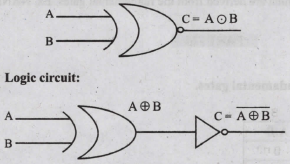
The XNOR (exclusive - NOR) gate is a combination XOR gate followed by an inverter. Its output is "true" if the inputs are the same, and "false" if the inputs are different.
The output of XNOR is C = AB + \(\bar {A} \) \(\bar {B} \)
= A ⊙ B
where ⊙ indicates included dot.
Truth table
| Input | Output | |
| A | B | C |
| 0 | 0 | 1 |
| 0 | 1 | 0 |
| 1 | 0 | 0 |
| 1 | 1 | 1 |
Logic symbol :
33.
The state represented in a algorithm is set of variables. At any place the value of the variables are substituted and evaluation is done.
34.
Whenever an object of a class is declared as a member of another class it is known as a container class. In the container-ship the object of one class is declared in another class.
Illustration: C++ program to illustrate the containership
#include < iostream >
using namespace std;
class outer
{
int date;
public:
void get ( );
};
class inner
{
int value;
outer ot;
//object ot of class outer is declared in
class inner
public;
void getdata( );
};
void outer::get( )
{
cout << "\nEnter a value";
cin >> data;
cout << "\nThe given value is" << data;
}
void inner:: getdata( )
{
cout << "\nEnter a value";
cin >> value;
cout << "\nThe given value is " << value;
ot.get( ); //calling of get( ) of class outer in getdata( )of class inner
}
int main ( )
{
inner in;
in.getdata( );
return( );
}
Output:
Enter a value 10
To given value is 10
Enter a value 20
The given value is 20
35.
(i) Hierarchical Inheritance
(ii) 41 Bytes
(ill) Price, SDName, Weight
(iv) DInput(), DShow( ), EDInput ( ), EDshow( ).
36.
Output
Seminar starts now
Welcome to seminar
Recap of previous seminar content
Lectures in the seminar on
Vote of thanks
Vote of thanks
Vote of thanks
37.
Following are some rules to be followed while implementing operator overloading.
(i) Precedence and Associativity of an operator cannot be changed.
(ii) No new operators can be created, only existing operators can be overloaded.
(iii) Cannot redefine the meaning of an operator's procedure. You cannot change how integers are added. Only additional functions can be to an operator.
(iv) Overloaded operators cannot have default arguments.
(v) When binary operators are overloaded, the left hand object must be an object of the relevant class.
38.
Scope refers to the accessibility of a variable.
There are four types of scopes in C++
(i) Local Scope
(ii) Function Scope
(iii) File Scope
(iv) Class Scope
(i) Local Scope
1. A local variable is defined within a block. A block of code begins and ends with curly braces {}.
2. The scope of a local variable is the block in which it is defined.
3. A local variable cannot be accessed from outside the block of its declaration.
4. A local variable is created upon entry into its block and destroyed upon exit;
Example:
int main()
{
int a,b; //Local variable
}
(ii) Function Scope
1. The scope of variable within a function is extended to the function block and all sub-blocks therein.
2. The lifetime of a function scope variable is the lifetime of the function block.
Example:
int sum(intx, int y); //x and y has function scope.
(iii) File Scope
1. A variable declared above all blocks and functions (including main()) has the scope of a file.
2. The lifetime of a file scope variable is the lifetime of a program.
3. The file scope variable is also called as global variable.
Example:
#include<iostream>
using namespace std;
int x,y; // x and y are global variable
void main()
{
,,,,,
}
(iv) Class Scope
1. Data members declared in a class has the class scope.
2. Data members declared in a class can be accessed by all member functions of the class.
Example:
Class example
{
int x,y; //x and y can be accessed by print() and void():
void print():
void total();
};
39.
#include <iostream>
using namespace std;
#include <math.h>
int main()
{
int x, n;
float sum= 0;
cout<<"Enter the value for x:";
cin>>x;
cout<<"Enter the number of terms";
cin>>n;
for (int i=0; i<n; i++)
sum = sum + Pow(x,i);
cout<<"Sum="<< Sum<<endl;
cin.get();
return 0;
}
40.
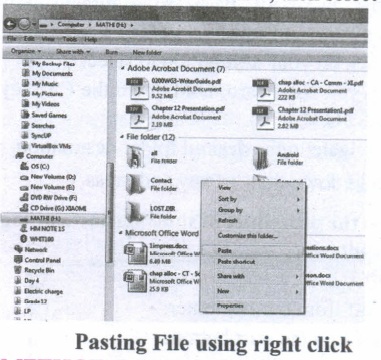
There are several methods of transferring files to or from a removable disk.
(i) Copy and Paste
(ii) Drag and Drop
(iii) Send To
(iv) Copy and Paste using keyboard shortcuts
METHOD 1:
Plug the USB flash drive directly into an available USB port.
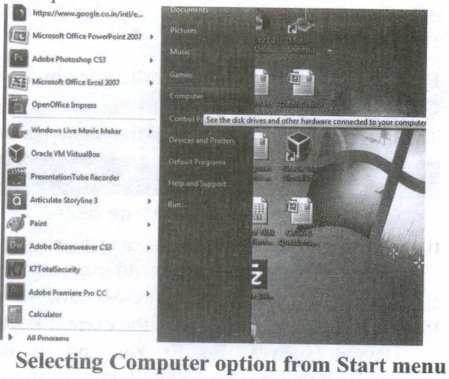
(i) Click Start ⟶ Computer.
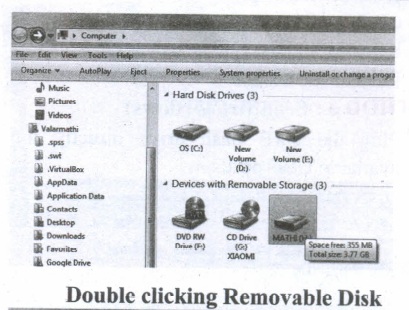
(ii) Double-click on the Removable Disk associated with the USB flash drive.
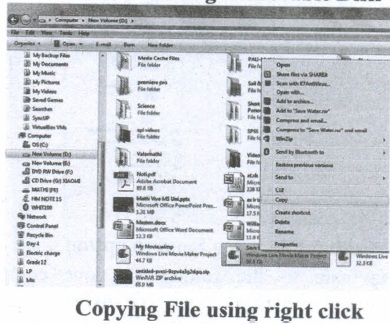
(i) Navigate to the folders in your computer containing files you want to transfer Right click on the file you want to copy, then select Copy.
(ii) Return to Removable Disk window, right click within the window, then select Paste.
METHOD 2:
Drag and Drop
(i) Plug the USB flash drive directly into an available USB port.
(ii) Allow the computer to recognize the drive, then click Start ⟶ Computer.
(iii) Navigate to 'the folders in your computer containing files you want to transfer.
(iv) Click and drag the files you want to the Removable Disk.
(v) Release the mouse.
METHOD 3:
Send To (Windows)
(i) Plug the USB flash drive directly into an available USB port.
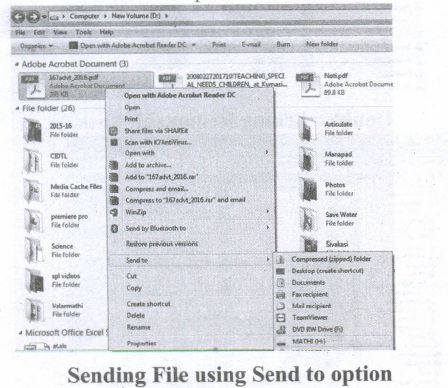
(ii) Navigate to the folders in your computer containing files you want to transfer.
(iii) Right-click on the file you want to transfer to your removable disk.
(iv) Click Send To and select the Removable Disk associated with the USB flash drive.
METHOD 4:
Copy and Paste using keyboard shortcuts (Windows)
(i) Plug the USB flash drive directly into an available USB port.
(ii) Click on your desired file to select it.
(iii) On your keyboard, hold down the Ctrl key and press C.
(iv) Navigate to the desired folder destination.
(v) Hold down the Ctrl key and press V.
41.
Let the variables a, b, c represent Glass A, Glass B and Glass C and a, b, c can store values APPLE, GRAPE or EMPTY.
Specification:
1 exchange (a, b)
2-inputs: a, b: APPLE, GRAPE
3-outputs: a, b: = GRAPE, APPLE
Algorithm:
1. exchange (a, b)
2. a, b, c :- APPLE, GRAPE, EMPTY.
3. c:=b
4. -- a, b, c :- APPLE, EMPTY, GRAPE,
5. b:= a
6. --a, b, c = EMPTY, APPLE, GRAPE
7. a: = c
8. --a, b, c = GRAPE, APPLE, EMPTY
42.
(i) Scanner:
Scanners are used to enter the information directly into the computer's memory. This device works like a Xerox machine. The scanner converts any type of printed or written information including photographs into a digital format, which can be manipulated by the computer.
(ii) Fingerprint Scanners:
Fingerprint Scanner is a fingerprint recognition device used for computer security, equipped with the fingerprint recognition feature that uses biometric technology. Fingerprint Reader / Scanner is a very safe and convenient device for security instead of using passwords, which is vulnerable to fraud and is hard to remember.
(iii) Monitor:
Monitor is the most commonly used output device to display the information. It looks like a TV. Pictures on a monitor are formed with picture elements called PIXELS. Monitors may either be Monochrome which display text or images in Black and White or can be color, which display results in multiple colors. There are many types of monitors available such as CRT (Cathode Ray Tube), LCD (Liquid Crystal Display) and LED (Light Emitting Diodes). The monitor works with the VGA (Video Graphics Array) card. The video graphics card helps the keyboard to communicate with the screen. It acts as an interface between the computer and display monitor. Usually the recent motherboards incorporate built-in video card.
(iv) Plotter:
Plotter is an output device that is used to produce graphical output on papers. It uses single colour or multi colour pens to draw pictures.
43.
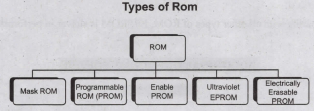
Read-only memory (ROM):
1. Read only memory refers to special memory in a computer with pre-recorded data at manufacturing time which cannot be modified.
2. The stored programs that start the computer and perform diagnostics are available in ROMs. ROM stores critical programs such as the program that boots the computer.
3. Once the data has been written onto a ROM chip, it cannot be modified or removed and can only be read.
4. ROM retains its contents even when the computer is. turned off. So, ROM is called as a non-volatile memory.
Programmable Read-Only Memory (PROM):
1. Programmable read-only memory is also a nonvolatile memory on which data can be written only once. Once a program has been written onto a PROM, it remains there forever.
2. Unlike the main memory, PROMs retain their contents even when the computer is turned off.
3. The PROM differs from ROM. PROM is manufactured as a blank memory, whereas a ROM is programmed during the manufacturing process itself.
4. PROM programmer or a PROM burner is used to write data to a PROM chip. The process of programming a PROM is called burning the PROM.
Erasable Programmable Read-Only Memory (EPROM):
1. Erasable Programmable Read Only Memory is a special type of memory which serves as a PROM, but the content can be erased using ultraviolet rays.
2. EPROM retains its contents until it is exposed to ultraviolet light. The ultraviolet light clears its contents, making it possible to reprogram the memory.
3. An EPROM differs from a PROM, PROM can be written only once and cannot be erased.
4. EPROMs are used widely in personal computers because they enable the manufacturer to change the contents of the PROM to replace with updated versions or erase the contents before the computer is delivered.
Electrically Erasable Programmable Read Only Memory (EEPROM)
1. Electrically Erasable Programmable Read Only Memory is a special type of PROM that can be erased by exposing it to an electrical charge.
2. Like other types of PROM, EEPROM retains its contents even when the power is turned off.
3. Comparing with all other types of ROM, EEPROM is slower in performance.

11th Standard Syllabus & Materials
11th Standard
TN 11th Tamil பீடு பெற நில் - செய்யுள் - காவடிச்சிந்து Important Questions And Answers Study Material - QB365 Set A
NEW11th Standard
TN 11th Tamil பீடு பெற நில் - உரைநடை - மலை இடப்பெயர்கள் : ஓர் ஆய்வு Important Questions And Answers Study Material - QB365 Set A
NEW11th Standard
TN 11th Tamil மாமழை போற்றுதும் - துணைப்பாடம் - யானை டாக்டர் Important Questions And Answers Study Material - QB365 Set A
NEW11th Standard
TN 11th Tamil மாமழை போற்றுதும் - செய்யுள் - ஐங்குறுநூறு Important Questions And Answers Study Material - QB365 Set A



Tamilnadu Stateboard 11th Standard Subjects

Maths

Commerce

Economics

Biology

Business Maths and Statistics

Accountancy
Computer Science

Physics

Chemistry
Maths
Biology
Economics
Physics
Chemistry

History
Business Maths and Statistics

Computer Science
Accountancy

Computer Applications
History
Computer Technology
Commerce
Computer Applications
Computer Technology

Tamil

English

French
Tamilnadu Stateboard Standards
