
 100% FREE ACCESS
11th Standard Syllabus & Materials
11th Standard
TN 11th Tamil இயற்கை வேளாண்மை,சுற்றுச்சூழல் -செய்யுள் - மனோன்மணீயம் Important Questions And Answers Study Material - QB365 Set A
NEW11th Standard
TN 11th Tamil என்னுயிர் என்பேன் -துணைப்பாடம் - இசைத்தமிழர் இருவர் Important Questions And Answers Study Material - QB365 Set A
NEW11th Standard
TN 11th Tamil மொழி கலை -செய்யுள் - ஒவ்வொரு புல்லையும் Important Questions And Answers Study Material - QB365 Set A
NEW11th Standard
TN 11th Tamil பீடு பெற நில் - இலக்கணம் - பகுபத உறுப்புகள் Important Questions And Answers Study Material - QB365 Set A
NEW11th Standard
TN 11th Tamil பீடு பெற நில் - துணைப்பாடம் - வாடிவாசல் Important Questions And Answers Study Material - QB365 Set A
NEW11th Standard
TN 11th Tamil பீடு பெற நில் - செய்யுள் - குறுந்தொகை Important Questions And Answers Study Material - QB365 Set A

Published on: 26/07/2019
Production Analysis
Download Tamil Nadu 11th Standard Economics question papers, model tests, one-mark questions, important questions, and public exam papers in PDF format. Free study materials and answer keys for TN State Board students.
Questions + Answers key
Take MCQ Economics Test
1.
__________ represent Human capital.
Money
Efficiency
Hard work
All the above
2.
_________ faces both risks and uncertainties.
Entrepreneur
Labour
Land
None of these
3.
__________ is the other name given for factor of production.
Inputs
Outputs
Exertion
Formation
4.
___________ may be classified into five kinds
External Economies
Economies of scale
Internal Economies
Modern Economy
5.
_____________ is a free gift of nature.
Land
Organisation
Capital
All of these
6.
The short-run production is studied through
The Law of Returns to scale
The Law of Variable Proportions
Iso-quants
Law of Demand
7.
In a firm 5 units of factors produce 24 units of the product. When the number of factor increases by one, the production increases to 30 units. Calculate the Average Product.
30
6
5
24
8.
Formula for calculating AP is
\(\frac { \Delta TP }{ N } \)
\(\frac { \Delta TP }{ \Delta N } \)
\(\frac { TP }{ MP } \)
\(\frac { TP }{ N } \)
9.
The man-made physical goods used to produce other goods and services are referred to as
Land
Labour
Capital
Organization
10.
The primary factors of production are:
Labour and Organisation
Labour and Capital
Land and Capital
Land and Labour
11.
What are the forms of capital?
12.
What are factors of production?
13.
What are the assumptions of Iso-quant curve?
14.
What are the reasons for upward sloping supply curve?
15.
What are the conditions for producer’s equilibrium?
16.
17.
Bring out the differences between short run and long run production function.
18.
Illustrate the diagram for law of variable proportion
19.
Distinguish between Total Product (TP) and Average Product (AP).
20.
What are the characteristics of capital?
21.
State the Cobb-Douglas production function.
22.
Illustrate the concept of producer's Equilibrium.
23.
24.
Explain the internal and external economies of scale.
1.
(a)
Money
2.
(a)
Entrepreneur
3.
(a)
Inputs
4.
(c)
Internal Economies
5.
(a)
Land
6.
(b)
The Law of Variable Proportions
7.
(c)
5
8.
(d)
\(\frac { TP }{ N } \)
9.
(c)
Capital
10.
(d)
Land and Labour
11.
The forms of capital are:
1. Physical capital or Material Resources.
2. Money Capital or Monetary Resources, and
3. Human Capital or Human Resources.
12.
(i) The inputs that a firm uses in the production process are called factors of production.
(ii) It includes factor inputs and non-factor inputs
13.
(i) It is assumed that only two factors are used to produce a commodity.
(ii) Factors of production can be divided into small parts
(iii) Technique of production is constant.
(iv) Under the given techniques, factors of production can be used with maximum efficiency.
14.
(i) Firms will supply less at lower prices and more at higher prices.
(ii) As price of the commodity increases, the amount supplied also increases.
(iii) So, supply curve has a positive slope from left to right.
15.
(i) The iso-cost line must be tangent to iso-quant curve,
(ii) At point of tangency, the iso-quant curve must be convex to the origin.
16.
17.
| Basis for comparison | Short - run production function | Long - run production function |
| Meaning | Short run production function alludes to the time period in which at least one factor of production is fixed | Long run production function connotes the time period in which all the factors of production are variable. |
| Law | Law of variable proportions | Law of returns to scale. |
| Scale of production | No change in scale of production. | change in scale of production |
| Factor - ratio | Changes | Does not change |
| Entry and exit | There are barriers to entry and the firms can shut down but cannot fully exit. | Firms are free to enter and exit |
18.
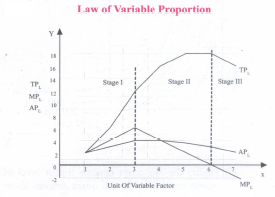
19.
Total Product:
(i) It refers to the total amount of commodity produced by combination of all inputs in a given period of time.
(ii) It can be calculated in two ways
TP = AP x N (or) AP = TP / N
Average Product:
(i) It refers to the output per unit of the input (or)
\(AP=\frac { TP }{ Q } (or)N\)
(ii) It is the result of the total product divided by the total output.
20.
(i) Capital is man-made.
(ii) Capital is mobile between places and persons.
(iii) Capital is a positive factor of production.
(iv) Capital's supply is elastic.
(v) Capital's demand is derived demand.
(vi) Capital is durable.
21.
(i) Charles Cobb and Paul Douglas have given a linear homogeneous production function.
(ii) A proportionate increase in the factors leads to a proportionate increase in output.
(iii) There is constant returns to scale with only labour and capital.
(iv) The elasticity of substitution between the factors is one.
Q = AL\(\alpha \)K\(\beta \)
Q = output; A = positive constant; K = Capital; L = Labour, \(\alpha \) + \(\beta \) = 1
22.
Producer's equilibrium happens when there is maximum output with minimum cost ie. optimum combination of the factors of production.
The two conditions to be fulfilled are
1. The iso-cost line must be tangent to iso-quant curve.
2. At the point of tangency, iso-quant must be convex and MRTSLK must be declining.
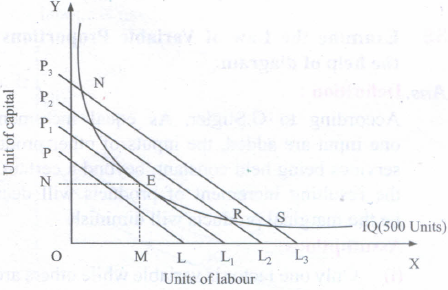
3. The producer is in equilibrium at E.
Slope of iso-quant curve = Slope of iso-cost curve.
23.
24.
Introduction:
(i) Scale of production refers to the ratio of factors of production.
(ii) Every producer wants to reduce the cost of production.
(iii) When there is large scale production he enjoy lot of advantages.
(iv) These advantages are called economies of scale.
(v) Marshall divided them into internal economies and external economies.
Internal Economies:
They refer to advantages enjoyed by a firm.
Technical Economies:
When there is large scale production, there is more capital, new technology, research and development.
Financial Economies:
Big firms can float shares in the market for capital expansion.
Managerial Economies:
(i) Specialisation of labour is followed.
(ii) There is delegation of work.
Labour Economies:
(i) There is division of labour.
(ii) Quality and productivity increases.
Marketing Economies:
(i) Producers can buy raw materials at cheaper cost.
(ii) Transport cost is less.
(iii) They enjoy bargaining power.
Economies of survival:
(i) Product diversification is possible.
(ii) This reduces the risk in production.
(iii) Even if the market for one product falls, the market for other commodities offsets it.
External Economies:
(i) They refer to changes in any factor outside the firm causing an improvement in the production process.
(ii) These advantages are enjoyed by all the firms in the industry due to the structural growth.
Example:
1. Increased transport facilities.
2. Banking facilities.
3. Development of townships.
4. Development of information and communication.

11th Standard Syllabus & Materials
11th Standard
TN 11th Tamil பீடு பெற நில் - செய்யுள் - காவடிச்சிந்து Important Questions And Answers Study Material - QB365 Set A
NEW11th Standard
TN 11th Tamil பீடு பெற நில் - உரைநடை - மலை இடப்பெயர்கள் : ஓர் ஆய்வு Important Questions And Answers Study Material - QB365 Set A
NEW11th Standard
TN 11th Tamil மாமழை போற்றுதும் - துணைப்பாடம் - யானை டாக்டர் Important Questions And Answers Study Material - QB365 Set A
NEW11th Standard
TN 11th Tamil மாமழை போற்றுதும் - செய்யுள் - ஐங்குறுநூறு Important Questions And Answers Study Material - QB365 Set A



Tamilnadu Stateboard 11th Standard Subjects

Maths

Commerce
Economics

Biology

Business Maths and Statistics

Accountancy

Computer Science

Physics

Chemistry
Maths
Biology
Economics
Physics
Chemistry

History
Business Maths and Statistics

Computer Science
Accountancy

Computer Applications
History
Computer Technology
Commerce
Computer Applications
Computer Technology

Tamil

English

French
Tamilnadu Stateboard Standards
