
 100% FREE ACCESS
11th Standard Syllabus & Materials
11th Standard
TN 11th Tamil இயற்கை வேளாண்மை,சுற்றுச்சூழல் -செய்யுள் - மனோன்மணீயம் Important Questions And Answers Study Material - QB365 Set A
NEW11th Standard
TN 11th Tamil என்னுயிர் என்பேன் -துணைப்பாடம் - இசைத்தமிழர் இருவர் Important Questions And Answers Study Material - QB365 Set A
NEW11th Standard
TN 11th Tamil மொழி கலை -செய்யுள் - ஒவ்வொரு புல்லையும் Important Questions And Answers Study Material - QB365 Set A
NEW11th Standard
TN 11th Tamil பீடு பெற நில் - இலக்கணம் - பகுபத உறுப்புகள் Important Questions And Answers Study Material - QB365 Set A
NEW11th Standard
TN 11th Tamil பீடு பெற நில் - துணைப்பாடம் - வாடிவாசல் Important Questions And Answers Study Material - QB365 Set A
NEW11th Standard
TN 11th Tamil பீடு பெற நில் - செய்யுள் - குறுந்தொகை Important Questions And Answers Study Material - QB365 Set A

Published on: 31/07/2019
Cost and Revenue Analysis
Download Tamil Nadu 11th Standard Economics question papers, model tests, one-mark questions, important questions, and public exam papers in PDF format. Free study materials and answer keys for TN State Board students.
Questions + Answers key
Take MCQ Economics Test
1.
Find total fixed cost where TC = 500 and TVC= 100.
100
200
300
400
2.
Find total cost where TFC = 200 and TVC = 150
300
350
200
150
3.
The cost that remains constant at all levels of output is _____ cost.
fixed
variable
real
social
4.
Money cost is also known as _____ cost.
explicit
implicit
social
real
5.
Cost refers to _____.
Price
value
fixed cost
cost of production
6.
What is prime cost?
7.
Write a short note on floating cost.
8.
What is Economic cost?
9.
What is meant by sunk cost?
10.
Explicit Cost - Define.
11.
Explain Average cost with the help of a diagram.
12.
Explain Average Variable cost with the help of figure.
13.
What is social cost?
14.
Write a short note on Marginal Revenue.
15.
State the relationship between AC and MC.
16.
If the total cost = 100 + Q3, find out AVC, AC, TFC, AFC and TVC when Q = 10.
17.
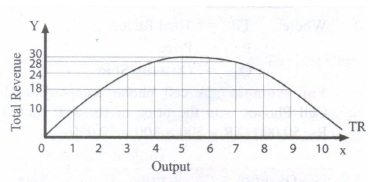
Explain the Total Revenue with the help of Diagram.
18.
Bring out the relationship between AR and MR curves under various price conditions.
19.
If total cost = 10+ Q3, find out AC, AVC, TFC, AFC when Q = 5.
1.
(d)
400
2.
(b)
350
3.
(a)
fixed
4.
(a)
explicit
5.
(d)
cost of production
6.
(i) All costs that vary with output, together with the costs of administration are known as prime cost.
(ii) In short, prime cost = variable costs + cost of administration.
7.
(i) It refers to all expenses that are directly associated with business activities but not with asset creation.
(ii) A floating cost is necessary to run the day-to-day business of a firm.
8.
(i) It refers to all payments made to the resources owned and purchased
(ii) It is the summation of explicit and implicit costs.
(iii) Economic Cost = Implicit Cost + Explicit Cost.
9.
A cost incurred in the past and cannot be recovered anymore in future, once invested it is treated as drowned or disappeared.
10.
Payment made to others for the purchase of factors of production is known as explicit cost. It is also called accounting cost or out of pocket cost.
11.
(i) It refers to the total cost per unit of output.
(ii) ATC=TC/Q (or)
(iii) ATC=AFC+AVC
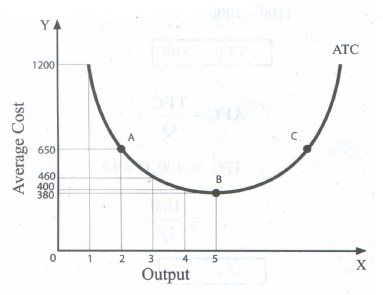
(iv) ATC curve is also a 'U' shaped curve.
(v) Initially the ATC declines reaches a minimum when the plant is operated optimally, and rises beyond the optimum output.
(vi) The 'U' shape of the AC reflected the law of the variable proportions.
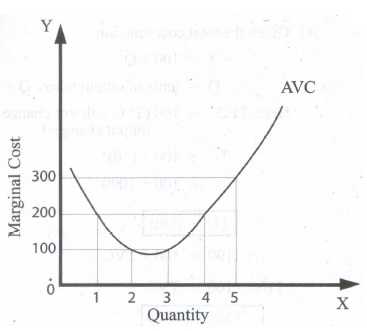
12.
(i) It refers to the total variable cost per unit of output.
(ii) It is obtained by dividing total variable cost (TVC) by the quantity of output (Q).
(iii) AVC = TVC/Q Where AVC - Average variable cost, TVC - Total variable cost,
Q - Quantity of output.
| Q(in Unit) | TVC (in Rs) | \(AVC=\frac{TVC}{Q}(in\ Rs)\) |
| 0 | 0 | 0/0=0 |
| 1 | 200 | 200/1=200 |
| 2 | 300 | 300/2=150 |
| 3 | 400 | 400/3=133 |
| 4 | 600 | 600/4=150 |
| 5 | 900 | 900/5=180 |
13.
(i) It refers to the total cost borne by the social due to the production of a commodity.
(ii) Social cost is the cost that is not borne by the firm, but incurred by others in the society.
(iii) For example: Large business firms create air pollution etc.
(iv) It is also called as External cost.
14.
Marginal revenue is the addition to the total revenue by the sale of an additional unit of a commodity. It is got by dividing change in TR by the change in quantity sold.
\(M R=\frac{\Delta T R}{\Delta Q}\), where MR = Marginal revenue.
\(M R=T R_{n}-T R_{n-1} \quad \Delta T R=\text { change in total revenue. } \)
\(M R=T R_{n+1}-T R_{n} \quad \Delta Q=\text { change in total quantity. } \)
\(T R_{n}=\text { total revenue of } n^{\text {th }} \text { item } \)
\(T R_{n-1}=\text { total revenue of } n-1^{\text {th }} item\)
\(T R_{n+1}=\text { total revenue of } n+1^{\text {th }}item\)
15.
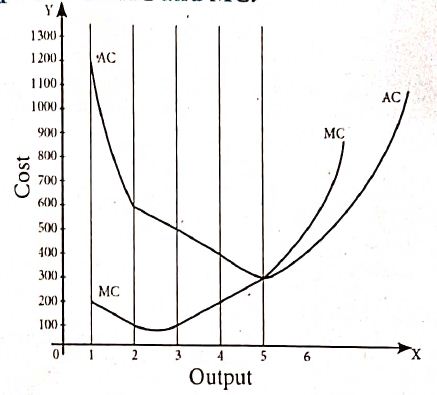
When AC is falling, MC remains below AC.
When AC becomes constant MC becomes equal to it.
When AC starts increasing MC is above the AC
MC always cuts AC at its minimum point from below.
16.
TC = TFC + TVC
\(AVC=\frac{TVC}{Q}\)
\(AFC=\frac{TFC}{Q}\)
\(AC=\frac{TC}{Q}\)
(i) TC = 100 + Q3. Total cost has two components TFC and TVC.
(ii) TFC = is the total fixed cost which does not change with the level of output.
(iii) It is determined by putting the value of Q.
(iv) Given the total cost function T = 100+Q3
Q = units of output where Q = 10
Here TFC = 100 (TFC will not change with output changes)
TC 100 + (10)3
= 100 + 1000
TC = 1100
\(\therefore\)1100 = 100 + TVC
1100 - 100 = TVC
\(\therefore\)TVC = 1000
TVC = 1000, TC = 1100 \(\therefore\) TFC =?
TC = TFC + TVC
1100 = TFC + 1000
1100 - 1000 = TFC
\(\therefore\)TFC = 100
\(AFC=\frac{TFC}{Q}\)
TFC = 100, Q = 10
\(\therefore\) AFC = 10
\(AFC=\frac{TFC}{Q}\)
TVC = 1000, Q = 10
\(\therefore\) AVC = 100
\(AC=\frac{TC}{Q}\)
TC = 1100, Q = 10
\(\therefore\) AC = 110
or
AC = AFC + AVC
AFC = 10, AVC = 100
AC = 10 + 100
\(\therefore\) AC = 110
17.
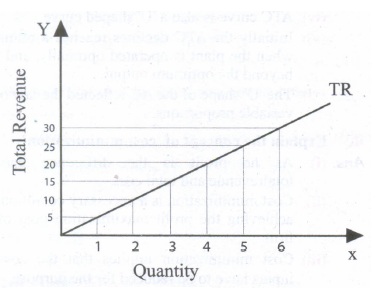
(i) Total revenue is the amount of income received by the firm from the sale of its products.
(ii) It is obtained by multiplying the price of the commodity by the number of units sold
(iii) TR = P x Q
Where TR = Total Revenue
P = Price
Q = Quantity Sold
For example: A cell phone company sold 100 Cell Phones with the price of Rs. 500 each TR is Rs. 50,000 (TR = 500 x 100 = 50,000)
| Quantity Sold(Q) | Price(P) Rs | Total Revenue(TR) Rs |
| 1 | 5 | 5 |
| 2 | 5 | 10 |
| 3 | 5 | 15 |
| 4 | 5 | 20 |
| 5 | 5 | 25 |
| 6 | 5 | 30 |
When price is declining:
With increase in quantity sold the behaviour of TR is shown in the following table and diagram
| Quantity Sold(Q) | Price(P) Rs | Total Revenue (TR) Rs |
| 1 | 10 | 10 |
| 2 | 9 | 18 |
| 3 | 8 | 24 |
| 4 | 7 | 28 |
| 5 | 6 | 30 |
| 6 | 5 | 30 |
| 7 | 4 | 28 |
| 8 | 3 | 24 |
| 9 | 2 | 18 |
| 10 | 1 | 10 |
18.
| Q | Price Rs | TR | AR | MR |
| 1 | 5 | 5 | 5 | 5 |
| 2 | 5 | 10 | 5 | 5 |
| 3 | 5 | 15 | 5 | 5 |
| 4 | 5 | 20 | 5 | 5 |
| 5 | 5 | 25 | 5 | 5 |
| 6 | 5 | 30 | 5 | 5 |
.JPG)
\(A R=\frac{T R}{Q}\)
\( M R=T R_{n}-T R_{n-1}\)
Constant AR & MR (fixed price)
When price remains constant, MR is also constant and AR / MR curves coincide.
Declining AR and MR
When a firm sells large quantities at lower prices both AR & MR will fall but the fall in MR will be steeper than the fall in AR.
| Q | AR | TR | MR |
| 1 | 10 | 10 | 10 |
| 2 | 9 | 18 | 8 |
| 3 | 8 | 24 | 6 |
| 4 | 7 | 28 | 4 |
| 5 | 6 | 30 | 2 |
| 6 | 5 | 30 | 0 |
| 7 | 4 | 28 | -2 |
.JPG)
(i) MR is lower than AR.
(ii) Both AR and MR slope downwards.
(iii) MR divides the distance between AR curve and axis into 2 equal parts.
(iv) The decline in AR need not be a straight line or linear.
(v) If the prices are declining with the increase in quantity sold, the AR can be nonlinear, taking a shape of concave or convex to the origin.
19.
\(\text { TC }=10+Q^{3} \)
\(A C=\frac{10}{Q}+\frac{Q^{3}}{Q}=\frac{10}{Q}+Q^{2}=\frac{10}{5}+5^{2}=2+25=27 \)
\(\text {AVC }=\frac{Q^{3}}{Q}=Q^{2}=5^{2}=25 \)
\(\text {TFC }=10 \)
\(\text {AFC }=\frac{10}{\mathrm{Q}}=\frac{10}{5}=2 \)
\(Ans; \mathrm{AC}=27 ; \quad \mathrm{AVC}=25 ; \quad \mathrm{TFC}=10 ; \quad \mathrm{AFC}=2.\)

11th Standard Syllabus & Materials
11th Standard
TN 11th Tamil பீடு பெற நில் - செய்யுள் - காவடிச்சிந்து Important Questions And Answers Study Material - QB365 Set A
NEW11th Standard
TN 11th Tamil பீடு பெற நில் - உரைநடை - மலை இடப்பெயர்கள் : ஓர் ஆய்வு Important Questions And Answers Study Material - QB365 Set A
NEW11th Standard
TN 11th Tamil மாமழை போற்றுதும் - துணைப்பாடம் - யானை டாக்டர் Important Questions And Answers Study Material - QB365 Set A
NEW11th Standard
TN 11th Tamil மாமழை போற்றுதும் - செய்யுள் - ஐங்குறுநூறு Important Questions And Answers Study Material - QB365 Set A



Tamilnadu Stateboard 11th Standard Subjects

Maths

Commerce
Economics

Biology

Business Maths and Statistics

Accountancy

Computer Science

Physics

Chemistry
Maths
Biology
Economics
Physics
Chemistry

History
Business Maths and Statistics

Computer Science
Accountancy

Computer Applications
History
Computer Technology
Commerce
Computer Applications
Computer Technology

Tamil

English

French
Tamilnadu Stateboard Standards
