
 100% FREE ACCESS
11th Standard Syllabus & Materials
11th Standard
TN 11th Tamil இயற்கை வேளாண்மை,சுற்றுச்சூழல் -செய்யுள் - மனோன்மணீயம் Important Questions And Answers Study Material - QB365 Set A
NEW11th Standard
TN 11th Tamil என்னுயிர் என்பேன் -துணைப்பாடம் - இசைத்தமிழர் இருவர் Important Questions And Answers Study Material - QB365 Set A
NEW11th Standard
TN 11th Tamil மொழி கலை -செய்யுள் - ஒவ்வொரு புல்லையும் Important Questions And Answers Study Material - QB365 Set A
NEW11th Standard
TN 11th Tamil பீடு பெற நில் - இலக்கணம் - பகுபத உறுப்புகள் Important Questions And Answers Study Material - QB365 Set A
NEW11th Standard
TN 11th Tamil பீடு பெற நில் - துணைப்பாடம் - வாடிவாசல் Important Questions And Answers Study Material - QB365 Set A
NEW11th Standard
TN 11th Tamil பீடு பெற நில் - செய்யுள் - குறுந்தொகை Important Questions And Answers Study Material - QB365 Set A

Published on: 14/03/2020
11th Standard Economics English Medium All Chapter Book Back and Creative Five Marks Questions 2020
Download Tamil Nadu 11th Standard Economics question papers, model tests, one-mark questions, important questions, and public exam papers in PDF format. Free study materials and answer keys for TN State Board students.
Questions + Answers key
Take MCQ Economics Test
1.
Discuss Thiruvalluvar's contribution to Indian economy.
2.
What are the causes of Rural Poverty?
3.
Differentiate between perfect competition and monopoly.
4.
Write a short note 'Sivakasi'.
5.
Explain the Marginal Productivity theory of wage.
6.
Explain the Wage Fund Theory of Wages.
7.
Explain the short run Average Cost curves with suitable diagrams.
8.
Examine the nature of Economic laws.
9.
Explain the wealth definition given by Adam Smith.
10.
Solve by Cramer's rule
\(2{ x }_{ 1 }+3{ x }_{ 2 }=7;\)
\(2{ x }_{ 1 }+{ x }_{ 2 }=5\)
11.
Describe the various types of industries in Tamil Nadu. The Government is promoting industrial parks like Rubber Park, Apparel Park, Floriculture Park, TICEL Park for Biotechnology, Siruseri IT Park and Agro Zones. Tamil Nadu has a network of about 110 industrial parks/estates that offer developed plots with supporting infrastructure.
12.
Explain briefly total cost with a suitable diagram.
13.
What are the problems of British Rule in India?
14.
Explain briefly the Iso-cost Line with the help of a diagram?
15.
Enumerate the determinants of Demand?
16.
Explain the indifference curve approach?
17.
Discuss the Arguments in favour of LPG?
18.
What are the problem in Agree?
19.
Explain the Integral Calculus?
20.
What are the factors determining supply?
21.
Briefly explain about Human development Report 2016.
22.
Explain the law of Equi-marginal utility
23.
Elucidate the law of diminishing marginal utility with diagram.
24.
The demand and supply functions are Pd= 1600 - x2 and Ps = 2x2 + 400 respectively. Find the consumer's surplus and producer's Surplus at equilibrium point.
25.
Explain the comparison among the features of various markets.
26.
Explain the B.R. Ambedkar Economic ideas in Agricultural Economics.
27.
Explain about Agrarian Crisis after reforms.
28.
29.
Explain the role of SSIs in economic development ?
30.
31.
Explain the Marginal Productivity Theory of Distribution.
32.
33.
"The features of Rural Economy are peculiar"- Argue.
34.
List out the properties of iso-quants with the help of diagrams.
35.
Explain the public transport system in Tamil Nadu.
36.
37.
Examine the Law of Variable Proportions with the help of diagram.
38.
Describe the salient features of EXIM policy (2015 - 2020)
39.
Explain the objectives and characteristics of SEZs.
40.
41.
Compare and contrast various definitions of Economics.
42.
How price and output are determined under the perfect competition?
43.
Bring out the features of perfect competition.
44.
Bring out the relationship between AR and MR curves under various price conditions.
45.
Discuss the short run cost curves with suitable diagram.
46.
Bring out Jawaharlal Nehru's contribution to the idea of economic development.
47.
Write the importance of mineral resources in India.
1.
Thiruvalluvar: The economic ideas of Thiruvalluvar are found in his immortal work, Thirukkural, a book of ethics. Even though scholars differ widely over the estimation of the period of Thiruvalluvar, it is generally believed that, he belongs to the Sangam age in Tamil Nadu around third century A.D. Thiruvalluvar's work is marked by pragmatic idealism. A large part of Valluvar's economic ideas are found in the second part of Thirukkural, the porutpal. It deals with wealth. Thiruvalluvar is a fundamental thinker. He believes that rains are the basic support of life. Since rain provides food, it forms the basis for stable economic life. Agriculture which is the most fundamental economic activity depends on rain, "It is rain that both ruins and aids the ruined to rise".
(i) Factors of Production: Thiruvalluvar has made many passing references about the factors of production viz., Land, Labour, Capital, Organisation, Time, Technology etc. He says, "Unfailing harvest, competent body of men, group of men, whose wealth knows no diminution, are the components of an economy". (KuraI61)
(ii) Agriculture: According to Thiruvalluvar, agriculture is the most fundamental economic activity. They are the axle-pin of the world, for on their prosperity revolves prosperity of other sectors of the economy, 'The ploughmen alone', he says "live as the freemen of the soil; the rest are mere slaves that follow on their toil" (Kural 1032). Valluvar believes that agriculture is superior to all other occupation.
(iii) Public Finance: Thiruvalluvar has elaborately explained Public Finance under the headings Public Revenue, Financial Administration and Public expenditure. He has stated these as
1) Creation of revenue,
2) Collection of revenue,
3) Management of revenue
4) Public expenditure
(iv) Public Expenditure: Valluvar has recommended a balanced budget. "It is not a great misfortune for a state if its revenues are limited, provided the expenditure is kept within bounds." He has given certain guidelines for a budgetary policy. "Budget for a surplus, if possible, balances the budget at other times, but never budget for a deficit." Valluvar advocates the following main items of public expenditure:
1) Defence
2) Public Works and
3) Social Services.
(v) External Assistance: Valluvar was against seeking external assistance. According to Kural No. 739, countries taking external assistance are not to be considered as countries at all. In other words, he advocated a self-sufficient economy.
(vi) Poverty and Begging: Valluvar consideres freedom from hunger as one of the fundamental freedoms that should be enjoyed by every citizen. According to him 'poverty' is the root cause of all other evils which would lead to ever-lasting sufferings. It is to be noted that the number of people living below poverty line, begging, sleeping on the road sides and rag picking in India has been increasing.
(vii) Wealth: Valluvar has regarded wealth as only a means and not an end. He said, "Acquire a great fortune by noble and honourable means." He condemned hoarding and described hoarded wealth as profitless richness. To him industry is real wealth and labour is the greatest resource.
(viii) Welfare State: Thiruvalluvar is for a welfare state. In a welfare state there will be no poverty illiteracy, disease and industry. The important elements of a welfare state are
1) perfect health of the people without disease
2) abundant wealth
3) good crop
4) prosperity and happiness and
5) full security for the people.
2.
(i) The distribution of land is highly skewed in rural areas. Therefore, majority of rural people work as hired labour to support their families.
(ii) Lack of Non-farm Employment: Non-farm employment opportunities do not match the increasing labour force. The excess supply of labour in rural areas reduces the wages and increases the incidence of poverty.
(iii) Lack of Public Sector Investment: The root cause of rural poverty in our country is lack of public sector investment on human resource development.
(iv) Inflation: Steady increase in prices affects the purchasing power of the rural poor leading to rural poverty.
(v) Low Productivity: Low productivity of rural labour and farm activities is a cause as well as the effect of poverty.
(vi) Unequal Benefit of Growth: Major gains of economic development are enjoyed by the urban rich people leading to concentration of wealth. Due to defective economic structure and policies, gains of growth are not reaching the poor and the contributions of poor people are not accounted properly.
(vii) Low Rate of Economic Growth: The rate of growth of India is always below the target and it has benefited the rich. The poor are always denied of the benefits of the achieved growth and development of the country.
(viii) More Emphasis on Large Industries: Huge investment in large industries catering to the needs of middle and upper classes in urban areas are made in India. Such industries are capital-intensive and do not generate more employment opportunities. Therefore, poor are not in a position to get employed and to come out from the poverty in villages.
(ix) Social Evils: Social evils prevalent in the society like custom, believes etc. increase unproductive expenditure.
3.
The main aim of firms both under monopoly and perfect 'competition is to maximise profit. In both the market forms, the firms are in equilibrium at the output level where MC=MR.
| S.no | Perfect competition | Monopoly |
| 1 | Average revenue curve is a horizontal straight line parallel to x-axis. Marginal revenue is equal to average revenue and price. |
Both average revenue curve and marginal revenue curve are downward falling curves, MR< (AR + Price) |
| 2 | At the equilibrium MC = MR = AR. That is price charged is equal to marginal cost of product. |
At the equilibrium MC = MR < AR. That is price charged is above MC. |
| 3 | The firm in the long run comes to equilibrium at the minimum point or the lowest point of the long run average cost curve. The firm tends to be of optimum size operating at the minimum average cost. |
Even in the long run equilibrium the firm will be operating at a higher level of average cost. The firm stops short of optimum size. |
| 4 | Equilibrium can be considered only under increasing cost and not under decreasing or constant cost condition. |
Equilibrium situation is possible a increasing, decreasing or constant cost condition. |
| 5 | The firm can earn only normal profit in the long run and may earn super profit in the short run. |
But monopoly firm earns super normal profit both in short run and long run. |
| 6 | Price will be lower and the output is larger. | Price is higher and the output will be smaller. |
4.
Sivakasi :
(i) Sivakasi is a town in Virudhu Nagar District of Tamil Nadu.
(ii) The town of Sivakasi is a leader in the areas of printing, fireworks, and safety matches. It was fondly called as "Little Japan" by Jawaharlal Nehru.
(iii) It contributes to 80% of India's fireworks production. Sivakasi provides over 60% of India's total offset printing solutions.
(iv) Sivakasi contributes 60% of safety match production.
(v) More than 450 firework factories and 4500 safety match units provide direct employment to nearly 0.5 million people and indirect employment to 02 million people.
(vi) More than that Sivakasi accounts for USD 80 million exports of safety matches, printing and firework in 2013-14.
5.
Marginal Productivity Theory of Wage:
(i) The application of a general theory of distribution to wage fixation is the marginal productivity theory of wages.
(ii) According to the theory wages are determined by the marginal productivity of labour and equal to it at the point of equilibrium.
(iii) Under perfect competition, wage is paid equal to marginal product of labour (wage = MPL)
(iv) But in real world where there is imperfect competition, there is exploitation of labour and wage is less than MPl.
6.
Wage Fund Theory of Wages:
(i) This theory was first propounded by Adam Smith. But the credit goes to J.S.Mill who perfected this theory.
(ii) According to Mill "every employer will keep a given amount of capital for payment to the workers". It is a known as "Wage Fund". It is fixed and constant.
(iii) Wages depend directly upon the fund and inversely with number of labourers employed. The average wage of a worker can be calculated by using the formula.
(iv) 
(v) If the number of workers increases, the wage per worker would fall and vice versa.
Criticisms
(a) It does not explain the difference in wages in different occupations.
(b) It ignores the role of trade unions.
(c) Actually the capitalists will take away a large sum before making payment of wages.
7.
Short run Average Cost curves:
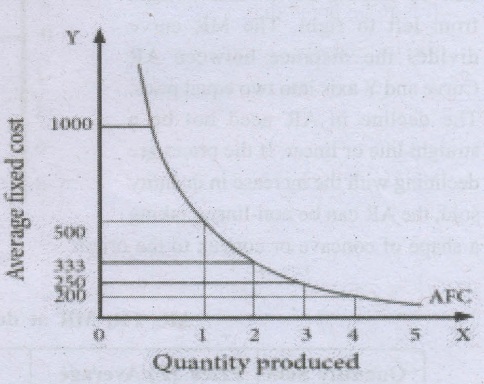
(i) Average Fixed Cost (AFC)
It refers to the fixed cost per unit of output. It is obtained by dividing the total fixed cost by the quantity of output. AFC = TFC / Q where, AFC denotes average fixed cost, TFC denotes total fixed cost and Q denotes quantity of output. For example, if TFC is 1000 and the quantity of output is 10, the AFC is Rs.100, obtained by dividing Rs.1000 by 10.
Table: Average Fixed Cost
| Q (in unit) |
TFC (in Rs.) |
AFC TFC/Q (in Rs.) |
|
0 |
1000 1000 1000 1000 1000 1000 |
1000/0=\(\infty \) 1000/1=1000 1000/2=500 1000/3=333 1000/4=250 1000/5=200 |
It is to be noted that
(a) AFC declines as output increases, as fixed cost remains constant
(b) AFC curve is a downward sloping throughout its length, never touching X and Y axis. It is asymptotic to both the axes.
(c) The shape of the AFC curve is a rectangular hyperbola.
Average Variable Cost (AVC)
Table: Average Variable Cost
| Q(in unit) | TVC (in Rs.) |
AVC TVC/Q (in Rs.) |
| 0 1 2 3 4 5 |
0 |
0/0=0 |
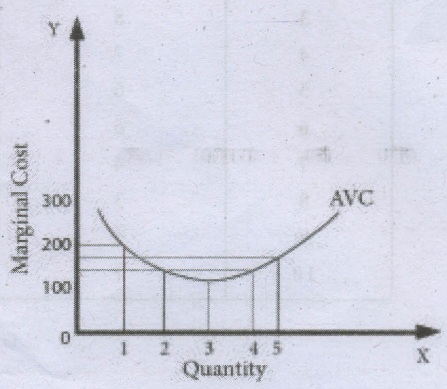
It refers to the total variable cost per unit of output. It is obtained by dividing total variable cost (TVC) by the quantity of output (Q). AVC = TVC / Q where, AVC denotes Average Variable cost, TVC denotes total variable cost and Q denotes quantity of output. For example, When the TVC is Rs. 300 and the quantity produced is 2, the AVC is f RS.150, (AVC = 300/2 = 150)
AVC is shown in table and Diagram
If TVC = Q3 - 18Q2 + 9lQ
AVC = Q2 -18Q + 91
It is to be noted that
(a) AVC declines initially and then increases with the increase of output.
(b) AVC declines up to a point and moves upwards steeply, due to the law of returns.
(c) AVC curve is a U-shaped curve.
Average Total Cost (ATC) or Average Cost (AC)
It refers to the total cost per unit of output. It can be obtained in two ways.
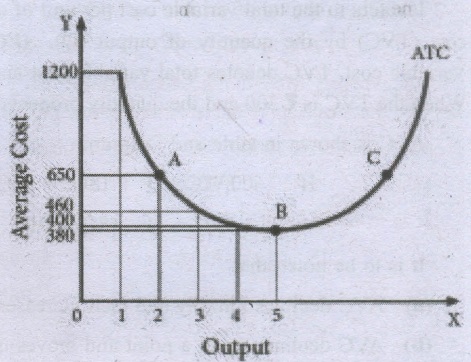
(1) By dividing the firm's total cost (TC) by the quantity of output (Q). ATC = TC / Q. For example, if TC is Rs. 1600 and quantity of output is Q = 4, the Average Total Cost is Rs. 400. (ATC = 1600/4 = 400)
If ATC is Q3 - 18Q2 + 91Q +12, then AC = Q2 - 18Q +91 + 12/Q
(2) By ATC is derived by adding together Average Fixed Cost (AFC) and Average Variable Cost (AVC) at each level of output ATC = AFC + AVC. For example, when Q = 2, TFC = 1000, TVC = 300; AFC = 500; AVC = 150; ATC = 650. ATC or AC is shown in table and Diagram
| Q (in unit) |
TFC (in Rs.) |
TVC (in Rs.) |
TC (in Rs.) TFC+TVC |
ATC (TC/Q) (in Rs.) |
AFC (in Rs.) |
AVC (in Rs.) |
ATC (AFC + AVC) (in Rs.) |
| 0 1 2 3 4 5 |
1000 1000 1000 1000 1000 1000 |
0 200 300 400 600 900 |
1000 1200 1300 1400 1600 1900 |
1000/0=\(\infty \) 1200/1=1200 1300/2=650 1400/3=466 1600/4=400 1900/5=380 |
0 1000 500 333 250 200 |
0 200 150 133 150 180 |
0+0=0 1000+200=1200 500+150=650 333+133=466 250+150=400 200+180=380 |
It should be noted that
(a) ATC curve is also a 'U' shaped curve.
(b) Initially the ATC declines, reaches a minimum when the plant is operated optimally, and rises beyond the optimum output.
(c) The 'U' shape of the AC reflects the law of the variable proportions.
8.
Nature of Economic Laws:
(i) A Law expresses a causal relation between two or more than two phenomena.
(ii) Marshall states that the Economic laws are statement of tendencies, and those social laws, which relate to those branches of conduct in which the strength of the motives chiefly concerned can be measured by money price.
(iii) In natural sciences, a definite result is expected to follow from a particular cause.
(iv) In Economic science, the laws function with cause and effect. The consequences predicted by the data, necessarily and invariably follow.
(v) However, Economic laws are not as precise and certain as the laws in the physical sciences.
(vi) Marshall holds the opinion that there are no laws of economics which can be compared for precision with the law of gravitation.
(vii) A physical scientist carrying out controlled experiments in his laboratory can test the scientific laws very easily by changing the conditions obtaining there.
(viii) Changes in Economic science cannot be brought about easily. As a result, prediction regarding human behaviour is likely to go wrong. There are exceptions to the Law of Demand. Thus, economic laws are not inviolable.
(ix) As unpredictability is invariably associated with the economic laws. Marshall compares them to the laws of tides. Just as it cannot be predicted and said with certainty that a high tide would follow a low tide, unpredictability prevails in Economics. Human behaviour is volatile.
(x) Economic laws are not assertive but they are indicative. The Law of Demand, for example, states that other things remaining the same, the quantity demanded of a commodity increase, as its price decreases and vice versa.
(xi) The use of the assumption 'other things remaining the same' (ceteris paribus) in Economics makes the Economic laws hypothetical. It might be argued that the laws in other sciences can also be called hypothetical. It should be admitted however that in the case of Economics, the hypothetical elements in its laws are a little less pronounced than in the laws of physical sciences.
(xii) But since money is used as the measuring rod, laws in economics are more exact, precise and accurate than the other social sciences. As the value of the measuring- rod money is not constant, there is always a hypothetical element surrounding the laws of. Economics.
(xiii) Some economic laws are simply truisms. For example, saving is a function of income. Another example of truism is human wants are unlimited.
9.
Wealth Definition: Adam Smith
(i) Adam Smith (1723 - 1790), in his book "An Inquiry into Nature and Causes of Wealth of Nations" (1776) defines "Economics c the science of wealth".
(ii) He explains how a nation's wealth is created and increased. He considers that the individual in the society wants to promote his own gain and in this process, he is guided and led by an "invisible hand".
(iii) He states that every man is motivated by his self interest This means that each person works for his own good.
(iv) Smith favours the introduction of "division of labour" to increase the quantum of output.
(v) Severe competition in factories and society helps in bettering the product.
(vi) Supply force is very active and a commodity is made available to the consumers at the lowest price.
Criticism:
(vii) For Smith, Economics consists of 'wealth-getting' activities and 'wealth-spending' activities.
(viii) An undue emphasis is given to material wealth. Wealth is treated to be an end in itself.
(ix) This view leads him to ignore human welfare as an essential part of Economics. Smith gives his definition when religious and spiritual values are held high.
(x) Ruskin and Carlyle regard Economics as a 'dismal science', "pig science" etc. as it teaches selfishness which is against ethics.
10.
The coefficient and the constant terms are given below for the equations
\(\triangle =\left| \begin{matrix} 2 & 3 \\ 2 & 1 \end{matrix} \right| \)
\(\triangle =2-6=-4\)
\(\triangle { x }_{ 1 }=\left| \begin{matrix} 7 & 3 \\ 5 & 1 \end{matrix} \right| \)
\(=7-15=-8\)
\( \triangle { x }_{ 2 }=\left| \begin{matrix} 2 & 7 \\ 2 & 5 \end{matrix} \right| \)
\(=10-14=-4\)
\(By\quad Carmer's\quad rule\)
\( { x }_{ 1 }=\frac { \triangle { x }_{ 1 } }{ \triangle } \)
\(=\frac { -8 }{ -4 } \)
\(=2\)
\({ x }_{ 2 }=\frac { \triangle { x }_{ 2 } }{ \triangle } \)
\(=\frac { -4 }{ -4 } =1\)
\(solution\quad set\)
\(\left( { x }_{ 1 }{ ,x }_{ 2 } \right) =\left\{ 2,1 \right\} \)
11.
The Government is promoting industrial parks like Rubber Park, Apparel Park, Floriculture Park, TICEL Park for Biotechnology, Siruseri IT Park and Agro Zones. Tamil Nadu has a network of about 110 industrial parks/estates that offer developed plots with supporting infrastructure.
Types of Industries:
i) Textiles:
Tamil Nadu is the largest textile hub of India and also "Yarn Bowl" of the country accounting for 41% of India's cotton yarn production. The western part of Tamil Nadu comprising Coimbatore, Tiruppur, Erode, Dindigul and Karur has the majority of spinning mills manufacturing cotton/polyster blended yarn and silk yarn used by garment units in Tamil Nadu. Tiruppur known as "knitting city" is the exporter of garments worth USD 3 million. Erode is the main cloth market both retail and Wholesale market.
ii) Leather:
Tamil Nadu occupies for 30% of leather exports and about 70% of leather production in the country. Hundreds of leather and tannery industries are located around Vel/ore, Dindigul and Erode. Every year the state hosts the India International Leather Fair in Chennai.
iii) Electronics:
Chennai has emerged at EMS Hub of India. Many Multi-national companies have chosen Chennai as their South Asian manufacturing hub.
iv) Automobiles:
Chennai nicknamed as "The Detroit of Asia" is home to large number of auto component industries. Tamil Nadu has 28% share each in automotive and auto component industries, 19% in the trucks segment and 18% each in ' passenger cars and two wheelers.
v) Cement:
Tamil Nadu ranks third in Cement production in India. Among 10 largest cement companies in India as on 2018, Ramco cement and India Cement find prominent place. And also Tamil Nadu stands second in number of cement plants with 21 units against 35 units in Andra Pradesh.
vi) Fireworks:
The town of Sivakasi is a leader in the areas of printing, fireworks and safety matches. It was fondly called as "Little Japan" by Jawaharlal Nehru. It contributes to 80% of India's fireworks production. Sivakasi provides over 60% of India's total offset printing solutions.
vii) Other Industries:
One of the global electrical equipment public sector companies BHEL has manufacturing plants in Tiruchirappalli and Ranipet. TNPL and the State Government, the world's biggest bagasse-based paper mill in Karut The region around Salem is rich in mineral ores. The country's largest steel plant public sector undertaking SAIL has a steel plant in Salem.
12.
Total Cost:
Total cost means the sum total of all payments made in the production. It is also called as total cost of production.
TC = TFC + TYC
For example, when the total fixed cost is Rs.1000 and the total variable cost is Rs. 200 then the total cost is Rs.1200 (Rs.1000 + Rs.200)
IF TFC = 12 and
TYC = Q3 -18Q2 + 91Q
TC = 12 + Q3 - 18Q2 + 91Q
| Output (in unit) |
Total Fixed Cost (TFC) (in Rs) |
Total Variable Cost (TVC) (in Rs) |
Total Cost (TC) TFC+TVC (in Rs) |
| 0 | 1000 | 0 | 1000 |
| 1 | 1000 | 200 | 1200 |
| 2 | 1000 | 300 | 1300 |
| 3 | 1000 | 400 | 1400 |
| 4 | 1000 | 500 | 1500 |
| 5 | 1000 | 600 | 1600 |
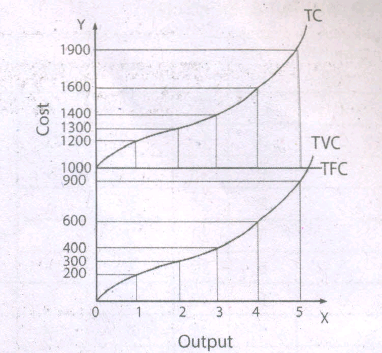
It is to be noted that,
a) The TC curve is obtained by adding TFC + TVC curves vertically.
b) TFC curve remains parallel to x-axis indicating a straight line.
c) TVC starts from the organ and move upwards as no variable cost is incurred at zero output.
d) When TFC + TVC are added, TC starts from TFC and move upwards.
e) TC curve lies above the TVC curve.
f) TVC and TC curves are the same shapes but beginning point is different.
13.
a) The British rule stunted the growth of Indian enterprise.
b) The economic policies of British checked and retarded capital formation in India.
c) the drain of wealth financed capital development in Britain.
d) Indian agricultural sector became stagnant and deteriorated even when a large section of Indian population was depend on agriculture for subsistence.
e) The British rule in India led the collapse of handicraft industries.
f) Some efforts by the colonial British regime in developing the plantations, mines, jute mills banking and shipping mainly promoted a system of capitalist firms that were managed by foreigners. These profit motives led to further drain of resources from India.
14.
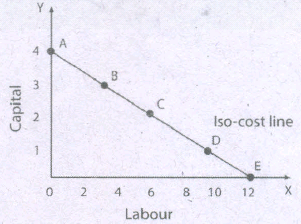
The Iso-cost line: The iso-cost line is an important component in analysing producer's behaviour. The iso-cost line represents different combinations of inputs which shows the same amount of cost. The iso-cost line gives information on factor prices and financial resources of the firm. It is otherwise called as "lso-price line" or "iso-income line" or "iso-expenditure line" or "total outlay curve".
Suppose that a producer has a total budget of H2O and for producing a certain level of output, he has to spend this amount on two factors Labour (L) and Capital (K). Prices of factors K is no and L is HO. Iso Cost Curve can be drawn by using the following hypothetical table.
| The Iso-Cost | |||
| Combination | Units of Capital Price = Rs 30 | Units of Labour Price = Rs 10 | Total Expenditure( in Rupees) |
| A | 4 | 0 | 120 |
| B | 3 | 3 | 120 |
| C | 2 | 6 | 120 |
| D | 1 | 9 | 120 |
| E | 0 | 12 | 120 |
As shown in Table, there are five combinations of capital and labour such as combination A represents 4 units of capital and zero units of labour and this combination costs Rs 120.
Similarly other combinations (B, C, D and E) cost same amount of rupees (Rs 120).
Symbolically,
4K + OL = Rs.120
3K + 3 = Rs.120
2K + 6L = Rs.120
lK + 9L = Rs.120, and
OK + 12L = Rs.120.
Thus, all the combinations A, B, C, D and E cost the same total expenditure.
From the figure it is shown that the costs to be incurred on capital and labour are represented by the triangle OAE. The line AE is called as Iso-cost line.
15.
Introduction: Demand is always related to price. Demand is always a specific quantity which a consumer is willing to purchase.
Demand Function: Demand depends upon price. This means demand for a commodity is a functions of price. D = f (P)
Determinants of Demand:
i. Changes in Tastes and Fashions:
The demand for some goods and services is very susceptible to changes in tastes and fashions.
ii. Changes in Weather:
An unusually dry summer results in a increase in the demand for cool drinks.
iii. Taxation and Subsidy:
The subsidies will bring down the prices. Therefore taxes reduce demand and subsidies raise demand.
iv. Changes in expectations:
Expectation of rise in price in future results in increase in demand,
v. Changes in savings:
Savings and demand are inversely related.
vi. State of Trade Activity:
During the period of boom and prosperity demand for all commodities tendes to increase. On the contrary, during time to depression, there is general slackening of demand.
vii. Advertisement:
Advertisement is a powerful instrument increasing the demand in the market.
viii. Changes in income:
An increase in family income may increase the demand for durables like video recorders and refrigerators. Equal distribution of income enables poor to get more income.
ix. Change in population:
The demand for goods depends on the size of population. An increase in population tends to increase the demand for goods and a decrease in population tends to decrease the demand (if other things remain constant).
16.
Introduction: J.R.Hicks end R.G.D.Allen refined the Indifference Curve Approach in 1934. Later, in 1939 J.R.Hicks in his book "Value and Capital" gave a final shape to this "Indifference Curve Analysis". This theory is also based on scale of preference.
Assumption:
i. The consumer is rational and his aim is to derive maximum satisfaction.
ii. Utility can be ranked or compared or ordered. by ordinal number such as I, II, III and so on.
iii. The Indifference Curve Approach is based on the concept "Diminishing Marginal Rate of Substitution".
iv. The consumer is consistent. This assumption is called as the assumption of transitivity. If the consumer prefers combination A to B and B to C, then he should prefer A to C. If A>B and B>C, then A>C.
Indifference Schedule:
Indifference Schedule is a table which shows the different combination of two goods that gives equal satisfaction to the consumer.
| Indifference Schedule | |
| Apple | Orange |
| 1 | 20 |
| 2 | 15 |
| 3 | 12 |
| 4 | 10 |
| 5 | 9 |
Table has five combination of two commodities Apple and Orange. This schedule is called as "Indifference Schedule". He will neither be better off nor whose off which ever combination he 4 chooses.
An indifference curve:
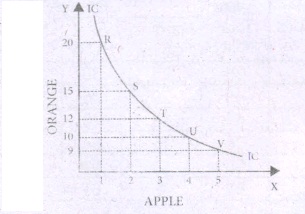
Different combination of two commodities (as found in Indifference Schedule) can be presented in a diagram. Then consumer gets different points and when such points are connected, a curve is obtained. The said curve is called as "Indifference Curve".
An indifference curve is the locus of all combinations of commodities from which the consumer derives the same level of satisfaction. It is also called "Iso-Utility Curve" or Equal Satisfaction Curve".
Explanation:
X axis represents apple and Y axis represents orange. Point 'R' represents combination of 1apple and 20 oranges., at 'S' 2 apples and 15 oranges and at 'T' 3 apples and 12 oranges. Similarly UKV points are obtained. These five points give the same level of satisfaction. The consumer will be neither better off nor worse off ln choosing any one of these points. When one joins all these five points (RS, T) U and V one can get the Indifference Curve 'IC'.
17.
(i) Liberalization was necessitated because various licensing policies were said to be deterring the growth of the economy.
(ii) Privatization was necessitated because of the belief that the private sector was not given enough opportunities to earn more money.
(iii) Globalization was necessitated because today a developed country can grow without the help of the under developed countries. Natural and human resources of the developing countries are exploited by the developed countries and the developing economies are used as market for the finished goods of the developed countries. The surplus capital of the developed countries are invested in backward economies.
18.
i. People Related Problems
The problems related to individuals and their standard of living consist of illiteracy, lack of technical know how, low level of confidence, dependence on
ii. Infrastructural Related Problems:
Poor infrastructure facilities like, water, electricity, transport, educational institutions, communication, health, employment, storage facility, banking and insurance are found in rural areas.
iii. Economics related Problems:
The economic problems related to rural areas are: inability to adopt high cost technology, high cost of inputs, under privileged rural industries, low income, indebtedness and existence of inequality in land holdings and assets. In fertile areas, a few absentee landlords own large area and they do not evince greater Interest in improving the performance of agriculture.
iv. Leadership Related Problems:
The specific leadership related problems found in rural areas are: Leadership among the hands of inactive and incompetent people, self-interest of leaders, biased political will, less bargaining power and negation skills and dominance of political leaders.
v. Administrative Problems:
The rural administrative problems consist of political interference, lack of motivation and interest, low wages in villages, improper utilization of budget, and absence of monitoring and implementation of rural development programme.
19.
Differential calculus measures the rate of change of functions. In Economics it is also necessary to reverse the process of differentiation and find the function F(x) whose rate of change has been given. This is called integration. The function F(x) is termed an integral or anti-derivative of the function f(x) The integral of a function f(x) is expressed mathematically as \(\int { f\left( x \right) dx } =F(x)+C\)
Here the left hand side of the equation is read "the integral of f(x) with respect to x" The symbol +" is an integral sign, f(x) is integrand, C is the constant of integration, and F(x)+c is an indefinite integral. It is so called because, as a function of x, which is here unspecified, it can assume many values.
20.
1. Price of the commodity
Higher the price larger the supply Price IS the incentive for the producers and sellers to supply more.
2. Price of other commodities
The supply of a commodity depends not only upon its price but also price of other commodities For instance if the price of commercial crops like cotton rise, this may result in reduction in cultivation of food crops like paddy and so its supply.
3. Price of factors
When the input prices go up, this result in rise in cost and supply will be affected.
4. Price expectations
The expectation over future prices determines present supply. If a rise in price is anticipated in future sellers tend to retain their produce for future sale and so supply in present market is reduced.
5. Technology
With advancement in technology production level improves, average cost production level improves average cost declines and as a result supply level increases.
6. Natural factors
In agriculture, natural factor like monsoon, climate etc. play a vital role in determining production level.
7. Discovery of new raw materials The discovery of new raw materials which are cheaper and of high quality tends to increase supply of the product.
8. Taxes and subsidies
Subsidies for inputs, credit, power etc. encourage the producers to produce more. Withdrawal of such incentives will hamper production. Taxes both dirt and indirect kill the ability and willingness to produce more.
9. Objective of the firm
When the goal of the firm is sales maximisation or improving market share, the supply of the product is likely to be higher.
21.
(i) The global human development reports published by the United Nations Development Programme.
(ii) It recognizes that in every society certain groups are far more likely to suffer disadvantages than others and identifies, deep-rooted and often unmeasured, barriers to development.
(iii) The report also looks to what societies should do to advance human development for everyone.
(iv) It sets forward policy recommendations at the national level and also looks at ways in which the global development.
(v) Landscape could be made more effective in the fight to leave no one behind and achieve the 2030 Agenda and Sustainable Development Goals.
22.
Introduction:
(i) The law of diminishing marginal utility was extended and is called Law of Equi-marginal utility
(ii) Law of substitution or Law of consumer's Equilibrium or Gossen's II law or law of maximum satisfaction.
Definition:
Marshall, "If a person has a thing which he can put to several uses, he will distribute it among these uses in such a way that it has the same marginal utility in all. For, if it had a greater marginal utility in one use than another, he would gain by taking away some of it from the second use and applying it to first.
Assumption
(i) Consumer is rational and wants maximum satisfaction.
(ii) Utility is measurable in cardinal numbers.
(iii) Marginal utility of money is constant.
(iv) Income of the consumer is given.
(v) There is perfect competition.
(vi) Price is given.
(vii) Law of diminishing marginal utility operates
Explanation:
(i) The consumer has Rs. 11.
(ii) He wants to spend it on apple ( Rs 1 each) and orange (Rs. 1 each)
(iii) He will be in equilibrium only when he gets maximum satisfaction ie.
\(\mathrm{K}=\frac{\text { Marginal utility of apple }}{\text { Price of apple }}=\frac{\text { Marginal utility of orange }}{\text { Price of orange }}\)
If is \(\frac{\mathrm{MU_A}}{\mathrm{P_A}}\) less than \(\frac{\mathrm{MU_O}}{\mathrm{P_O}}\) he would transfer money from apple to orange till it is equal.
He should buy 6 units of apple & 5 units of oranges. He gets (92 + 58) = 150 units satisfaction.
\(\frac{\mathrm{MU_A}}{\mathrm{P_A}}=\frac{\mathrm{MU_O}}{\mathrm{P_O}}=\frac{4}{1}=\frac{4}{1}\)
| Apple | orange | |||
| Units of Commodities | Total Utility | marginal Utility | Total Utility | marginal Utility |
| 1 | 25 | 25 | 30 | 30 |
| 2 | 45 | 20 | 41 | 11 |
| 3 | 63 | 18 | 49 | 8 |
| 4 | 78 | 15 | 54 | 5 |
| 5 | 88 | 10 | 58 | 4 |
| 6 | 92 | 4 | 61 | 3 |
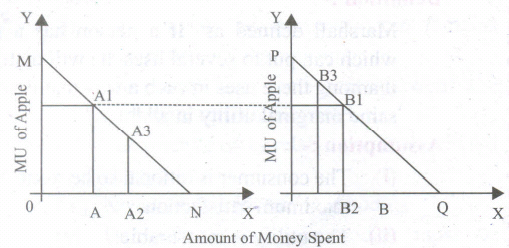
Explanation:
(i) X axis shows amount of money spent
(ii) Y axis shows marginal utility of apple and orange.
(iii) If consumer spends Rs.6 on apple and Rs.5 on orange MU will be equal.
(iv) ie. AA1 = BB1 = 4 = 4. So he gets maximum utility.
Criticisms:
(i) Utility cannot be measured.
(ii) No consumer compares the utility and disutility from each unit of the commodity while buying it.
(iii) This law cannot be applied to durable goods.
Conclusion:
(i) The law of Equi-marginal utility is an improvement over the law of diminishing marginal utility because it can be used for many commodities consumed at the same time.
23.
Introduction:
(i) H. H. Gossen first formulated this law.
(ii) So Jevons called it "Gossen's First law of consumption"
(iii) Marshall perfected it on the basis of cardinal analysis.
(iv) It is based on the satiable character of human wants.
Definition
Marshall states the law as "the additional benefit which a person derives from a given increase of his stock of a thing, diminishes with every increase in the stock that he already has".
Assumptions
(i) Utility can be measured - 1,2,3.
(ii) Marginal utility of money is constant.
(iii) The consumer is rational. He wants maximum satisfaction.
(iv) The units consumed must be reasonable in size.
(v) The commodity must be homogeneous.
(vi) The consumption must be continuous.
(vii) There is no change in taste, habit, preferences, fashion, income & character of the consumer.
Illustration:
(i) Suppose a consumer wants to consume 7 apples one after another.
(ii) The utility from the first apple is 20.
(iii) The utility from the 2nd apple is less than the first (15), the utility from the 3rd apple is less than the 2nd (10) and so on.
(iv) Finally the utility from the 5th apple becomes zero and the utility from the 6th apple is -5.
| Number of Apples | Total utility | Marginal Utility |
| 1 | 20 | 20 |
| 2 | 35 | 15(35 - 20) |
| 3 | 45 | 10(45 - 35) |
| 4 | 50 | 5 (50 - 45) |
| 5 | 50 | 0 (50 - 50) |
| 6 | 45 | -5 (45- 50) |
| 7 | 35 | -10 (35-45) |
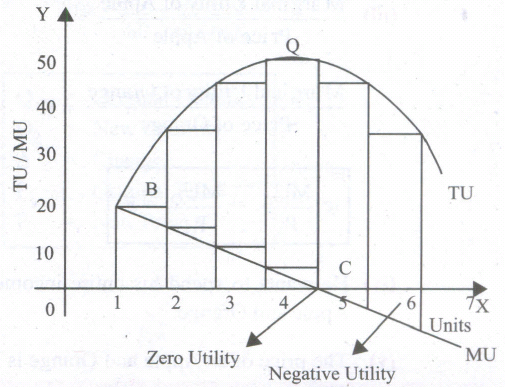
Explanation:
(i) TU goes on increasing but at a diminishing rate.
(ii) MU goes on diminishing
(iii) When MU is zero TU is maximum.
(iv) When MU becomes negative, TU diminishes.
Criticism:
(i) Utility is subjective so cannot be measured numerically.
(ii) The assumptions are unrealistic.
(iii) The law is not used for indivisible commodities.
Exceptions:
(i) Hobbies
(ii) Drunkards
(iii) Readings
(iv) Misers
(v) Music
(vi) Poetry
Importance:
(i) It is a fundamental law of consumption.
(ii) It is the basis for the law of demand, elasticity of demand, consumer's surplus.
(iii) Finance Minister uses it for progressive taxation.
(iv) Redistribution of income is justified.
(v) Adam Smith uses it for his "diamond water paradox".
Conclusion:
The law of diminishing marginal utility is of great use in our daily life.
24.
For equilibrium Pd = Ps
\(1600-x^{2} =2 x^{2}+400
\)
\(1600-400 =2 x^{2}+x^{2}
\)
\(3 x^{2} =1200
\)
\(x^{2} =400
\)
\(x =\pm 20
\)
\(P_{\mathrm{d}} =1600-(20)^{2} \)
=1600-400
=1200
\(\mathrm{P}_{\mathrm{s}} =2(20)^{2}+400 \)
= 2(400) + 400
= 800 + 400
= 1200
Consumer's surplus:
\(\mathrm{C}_{\mathrm{s}}=\int_{0}^{20}\left(1600-x^{2}\right) \mathrm{d} x-(20 \times 1200)
\)
\(=\left[1600 x-\frac{x^{3}}{3}\right]_{0}^{20}-(24000)=\left[1600(20)-\frac{20^{3}}{3}\right]-24000
\)
\(=32000-\frac{8000}{3}-24000=5,333.34\)
Producer's surplus:
\(\mathrm{P}_{\mathrm{s}} =(20 \times 1200)-\int_{0}^{20}\left(2 x^{2} +400\right) \mathrm{d} x
\)
\(=24000-\left[\frac{2 x^{3}}{3}+400 x\right]_{0}^{20}
\)
\(=24000-\left[\frac{2(20)^{3}}{3}+400(20)\right]=24000-\left[\frac{2 \times 8000}{3}+8000\right]\)
= 24000-5333.33 - 8000 = 10,666.67
25.
| SI.No | Features | Perfect Competition | Monopoly | Monopolistic Competition |
| 1 | No of producers/sellers | Large | Only one | A few (or) some |
| 2 | Nature of the product | Homogeneous | Unique | Differentiated Product |
| 3 | Control over price | Price taker | Price maker | Price variation |
| 4 | Entry/Exit | Free | Entry prevented | The existence of entry possibility |
| 5 | Profit | No ultimate profit | Monopoly profit | Profit arising due to markets special feature |
| 6 | Market knowledge | Complete | Complete | partial |
| 7 | Cost Curves | Same | Same | Same |
| 8 | AR Curves | parallel to X-axis perfectly elastic | Fairly flat more elastic | Steep (highly inelastic) |
| 9 | Quantity | Very large | Substantially large | Very small |
| 10 | Price | Very low | Low | Very high |
| 11 | Market Power | Little | Less | More |
26.
The main economic ideas of B.R. Ambedkar (1891-1956) may be studied under four broad headings. They are.
(A) Financial Economics:
(i) Much of the work done by B.R. Ambedkar during the period (1913-1923) was in the field of finance Economics.
(ii) He divided the evolution of provincial Finance into three stages such as
(i) Budget by Assignment
(ii) Budget by Assigned Revenue
(iii) Budget by Shared Revenue
(B) Agricultural Economics:
In 1918, Ambedkar published a paper "Small holdings in India and their Remedies".
(C) Economics of Caste:
(i) Ambedkar believed that caste was an obstacle to social mobility.
(ii) The caste system has resulted in the absence of social democracy in India as distinct from political democracy.
(D) Economics of socialism:
(i) Ambedkar was a socialist. He was a champion of state socialism.
(ii) He advocated the nationalization of all key industries and suggested state ownership of land and collective farming.
27.
(a) High Input Costs:
(i) The biggest input for farmers is seeds. Before liberalisation, farmers across the country had access to seeds from the state government institutions.
(ii) The institutions produced own seeds and were responsible for their quality and price.
(iii) With liberalization, India's seed market was opened up to global agribusiness. Also, following the deregulation many state government institutions were closed down in 2003.
(iv) These hit farmers doubly hard.
(v) Seed prices shot up, and fake seeds made an appearance in a big way.
(b) Cutback in agricultural subsidies:
Liberalisation policies reduced pesticide and fertilizer subsidy and so fertilizer prices have increased by 300% and electricity tariffs have been also increased.
(c) Reduction of import Duties:
(i) With a view to open India's market, the liberalisation reforms also withdrew tariffs and duties on imports, which protect and encourage domestic industry.
(ii) By 2001 India completely removed restrictions on imports of almost 1,500 items including food
(iii) As a result, cheap imports flooded the market, pushing prices of crops like cotton and pepper down.
(d) Paucity of credit facilities:
(i) After 1991 the lending pattern of commercial banks, including nationalised banks drastically changed.
(ii) This has forced the farmers to rely on moneylenders who charge exorbitant rate of interest.
28.
The concept of economic planning in India was the limited natural resources are utilized skillfully so as to achieve the desired goals.
(i) First Five Year Plan (1951 - 1956) :
Agriculture development of the country.
(ii) Second Five Year Plan (1956 - 1961) :
Industrial Development of the country.
(iii) Third Five Year Plan (1961 - 1966) :
To make the economy independent and to reach self active position to take off.
(iv) Fourth Five Year Plan (1969 - 1974) :
The two main objectives of this plan growth with stability and progressive achievement of self reliance.
(v) Fifth Five year Plan (1974 - 1979) :
In this plan top priority was given to agriculture, next cement industry and mines.
(vi) Sixth Five Year Plan (1980 - 1985) :
Poverty eradication and technological self reliance was the main objective of this plan.
(vii) Seventh Five Year Plan (1986 - 1991) :
The establishment of the self sufficient economy opportunities for productive employment.
(viii) Eighth Five Year Plan (1992 - 1997) :
The top priority was given to development of human resources, employment, education and public health.
(ix) Ninth Five Year Plan (1997 - 2002) :
The main focus of this plan growth with justice and equity
(x) Tenth Five Year Plan (2002- 2007) :
To double the per capita income of India next 10 years.
(xi) Eleventh Five Year Plan (2007 - 2012) :
"Faster and more inclusive growth was the main aim of this plan"
(xii) Twelfth Five Year Plan (2012 - 2017) :
Its main aim is "Faster, more inclusive and sustainable growth".
29.
Introduction :
(i) Small scale industries play an important role for the development of Indian economy.
(ii) 60 - 70% of total innovations in India comes from SSIs.
Provides employment:
(i) SSIs use labour intensive techniques.
(ii) They provide employment to artisans, technically qualified persons and professionals, people engaged in traditional arts, people in villages and unorganized sector.
(iii) The employment-capital ratio is high.
Brings balanced regional development:
(i) SSIs are set up in backward and rural areas.
(ii) This promotes decentralised development of industries.
(iii) They reduce congestion, slums, sanitation and pollution in cities since they are found outside city limits.
(iv) They improve the standard of living of people in suburban and rural areas
(v) The entrepreneurial talent is tapped from different regions.
Helps in mobilization of local resources:
(i) SSIs mobilize and use local resources like small savings, entrepreneurial talent etc of the entrepreneurs which might have remained idle.
(ii) It promotes traditional family skills and handicrafts.
Paves for optimisation of capital:
(i) SSIs needs less capital. They give quick profit due to shorter gestation period.
(ii) SSIs functions as a stabilizing force by providing high output-capital ratio and high employment capital ratio.
(iii) They encourage people living in rural areas to save and channelize them into industrial activities.
Promotes export:
(i) Since they do not need sophisticated machinery, import of machinery from abroad is not needed.
(ii) There is great demand for goods produced by SSIs.
(iii) They reduce the pressure on balance of payment as they earn foreign exchange
Complements large scale industries:
(i) They provide components, parts, accessories to large scale industries.
(ii) They serve as ancillaries to large scale units.
Meets consumer demand:
(i) SSIs produce a wide range of consumer products.
(ii) They serve as an anti-inflationary force by providing goods of daily use.
Develops entrepreneurship:
(i) SSIs help to develop entrepreneurs.
(ii) They help the job seekers to become job givers.
(iii) They promote self-employment and a spirit of self-reliance.
(iv) It increases the per capita income of India.
(v) There is development of backward areas and weaker sections.
(vi) It helps in equitable distribution of income.
30.
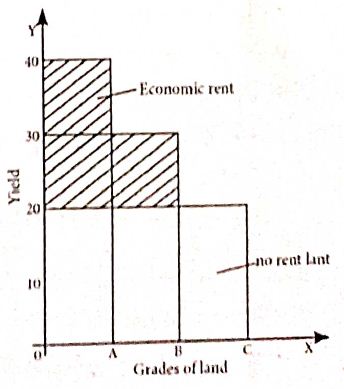
31.
Introduction:
(i) Marginal productivity theory of distribution was developed by Clark, Wicksteed and Walras.
(ii) This theory explains how the prices of various factors of production are determined.
Assumptions
(i) All the factors of production are homogeneous, can be substituted for each other and are perfectly mobile.
(ii) There is perfect competition in the factor & product market.
(iii) There is full employment with no technological change.
(iv) The theory is applicable only in long run.
(vi) The entrepreneurs aim at profit maximisation.
(vii) There is no government intervention in fixing the price of a factor.
Explanation:
(i) The reward for any factor of production is equal to the marginal productivity of that factor.
(ii) The greater the productivity of a factor higher will be its reward.
(iii) The price of a factor of production depends upon its productivity.
(vi) The price will be equal to marginal revenue product of that factor.
(v) Under certain conditions, the price of a factor will be equal to both the average and marginal products of that factor.
Marginal productivity under perfect competition:
.JPG)
(i) fig (a) x axis represents factor units.
(ii) y axis shows factor price & revenue.
MRP = Marginal revenue product curve.
ARP = Average revenue product curve.
AFC = Average factor cost curve.
MFC = Marginal factor cost curve.
(iii) AFC is horizontal & MFC coincides with it.
(iv) The firm is in equilibrium (maximum profit) when MFC = MRP at Q by employing ON units of factors & paying (OP price or NQ) where MFC = MRP = ARP.
(v) The price paid to the factor NQ is equal to MRP (NQ) and ARP (NQ) beyond Q no employer will employ factors because after that point, the price paid to the factor is more than MRP and ARP.
Marginal productivity under Imperfect competition:
.JPG)
(i) fig(b) AFC represents the price paid to the factors. It increases as the number of factors demanded by the employer increases.
(ii) As AFC rises, MFC lies above AFC. It represents the MC paid to the factors.
(iii) At the point Q, MFC = MRP, where the employer attains his maximum profit and so he stops employment of the factors at the point.
(iv) But the AC paid is NRSO and AR is NQ or OP
(v) Total revenue is NQPO.
(vi) Exploitation per unit of factor is RQQ
(vii) But the total number of factors is ON. Thus the total exploitation of factor by the employer is RQ XSR = PQRS (shaded area).
Criticisms:
(i) Factors of production are not homogeneous.
(ii) They cannot be substituted for each other.
(iii) It cannot be applied in the short run.
Conclusion:
This theory is also called "General Theory of Distribution" or "National Dividend Theory of distribution".
32.
33.
Introduction:
Rural economy refers to villages and rural community refers to people living in villages.
Features of rural economy:
Village is an institution:
(i) Village is a primary institution and it satisfies almost all the needs of the rural community.
(ii) The rural people have a feeling of belongingness and a sense of unity towards each other.
Dependence on agriculture:
The rural economy depends on nature and agricultural activities.
Life of rural people:
(i) Lifestyle in village is very simple. Education, housing, health and sanitation, transport and communication, banking, roads and markets are limited and unavailable.
(ii) Rural people rely on faith, superstitions and traditional cultural practices.
(iii) The methods of production, social organization, political mobilization, rural sector is extremely weak and backward.
(iv) The incidence of alcohol drinking has gone up.
Population density:
Population density is very low. Houses are scattered in the entire village.
Employment:
There is unemployment, seasonal unemployment and underemployment.
Poverty:
(i) Basic needs of the people like food, clothing and shelter are not met
(ii) About 22 crores of people in rural areas are poor and live below poverty line.
Indebtedness:
(i) People in rural areas are highly indebted owing to poverty, underemployment, lack of farm and non-farm employment opportunities, low wage employment, seasonality in production, poor marketing network.
(ii) Since formal loan facilities are not available to the villagers, they depend on local money lenders who squeeze the villagers.
Rural income
Large proportion of labourers are underemployed and the scope for increasing their income is limited.
Dependency:
Rural households are largely dependent on social grants and remittances from family members working in urban areas.
Dualism:
The co-existence of features of organised and unorganised, traditional and modern, regulated and unregulated, poor and rich, skilled and unskilled is very common in rural areas.
Inequality:
There is inequality in distribution of income, wealth and assets. Land, livestock are owned by a few people. Landlords dominate the rural activities.
Migration:
Rural people migrate from villages to urban areas for gainful employment. Lack of basic amenities in rural areas also push the people to urban areas.
34.
Iso and quant are derived from the Greek language, meaning 'equal' and 'quantity'.
Definition:
Isoquant curve is a locus of points representing various combinations of two inputs capital and labour yielding the same output. It is also called equal product curve or product indifference curve.
Properties:
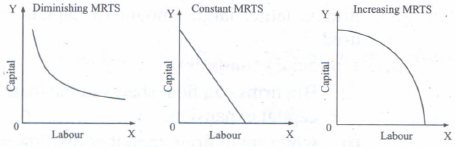
1. The isoquant curve has negative slope:
(i) Capital is being substituted by labour.
(ii) Isoquant has negative slope because of diminishing MRTS.
(iii) Constant MRTS (straight line) and increasing MRTS (concave) are also possible.
(iv) It depends on the nature of isoquant curve
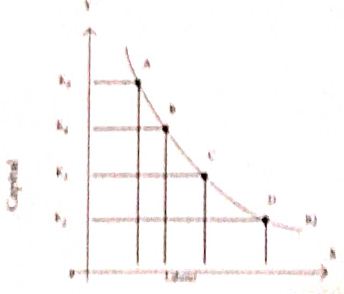
2. Isoquant curve is convex to origin:
The capital substituted per unit of labour goes on decreasing so the isoquant is convex to the origin.
3. Isoquant curves cannot intersect each other:
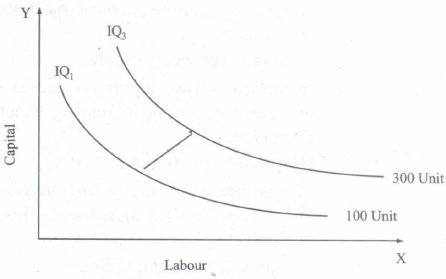
Point A lies on IQ1 and IQ2, Point C lies on IQ2, showing higher output Point B
lies on IQ1, showing lower output. C = A, B = A But C > B.
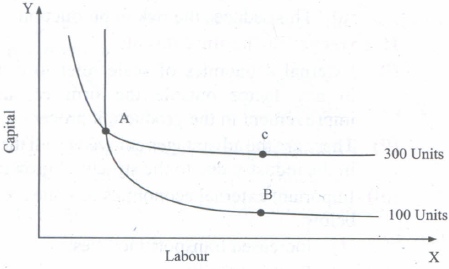
4. Upper isoquant curve represents a higher level of output:
Higher IQ2 shows higher output 200 units. Lower IQ1 shows lower output 100 units. IQ2 means the use of more factors than IQ1. Arrow shows increase in output with a right and upward shift of an isoquant curve.
5. Isoquant curve does not touch either x axis or y axis:
In IQ2 only capital is used and in IQ1 only labour is used.
.JPG)
Conclusion:
These are the properties of isoquant curves.
35.
Tamil Nadu has a well established transportation system that connects all parts of the state. Tamil Nadu has an extensive road network in terms of its spread and quality, providing links between urban centres, agricultural market places & rural habitations in the countryside.
Roadways:
There are 28 national highways. The state has a total road length of 167,000 km of which 60,628 km are maintained by Highways Department. It ranks 2nd in India with 20% in total road projects under public-private partnership model.
Railways:
(i) Tamil Nadu has a well-developed rail network under Southern Railway (HQ at Chennai).
(ii) The Southern Railway covers Tamil Nadu, Kerala, Puducherry, parts of Karnataka and Andhra Pradesh.
(iii) The total railway track length is 6,693 km.
(iv) There are 690 railway stations. It is connected to most major cities.
(v) The main rail junctions are Chennai, Coimbatore, Erode, Madurai, Salem, Tiruchirapalli, Tirunelveli, Chennai has a well established suburban railway network, a Mass Rapid Transport system and a Metro system the direct underground stretch operational since May 2017.
Airways:
Tamil Nadu has 4 major international airports (Chennai, Coimbatore, Madurai, Trichy). Chennai International airport is the III largest airport in India. Domestic airports are at Tuticorin, Salem and Madurai. Increased industrial activity has given rise to an increase in passenger traffic & freight movement.
Ports:
(i) Chennai, Ennore & Tuticorin have major ports. Nagapattinam has an intermediate port.
(ii) There are 23 minor ports.
(iii) The ports handle 73 million metric tonnes of cargo.
(iv) All the minor ports are managed by the Tamil Nadu Maritime Board.
(v) Chennai port is an artificial harbour & the second principal port in India for handling containers.
(vi) It is currently being upgraded to have a dedicated terminal for cars capable of handling 4,00,000 vehicles.
(vii) Ennore port was recently converted from an intermediate port to a major port.
(viii) It handles all the coal and ore traffic in Tamil Nadu.
36.
37.
Introduction:
The law states that if all other factors are fixed and one input is varied in the short run, the total output will increase at an increasing rate at first, then be constant and finally increase at a declining rate.
Definition:
"As equal increments of one input are added, the inputs of other productive services being held constant, beyond a certain point, the resulting increments of product will decrease (i.e) the MP will diminish". - G. Stigler
Assumptions:
1. Only one factor is variable.
2. All units of the variable factor are homogeneous.
3. The product is measured in physical units.
4. No change in technology.
5. No change in price of the product.
| Units of variable factor | Total Product (TPL) | Marginal Product (MPL) | Average Product (APL) | Stages |
| 1 2 3 |
2 6 12 |
2 4 6 |
2 3 4 |
I |
| 4 5 |
16 18 |
4 2 |
4 3.6 |
II |
| 6 7 |
18 16 |
0 -2 |
3 2.28 |
III |
x-axis represents labourers. y-axis represents TPL, MPL, APL
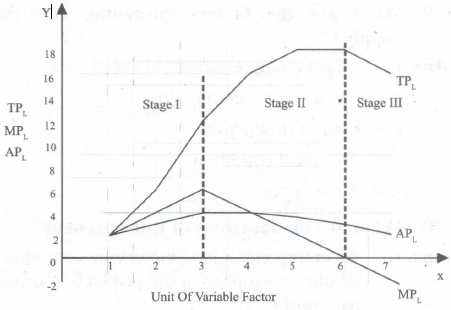
| Stages | Total Product (TP) | Marginal Product (MP) | Average Product (AP) |
| Stage I | It increases at an increasing rate. Then it increases at a decreasing rate. This is the point of inflection. |
It increases, reaches maximum and starts to decrease. | It increases, reaches maximum. |
| Stage II | It continues to increase at a diminishing rate and reaches maximum | It continues to diminish and becomes zero. | It is equal to MP then begins to diminish. |
| Stage III | It diminishes. | It becomes negative | It diminishes but always is positive. |
Conclusion:
The law of variable proportion helps the producer to decide on the amount of factors to be employed.
38.
Introduction:
The government of India, Ministry of Commerce and Industry announced New Foreign Trade Policy on 1st April 2015 for a period 2015 - 2020.
Salient Features:
(i) Reduce export obligations by 25% and give boost to domestic manufacturing supporting the 'Make in India' concept.
(ii) As a step to Digital India concept, online procedure to upload digitally signed document by CA/CS/Cost Accountant are developed and further mobile app for filing tax, stamp duty has been developed.
(iii) Repeated submission of physical copies of documents available on Exporter Importer Profile is not required.
(iv) Export obligation period for export items related to defence, military store, aerospace and nuclear energy to be 24 months.
Conclusion: EXIM Policy 2015 - 2020 is expected to double the share of India in World Trade from present level of 3% by 2020. This is too ambitious.
39.
Introduction:
(i) In order to promote export and industrial growth SEZ was introduced in many countries.
(ii) India was one of the first in Asia to set up EPZ (Kandla, 1965).
(iii) SEZ covers free trade zones, export processing zones, industrial parks, economic and technology development zones, high-tech zones, science and innovation parks, free ports, enterprise zones.
Major objectives of SEZs
(i) To enhance foreign investment, to attract foreign direct investment and increase GDP.
(ii) To increase shares in global export.
(iii) To generate additional economic activity.
(iv) To create employment opportunities.
(v) To develop infrastructure facilities.
(vi) To exchange technology in the global market.
Characteristics:
(i) Geographically demarcated area with physical security.
(ii) administered by single authority.
(iii) Streamlined procedures.
(iv) Having separate customs area.
(v) Governed by more liberal economic laws.
(vi) Greater freedom to firms located in SEZs.
(vii) They need not respect the government's rules and regulations.
(viii) The social and environmental impacts were disastrous.
40.
41.
| Wealth | Welfare | Scarcity | Growth |
| Adam Smith classical era. |
Alfred Marshall- neo classical era. |
Lionel Robbins new age. |
Paul Samuelson modern age. |
| An Inquiry into nature and causes of Wealth of Nations (1776). |
Principles of |
An Essay on the nature and Significance of Economic Science (1932). |
Economics studies how men and society choose with or without the use of money, to employ scarce productive resources which could have alternative uses, to produce various commodities over time and distribute them for consumption now and in the future among various people and groups of society. |
| Economics is the science of wealth. | Economics is a study of mankind in the ordinary business of life, it examines that part of individual and social action which is most closely connected with the attainment and with the use of material requisites of well being. It studies wealth and man. |
Economics is a science which studies human behaviour as a relationship between ends and scarce means which have alternative uses. |
Economics deals with how the society uses the limited resources for alternative uses. |
| Deals with only the goods which are scarce and have money value |
wealth and welfare of man is important. | Human behaviour regarding choice is important. |
It covers production, distribution and consumption. |
| Deals with consumption, production, exchange, distribution of wealth. |
Only material welfare is considered, differentiates between material and immaterial things. |
Economic problem arises because of scarcity of resources. |
Economics is a social science. |
| By introducing welfare, economics becomes inexact. |
Ethical aspects are not considered so Economics is exact |
||
| Welfare definition makes Economics classificatory. | Economics is a positive science. |
||
| Economics is a science of individual behaviour. |
|||
| Both material and immaterial activities are considered. |
42.
Short run equilibrium:
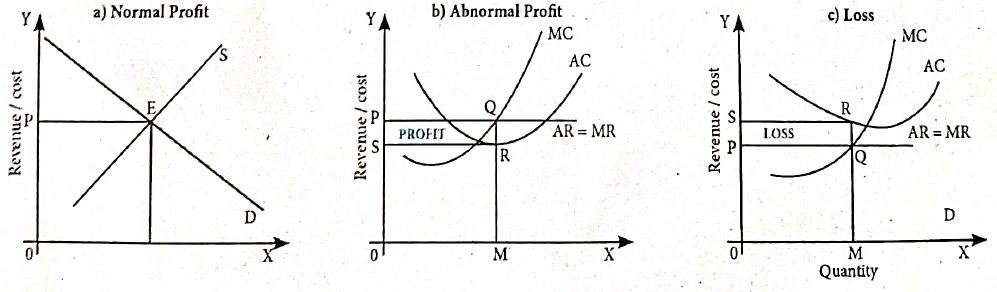
In diagram (a) the demand and supply of all firms interact and price OP is fixed.
(i) In diagram (b) the AC is less than the price.
(ii) At equilibrium MC = MR, AR = QM, AC = RM. Profit per unit is RQ
(iii) Total profit is PQRS.
(iv) In diagram (c) AC is greater than AR.
(v) At equilibrium AR = QM, AC = RM, loss per unit is RQ.
(vi) Total loss is PQRS.
(vii) When there is abnormal profit, new firms will enter the industry
(viii) Supply increases, price falls, profits become normal.
Long run equilibrium:
.JPG)
(i) All factors are variable. Firms earn normal profit.
(ii) There is no tendency for new firms to enter or leave the industry.
(iii) Equilibrium is at minimum point of LAC.
(iv) At point E, LMC = MR = AR = LAC.
(v) AC = QM, AR = QM.
(vi) Profit is normal.
(vii) Long run equilibrium price is lower than short run equilibrium price.
(viii) Long run equilibrium quantity is larger than short run equilibrium quantity.
43.
Large number of buyers and sellers:
(i) Since there are large number of buyers and sellers each individual buyer or seller buys or sells a very small quantity of the product found in the market.
(ii) So he has no power to fix the price of the product.
(iii) He is only a price taker.
Homogeneous product & uniform price:
(i) All the units of the product are perfectly substitutable - they are of the same size, shape, colour, quality.
(ii) So a uniform price prevails in the market.
Free entry and exit:
(i) In the short run, the very efficient producer can produce the product at a very low cost & earn super normal profit.
(ii) This attracts new firms to enter.
(iii) When there are more firms, supply increases, so price falls.
(iv) Inefficient producer faces loss & so quits the market.
Absence of transport cost:
The prevalence of the uniform price is also due to the absence of the transport cost.
Perfect knowledge of the market:
(i) All buyers and sellers have a thorough knowledge of the quality of the product, prevailing price.
No government intervention:
(i) No government regulation on supply of raw materials & in price determination.
44.
| Q | Price Rs | TR | AR | MR |
| 1 | 5 | 5 | 5 | 5 |
| 2 | 5 | 10 | 5 | 5 |
| 3 | 5 | 15 | 5 | 5 |
| 4 | 5 | 20 | 5 | 5 |
| 5 | 5 | 25 | 5 | 5 |
| 6 | 5 | 30 | 5 | 5 |
.JPG)
\(A R=\frac{T R}{Q}\)
\( M R=T R_{n}-T R_{n-1}\)
Constant AR & MR (fixed price)
When price remains constant, MR is also constant and AR / MR curves coincide.
Declining AR and MR
When a firm sells large quantities at lower prices both AR & MR will fall but the fall in MR will be steeper than the fall in AR.
| Q | AR | TR | MR |
| 1 | 10 | 10 | 10 |
| 2 | 9 | 18 | 8 |
| 3 | 8 | 24 | 6 |
| 4 | 7 | 28 | 4 |
| 5 | 6 | 30 | 2 |
| 6 | 5 | 30 | 0 |
| 7 | 4 | 28 | -2 |
.JPG)
(i) MR is lower than AR.
(ii) Both AR and MR slope downwards.
(iii) MR divides the distance between AR curve and axis into 2 equal parts.
(iv) The decline in AR need not be a straight line or linear.
(v) If the prices are declining with the increase in quantity sold, the AR can be nonlinear, taking a shape of concave or convex to the origin.
45.
Average fixed cost:
1. It refers to the fixed cost per unit of output.
2. It declines as output increases as fixed cost is constant.
3. It never touches the axis.
4. It is rectangular hyperbola.
.JPG)
Average variable cost:
1. It is the variable cost per unit of output.
2. It initially declines and then increases with the increase of output
3. This is due to law of returns.
4. AVC curve is a 'U' shaped curve.
.JPG)
Average total cost or average cost:
1. It is got by dividing TC by Q or by adding AFC and AVC.
2. It is u shaped.
3. Initially it declines, reaches minimum when the plant is used optimally & rises beyond the optimum output.
4. This is due to the law of variable proportions.
.JPG)
Marginal cost:
1. It is the change in total cost resulting from producing one extra unit of output.
2. First it falls due to more efficient use of variable factors.
3. It increases after the lowest point and it slopes upward.
4. It is 'u' shaped.
.JPG)
| Q (in unit) | TFC in (Rs) | TVC in (Rs) | TC in (in Rs)TFC + TVC | ATC (TC/Q)(in Rs) | AFC in(Rs) | AVC in(Rs) | ATC (AFC + AVC)(in Rs) |
| 0 | 1000 | 0 | 1000 | α | 0 | 0 | 0 |
| 1 | 1000 | 200 | 1200 | 1200 | 1000 | 200 | 1200 |
| 2 | 1000 | 300 | 1300 | 650 | 500 | 150 | 650 |
| 3 | 1000 | 400 | 1400 | 466 | 333 | 133 | 466 |
| 4 | 1000 | 600 | 1600 | 400 | 250 | 150 | 400 |
| 5 | 1000 | 900 | 1900 | 380 | 200 | 180 | 380 |
46.
Introduction:
(i) Jawaharlal Nehru one of the chief builders of modern India was the first Prime Minister of Independent India.
(ii) He was a great patriot, thinker and statesman.
Democracy and secularism:
(i) Nehru believed in democracy, free speech, civil liberty, adult franchise, the Rule of law and Parliamentary democracy.
(ii) He favoured secularism.
(iii) Secularism means equal respect for all religions. In our country we have Hinduism, Islam, Christianity, Buddhism, Jainism, Sikhism and so on.
(iv) But there is no domination by religious majority.
Planning:
(i) Nehru introduced planning in our country.
(ii) Planning was linked with industrialisation and self-reliance.
(iii) Nehru contributed to the advancement of science, research, technology and industrial development.
(iv) Many IITs and Research Institutions were established.
Democratic socialism:
(i) Nehru wanted a socialistic pattern of society.
(ii) His socialism is democratic socialism.
Conclusion:
(i) Nehru's views on economics and social problems are found in his innumerable speeches and in the books he wrote.
47.
Introduction:
Mineral resources are valuable natural resources that play an important role in the economic development of India. Important minerals found in India include iron ore, coal, lignite, bauxite, mica, crude oil, gold, and diamonds.
1. Iron Ore
India has abundant reserves of high-quality iron ore. It is the basic raw material for the iron and steel industry. Major iron ore producing states are Odisha, Chhattisgarh, Karnataka, Jharkhand, and Goa.
2. Coal and Lignite
Coal is the most important source of commercial energy in India. It is used for electricity generation and industrial purposes. Major coal-producing states include Jharkhand, Odisha, Chhattisgarh, West Bengal, and Madhya Pradesh.
3. Bauxite
Bauxite is the chief ore of aluminium. Aluminium is widely used in transport, construction, and electrical industries. Odisha is the leading producer of bauxite in India.
4. Mica
Mica is a good insulator and heat-resistant mineral. It is used in electrical and electronic industries. India is one of the leading producers of mica.
5. Crude Oil
Crude oil is an important source of energy. It is used to produce petrol, diesel, kerosene, and other petroleum products. Major oil-producing areas are Assam, Gujarat, and offshore regions.
6. Gold and Diamonds
Gold and diamonds have high commercial value. They support the jewellery industry and contribute to exports.
Conclusion:
Mineral resources are essential for industrial development, energy production, employment generation, and economic growth. Therefore, they are a valuable asset for India's development.

11th Standard Syllabus & Materials
11th Standard
TN 11th Tamil பீடு பெற நில் - செய்யுள் - காவடிச்சிந்து Important Questions And Answers Study Material - QB365 Set A
NEW11th Standard
TN 11th Tamil பீடு பெற நில் - உரைநடை - மலை இடப்பெயர்கள் : ஓர் ஆய்வு Important Questions And Answers Study Material - QB365 Set A
NEW11th Standard
TN 11th Tamil மாமழை போற்றுதும் - துணைப்பாடம் - யானை டாக்டர் Important Questions And Answers Study Material - QB365 Set A
NEW11th Standard
TN 11th Tamil மாமழை போற்றுதும் - செய்யுள் - ஐங்குறுநூறு Important Questions And Answers Study Material - QB365 Set A



Tamilnadu Stateboard 11th Standard Subjects

Maths

Commerce
Economics

Biology

Business Maths and Statistics

Accountancy

Computer Science

Physics

Chemistry
Maths
Biology
Economics
Physics
Chemistry

History
Business Maths and Statistics

Computer Science
Accountancy

Computer Applications
History
Computer Technology
Commerce
Computer Applications
Computer Technology

Tamil

English

French
Tamilnadu Stateboard Standards
