
 100% FREE ACCESS
11th Standard Syllabus & Materials
11th Standard
TN 11th Tamil இயற்கை வேளாண்மை,சுற்றுச்சூழல் -செய்யுள் - மனோன்மணீயம் Important Questions And Answers Study Material - QB365 Set A
NEW11th Standard
TN 11th Tamil என்னுயிர் என்பேன் -துணைப்பாடம் - இசைத்தமிழர் இருவர் Important Questions And Answers Study Material - QB365 Set A
NEW11th Standard
TN 11th Tamil மொழி கலை -செய்யுள் - ஒவ்வொரு புல்லையும் Important Questions And Answers Study Material - QB365 Set A
NEW11th Standard
TN 11th Tamil பீடு பெற நில் - இலக்கணம் - பகுபத உறுப்புகள் Important Questions And Answers Study Material - QB365 Set A
NEW11th Standard
TN 11th Tamil பீடு பெற நில் - துணைப்பாடம் - வாடிவாசல் Important Questions And Answers Study Material - QB365 Set A
NEW11th Standard
TN 11th Tamil பீடு பெற நில் - செய்யுள் - குறுந்தொகை Important Questions And Answers Study Material - QB365 Set A

Published on: 14/03/2020
11th Standard Economics English Medium All Chapter Book Back and Creative Three Marks Questions 2020
Download Tamil Nadu 11th Standard Economics question papers, model tests, one-mark questions, important questions, and public exam papers in PDF format. Free study materials and answer keys for TN State Board students.
Questions + Answers key
Take MCQ Economics Test
1.
What are the sources depends upon the supply loanable funds?
2.
Write a note on the Rural Road.
3.
What are the major objectives of SEZ's?
4.
Briefly explain the defects of monopolistic competition.
5.
What are the factors influencing elasticity of demand?
6.
Explain the importance of microeconomics.
7.
Given TR = 50Q - 4Q2, find marginal revenue when Q = 3.
8.
Differentiate the function y = 3x2 + 16x3 with respect to x.
9.
State the standard forms of Differentiation for constant, addition and subtraction. Some Standard Forms of Differentiation:
(Constant; addition and subtraction only)
10.
Find the supply function of a commodity such that the quantity supplied is zero, when the price is Rs.5 or below and the supply (quantity) increases continuously at the constant rate of 10 units for each one rupee rise when the price is above Rs.5.
11.
Trace the development of Health care in India.
12.
What is meant by life expectancy at birth?
13.
What are the assumption of Marginal Productivity Theory of Distribution?
14.
What are the requirements for Rural Development?
15.
Write a short; note on MSMEs.
16.
Distinguish between Economic cost and Social cost.
17.
Explain SEZ?
18.
Discuss the second Green Revolution?
19.
What are the conditions of price discrimination?
20.
Define Accounting cost.
21.
Explain the small scale industries in Indian economy
22.
Mention the relationship between marginal utility and total utility.
23.
Explain about air transport in Tamil Nadu.
24.
Examine the major implications of samuelson growth definition
25.
Bring out the differences between short run and long run production function.
26.
What is PQLI?
27.
Give a note on Twelfth Five Year Plan.
28.
Explain Isoquant map with the help of diagram.
29.
30.
Write a note on Regional Rural Banks.
31.
What are the renewable sources of power in Tamil Nadu?
32.
Describe development of textile industry in Tamil Nadu.
33.
Bring out the relationship among Total, Average and Marginal Products.
34.
What are the factors governing elasticity of supply?
35.
Describe briefly the Innovation Theory of Profit.
36.
What is GST? Write its advantages.
37.
38.
39.
Differentiate between 'firm' and 'industry'.
40.
State the meaning of selling cost with an example.
41.
42.
Explain the scarcity definition of Economics and assess it.
43.
Write a short note on Marginal Revenue.
44.
State the differences between money cost and real cost.
45.
46.
Define Economic Development.
1.
The supply of loanable funds depends upon the following four sources:
(i) Savings (S): Loanable funds come from savings. According to this theory, savings may be of two types, namely,
(a) Savings planned by individuals are called "ex-ante savings". Eg. LIC premium, EMI payment etc.
(b) The unplanned savings are called, "ex-post savings". Savings is left out after spending are ex-post saving.
(ii) Bank Credit (BC): The bank credit is another source of loanable funds. Commercial banks create credit and supply loanable funds to the investors.
(iii) Dishoarding (DR): Dishoarding means bringing out the hoarded money into use and thus it constitutes a source of supply of loanable funds. In India, after 1991, Public sector undertakings are being sold to private people to mobilize more funds. This is also called disinvestment.
(iv) Disinvestment(DI): Disinvestment is the opposite of investment. In other words disinvestment means not providing sufficient funds for depreciation of equipment. It gives rise to the supply of loanable funds. All the four sources of supply of loanable funds vary directly with the interest rate.
2.
Road transport is an important constituent of the transport system. Rural roads constitute the very life line of rural economy. A well-constructed road network in rural area would bring several benefits including the linking of remote villages with urban centres, reduction in cost of transportation of agricultural inputs and promotion of marketing for rural produces. It helps the farmers to bring their produce to the urban markets and to have access to distant markets and other services.
3.
(i) To enhance foreign investment, especially to attract foreign direct investment (FDI) and thereby increasing GD!?.
(ii) To increase shares in Global Export (International Business).
(iii) To generate additional economic activity.
(iv) To create employment opportunities.
(v) To develop infrastructure facilities.
(vi) To exchange technology in the global market.
4.
The defects of monopolistic competition are:
(i) Unemployment: Though there may be many types of unemployment in the economy. Monopolistic competition condition will aggravate the unemployment condition.
(ii) Excess capacity: The firm will not produce optimum output at the lowest average cost point. A firm in the long run equilibrium produces an output which is less than socially optimum or ideal output.
(iii) Cross transport: If firms cater to the needs of the locality, transport expenditure may be minimised. Eg. Cloth produced in Bangalore will be sold at Ahmedabad and, cloth produced in Ahmedabad will be sold at Bangalore. Hence the cost of cloth will be increased necessarily due to transport cost.
(iv) Failure to specialise: The advantages arising out of a specialisation are lost. The cost advantage can be had only if the sales are expanded.
(v) Advertising: There is a lot of waste in competitive advertisement under monopolistic competition. The wasteful and competitive advertisement lead to high cost to consumers.
Besides monopolistic competition encourages large number of inefficient firms. Thus monopolistic competition is said to possess many defects or wastes.
5.
(i) Nature of the commodity.
(ii) Uses of the commodity.
(iii) Existence of substitutes.
(iv) Postponement of demand.
(v) Amount of money spent.
(vi) Habits.
(vii) Range of prices of commodities.
(viii) Time factor elasticity
In studying the elasticity of demand, we cannot decisively say which factor is influencing in a bigger way. The net result of demand being either elgstic or inelastic will depend on the interplay of all these influences stated above.
6.
The importance of microeconomics are:
(i) To understand the operation of an economy.
(ii) To provide tools for economic policies.
(iii) To examine the condition of economic welfare.
(iv) Efficient utilization of resources.
(v) Useful in international trade.
(vi) Useful in decision making.
(vii) Optimal resource allocation.
(viii) Basis for prediction.
(ix) Price determination.
(x) Calculated to promote efficiency in production and the welfare of the masses.
(xi) Useful in public finance.
7.
TR = 50Q - 4Q2
MR = d(TR)/dQ
MR = 50(1)Q1-1 - 4(2)Q2-1
= 50(1)Q0 - 8 Q1
= 50(1) - 8Q (\(\therefore\) Q0 = 1, Q1 = Q)
MR = 50 - 8Q
When Q = 3
MR = 50 - 8(3) = 26
8.
y = 3x2 + 16x3
Differentiating,
\(\frac{dy}{dx}=3(2)x^{2-1}+16(3)x^{3-1}\)
= 6x1 + 48x2
\(\frac{dy}{dx}=6x+48x^{2}\)
9.
\((i)\frac { d(c) }{ d(x) } =0\) Where C is a constant. (Read differentitation of 'c' with repect to 'x' is)
\((ii)\frac { d({ x }^{ n }) }{ d(x) } ={ nx }^{ n-1 }\)
\((iii) \frac { d(x) }{ dx } =1x^{ 1-1 }={ 1x }^{ 0 }=1\)
\((iv)\frac { d(u+v) }{ d(x) } =\frac { du }{ dx } +\frac { dv }{ dx } \)
\((v) \frac { d(u+v) }{ dx } =\frac { du }{ dx } +\frac { dv }{ dx } \)
10.
To construct the linear supply function at least two points are needed. First data point of supply function is obtained from the statement that the quantity supplied is zero, when the price is Rs 5, that is (0, 5). The second and third data points of supply function can be obtained from the statement that supply increases 10 units for each one rupee rise in price, that is (10, 6) & (20, 7).
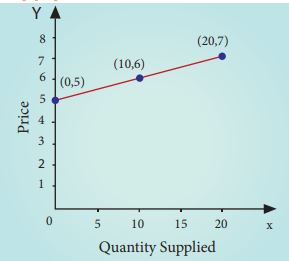
The equation of the straight line joining two data points (10, 6) and (20, 7) is given as
The equation of the straight line is
\(\frac { y-{ y }_{ 1 } }{ { y }_{ 2 }-{ y }_{ 1 } } =\frac { x-{ x }_{ 1 } }{ { x }_{ 2 }-{ x }_{ 1 } } \)
substituting the values of (X1, Y1) (X2, Y2) by (10, 6), (20, 7) respectively,
\(\frac { Y-6 }{ 7-6 } =\frac { X-10 }{ 20-10 }\)
\( \frac { Y-6 }{ 1 } =\frac { X-10 }{ 10 } \)
Then y-6 = \(\frac { X-10 }{ 10 } \)
10(Y - 6) = X - 10
10Y - 60 = X - 10
10Y - 60 + 10 = X
10Y - 50 = X
-X = -10Y + 50
Multiplying both sides by minus (-), we get
X = -50 + 10Y .
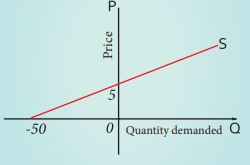
Considering X as quantity supplied and Y as price (P)
Then X = 10p - 50 (or)
(X = -50 + 10p)
If Price = 0; Q = -50
If Q = 0; P = 5
Note: The coefficient of 'p' is - in demand function.
The coefficient of 'p' is + in supply function.
11.
(a) Health in India:
(i) Health in India is a state government responsibility. The Central Council Of Health and Welfare formulates the various health care projects and health department reform policies.
(ii) The administration of health industry in India as well as the technical needs of the health sector are the responsibility of the Ministry Of Health And Welfare.
(iii) Health care in India has many forms. These are the ayurvedic medicine practice, Unani or galenic herbal care, homeopathy, allopathy, yoga, and many more. Each different healthcare form has its own treatment system and practice patterns.
(iv) The medical practicing in India needs a proper licensing from the Ministry of Health. All. medical systems are now under one ministry viz AYUSH.
(b) Health Care Services in India:
(i) The health care services in India are mainly the responsibility of the Ministry of Health. State wise, health status is better in Kerala as compared to other States. Compared to other developed countries, India's health status is not satisfactory. India's health status is poor compared to Sri Lanka.
12.
Examine the life expectancy at birth in India:
Life expectancy at birth:
(i) It refers to the mean expectation of life at birth. Life expectancy has improved over the years.
(ii) Life expectancy is low when death rate is high and/or instances, of early death are high.
(iii) On the other hand, life expectancy is high when death rate is low and/or instances of early death are low.
| Year | Male | Female | Overall |
| 1951 | 32.5 | 31.7 | 32.1 |
| 1991 | 58.6 | 59.0 | 58.7 |
| 2001 | 61.6 | 63.3 | 62.5 |
| 2011 | 62.6 | 64.2 | 63.5 |
(iv) During 1901-11, life expectancy was just 23 years. It increased to 63;5 years in 2011.
(v) A considerable fall in death rate is responsible for improvement in the life expectancy at birth.
(vi) However the life expectancy in India is very low compared to that of developed countries.
13.
Marginal Productivity Theory of Distribution is based on the following assumption.
i) All the factors of production are homogeneous.
ii) Factors of production can be substituted for each other.
iii) There is perfect competition both in factor and product market.
iv) There is perfect mobility of factors of production.
v) There is full employment of factors.
vi) This theory is applicable only in longrun.
vii) The entrepreneurs aim at profit maximization.
viii) There is no government intervention in fixing the price of a factor.
ix) There is no technological change.
14.
Requirements for Rural Development
i) Efforts need to be made to raise farm and non-farm rural real incomes.
ii) Investment in basic infra-structure and social services need to be increased.
iii) Coordinated and integrated programmes for solving the present problems and to achieve sustainable development need to be designed.
iv) Persons and leaders with an understanding of reality of rural problems and with the required foresight vision should be consulted while designing development programmes.
15.
The Micro, Small and Medium Enterprises are defined under the MSME Act 2006. The enterprises based on the investment in plant, machinery and equipment (excluding land and building).
Tamil Nadu accounts of 1507% Micro, Small and Medium Enterprises (highest among states) with 6.89 lakhs registered MSMEs. Producing over 8000 varieties of product for a total investment of more than Rs.32,008 crores.
MSMEs produce a wide variety of products in almost all sectors. The prominent among them are the engineering, electrical, chemical, plastics, steel, paper, matches, textiles, hosiery and garment sector. Around 15.61 lakh entrepreneurs have registered providing employment opportunity to about 99.7 lakh persons with total investment of Rs.1,68,331 crores.
16.
Cost: Cost refers to the total expenses incurred in the production of commodity. The functional relationship between cost and output is expressed as "Cost Function".
C = f(Q)
| S.No. | Economic Cost | Social Cost |
| 1. | It refers to all payments made to the resources to regular supply in the process of production | It refers to the total cost borne by the society due to production of a commodity. |
| 2. | It is the summation of Explicit cost and Implicit cost. | It is also called External cost. |
| 3. | It is the relevant to calculate the profit (Economic profit of a firm) | But incurred by other in the society (efforts and sacrifices undergone by the various members in the society) |
| 4. | (Ex) Payment for raw materials, rent for building | (ex) Large business firm cause air pollution, water pollution in a particular area) |
17.
It is an area in which business and trade laws are different from rest of the country mainly aiming at increasing trade, investment and job creation.
18.
The Government of India had implemented Second Green revolution to achieve higher agricultural growth. The target of Second Green Revolution was to increase 400 million tons of food grain production as against about 214 million tons in 2006-07. This is to be achieved by 2020. In agricultural sector, the growth rate of 5% to 6% has to be maintained over next 15 years. There may be changes in these statistics.
19.
Price discrimination is possible only if the following conditions are fulfilled :
i. The demand must not be transferable from the high priced market to the low priced market.
ii. The monopolist should keep the two markets or different markets separate so that the commodity will not be moving from one market to the other market.
20.
Accounting costs or explicit costs are the payments made by the entrepreneur to the suppliers of various productive factors. The accounting costs are only those costs, which are directly paid out or accounted for by the producer i.e. wages to the labourers employed, prices for the raw materials purchased, fuel and power used, rent for the building hired for the production work, the rate of interest on the borrowed capital and the taxes paid.
21.
(i) Small scale industries play an important role in an Indian economy in many ways.
(ii) 60 to 70% of the total innovations in India come from the SSIs.
(iii) Small Scale Industries provide employment, Balanced regional development, optimisation of capital, utilize the local resources, promote exports, to meet consumer demand, to develop entrepreneurship, complement to large scale industries.
22.
| Total utility | Marginal utility |
| Increases at a diminishing rate | Goes on diminishing |
| Reaches maximum | Becomes zero |
| Diminishes | Becomes negative |
23.
(i) Tamil Nadu has four major international airports.
(ii) Chennai international airport is currently the third largest airport in India after Mumbai and Delhi.
(iii) Other International Airports in Tamil Nadu include Coimbatore International Airport, Madurai International Airport, Tiruchirappalli International Airport.
(iv) It also has domestic Airports at Tuticorin, Salem and Madurai which connect several parts of the country.
(v) Increased industrial activity has given rise to an increase in passenger traffic as well as freight movement which has been growing at over 18-percent per year.
24.
(i) Samuelson states that the means are scarce so such means could be put to alternative uses.
(ii) He makes his definition dynamic by including the element of time.
(iii) His definition is applicable only in a barter economy, where money is not used.
(iv) Samuelson treats economics as a social science, whereas Robbins regards science of individual behaviour.
25.
| Basis for comparison | Short - run production function | Long - run production function |
| Meaning | Short run production function alludes to the time period in which at least one factor of production is fixed | Long run production function connotes the time period in which all the factors of production are variable. |
| Law | Law of variable proportions | Law of returns to scale. |
| Scale of production | No change in scale of production. | change in scale of production |
| Factor - ratio | Changes | Does not change |
| Entry and exit | There are barriers to entry and the firms can shut down but cannot fully exit. | Firms are free to enter and exit |
26.
(i) Morris D Morris developed the Physical Quality of Life Index (PQLI).
(ii) It is a measure to calculate the quality of life
(iii) He included life expectancy, infant mortality rate and literacy rate. A scale of each indicator ranges from 1 to 100.
(iv) Number 1 represents worst performance of any country.
(v) 100 is the best performance. Eg. in case of life expectancy, the upper limit is 100.
(vi) This was assigned to 77 years which was achieved by Sweden in 1973.
(vii) The lower limit 1 was assigned to 28 years achieved by Guinea-Bissau in 1960.
(viii) The difference between HDI and PQLI is the inclusion of income.
(ix) In HDI income is included and it represents both physical and financial aspects of development.
(x) In PQLI income is excluded and only physical aspects of life are considered.
27.
(i) Twelfth Five Year Plan period was 2012 - 2017.
(ii) Its main theme is "Faster, more inclusive and sustainable growth".
(iii) Its growth rate target is 8%.
28.
(i) An Iso quant map has different iso quant curves representing the different combinations of two factors yielding different levels of output.
(ii) An Iso quant is a family of iso quant
(iii) More than one iso quant is called Iso quant map.
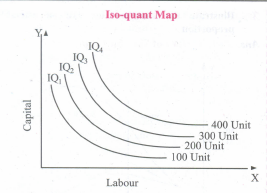
(iv) Higher the Iso quant denotes higher level of output and lower the Iso quant denotes lower level of output.
29.
30.
(i) RRBs came into existence in 1975.
(ii) They develop the rural economy by providing credit and other facilities to the small and marginal farmers, agricultural labourers, artisans and small entrepreneurs.
(iii) RRBs are set up by the joint efforts of the Centre and State governments and commercial banks.
(iv) At present there are 64 RRBs.
(v) The RRBs confine their lending only to the weaker sections and their lending rates are at par with the prevailing rate of co-operative societies.
31.
Wind energy: Muppandal wind farm supplies the villagers with electricity for work. Wind farms are found in Nagercoil, Tuticorin, Coimbatore, Pollachi, Dharapuram & Udumalaipettai. They generate about half of India's 2000 megawatts of wind energy.
Nuclear energy: The Kalpakkam Nuclear Power Plant and the Koodankulam Nuclear Power Plant are the major nuclear energy plants for the energy grid.
Thermal energy: The thermal power plants are at Athippattu (North Chennai), Ennore, Mettur, Neyveli & Thoothukudi.
Hydel energy: There are 20 hydroelectric units in Tamil Nadu at Hundah, Mettur, Periyar, Maravakandy, Parson Valley.
Solar energy: Tamil Nadu tops in solar power generation. Wind energy: Tamil Nadu has the highest installed wind energy capacity in India. The state has very high quality of offshore wind energy potential off the Tirunelveli coast & southern Thoothukudi & Rameswaram Coast.
32.
(i) Tamil Nadu is the largest textile hub of India.
(ii) It is known as the "Yarn Bowl' of India with 41% of India's cotton yarn production.
(iii) It provides employment to 35 million people, contributing 4% of GDP and 35% of gross export earnings.
(iv) From spinning to garment manufacturing the entire textile production chain facilities are in Tamil Nadu.
(v) Coimbatore, Tiruppur, Erode, Dindigul & Karur have the majority of spinning mills manufacturing cotton/polyester/ blended yarn.
(vi) Yarn is exported to China, Bangladesh, Tiruppur (knitting city) exports garments worth USD 3 billion. Karur is famous for textile manufacturing.
(vii) Erode is the main cloth market in south India for retail & wholesale ready-mades.
33.
Relationship among Total, Average and Marginal Products.
| Stages | Total Product | Marginal Product | Average Product |
| Stage - I | It increases at an increasing rate. Then it increases at a decreasing rate. This is the point of inflexion. | It increases, reaches maximum and starts to decrease. | It increases, reaches maximum. |
| Stage - II | It continues to increase at a diminishing rate and reaches maximum | It continues to diminish and becomes zero. | It is equal to MP then begins to diminish. |
| Stage - III | It diminishes. | It becomes negative. | It diminishes but always greater than zero (positive) |
34.
Nature of the commodity:
(i) Durable goods can be stored for long till price increases so elasticity of supply is high.
(ii) Perishables have to be sold immediately, so elasticity of supply is low.
Cost of production:
When there is constant or increasing returns, supply increases so elasticity of supply is greater.
Technology:
In large-scale production with huge capital investment supply cannot be adjusted easily, so elasticity of supply is less.
Time factor:
During very short period, supply cannot be adjusted, so elasticity of supply is very low.
35.
(i) According to Schumpeter profit is the reward for innovation.
(ii) Innovation means invention put into commercial practice.
(iii) Innovation may consist of introduction of a new product or a new method of production or opening a new market or discovery of new raw materials or reorganisation of an industry.
(iv) The cost of production decreases and so profit increases.
(v) Innovation should be done continuously.
36.
(i) Goods and Services Tax is defined as the tax levied when a consumer buys a good or service.
(ii) It is proposed to be a comprehensive indirect tax levied on manufacture, sale and consumption of goods and services.
(iii) It replaces all indirect taxes on goods and services by the government.
(iv) It is a one-point tax.
(v) The GST Act was passed on 29th March 2017 and came into effect on 1st July 2017.
(vi) The motto is one nation, one market, one tax.
Advantages:
(i) Removing Cascading tax effect.
(ii) Single point tax.
(iii) Higher threshold for registration.
(iv) Composition scheme for small business.
(v) Online simpler procedure under GST.
(vi) Defined treatment for e-commerce
(vii) Increased efficiency in logistics.
(viii) Regulating the unorganized sector
37.
38.
39.
Firm : A single production unit in an industry, producing a large or a small amount of the commodity. (eg) Hamam, Lux are 2 firms.
Industry : A group of firms producing the same product. (eg) soap industry.
40.
(i) Expenditure involved in selling the product is called selling cost.
(ii) It is the cost incurred to alter the position of the demand curve for a product. (eg) advertisement.
(iii) Sales promotion by advertisement is called non-price competition.
41.
42.
Definition: "Economics is a science which studies human behaviour as a relationship between ends and scarce means, which have alternative uses."
Explanation:
(i) Human beings have unlimited wants (ends)
(ii) Supply of resources is scarce in relation to demand.
(iii) Scarce resources have alternative uses.
Assessment:
(i) Robbins says that economics is neutral between ends.
(ii) He focuses on the theory of resource allocation.
(iii) He ignores theory of economic growth and development and macroeconomic aspects.
43.
Marginal revenue is the addition to the total revenue by the sale of an additional unit of a commodity. It is got by dividing change in TR by the change in quantity sold.
\(M R=\frac{\Delta T R}{\Delta Q}\), where MR = Marginal revenue.
\(M R=T R_{n}-T R_{n-1} \quad \Delta T R=\text { change in total revenue. } \)
\(M R=T R_{n+1}-T R_{n} \quad \Delta Q=\text { change in total quantity. } \)
\(T R_{n}=\text { total revenue of } n^{\text {th }} \text { item } \)
\(T R_{n-1}=\text { total revenue of } n-1^{\text {th }} item\)
\(T R_{n+1}=\text { total revenue of } n+1^{\text {th }}item\)
44.
| S.No | Money cost | Real cost |
| 1 | Cost is expressed in money. It includes the expenditures such as cost of raw materials, payment of rent, interest on capital, expenses on fuel and power, expenses on transportation and other types of production related costs. | Cost is expressed in the form of efforts, pain and sacrifices incurred by the factor owners for their services in production |
| 2 | Also called prime cost, nominal cost, accounting cost, explicit cost, out-of-pocket cost. | Adam Smith regarded pain and sacrifices as real cost. |
45.
46.
It refers to an improvement in citizens' quality of life and well-being of a country which is measured by per capita income along with several other development indicators like Human Development Index, Physical Quality of Life Index and Gross National Happiness Index.

11th Standard Syllabus & Materials
11th Standard
TN 11th Tamil பீடு பெற நில் - செய்யுள் - காவடிச்சிந்து Important Questions And Answers Study Material - QB365 Set A
NEW11th Standard
TN 11th Tamil பீடு பெற நில் - உரைநடை - மலை இடப்பெயர்கள் : ஓர் ஆய்வு Important Questions And Answers Study Material - QB365 Set A
NEW11th Standard
TN 11th Tamil மாமழை போற்றுதும் - துணைப்பாடம் - யானை டாக்டர் Important Questions And Answers Study Material - QB365 Set A
NEW11th Standard
TN 11th Tamil மாமழை போற்றுதும் - செய்யுள் - ஐங்குறுநூறு Important Questions And Answers Study Material - QB365 Set A



Tamilnadu Stateboard 11th Standard Subjects

Maths

Commerce
Economics

Biology

Business Maths and Statistics

Accountancy

Computer Science

Physics

Chemistry
Maths
Biology
Economics
Physics
Chemistry

History
Business Maths and Statistics

Computer Science
Accountancy

Computer Applications
History
Computer Technology
Commerce
Computer Applications
Computer Technology

Tamil

English

French
Tamilnadu Stateboard Standards
