
 100% FREE ACCESS
11th Standard Syllabus & Materials
11th Standard
TN 11th Tamil இயற்கை வேளாண்மை,சுற்றுச்சூழல் -செய்யுள் - மனோன்மணீயம் Important Questions And Answers Study Material - QB365 Set A
NEW11th Standard
TN 11th Tamil என்னுயிர் என்பேன் -துணைப்பாடம் - இசைத்தமிழர் இருவர் Important Questions And Answers Study Material - QB365 Set A
NEW11th Standard
TN 11th Tamil மொழி கலை -செய்யுள் - ஒவ்வொரு புல்லையும் Important Questions And Answers Study Material - QB365 Set A
NEW11th Standard
TN 11th Tamil பீடு பெற நில் - இலக்கணம் - பகுபத உறுப்புகள் Important Questions And Answers Study Material - QB365 Set A
NEW11th Standard
TN 11th Tamil பீடு பெற நில் - துணைப்பாடம் - வாடிவாசல் Important Questions And Answers Study Material - QB365 Set A
NEW11th Standard
TN 11th Tamil பீடு பெற நில் - செய்யுள் - குறுந்தொகை Important Questions And Answers Study Material - QB365 Set A

Published on: 14/03/2020
11th Standard Economics English Medium All Chapter Book Back and Creative Two Marks Questions 2020
Download Tamil Nadu 11th Standard Economics question papers, model tests, one-mark questions, important questions, and public exam papers in PDF format. Free study materials and answer keys for TN State Board students.
Questions + Answers key
Take MCQ Economics Test
1.
If Y = 2x3 – 6x, then find \(\frac { dy }{ dx } \)
2.
What are the different methods of disinvestment deployed in India.
3.
What is called a square matrix?
4.
What do you mean by colonialism?
5.
State the different types of Imperfect competition.
6.
State the law of Diminishing Marginal Utility (DMU) as given by Marshall.
7.
What does the term External Economies to scale refer to?
8.
Define Marginal Product.
9.
Define Statutory Liquidity Ratio?
10.
What are the Equilibrium conditions for a firm?
11.
What is Average Cost (AC)?
12.
What are the different types of Natural resources?
13.
Distinguish between nominal income and real income?
14.
Mention few determinants of Elasticity of demand?
15.
Define Population Density.
16.
Define Small Scale Industries (SSIs)?
17.
What do you mean by following plan?
18.
If 124 = 68 + 8x what is x?
19.
What do you mean by Isoquant?
20.
What are the degrees of price elasticity of demand?
21.
Write down the criticisms of marginal productivity theory of distribution?
22.
23.
What is the gross export earning of Tamil Nadu?
24.
What is the position of Tamil Nadu in sex ratio?
25.
Write any five weaknesses of Indian economy?
26.
What are the major features of Robbins definitions?
27.
What is Marginal Revenue?
28.
What is the formula for elasticity of supply if you know the supply function?
29.
Mention the indicators which are used to calculate HDI.
30.
What are the objectives of Tenth five year plan?
31.
Define open unemployment.
32.
What do you mean by Rural Development?
33.
What are the reasons for upward sloping supply curve?
34.
35.
Define Micro industry.
36.
What is heritage tourism?
37.
State the reasons for implementing LPG.
38.
Why was structural reform implemented in Indian Economy?
39.
Who is price-taker?
40.
Define Market.
41.
42.
What is meant by Economics?
43.
44.
What is profit?
45.
Give the definition for 'Real cost'.
46.
47.
List out the reasons for low per capita income as given by V.K.R.V. Rao.
48.
Give a short note on Sen's 'Choice of Technique'.
1.
Y = 2x3 – 6x
Differentiate ‘y’ with respect to x,
\(\frac { dy }{ dx } =2\left( 3 \right) { x }^{ 3-1 }-6\left( 1 \right) { x }^{ 1-1 }\)
\(=6{ x }^{ 2 }-6{ x }^{ 0 }\)
\(\frac { dy }{ dx } =6{ x }^{ 2 }-6\)
2.
(i) Equity offer to retail investors through domestic public issues.
(ii) Equity offer through global depository receipt to tap overseas markets.
(iii) Equity offer through differential pricing method when share of PSUs are sold public sector financial institutions and banks.
3.
(i) Matrix is rectangular array of numbers systematically arranged in rows and columns within brackets.
(ii) In a matrix, if the number of rows and columns are equal, it is called a 'square matrix'.
4.
(i) Colonialism refers to a system of political and social relations between two countries, of which one is the ruler and the other is its colony.
(ii) The ruling country not only has political control over the colony, but it also determines the economic policies of the subjugated country.
5.
Different types of Imperfect competition are :
(i) Monopoly
(ii) Discriminating monopoly,
(iii) Bilateral monopoly,
(iv) Monopolistic competition,
(v) Oligopoly and
(vi) Duopoly.
6.
Law of Diminishing Marginal Utility (DMU) :
"The additional benefit which a person derives from a given increase of his stock of a thing, diminishes with every increase in the stock that he already has." states Marshall.
7.
(i) The term "External Economies to scale" refers to changes in any factor outside the firm causing an improvement in the production process. This can take place in the case of industry also.
(ii) These are the advantages enjoyed by all the firms in the industry due to structural growth.
8.
The Marginal Product of a factor of Production means the addition made to the total product by employment of an additional unit of that factor. The Marginal Product may be expressed as MPP, VMP and MRP.
9.
Statutory Liquidity Ratio refers to the amount that the commercial banks require to maintain in the form of cash or gold or government approved securities before providing credit to the customers.
10.
Equilibrium of the firm means that the firm readies the maximum profit.
i. MC = MR.
ii. MC cuts MR curve from below (sufficient conditions).
11.
It refers to the total cost per unit of output. It can be obtained in two ways.
i) By dividing the firm's total cost (TC) by the Quantity of output (Q).
ATC (or) AC = TC/Q.
ii) By ATC is derived by adding together Average Fixed cost (AFC) and Average variable cost (AVC) at each level of output.
ATC = AFC + AVC.
12.
Natural Resources
Any stock (or) reserve that can be drawn from nature is a Natural resource.
Types of Natural Resources
i) Renewable Resources than can regenerated in a given span of time forest, biomass, hydro-energies, etc.
ii) Non-renewable Resources: Resources that cannot be regenerated. Eg., fossil fuels - coal, petroleum, minerals, etc.
13.
| S.No | Nominal Income | Real Income |
| 1. | Nominal Income refers to income expressed in terms of money | Real Income is the amount of goods that can be purchased with money as Income |
| 2. | It is termed as the money income | It is the purchasing power of Income (Money) |
14.
Determinants of Elasticity of demand
i) Availability of substitutes.
ii) Proportion of Consumer's Income.
iii) Number of uses of Commodity.
iv) Complementarity between goods and
v) Time.
15.
Number of persons living per sq. km or per sq. mile
16.
Most small scale industries are located near urban centres. They produce goods for local as well as foreign makets.
17.
(i) This plan was started with an annual plan for 1978 - 1979
(ii) It is a continuation of the terminated fifty year plan.
18.
124 = 68 + 8x
124 - 68 = 8x
56 = 8x
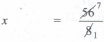
∴ x=7
19.
(i) An Isoquant curve can be defined as the locus of points representing various combinations of two inputs capital and labour yielding the same output.
(ii) The Isoquant is also called as the "Equal product curve" (or) The "Iso-Product curve".
20.
(i) Perfectly Elastic Demand (Ep = \(\infty\))
(ii) Perfectly Inelastic Demand (Ep = 0)
(iii) Relatively Elastic Demand (Ep > 1)
(iv) Relatively Inelastic Demand (Ep < 1)
(v) Unitary Elastic Demand (Ep = 1)
21.
(i) In reality, the factors of production are not homogeneous.
(ii) In practice, factors cannot be substituted for each other.
(iii) This theory is applicable only in the long run.
22.
23.
(i) Tamil Nadu is the largest textile hub of India.
(ii) The textile industry plays a significant role in the Indian economy by providing direct employment to an estimated 35 million people and thereby contributing 4% of GDP and 35% of gross export earnings.
24.
Tamil Nadu stands third position next only to Kerala state and Puducherry Union Territory in sex ratio.
25.
(i) Large population
(ii) Increasing prices of essential goods.
(iii) Lack of infrastructure.
(iv) Inadequate employment opportunities.
(v) Economic Disparities.
26.
(i) Ends refer to wants, Human beings have unlimited wants.
(ii) Means are limited.
(iii) The scarce means time and money are utilized in alternative uses.
27.
(i) Marginal Revenue is the addition made to the total revenue by the sale of an additional unit of a commodity.
(ii) MRn = TRn - TRn-1
28.
Elasticity of supply is the relative change in supply in response to a relative change in price. If S is supply, the supply function is S = f(p)
The formula for elasticity of supply \(e_{\mathrm{s}}=\frac{\mathrm{P}}{\mathrm{S}} \cdot \frac{\mathrm{ds}}{\mathrm{dp}} ; \frac{\mathrm{ds}}{\mathrm{dp}}=\) slope
29.
Longevity (measured by life expectancy at birth), Educational attainments, and Standard of living (measured by real GDP per capita).
30.
(i) The plan aimed to double the per capita income of India in the next 10 years.
(ii) It aimed to reduce the poverty ratio to 15 % by 2012.
(iii) Its growth target was 8.0 % but it
achieved only 7.2%.
31.
(i) Open unemployment is found among agricultural labourers, rural artisans and literate persons.
(ii) Here the unemployed people are identified as they remain without work.
32.
Rural Development is a process of improving the rural areas, rural people and rural living.
33.
(i) Firms will supply less at lower prices and more at higher prices.
(ii) As price of the commodity increases, the amount supplied also increases.
(iii) So, supply curve has a positive slope from left to right.
34.
35.
It is an enterprise with a capital investment not more than 25 lakhs.
36.
It is the practice of travelling abroad to places of historical or cultural interest or heritage importance including churches, mosques, temples, sacred mountains & caves.
37.
(i) Liberalization was needed because the various licensing policies were preventing economic growth.
(ii) Since the private sector was not given enough opportunities to earn more money privatization was done.
(iii) Globalization was needed because today a developed country
can grow without the help of the underdeveloped countries.
38.
(i) There was poverty and unemployment.
(ii) In 1991 there was a severe economic crisis in the form of a serious Balance of Payments problem.
(iii) So a set of policies known as structural reforms were introduced to meet the crisis.
39.
A person who has no power to fix the price of the product is a price taker. A seller in perfect competition is a price taker.
40.
Market refers to a system of exchange between the buyers and the sellers of a commodity.
41.
42.
(i) Economics means management of households.
(ii) It comes from the Greek word oikonomikos.
43.
44.
(i) Profit is earned by the entrepreneur for his entrepreneurial function.
(ii) It is the amount left with the entrepreneur after he has paid for all the other factors.
45.
It is the payment made for the efforts, pain and sacrifices of all factor owners in production.
46.
47.
(i) Uneconomic holdings with subdivisions and fragmentation.
(ii) Low levels of water availability for crops.
(iii) Excess population pressure on agriculture due to fewer industries.
(iv) Absence of capital and autonomy in currency policy.
48.
Sen's 'Choice of Technique' was a research work where he argued that in a labour surplus economy, generation of employment cannot be increased at the initial stage by the adoption of capital-intensive technique.

11th Standard Syllabus & Materials
11th Standard
TN 11th Tamil பீடு பெற நில் - செய்யுள் - காவடிச்சிந்து Important Questions And Answers Study Material - QB365 Set A
NEW11th Standard
TN 11th Tamil பீடு பெற நில் - உரைநடை - மலை இடப்பெயர்கள் : ஓர் ஆய்வு Important Questions And Answers Study Material - QB365 Set A
NEW11th Standard
TN 11th Tamil மாமழை போற்றுதும் - துணைப்பாடம் - யானை டாக்டர் Important Questions And Answers Study Material - QB365 Set A
NEW11th Standard
TN 11th Tamil மாமழை போற்றுதும் - செய்யுள் - ஐங்குறுநூறு Important Questions And Answers Study Material - QB365 Set A



Tamilnadu Stateboard 11th Standard Subjects

Maths

Commerce
Economics

Biology

Business Maths and Statistics

Accountancy

Computer Science

Physics

Chemistry
Maths
Biology
Economics
Physics
Chemistry

History
Business Maths and Statistics

Computer Science
Accountancy

Computer Applications
History
Computer Technology
Commerce
Computer Applications
Computer Technology

Tamil

English

French
Tamilnadu Stateboard Standards
