
 100% FREE ACCESS
11th Standard Syllabus & Materials
11th Standard
TN 11th Tamil இயற்கை வேளாண்மை,சுற்றுச்சூழல் -செய்யுள் - மனோன்மணீயம் Important Questions And Answers Study Material - QB365 Set A
NEW11th Standard
TN 11th Tamil என்னுயிர் என்பேன் -துணைப்பாடம் - இசைத்தமிழர் இருவர் Important Questions And Answers Study Material - QB365 Set A
NEW11th Standard
TN 11th Tamil மொழி கலை -செய்யுள் - ஒவ்வொரு புல்லையும் Important Questions And Answers Study Material - QB365 Set A
NEW11th Standard
TN 11th Tamil பீடு பெற நில் - இலக்கணம் - பகுபத உறுப்புகள் Important Questions And Answers Study Material - QB365 Set A
NEW11th Standard
TN 11th Tamil பீடு பெற நில் - துணைப்பாடம் - வாடிவாசல் Important Questions And Answers Study Material - QB365 Set A
NEW11th Standard
TN 11th Tamil பீடு பெற நில் - செய்யுள் - குறுந்தொகை Important Questions And Answers Study Material - QB365 Set A

Published on: 01/10/2019
Production Analysis
Download Tamil Nadu 11th Standard Economics question papers, model tests, one-mark questions, important questions, and public exam papers in PDF format. Free study materials and answer keys for TN State Board students.
Questions + Answers key
Take MCQ Economics Test
1.
_____________ is a free gift of nature.
Land
Organisation
Capital
All of these
2.
Modern economists have propounded the law of
Increasing returns
Decreasing returns
Constant returns
Variable proportions
3.
Mention the economies reaped from inside the firm
financial
technical
managerial
all of the above
4.
The short-run production is studied through
The Law of Returns to scale
The Law of Variable Proportions
Iso-quants
Law of Demand
5.
The primary factors of production are:
Labour and Organisation
Labour and Capital
Land and Capital
Land and Labour
6.
Explain - "Scale of Production"?
7.
What do you mean by law of supply?
8.
Who is an 'Organizer'?
9.
What are the conditions for producer’s equilibrium?
10.
11.
State the production function.
12.
13.
Describe law of variable proportions?
14.
What are the factors determining supply?
15.
Distinguish between Total Product (TP) and Average Product (AP).
16.
State the Cobb-Douglas production function.
17.
Illustrate the concept of producer's Equilibrium.
18.
What are the functions of Entrepreneur?
19.
20.
Explain the internal and external economies of scale.
21.
List out the properties of iso-quants with the help of diagrams.
1.
(a)
Land
2.
(a)
Increasing returns
3.
(d)
all of the above
4.
(b)
The Law of Variable Proportions
5.
(d)
Land and Labour
6.
"Scale of Production" refers to the ratio of factors of production. This ratio can change because of availablity of factore. The scale of production is an important fact (or) affecting the cost of production.
7.
(i) Law of supply is associated with production analysis.
(ii) It explains the positive (or) direct relationship between Price and quantity supplied.
8.
(i) The man behind organizing the business is called 'Organizer' or 'Entrepreneur'
(ii) An organiser is the most important factors of production.
9.
(i) The iso-cost line must be tangent to iso-quant curve,
(ii) At point of tangency, the iso-quant curve must be convex to the origin.
10.
11.
(i) Production function refers to the relationship among units of the factors of production (inputs) and the resultant quantity of a good produced (output).
(ii) Q = f(N, L, K, T);
Q = Quantity of output, N = Land, L = Labour, K = Capital, T = Technology
12.
13.
The law states that if all other factors are fixed and one input is varied in the short run, the total output will increase at an increasing rate at first instance, be constant at a point and then eventually decrease. Marginal product will become negative at last.
According to G. Stigler, 1/ As equal increments of one input are added, the inputs of other productive services being held constant, beyond a certain point, the resulting increments of product will decrease, i.e., the marginal product will diminish".
Assumptions:
(i) Only one factor is variable while others are held constant.
(ii) All units of the variable factors are homogeneous.
(iii) The product is measured in physical units.
(iv) There is no change in the state of technology.
(v) There is no change in the price of the product.
14.
(i) Price of commodity.
(ii) Price of the other commodity.
(iii) Price of factors.
(iv) Price expectations.
(v) Technology.
(vi) Natural factors
(vii) Discovery of new raw materials.
(viii) Taxes and Subsidies.
(ix) Objective of the firm.
15.
Total Product:
(i) It refers to the total amount of commodity produced by combination of all inputs in a given period of time.
(ii) It can be calculated in two ways
TP = AP x N (or) AP = TP / N
Average Product:
(i) It refers to the output per unit of the input (or)
\(AP=\frac { TP }{ Q } (or)N\)
(ii) It is the result of the total product divided by the total output.
16.
(i) Charles Cobb and Paul Douglas have given a linear homogeneous production function.
(ii) A proportionate increase in the factors leads to a proportionate increase in output.
(iii) There is constant returns to scale with only labour and capital.
(iv) The elasticity of substitution between the factors is one.
Q = AL\(\alpha \)K\(\beta \)
Q = output; A = positive constant; K = Capital; L = Labour, \(\alpha \) + \(\beta \) = 1
17.
Producer's equilibrium happens when there is maximum output with minimum cost ie. optimum combination of the factors of production.
The two conditions to be fulfilled are
1. The iso-cost line must be tangent to iso-quant curve.
2. At the point of tangency, iso-quant must be convex and MRTSLK must be declining.
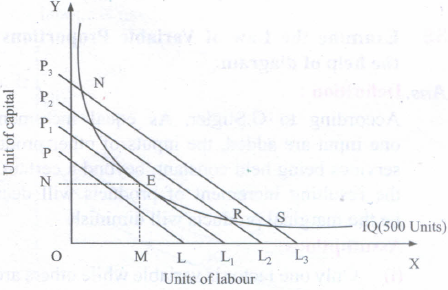
3. The producer is in equilibrium at E.
Slope of iso-quant curve = Slope of iso-cost curve.
18.
Initiation: He considers the situation and availability of resources and plans the process of production.
Innovation: He introduces new methods in the production process.
Co-ordination: He uses a particular combination of the factors of production.
Control, direction & supervision: He directs the factors to get better results and supervises for the efficient functioning of all factors.
Risk taking, uncertainty bearing: Risk is insured, uncertainties cannot be insured.
19.
20.
Introduction:
(i) Scale of production refers to the ratio of factors of production.
(ii) Every producer wants to reduce the cost of production.
(iii) When there is large scale production he enjoy lot of advantages.
(iv) These advantages are called economies of scale.
(v) Marshall divided them into internal economies and external economies.
Internal Economies:
They refer to advantages enjoyed by a firm.
Technical Economies:
When there is large scale production, there is more capital, new technology, research and development.
Financial Economies:
Big firms can float shares in the market for capital expansion.
Managerial Economies:
(i) Specialisation of labour is followed.
(ii) There is delegation of work.
Labour Economies:
(i) There is division of labour.
(ii) Quality and productivity increases.
Marketing Economies:
(i) Producers can buy raw materials at cheaper cost.
(ii) Transport cost is less.
(iii) They enjoy bargaining power.
Economies of survival:
(i) Product diversification is possible.
(ii) This reduces the risk in production.
(iii) Even if the market for one product falls, the market for other commodities offsets it.
External Economies:
(i) They refer to changes in any factor outside the firm causing an improvement in the production process.
(ii) These advantages are enjoyed by all the firms in the industry due to the structural growth.
Example:
1. Increased transport facilities.
2. Banking facilities.
3. Development of townships.
4. Development of information and communication.
21.
Iso and quant are derived from the Greek language, meaning 'equal' and 'quantity'.
Definition:
Isoquant curve is a locus of points representing various combinations of two inputs capital and labour yielding the same output. It is also called equal product curve or product indifference curve.
Properties:
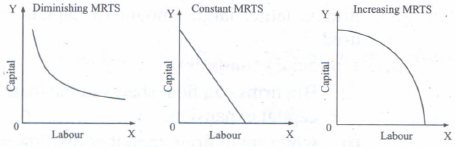
1. The isoquant curve has negative slope:
(i) Capital is being substituted by labour.
(ii) Isoquant has negative slope because of diminishing MRTS.
(iii) Constant MRTS (straight line) and increasing MRTS (concave) are also possible.
(iv) It depends on the nature of isoquant curve
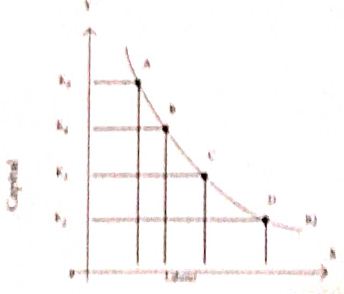
2. Isoquant curve is convex to origin:
The capital substituted per unit of labour goes on decreasing so the isoquant is convex to the origin.
3. Isoquant curves cannot intersect each other:
Point A lies on IQ1 and IQ2, Point C lies on IQ2, showing higher output Point B
lies on IQ1, showing lower output. C = A, B = A But C > B.
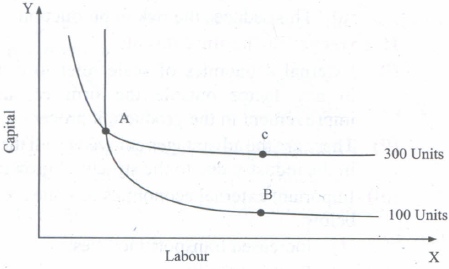
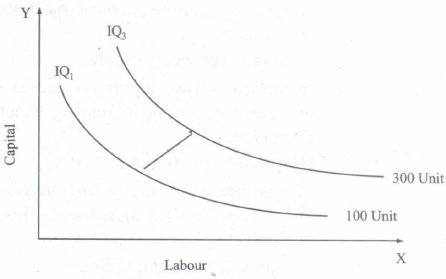
4. Upper isoquant curve represents a higher level of output:
Higher IQ2 shows higher output 200 units. Lower IQ1 shows lower output 100 units. IQ2 means the use of more factors than IQ1. Arrow shows increase in output with a right and upward shift of an isoquant curve.
5. Isoquant curve does not touch either x axis or y axis:
In IQ2 only capital is used and in IQ1 only labour is used.
.JPG)
Conclusion:
These are the properties of isoquant curves.

11th Standard Syllabus & Materials
11th Standard
TN 11th Tamil பீடு பெற நில் - செய்யுள் - காவடிச்சிந்து Important Questions And Answers Study Material - QB365 Set A
NEW11th Standard
TN 11th Tamil பீடு பெற நில் - உரைநடை - மலை இடப்பெயர்கள் : ஓர் ஆய்வு Important Questions And Answers Study Material - QB365 Set A
NEW11th Standard
TN 11th Tamil மாமழை போற்றுதும் - துணைப்பாடம் - யானை டாக்டர் Important Questions And Answers Study Material - QB365 Set A
NEW11th Standard
TN 11th Tamil மாமழை போற்றுதும் - செய்யுள் - ஐங்குறுநூறு Important Questions And Answers Study Material - QB365 Set A



Tamilnadu Stateboard 11th Standard Subjects

Maths

Commerce
Economics

Biology

Business Maths and Statistics

Accountancy

Computer Science

Physics

Chemistry
Maths
Biology
Economics
Physics
Chemistry

History
Business Maths and Statistics

Computer Science
Accountancy

Computer Applications
History
Computer Technology
Commerce
Computer Applications
Computer Technology

Tamil

English

French
Tamilnadu Stateboard Standards
