
 100% FREE ACCESS
11th Standard Syllabus & Materials
11th Standard
TN 11th Tamil இயற்கை வேளாண்மை,சுற்றுச்சூழல் -செய்யுள் - மனோன்மணீயம் Important Questions And Answers Study Material - QB365 Set A
NEW11th Standard
TN 11th Tamil என்னுயிர் என்பேன் -துணைப்பாடம் - இசைத்தமிழர் இருவர் Important Questions And Answers Study Material - QB365 Set A
NEW11th Standard
TN 11th Tamil மொழி கலை -செய்யுள் - ஒவ்வொரு புல்லையும் Important Questions And Answers Study Material - QB365 Set A
NEW11th Standard
TN 11th Tamil பீடு பெற நில் - இலக்கணம் - பகுபத உறுப்புகள் Important Questions And Answers Study Material - QB365 Set A
NEW11th Standard
TN 11th Tamil பீடு பெற நில் - துணைப்பாடம் - வாடிவாசல் Important Questions And Answers Study Material - QB365 Set A
NEW11th Standard
TN 11th Tamil பீடு பெற நில் - செய்யுள் - குறுந்தொகை Important Questions And Answers Study Material - QB365 Set A

Published on: 12/03/2019
+1 Public Exam March 2019 Creative Questions and Answers
Download Tamil Nadu 11th Standard Economics question papers, model tests, one-mark questions, important questions, and public exam papers in PDF format. Free study materials and answer keys for TN State Board students.
Questions + Answers key
Take MCQ Economics Test
1.
The revenue function and demand function from marginal revenue function. Give the Reason.
2.
What is the performance of Tamil Nadu Economy?
3.
State the impacts of Globalization.
4.
Give an account of Cotton and Textile Industry of India.
5.
Mention the importance of Rural Road
6.
Examine the Birth rate and death rate of India.
7.
What are the determinants of Demand? Explain.
8.
Bring out the features of Monopoly?
9.
Discuss the Stable Equilibrium with the help of a diagram?
10.
What do you know about green revolution?
11.
Explain about MUDRA.
12.
Write the classification of wants.
13.
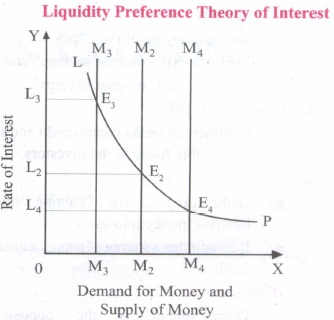
Draw the diagram for liquidity preference theory of interest.
14.
Write a short note on Liberalization.
15.
Write short note on Gross National Happiness index.
16.
Explain 'Monopsony'.
17.
Examine the major implications of samuelson growth definition
18.
Explain Average cost with the help of a diagram.
19.
Explain the concept of division of labour.
20.
Distinguish between Total Product (TP) and Average Product (AP).
21.
What are the features of market?
22.
What is demand function?
23.
Give an account of Urbanisation in Tamil Nadu.
24.
What is rural development, according to the World Bank?
25.
What do you mean by Insurable Risks?
26.
What is personal distribution?
27.
State the indices which are used to assess the quality of life in India.
28.
What is meant by 'Advertising Elasticity of Demand'?
29.
What are the criticisms made on the law of Equi-Marginal Utility?
30.
What does the term "External diseconomies of scale refer to"?
31.
What is meant by Total Product (TP)?
32.
What are capital goods?
33.
Explain the following terms (or) concept?
i) FDI and
ii) FPI
34.
Distinguish between Natinal Market and International Market?
35.
What are the classifications of Public Sector Banks?
36.
Define - "Capital".
37.
Define Macro Economics?
38.
Define the Law of Diminishing Marginal Utility?
39.
Explain Automotives?
40.
Define Globalization?
41.
What is energy?
42.
Mention the relationship between MC and AC.
43.
Difference consumer goods and capital goods?
44.
What are the classification of public sector banks?
45.
What do you mean by law of supply?
46.
What are factors of production?
47.
What is market demand?
48.
Define budget line.
49.
Explain about micro scale enterprise
50.
What are the factors determining demand for loanable funds?
51.
Write down the criticisms of marginal productivity theory of distribution?
52.
What are the negative effects of Globalisation?
53.
Write a note on 'Dumping'.
54.
What is Monopoly?
55.
What are the six levels of education system in India?
56.
Which is called developed economies?
57.
Distinguish between free goods and economic goods.
58.
State four definitions of economics.
59.
What are the various books available in the titles of economics?
60.
What is Average Revenue?
1.
If R is the total revenue function when the output is x, then marginal revenue.
\(MR=\frac { dR }{ dx } \) integrating with respect to 'x' we get.
Revenue Function: R = ഽ(MR) dx + k
where 'k' is the constant of integration which can be evaluated under given conditions when x = 0, total revenue R = 0.
Demand Functi.on: P = \(\frac { R }{ x } ,x\neq 0\).
2.
Some of the states like Gujarat and Maharashtra seem to perform well in some of the economic indicators. Kerala tops in literacy, IMR and MMR. In recent years Tamil Nadu's performance is outstanding and far ahead of all other states in the spheres of health, higher education, growth of MSMEs, poverty alleviation and employment generation.
Tamil Nadu is placed third in health index: The Tamil Nadu state has come third after Kerala and Punjab in a health index report. The neo natal mortality rate is 14 lower than that of many other states and that the under 5 mortality has dropped horn 21 in 2014 to 20 in 2015.
The reasons for the relative success of Tamil Nadu lie in extending social policies to cover most of the population. For instance the Public Distribution System, midday meals and public health infrastructure have near universal coverage.
3.
Impacts of Globalization:
Positive effects:
(i) Expansion of Market
(ii) Development of infrastructure
(iii) Higher living standards
(iv) International co-operation
Negative effects:
(i) Cut throat competition
(ii) Rise in Monopoly
(iii) Discourage Domestic Firms
(iv) Increase in inequalities.
4.
Cotton and textile industry:
(i) Oldest industry of India, and employs largest number of workers.
(ii) It is the largest organised and broadbased industry which accounts for 4% of GDP, 20% of manufacturing value-added and one third of total export earnings.
(iii) The first Indian modernised cotton cloth mill was established in 1818 at Fort Gloaster near Calcutta. But this mill was not successful. The second mill named "Mumbai's Spinning and Weaving Co." was established in 1854 at Bombay by KGN Daber.
5.
(a) Road transport is an important constituent of the transport system. Rural roads constitute the very life line of rural economy.
(b) A well-constructed road network in rural area would bring several benefits including the linking of remote villages with urban centres, reduction in cost of transportation of agricultural inputs and promotion of marketing for rural produces.
(c) It helps the farmers to bring their produce to the urban markets and to have access to distant markets and other services.
(d) Rural roads in India constitute 26.50 lakh kms, of which 13.5 percent of the roads are surfaced.
6.
Birth rate and death rate:
(i) Crude Birth rate: It refers to the number of births per thousand of population.
(ii) Crude Death rate: It refers to the number of deaths per thousand of population Crude birth and death rates of India during various years
Table: Birth rate and death rate
| Year | C.B.R | C.D.R |
| 1951 | 39.9 | 27.4 |
| 2001 | 25.4 | 8.4 |
| 2011 | 21.8 | 7.11 |
(iii) Birth rate was 39.9 in 1951; it fell to 21.8 in 2011. Although the birth rate has declined, the decline is not so remarkable.
(iv) The death rate has declined from 27.4 in 1951 to 7.1 in 2011. However, from the data it is clear that the fall in birth rates is less than that of death rates.
(v) Kerala has the lowest birth rate (14.7) and Uttar Pradesh has the highest birth rate (29.5).
(vi) West Bengal has the lowest death rate. (6.3) and Orissa (9.2) has the highest.
(vii) Among States Bihar has the highest decadal (2001-11) growth rate of population, while Kerala has the lowest growth rate.
7.
Determinants of Demand:
(1) Changes in Tastes and Fashions: The demand for some goods and services is very susceptible to changes in tastes and fashions
(2) Changes in Weather: An unusually dry summer results in a increase in the demand for cool drinks.
(3) Taxation and Subsidy: If fresh taxes are levied or the existing rates of taxation on commodities are increased their prices go up. The subsidies will bring down the prices. Therefore taxes reduce demand and subsidies raise demand.
(4) Changes in Expectations: Expectations also bring about a change in demand. Expectation of rise in price in future results in increase in demand.
(5) Changes in Savings: Savings and demand are inversely related.
(6) State of Trade Activity: During the periods of boom and prosperity, the demand for all commodities tends to increase. On the contrary, during times of depression there is a general slackening of demand.
(7) Advertisement: In advanced capitalistic countries advertising is a powerful instrument increasing the demand in the market.
(8) Changes in Income: An increase in family income may increase the demand for durables like video recorders and refrigerators. Equal distribution of income enables poor to get more income. As a result consumption level increases.
(9) Change in Population: The demand for goods depends on the size of population. An increase in population tends to increase the demand for goods and a decrease in population tends to decrease the demand (if other things remain constant).
8.
Features of Monopoly :
(1) There is a single producer / seller of a product;
(2) The product of a monopolist is unique and has no close substitute;
(3) There is strict barrier for entry of any new firm;
(4) The monopolist is a price-maker;
(5) The monopolist earns maximum profit/ abnormal profit.
(6) Firm and industry: Under monopoly, there is no difference between a firm and industry. As there is only one firm, that single firm constitutes the whole industry
9.
Stable Equilibrium
a. Prof. Stigler states "equilibrium is a position from which there is no net tendency to move".
b. Its absence is referred to as disequilibrium.
c. A resource is in equilibrium when it gets fully employed and gets its maximum payment.
d. Static equilibrium is based on given and constant prices, quantities, income, technology, population etc.
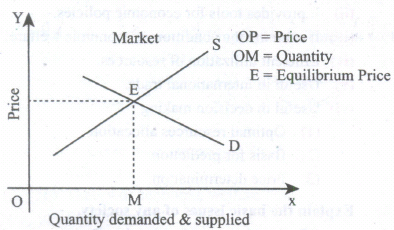
Explanation:
a. OX denotes Quantity demand and supplied and OY denotes price.
b. "DO. - Demand curve and "55" is the Supply curve.
c. At point "E" the quantity demanded is equal to Quantity supplied (0 = 5)
d. At equilibrium, price is stable because their is no tendency for change as (0 = 5).
10.
(i) The term green revolution refers to the renovation of agricultural practices.
(ii) During 1960's the traditional agricultural practices were gradually replaced by modern technology and agricultural practices.
(iii) The new technology was tried in 1960 - 61 as a pilot project in seven districts.
11.
(i) It is a public sector financial institution.
(ii) It provides loans at low rates to micro finance institutions.
(iii) And also provides credit to non-banking financial institutions, micro, small and medium enterprises.
(iv) It was launched on 8th April 2015.
(v) Mostly individual proprietorships running small manufacturing, trading or services activities.
(vi) Most of these are owned by people belonging to scheduled caste, scheduled tribe (or) other backward classes.
(vii) MUDRA was started specifically for financing these units.
12.
(i) Goods which are indispensable for the human being to exist in the world are called "necessaries" (for example food).
(ii) Goods which are not indispensable for life but to make our life easy, convenient and comfortable are called "comforts". (for example: TV)
(iii) Goods which are not very essential but are very costly are known as "Luxuries". (for example- Jewellery, Diamonds).
13.
14.
(i) Liberalization refers to removal of relaxation of governmental restriction in all stages in industry.
(ii) Delicensing, decontrol, deregulation, fiscal incentives and greater role for financial institutions are the various facets of liberalization.
15.
(i) The term "Gross National Happiness" was coined by the fourth king of Bhutan Jigme Singye Wangchuck, in 1972.
(ii) It is an indicator of progress, which measures sustainable development environmental conservation promotion of culture and good governance.
16.
(i) It is a market structure in which there is only one buyer of a good or service.
(ii) If there is only one customer for a certain good that customer has 'Monopsony' power in the market for that good.
(iii) Monopsony is analogous to monopoly. But monopoly has market power on the demand side rather than the supply side.
17.
(i) Samuelson states that the means are scarce so such means could be put to alternative uses.
(ii) He makes his definition dynamic by including the element of time.
(iii) His definition is applicable only in a barter economy, where money is not used.
(iv) Samuelson treats economics as a social science, whereas Robbins regards science of individual behaviour.
18.
(i) It refers to the total cost per unit of output.
(ii) ATC=TC/Q (or)
(iii) ATC=AFC+AVC
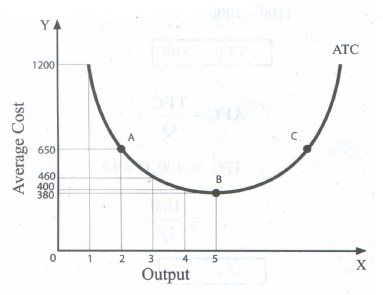
(iv) ATC curve is also a 'U' shaped curve.
(v) Initially the ATC declines reaches a minimum when the plant is operated optimally, and rises beyond the optimum output.
(vi) The 'U' shape of the AC reflected the law of the variable proportions.
19.
(i) Division of labour means dividing the process of production into distinct and several component process and assigning each component in the hands of a labour or a set of labourers, who are specialists in that particular process.
(ii) For Example: A tailor stitches maximum of four shirt a day in the case of garment exports firm, it may stitch more than 100 shirts a day
20.
Total Product:
(i) It refers to the total amount of commodity produced by combination of all inputs in a given period of time.
(ii) It can be calculated in two ways
TP = AP x N (or) AP = TP / N
Average Product:
(i) It refers to the output per unit of the input (or)
\(AP=\frac { TP }{ Q } (or)N\)
(ii) It is the result of the total product divided by the total output.
21.
The features of market are:
(i) Buyers and sellers of a commodity or a service.
(ii) A commodity to be bought and sold.
(iii) Price agreeable to buyer and seller.
(iv) Direct or indirect exchange
22.
Demand depends upon price. This means demand for a commodity is a function of price. Demand function mathematically is denoted as,
D = f(P),where D = Demand, f = function, P = Price.
23.
(i) Tamil Nadu is the most urbanised state with 48.4% of urban population against 31.5% for India as a whole.
(ii) The state accounts for 9.61% of total urbanites in India against 6% share of total population.
24.
According to World Bank, 'Rural Development' is a strategy designed to improve the economic and social life of a specific group of people - rural poor.
25.
(i) Certain risks are measurable or calculable.
(ii) Examples: risk of fire, theft and natural disasters.
(iii) Such risks are compensated by the Insurance companies
26.
Personal distribution is the distribution of National Income among the individuals.
27.
The quality of life is being assessed by several indices such as
(i) Human Development Index (HDI)
(ii) Physical Quality of Life Index (PQLI) and
(ill) Gross National Happiness Index (GNHI)
28.
Advertising Elasticity of Demand : The responsiveness of the change in demand due to the change in advertising or other promotional expenses, is known as advertising elasticity of demand.
29.
Criticisms made on the law of Equi-Marginal Utility :
(i) In practice, utility cannot be measured, only be felt.
(ii) This law cannot be applied to durable goods.
30.
(i) The term "External diseconomies" refers to the threat or disturbance to a firm or an industry from factor lying outside it.
(ii) Examples. Bus strike, bandh, establishment of new economic units in the locality etc.
31.
(i) Total Product (TP) refers to the total amount of commodity produced by the combination of all inputs in a given period of time.
(ii) TP = \(\sum { MP } \), i.e., TP is the summation of Marginal product.
32.
(i) Capital goods are goods which do not directly satisfy the consumer wants.
(ii) But they help to produce consumer goods.
(iii) For example, machines do not directly satisfy the consumers, but in factories, the manufacturers use them to produce consumer goods.
33.
Foreign Direct Investment (FDI): An investment in a business by an investor from another country.
Foreign Private Investment (FPI): It comprises Foreign Direct Investment and Foreign Portfolio Investment.
34.
| National Market | International Market |
| a) when products and services are sold and bought throughout a country. | when products and services are sold and bought at the world level. |
| b) Nation-wide market | Global Market (or) World-wide Market |
| c) (Ex) Tea, Coffee, Cement, Electrical goods, some printed books etc | (Ex) Petro, gold etc |
35.
Public sector banks are classified into two categories:
(i) Nationalised Banks
(ii) State Bank and its Associates.
36.
Marshall says "Capital consists of all kinds of wealth other than free gifts of nature, which yield income"
Bohm - Bawerk defines it as "a produced means of Production".
37.
Macro Economics is concerned with the economy as a whole. It is the study of aggregates such as national output, inflation, unemployment and taxes. The General Theory of Employment, Interest and Money published by Keynes is the basis of modern Macro Economics.
38.
Marshall states the law as "additional benefit which a person derives from a given increase of his stock of a thing, diminishes will every increase in the stock that he already has".
39.
"The Detroit of Asia" is home to a large number of auto component industries.
40.
Globalization refers to the integration of the domestic (india) economy with the rest of the world.
41.
Electrical energy is one of the necessary components of our life now a day without electricity, we cannot survive in this world of technology.
42.
The relationship between the marginal and the average cost is more a Mathematical one rather than economic
43.
| Consumer goods | Capital Goods |
| 1. Human wants are satisfied directly the consumer goods | Goods do not satisfy the consumer directly are called capital goods |
| 2. Example: TV, Fridge | Example: Machinery |
44.
Public sector banks are classified into 2 categories.
They are,
(i) Nationalised Banks
(ii) State Bank and its associates.
45.
(i) Law of supply is associated with production analysis.
(ii) It explains the positive (or) direct relationship between Price and quantity supplied.
46.
(i) The inputs that a firm uses in the production process are called factors of production.
(ii) It includes factor inputs and non-factor inputs
47.
Market demand means the total quantity of a commodity that all its buyers are willing to purchase at different prices over a given period of time.
48.
Budget line is a line showing different combinations of two goods which a consumer can attain at his given Income and Market price of the goods.
49.
Enterprises having not exceeding Rs. 25 Lakhs investment in plant and machinery and service sector industries having not exceeding Rs. 10 Lakhs investment in equipment.
50.
The demand for loanable funds depend upon the following:
(i) Demand for Investment (I)
(ii) Demand for Consumption (C)
(iii) Demand for Hoarding (H)
51.
(i) In reality, the factors of production are not homogeneous.
(ii) In practice, factors cannot be substituted for each other.
(iii) This theory is applicable only in the long run.
52.
(i) Cut throat competitions
(ii) Rise in Monopoly
(iii) Discourage domestic Firms
(iv) Increase in inequalities
53.
(i) Dumping refers to the practice of the monopolist charging the higher price in the local market and, lower price in the foreign market.
(ii) Through dumping a country expands its command over other countries for its product. It is called as 'international price discrimination'.
54.
(i) Monopoly has been derived from two words 'Mono' - single, 'poly' - to control.
(ii) Monopoly is a market situation in which there is only one seller.
(iii) There is no scope for competition.
55.
(i) Nursery Class
(ii) Primary Class
(iii) Secondary Class
(iv) Higher Secondary Class
(v) Graduation
(vi) Post Graduation
56.
Developed economies are those countries which are industrialised utilized their resources efficiently and high per capita income.
57.
| Sl.No | Economic Goods | Free Goods |
| 1 | Goods which scarce are called economic goods | Goods that are not scarce are called free goods. |
| 2 | Example: Chair, Table etc | Example: Air and Sunshine. |
58.
(i) Smith's Wealth Definition, representing the classical stage.
(ii) Marshall's Welfare Definition, representing the neoclassical stage.
(iii) Robbin's Scarcity Definition, representing the New age, and
(iv) Samuelson's Growth Definition, representing the Modern age
59.
(i) Introductory Economics
(ii) Economics an Introduction
(iii) Basic Economics
(iv) Elements of Economics
(v) Elementary Economics
(vi) Fundamentals of Economics etc.
60.
(i) Average revenue is the revenue per unit of the commodity sold.
(ii) It is calculated by dividing the total revenue (TR) by the number of units sold (Q).
(iii) AR = TR / Q
where AR = Average Revenue, TR = Total Revenue, Q = Quantity Sold

11th Standard Syllabus & Materials
11th Standard
TN 11th Tamil பீடு பெற நில் - செய்யுள் - காவடிச்சிந்து Important Questions And Answers Study Material - QB365 Set A
NEW11th Standard
TN 11th Tamil பீடு பெற நில் - உரைநடை - மலை இடப்பெயர்கள் : ஓர் ஆய்வு Important Questions And Answers Study Material - QB365 Set A
NEW11th Standard
TN 11th Tamil மாமழை போற்றுதும் - துணைப்பாடம் - யானை டாக்டர் Important Questions And Answers Study Material - QB365 Set A
NEW11th Standard
TN 11th Tamil மாமழை போற்றுதும் - செய்யுள் - ஐங்குறுநூறு Important Questions And Answers Study Material - QB365 Set A



Tamilnadu Stateboard 11th Standard Subjects

Maths

Commerce
Economics

Biology

Business Maths and Statistics

Accountancy

Computer Science

Physics

Chemistry
Maths
Biology
Economics
Physics
Chemistry

History
Business Maths and Statistics

Computer Science
Accountancy

Computer Applications
History
Computer Technology
Commerce
Computer Applications
Computer Technology

Tamil

English

French
Tamilnadu Stateboard Standards
