
 100% FREE ACCESS
11th Standard Syllabus & Materials
11th Standard
TN 11th Tamil இயற்கை வேளாண்மை,சுற்றுச்சூழல் -செய்யுள் - மனோன்மணீயம் Important Questions And Answers Study Material - QB365 Set A
NEW11th Standard
TN 11th Tamil என்னுயிர் என்பேன் -துணைப்பாடம் - இசைத்தமிழர் இருவர் Important Questions And Answers Study Material - QB365 Set A
NEW11th Standard
TN 11th Tamil மொழி கலை -செய்யுள் - ஒவ்வொரு புல்லையும் Important Questions And Answers Study Material - QB365 Set A
NEW11th Standard
TN 11th Tamil பீடு பெற நில் - இலக்கணம் - பகுபத உறுப்புகள் Important Questions And Answers Study Material - QB365 Set A
NEW11th Standard
TN 11th Tamil பீடு பெற நில் - துணைப்பாடம் - வாடிவாசல் Important Questions And Answers Study Material - QB365 Set A
NEW11th Standard
TN 11th Tamil பீடு பெற நில் - செய்யுள் - குறுந்தொகை Important Questions And Answers Study Material - QB365 Set A

Published on: 04/03/2019
11th Public Exam March 2019 Model Test
Download Tamil Nadu 11th Standard Economics question papers, model tests, one-mark questions, important questions, and public exam papers in PDF format. Free study materials and answer keys for TN State Board students.
Questions + Answers key
Take MCQ Economics Test
1.
___________shows various combinations of two products that give the same amount of satisfaction.
Iso cost curve
Indifference curve
Marginal Utility curve
Iso quanct
2.
Who gave welfare definition of economics?
Samuelson
Alfred Marshall
Pigou
Adam Smith
3.
There is strict barrier for entry of any new firm in_______________.
Perfect competition
Monopoly
Monopolistic competition
Oligopoly
4.
Which of the following is non-insurable risks?
Natural disaster
Theft
Fire
Public policy
5.
Steel Authority of India Ltd. (SAIL) was established in the year
1974
1970
1972
1971
6.
The locus of the points which gives same level of satisfaction is associated with
Indifference Curves
Cardinal Analysis
Law of Demand
Law of Supply
7.
Capital and Organisation are the ____________ factors of production.
Primary
Secondary
Tertiary
All of these
8.
The total length of the mettur dam is ___ meters.
1600 m
1700 m
1800 m
1500 m
9.
_____ Architect of new economic policy.
Manmohan Singh
Dr. Raj Krishna
Shri. P.V. Narasimha Rao
Amartya Sen
10.
Which feature is identified with rural areas?
Low population density
High population density
Low natural resources
Low human resources
11.
12.
13.
In health index, Tamil Nadu is ahead of
Kerala
Punjab
Gujarat
All the above
14.
In a firm 5 units of factors produce 24 units of the product. When the number of factor increases by one, the production increases to 30 units. Calculate the Average Product.
30
6
5
24
15.
Identify the formula of estimating average cost.
AVC/Q
TC/Q
TVC/Q
AFC/Q
16.
Which of the following is the way of privatisation?
Disinvestment
Denationalization
Franchising
All the above
17.
Utility means
Equilibrium point at which demand and supply are equal
Want-satisfying capacity of goods and services
Total value of commodity
Desire for goods and services
18.
Money wages are also known as
real wages
nominal wages
original wages
transfer wages
19.
The advocate of democratic socialism was
Jawaharlal Nehru
P.C. Mahalanobis
Dr. Rajendra Prasad
Indira Gandhi
20.
In 1614 Sir Thomas Roe was successful in getting permission from
Akbar
Shahjahan
Jahangir
Noorjahan
21.
Give short note on Sen's "Poverty and Inequality".
22.
Explain the Hydel Energy in Tamil Nadu.
23.
What are the properties of iso-quant curve?
24.
Mention few characteristics of SEZ..
25.
Why the transport cost is nil under Perfect Competition?
26.
Find the average cost function where TC = 60 + 10x + 15x2.
27.
28.
Define Cottage Industry.
29.
What is meant by Economics?
30.
Give the definition for 'Real cost'.
31.
What is need for study the mathematics economics?
32.
Explain ordinal utility approach.
33.
How are the energy sources classified? Explain.
34.
What are the conditions of price discrimination?
35.
How does the liberalisation helped in the recovery of Indian Economy?
36.
Write any three objectives of Industrial Policy 1991.
37.
What are the factors governing elasticity of supply?
38.
Distinguish between rent and quasi-rent.
39.
Compare positive economics and normative economics.
40.
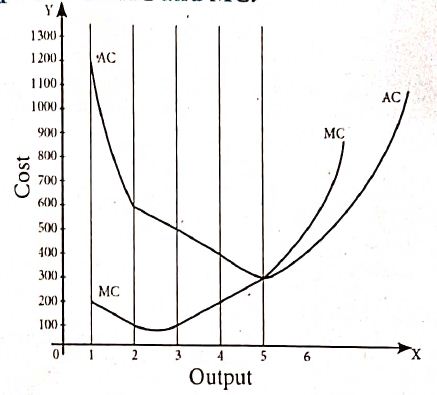
State the relationship between AC and MC.
41.
Describe the social Infrastructure.
42.
Describe the law of supply in details.
43.
Explain the steps involved in making presentation using the software 'Microsoft Powerpoint'.
44.
Give an account of the Monetary and Financial sector reforms.
45.
Explain the Agio theory of Interest.
46.
State the various kinds of Goods.
47.
Describe the various types of industries in Tamil Nadu. The Government is promoting industrial parks like Rubber Park, Apparel Park, Floriculture Park, TICEL Park for Biotechnology, Siruseri IT Park and Agro Zones. Tamil Nadu has a network of about 110 industrial parks/estates that offer developed plots with supporting infrastructure.
48.
Explain the meaning of Fixed and Variable factors and costs.
49.
Find the solution of the system of equation
7x1 - x2 - x3 = 0
10x1 - 2x2 + x3 = 8
6x1 + 3x2 - 2x3 = 7
50.
51.
Explain the role of SSIs in economic development ?
52.
53.
54.
Explain how price and output are determined under monopolistic competition with help of a diagram.
1.
(b)
Indifference curve
2.
(b)
Alfred Marshall
3.
(b)
Monopoly
4.
(d)
Public policy
5.
(a)
1974
6.
(a)
Indifference Curves
7.
(a)
Primary
8.
(b)
1700 m
9.
(a)
Manmohan Singh
10.
(a)
Low population density
11.
(d)
12.
(a)
13.
(c)
Gujarat
14.
(c)
5
15.
(b)
TC/Q
16.
(d)
All the above
17.
(b)
Want-satisfying capacity of goods and services
18.
(b)
nominal wages
19.
(a)
Jawaharlal Nehru
20.
(c)
Jahangir
21.
Sen has carried out massive work on poverty and inequality in India. Sen's major point has been that the distribution of income/consumption among the persons below the poverty line is to be taken into account.
22.
There are about 20 hydro electric units in Tamil Nadu. The prominent units are Hundah, Mettur, Periyar, Maravakandy, Parson Valley etc.
23.
(i) It has negative slope.
(ii) Convex to the origin.
(iii) Non-inter section of iso-quant curves.
(iv) An upper iso-quant curve represents a higher level of output.
(v) Iso-quant curve does not touch either x-axis or y-axis.
24.
Characteristics of SEZ:
i) Geographically demarked area with physical security.
ii) Administrated by single body/ authority.
iii) Having separate custom area.
iv) Greater freedom to the firms located in SEZs.
25.
Under perfect competition, a commodity is sold at uniform price throughout the market. So it is assumed that there is no transport cost.
26.
\(\mathrm{AC}=\frac{\mathrm{TC}}{x}
\)
\(\mathrm{TC}=60+10 x+15 x^{2}
\)
\(\mathrm{AC}=\frac{60}{x}+10+15 x\)
27.
28.
Cottage industry are carried out by artisans in their own homes, these industries are traditional, with no or little power.
29.
(i) Economics means management of households.
(ii) It comes from the Greek word oikonomikos.
30.
It is the payment made for the efforts, pain and sacrifices of all factor owners in production.
31.
The subject Economics deals with many quantitative variables and functions, in consumption, production, distribution and policy making. Hence, the mathematical methods would help economists to use the quantitative variables in a better way and to obtain accurate results. The lengthy and descriptive economic contents can be clearly set in simple notations in mathematical models for clear and easy understanding. For example, the number of pens demanded in a given time period in a Higher Secondary School is 200 when price is zero. This decreases by 10 for every Rs.1 rise in the price of pen. It is expressed mathematically as Q = 200 - 10 P, here Q is the quantity demanded and P is the price. Thus large information can be expressed and communicated with simple functions and equations.
32.
F. W. Edgeworth and Vilfredo Pareto criticised the Cardinal Utility Approach. It is otherwise called "Indifference Curve Approach". J. R. Hicks and R.G.D. Allen Approach. J. R. Hicks in his book "Value and Capital" gave a final shape to this "Indifference Curve Analysis".
Scale of Preference: This theory is also based on scale of preference. A rational consumer usually prefers the combination of goods which gives him maximum level of satisfaction. Thus, the consumer can arrange goods and their combination in order of their satisfaction.
Such an arrangement of combination of goods in the order of level of satisfaction is called the "Scale of Preference".
Assumptions:
(i) It assumes that the consumer possesses 'complete information' about all the relevant aspects of economic environment.
(ii) Consumer behaves rationally.
(iii) It also assumes 'continuity'. This means that the consumers are capable of ordering or ranking all combination of goods.
(iv) The consumer is not interested in anyone commodity as that utility analysis, but is a combination of goods.
(v) It assumes that the consumer has before him in indifference map for a pair of commodities.
(vi) The prices of these goods are given in the market and are assumed to be constant.
33.
Energy Sources:
Electrical energy is one of the necessary components of our life. Nowadays, without electricity, we cannot survive in this world of technology. The energy sources are classified under two heads based on the availability of the raw materials used, while generating energy.
(a) Non-renewable energy sources and
(b) Renewable energy sources
(a) Non-renewable energy sources: As the name suggests, the sources of energy which cannot be renewed or re-used are called non-renewable energy sources. Basically these are the energy sources which will get exhausted over a period of time. Some of the examples of this kind of resources are coal, oil, gas etc.
(b) Renewable energy sources: These are the kind of energy source which can be renewed or reused again and again. These kinds of materials do not exhaust or literally speaking these are available in abundant or infinite quantity. Example for this kind include
(i) Solar energy
(ii) Wind energy
(iii) Tidal energy
(iv) Geothermal energy
(v) Biomass energy
Sometimes renewable sources are also called non-conventional sources of energy since; these kinds of materials of these ways of energy production were not used earlier or conventionally.
34.
Price discrimination is possible only if the following conditions are fulfilled :
i. The demand must not be transferable from the high priced market to the low priced market.
ii. The monopolist should keep the two markets or different markets separate so that the commodity will not be moving from one market to the other market.
35.
(i) The liberalization policy helped in the recovery of Indian Economy.
(ii) There was enormous and regular flow of foreign direct investment.
(iii) Foreign Exchange reserves started raising.
(iv) There was rapid industrialization.
(v) The pattern of consumption started improving.
(vi) Infrastructure facilities such as express highways (metro rails, flyovers and airport started, expanding)
36.
(i) The policy aimed at correcting the weaknesses and rigidities in the various sectors of the economy - industry, trade, fiscal and agriculture.
(ii) To liberate the industry from licensing system.
(iii) To reduce the role of public sector.
(iv) To encourage foreign participation in India's industrial development.
37.
Nature of the commodity:
(i) Durable goods can be stored for long till price increases so elasticity of supply is high.
(ii) Perishables have to be sold immediately, so elasticity of supply is low.
Cost of production:
When there is constant or increasing returns, supply increases so elasticity of supply is greater.
Technology:
In large-scale production with huge capital investment supply cannot be adjusted easily, so elasticity of supply is less.
Time factor:
During very short period, supply cannot be adjusted, so elasticity of supply is very low.
38.
| SI.No | Rent | Quasi Rent |
|---|---|---|
| 1 | Rent accrues to land | Quasi - Rent accrues to man made appliances |
| 2 | The supply of land is fixed forever. | The supply of man made appliances is fixed for a short period only. |
| 3 | It enters into price. | It does not enter into price. |
| 4 | It is temporary. |
39.
| S.No | Positive Economics | Normative Economics |
| 1 | Deals with what is, how and why | deals with what ought to be |
| 2 | Analyses a problem on the basis of facts and examines its causes. | results are not based on facts but on social, cultural, political and religious considerations. |
| 3 | it is subjective | |
| 4 | (eg) if rate of interest increases we see why & how it can be reduced. | (eg) if rate of interest increases, we see whether it is good or bad |
40.
When AC is falling, MC remains below AC.
When AC becomes constant MC becomes equal to it.
When AC starts increasing MC is above the AC
MC always cuts AC at its minimum point from below.
41.
Social infrastructure refers to those structures which are improving the quality of manpower and contribute indirectly towards the growth of an economy. These structures are outside the system of production and distribution. The development of these social structures help in increasing the efficiency and productivity of manpower. For example, schools, colleges, hospitals and other civic amenities. It is a fact that one of the reasons for the low productivity of Indian workers is the lack of development of social infrastructure. The status and developments in the social infrastructure in India are discussed below.
Education:
(i) Education in India: Imparting education on an organized basis dates back to the days of 'Gurukul' in India. Since then the Indian education system has flourished and developed with the growing needs of the economy. The Ministry & Human Resource Development (MHRD) in India formulates education policy in India and also undertakes education programs.
(ii) Education system in India: Education in India until 1976was the responsibility of the State governments. It was then brought under concurrent list (both Centre and State). The centre is represented by the Ministry ofHuman Resource Development decides the India's education budget. The Education System in India consists of primary six level:
(a) Nursery class
(b) Primary class
(c) Secondary class
(d) Higher Secondary Level
(e) Graduation
(f) Post-Graduation
(iii) Education institutions in India: Education in India follows the 10 + 2 pattern. For higher education, there are various state run as well as private institutions and universities providing a variety of courses and subjects. The accreditation of the universities is decided under the University Grant Commission Act. The Education Department consists of various schools, colleges and universities imparting education on fair means for all sections of the society. The budget share of the education sector is around B% of GDP, of this largest proportion goes for school education. However, per pupil expenditure is the lowest for school students.
Health:
(i) Health in India: Health in India is a state government responsibility. The Central Council of Health and Welfare formulates the various health care projects and health department reform policies. The administration of health industry in India as well as the technical needs of the health sector are the responsibility of the Ministry of Health and Welfare. Health care in India has many forms. These are the ayurvedic medicine practice; unani or galenic herbal care, homeopathy, allopathy, yoga, and many more. Each different healthcare form has its own treatment system and practice patterns. The medical practicing in India needs a proper licensing from the Ministry of Health. All medical systems are now under one ministry viz AYUSH.
(ii) Health care services in India: The health care services in India are mainly the responsibility of the Ministry of Health. State wise, health status is better in Kerala as compared to other States. Compared to other developed countries, India's health status is not satisfactory. India's health status is poor compared to Sri Lank.
42.
Meaning: It is associated with production analysis. It explains the positive relationship between the price of a commodity and the supply of that commodity. For example, if the price of cloth increases, the supply of cloth will also increase.
Definition: "Other things remaining the same, if the price of a commodity increases its quantity supplied increases and if the price of a commodity decreases, quantity supplied also decreases".
Supply Function: The supply of a commodity depends on the factors such as price of commodity, price of labour, price of capital, the state of technology, number of firms, prices of related goods, and future price expectations and so on. Mathematically the supply function is
Qs = f (Px, Pr, Pf, T, O, E )
Where Qs = Quantity supplied of x commodity
Px = Price of x Commodity
Pr = Price of related goods
Pf = Price of factors of production
T = Technology
O = Objective of the producer
E = Expected Price of the commodity.
Assumptions:
(i) There is no change in the prices of factors of production.
(ii) There is no change in price of capital goods.
(iii) Natural resources and their availability remain the same.
(iv) Prices of substitutes are constant.
(v) There is no change in technology.
(vi) Climate remains unchanged.
(vii) Political situations remains unchanged.
(viii) There is no change in tax policy.
Explanation: Supply function is Qs = f (P) or Q = 20P.
P is an independent variable. When its value changes, new values of Qs can be calculated.
Supply Schedule: It shows the different quantities of supply at different prices. This information is given in the supply schedule given below.
| Price (P) | Supply(Qs) |
| 1 | 20 |
| 2 | 40 |
| 3 | 60 |
| 4 | 80 |
| 5 | 100 |
Qs = 20 P
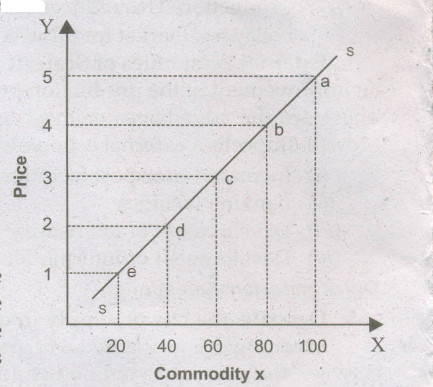
Supply Curve: A supply curve represents the data given in the supply schedule. As the price of the commodity increases, the quantum supplied of the commodity also increases. Thus-the supply curve has a positive slope from left to right.
The quantum supplied of commodity x is represented on X axis. And the price of the commodity is represented on the Y axis. The points such as e, d, c, b and a on the supply' curve 55', represent various quantities at different prices.
Factors determining supply:
(a) Price of the commodity
(b) Price of other commodities
(c) Price of factors
(d) Price expectations
(e) Technology
(f) Natural factors
(g) Discovery of new raw-materials
(h) Taxes and subsidies
(i) Objective of the firm
43.
Microsoft Power Point :
It is a software used to perform computer-based presentation.
Steps involved in making presentation:
(i) Click Start Menu
(ii) Click Program
(iii) Select Microsoft Powerpoint - Click.
(iv) New PowerPoint file will open, and then type the title and subtitle if wanted.
(v) A new slide can be inserted by 'click' on icon 'new slide' or using short key 'Ctrl + M'
(vi) We can type the content, insert the table, pictures, movies, sounds, etc., with the content.
(vii) Tab 'Design' helps to design the slides (can select common design for all slides or separate slide for each slide)
(viii) Click icon slide show, one can run slide show either starting from the first slide or starting from the current slide.
The power point presentation (PPT) facilitates the key points to be kept in memory and understand the particular topic. Recently, the smart classroom teaching uses the PPT to deliver the information in an effective way to enhance the quality of teaching.
44.
Monetary and Financial Sector Reforms:
Monetary reforms aimed at doing away with interest rate distortions and rationalizing the structure of lending rates.
The new policy tried in many ways to make the banking system more efficient. Some of the measures undertaken were:
(a) Reserve Requirements: Reduction in statutory liquidity ratio (SLR) and the cash reserve ratio (CRR) were recommended by the Narasimham Committee Report, 1991. It was proposed to cut down the SLR from 38.5 percent to 25 percent within a time span of three years. Similarly, it was proposed that the CRR be brought down to 3 to 5% over a period of four years.
(b) Interest Rate Liberalisation: Earlier, RBI controlled
(i) the interest rates payable on deposits,
(ii) the interest rates which could be charged for bank loans.
(c) Greater competition among public sector, private sector and foreign banks and elimination of administrative constraints.
(d) Liberalisation of bank branch licensing policy in order to rationalize the existing branch network.
(e) Banks were given freedom to relocate branches and open specialized branches
(f) Guidelines for opening new private sector banks.
(g) New accounting norms regarding classification of assets and provisions of bad debt were introduced in tune with the Narasimham Committee Report.
45.
Agio Theory of Interest/The Psychological Theory of Interest/Time Preference Theory:
(i) This theory was propounded by John Rae in 1834. But credit goes to Bohm Bawerk an Austrian School economist who has given final shape to the theory.
(ii) The American economist Irving Fisher modified and gave a new theory viz Time Preference theory.
(iii) According to this theory, people prefer present goods rather than future goods. Because the present goods are more certain than future goods, just "as a bird in the hand is worth two in the bush".
(iv) There are many countries where no one knows what will happen next day.
(v) ASEAN crisis of 1996 and American crisis of 2007-08 were not predicted even for economists, including Nobel Laureates.
(vi) So, when people save they have to postpone their present enjoyment or satisfaction.
(vii) If one postpones one's present satisfaction, one has to be paid an "Agio" or "Premium".
(viii) This premium is "interest". People prefer present consumption than future consumption due to the risk increasing and uncertainties of the present world.
46.
Kinds of Goods (and Services)
(a) Free and Economic goods
(i) Free goods are available in nature and in abundance. Man does not need to incur any expenditure to own or use them. For example air, and sunshine. Water was also an example in the past, but at present it has exchange value. So it is not a free good.
(ii) On the other hand, economic goods are not available in plenty. They are scarce in supply. Man has to spend money to own or use them.
(b) Consumer goods and Capital goods:
(iii) Consumer goods directly satisfy human wants, TV, Furniture, Automobile, etc.
(iv) Capital-goods (also called producer's goods) don't directly satisfy the consumer wants. They help to produce consumer goods. For example, machines do not directly satisfy the consumers, but in factories, the manufacturers need them.
(c) Perishable goods and Durable goods:
(v) Perishable goods are short-lived. Their life-span is limited. For example fish, fruits, flower, etc, do not have a long life.
(vi) Durable goods and semi-durable goods have a little longer life-time than the Perishable goods. For example, a table, a chair, etc.
47.
The Government is promoting industrial parks like Rubber Park, Apparel Park, Floriculture Park, TICEL Park for Biotechnology, Siruseri IT Park and Agro Zones. Tamil Nadu has a network of about 110 industrial parks/estates that offer developed plots with supporting infrastructure.
Types of Industries:
i) Textiles:
Tamil Nadu is the largest textile hub of India and also "Yarn Bowl" of the country accounting for 41% of India's cotton yarn production. The western part of Tamil Nadu comprising Coimbatore, Tiruppur, Erode, Dindigul and Karur has the majority of spinning mills manufacturing cotton/polyster blended yarn and silk yarn used by garment units in Tamil Nadu. Tiruppur known as "knitting city" is the exporter of garments worth USD 3 million. Erode is the main cloth market both retail and Wholesale market.
ii) Leather:
Tamil Nadu occupies for 30% of leather exports and about 70% of leather production in the country. Hundreds of leather and tannery industries are located around Vel/ore, Dindigul and Erode. Every year the state hosts the India International Leather Fair in Chennai.
iii) Electronics:
Chennai has emerged at EMS Hub of India. Many Multi-national companies have chosen Chennai as their South Asian manufacturing hub.
iv) Automobiles:
Chennai nicknamed as "The Detroit of Asia" is home to large number of auto component industries. Tamil Nadu has 28% share each in automotive and auto component industries, 19% in the trucks segment and 18% each in ' passenger cars and two wheelers.
v) Cement:
Tamil Nadu ranks third in Cement production in India. Among 10 largest cement companies in India as on 2018, Ramco cement and India Cement find prominent place. And also Tamil Nadu stands second in number of cement plants with 21 units against 35 units in Andra Pradesh.
vi) Fireworks:
The town of Sivakasi is a leader in the areas of printing, fireworks and safety matches. It was fondly called as "Little Japan" by Jawaharlal Nehru. It contributes to 80% of India's fireworks production. Sivakasi provides over 60% of India's total offset printing solutions.
vii) Other Industries:
One of the global electrical equipment public sector companies BHEL has manufacturing plants in Tiruchirappalli and Ranipet. TNPL and the State Government, the world's biggest bagasse-based paper mill in Karut The region around Salem is rich in mineral ores. The country's largest steel plant public sector undertaking SAIL has a steel plant in Salem.
48.
Fixed cost and variable cost: Fixed cost and variable cost are helpful in understanding the behaviour of costs over different levels of output.
Meaning of Fixed and Variable factors and costs:
Fixed and variable factors are with reference to short run production function. Short run is a period of time over which certain factors of production cannot be changed, and such factors are called fixed factors. The costs incurred on fixed factors are called fixed costs. The factors whose quantity can be changed in the short run are variable factors, and the costs incurred on variable factors are called variable costs
Fixed costs are those which are independent of output, that is, they do not change with changes in output. These costs are a 'fixed' amount, which must be incurred by a firm in the short run whether the output is small or large. E.g. contractual rent, interest on capital invested, salaries to the permanent staff, insurance premia and certain taxes. Variable costs are those costs, which are incurred on the employment of variable factors of production whose amount can be altered in the short run. Thus the total variable costs change with the level of output. It rises when output expands and falls when output contracts. When output is nil, variable cost becomes zero. These costs include payments such as wages of labour employed, prices of raw materials, fuel and power used arid the transport costs.
49.
The matrix form of the given equation is written as
\(\begin{bmatrix} 7 & -1 & -1 \\ 10 & -2 & +1 \\ 6 & 3 & -2 \end{bmatrix}\left[ \begin{matrix} { x }_{ 1 } \\ { x }_{ 2 } \\ { x }_{ 3 } \end{matrix} \right]\)\(=\begin{bmatrix} 0\\ 8\\ 7\\ \end{bmatrix}\)
\(\Delta\)=\(\begin{vmatrix} 7& -1& -1\\ 10& -2& +1\\ 6& 3& -2\\ \end{vmatrix}\)
=7(4-3)-(-1)(-20-6)+(-1)(30+12)
=7(1)+1(-26)-1(42)
=7 - 26 - 42 = - 61
\(\triangle \)x1 \(=\begin{bmatrix} 0 & -1 & -1 \\ 8 & -2 & +1 \\ 7 & 3 & -2 \end{bmatrix}\)
=0(4-3)-(-1)(-16-7)+(-1)(24+14)
=0+1(-23)-1(38)
=-23-38 = - 61
\(\Delta x_2=\begin{vmatrix} 7& 0& -1\\ 10& 8& 1\\ 6& 7& -2\\ \end{vmatrix}\)
=7(-16 - 7) - (0)(-20 - 6)+(-1)(70 - 48)
=7(-23)+0 - 1 (22)
=-161 - 22 = -183
\(\triangle \)x3 \(=\begin{bmatrix} 7 & -1 & 0 \\ 10 & -2 & 8 \\ 6 &3 & 7 \end{bmatrix}\)
=7(-14-24)-(-1)(70-48)+0(30+12)
=7(-38)+1(22)+0(42)
=-266+22+0
\(\triangle \)x1 = - 244
\(x_{1}=\frac{\Delta x_{1}}{\Delta}=\frac{-61}{-61}=1\)
\(x_{2}=\frac{\Delta x_{2}}{\Delta}=\frac{-183}{-61}=3\)
\(x_{3}=\frac{\Delta x_{3}}{\Delta}=\frac{-244}{-61}=4\)
50.
.JPG)
51.
Introduction :
(i) Small scale industries play an important role for the development of Indian economy.
(ii) 60 - 70% of total innovations in India comes from SSIs.
Provides employment:
(i) SSIs use labour intensive techniques.
(ii) They provide employment to artisans, technically qualified persons and professionals, people engaged in traditional arts, people in villages and unorganized sector.
(iii) The employment-capital ratio is high.
Brings balanced regional development:
(i) SSIs are set up in backward and rural areas.
(ii) This promotes decentralised development of industries.
(iii) They reduce congestion, slums, sanitation and pollution in cities since they are found outside city limits.
(iv) They improve the standard of living of people in suburban and rural areas
(v) The entrepreneurial talent is tapped from different regions.
Helps in mobilization of local resources:
(i) SSIs mobilize and use local resources like small savings, entrepreneurial talent etc of the entrepreneurs which might have remained idle.
(ii) It promotes traditional family skills and handicrafts.
Paves for optimisation of capital:
(i) SSIs needs less capital. They give quick profit due to shorter gestation period.
(ii) SSIs functions as a stabilizing force by providing high output-capital ratio and high employment capital ratio.
(iii) They encourage people living in rural areas to save and channelize them into industrial activities.
Promotes export:
(i) Since they do not need sophisticated machinery, import of machinery from abroad is not needed.
(ii) There is great demand for goods produced by SSIs.
(iii) They reduce the pressure on balance of payment as they earn foreign exchange
Complements large scale industries:
(i) They provide components, parts, accessories to large scale industries.
(ii) They serve as ancillaries to large scale units.
Meets consumer demand:
(i) SSIs produce a wide range of consumer products.
(ii) They serve as an anti-inflationary force by providing goods of daily use.
Develops entrepreneurship:
(i) SSIs help to develop entrepreneurs.
(ii) They help the job seekers to become job givers.
(iii) They promote self-employment and a spirit of self-reliance.
(iv) It increases the per capita income of India.
(v) There is development of backward areas and weaker sections.
(vi) It helps in equitable distribution of income.
52.
53.
54.
Introduction:
E.H. Chamberlin introduced the concept of monopolistic competition.
(i) Firm under monopolistic competition has equilibrium when MC = MR & when MC cuts MR from below.
(ii) The AR curve slopes downward and is fairly elastic.
(iii) Different firms produce different varieties of the product and sell them at different prices.
Each firm seeks to get equilibrium with regard to
1) price & output 2) product adjustment 3) selling cost adjustment
Short run equilibrium
.JPG)
In fig (a) OM is the equilibrium output. OP is the price.
TR = OMQP, TC = OMRS, Abnormal Profit = PQRS
In fig (b) TR = OMQP, TC = OMLR, Loss = PQLR
Long run equilibrium:
.JPG)
(i) In short run the firm may earn super normal profit or incur loss.
(ii) In the long run the AR is more elastic.
(iii) The firms earn only normal profit.
(iv) Equilibrium output = OM. Price = OP, AR = QM, AC = QM.
(v) Equilibrium is got when AR = AC. AR is tangent to AC at Q.

11th Standard Syllabus & Materials
11th Standard
TN 11th Tamil பீடு பெற நில் - செய்யுள் - காவடிச்சிந்து Important Questions And Answers Study Material - QB365 Set A
NEW11th Standard
TN 11th Tamil பீடு பெற நில் - உரைநடை - மலை இடப்பெயர்கள் : ஓர் ஆய்வு Important Questions And Answers Study Material - QB365 Set A
NEW11th Standard
TN 11th Tamil மாமழை போற்றுதும் - துணைப்பாடம் - யானை டாக்டர் Important Questions And Answers Study Material - QB365 Set A
NEW11th Standard
TN 11th Tamil மாமழை போற்றுதும் - செய்யுள் - ஐங்குறுநூறு Important Questions And Answers Study Material - QB365 Set A



Tamilnadu Stateboard 11th Standard Subjects

Maths

Commerce
Economics

Biology

Business Maths and Statistics

Accountancy

Computer Science

Physics

Chemistry
Maths
Biology
Economics
Physics
Chemistry

History
Business Maths and Statistics

Computer Science
Accountancy

Computer Applications
History
Computer Technology
Commerce
Computer Applications
Computer Technology

Tamil

English

French
Tamilnadu Stateboard Standards
