
 100% FREE ACCESS
11th Standard Syllabus & Materials
11th Standard
TN 11th Tamil இயற்கை வேளாண்மை,சுற்றுச்சூழல் -செய்யுள் - மனோன்மணீயம் Important Questions And Answers Study Material - QB365 Set A
NEW11th Standard
TN 11th Tamil என்னுயிர் என்பேன் -துணைப்பாடம் - இசைத்தமிழர் இருவர் Important Questions And Answers Study Material - QB365 Set A
NEW11th Standard
TN 11th Tamil மொழி கலை -செய்யுள் - ஒவ்வொரு புல்லையும் Important Questions And Answers Study Material - QB365 Set A
NEW11th Standard
TN 11th Tamil பீடு பெற நில் - இலக்கணம் - பகுபத உறுப்புகள் Important Questions And Answers Study Material - QB365 Set A
NEW11th Standard
TN 11th Tamil பீடு பெற நில் - துணைப்பாடம் - வாடிவாசல் Important Questions And Answers Study Material - QB365 Set A
NEW11th Standard
TN 11th Tamil பீடு பெற நில் - செய்யுள் - குறுந்தொகை Important Questions And Answers Study Material - QB365 Set A

Published on: 30/10/2019
Download Tamil Nadu 11th Standard Economics question papers, model tests, one-mark questions, important questions, and public exam papers in PDF format. Free study materials and answer keys for TN State Board students.
Questions + Answers key
Take MCQ Economics Test
1.
When marginal utility reaches zero, the total utility will be
Minimum
Maximum
Zero
Negative
2.
How much share of rural families in India is in debt?
Half
One fourth
Two third
Three fourth
3.
Which is considered as the basic unit for rural areas?
Panchayat
Village
Town
Municipality
4.
Ryotwari system was initially introduced in
Kerala
Bengal
Tamil Nadu
Maharashtra
5.
Which district has the lowest child sex ratio?
Madurai
Theni
Ariyalur
Cuddalore
6.
The command Ctrl +M is applied for
Saving
Copying
Getting new slide
Deleting a slide
7.
If x+y = 5 and x-y = 3 then, value of x
4
3
16
8
8.
Modern economists have propounded the law of
Increasing returns
Decreasing returns
Constant returns
Variable proportions
9.
Profit of a firm is obtained when __________.
TR < TC
TR - MC
TR > TC
TR = TC
10.
The process of reasoning from particular to general is
Deductive method
Inductive method
Positive economics
Normative economics
11.
The main source of irrigation in Tamil Nadu is
river
tank
well
canals
12.
When price remains constant, AR will be _____ MR.
equal to
greater than
less than
not related to
13.
The Arguments against LPG relate to ________
Economic growth
More investment
Disparities among people and regions
Modernization
14.
Who is the father of Economics?
Max Muller
Adam Smith
Karl Marx
Paul A Samuelson
15.
A statement of equality between two quantities is called
Inequality
Equality
Equations
Functions
16.
The reward given for the use of capital
rent
wage
interest
profit
17.
The cost that remains constant at all levels of output is _____ cost.
fixed
variable
real
social
18.
Formula for calculating AP is
\(\frac { \Delta TP }{ N } \)
\(\frac { \Delta TP }{ \Delta N } \)
\(\frac { TP }{ MP } \)
\(\frac { TP }{ N } \)
19.
In which year the population of India crossed one billion mark?
2000
2001
2005
1991
20.
Rent is the reward for the use of
Capital
Labour
Land
Organization
21.
\(\int { 5dx }\)
22.
23.
List out the weaknesses of Green Revolution.
24.
Rural Poverty - Define.
25.
26.
27.
28.
Differentiate the function y = 3x2 + 16x3 with respect to x.
29.
Describe the feature of human wants
30.
What is PQLI?
31.
32.
What are the renewable sources of power in Tamil Nadu?
33.
34.
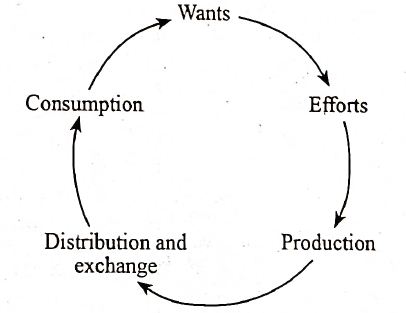
Explain different types of economic activities.
35.
36.
37.
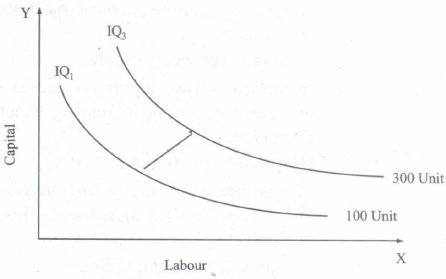
List out the properties of iso-quants with the help of diagrams.
38.
39.
Explain the objectives and characteristics of SEZs.
40.
41.
Bring out the features of perfect competition.
1.
(b)
Maximum
2.
(d)
Three fourth
3.
(b)
Village
4.
(c)
Tamil Nadu
5.
(c)
Ariyalur
6.
(c)
Getting new slide
7.
(a)
4
8.
(a)
Increasing returns
9.
(c)
TR > TC
10.
(b)
Inductive method
11.
(c)
well
12.
(a)
equal to
13.
(c)
Disparities among people and regions
14.
(b)
Adam Smith
15.
(c)
Equations
16.
(c)
interest
17.
(a)
fixed
18.
(d)
\(\frac { TP }{ N } \)
19.
(b)
2001
20.
(c)
Land
21.
\(\int { 5dx }\)=5x + c
22.
23.
(i) Indian agriculture is still a gamble of the monsoons.
(ii) This strategy needs heavy investment in seeds, fertilizers, pesticides and water.
(iii) Gap between irrigated and rain fed areas had widened.
(iv) Farm mechanization created unemployment.
(v) Larger chemical use reduced the soil fertility and spoiled human health.
24.
Rural poverty refers to the existence of poverty in rural areas.
25.
26.
27.
28.
y = 3x2 + 16x3
Differentiating,
\(\frac{dy}{dx}=3(2)x^{2-1}+16(3)x^{3-1}\)
= 6x1 + 48x2
\(\frac{dy}{dx}=6x+48x^{2}\)
29.
Characteristics
Wants are unlimited
(i) Wants are countless and various in kinds.
(ii) When one want is satisfied another want arises.
Wants become habits
(i) When a man starts reading newspaper in the morning it becomes a habit.
Wants are satiable
(i) We can satisfy particular wants at a given time.
(ii) When one feels hungry, he takes food and that want is satisfied.
Wants are alternative
(i) There are alternative ways to satisfy a particular want (eg) idly, dosa.
Wants are competitive
(i) There is competition among wants.
(ii) So we have to choose more urgent wants and satisfy them first.
Wants are complementary
(i) Satisfaction of a particular want requires the use of more than one commodity. (eg) car and petrol.
Wants are recurring
(i) Some wants occur again and again. For ex. if we feel hungry, we take food and satisfy our want.
(ii) But after some time we again feel hungry and want food.
30.
(i) Morris D Morris developed the Physical Quality of Life Index (PQLI).
(ii) It is a measure to calculate the quality of life
(iii) He included life expectancy, infant mortality rate and literacy rate. A scale of each indicator ranges from 1 to 100.
(iv) Number 1 represents worst performance of any country.
(v) 100 is the best performance. Eg. in case of life expectancy, the upper limit is 100.
(vi) This was assigned to 77 years which was achieved by Sweden in 1973.
(vii) The lower limit 1 was assigned to 28 years achieved by Guinea-Bissau in 1960.
(viii) The difference between HDI and PQLI is the inclusion of income.
(ix) In HDI income is included and it represents both physical and financial aspects of development.
(x) In PQLI income is excluded and only physical aspects of life are considered.
31.
32.
Wind energy: Muppandal wind farm supplies the villagers with electricity for work. Wind farms are found in Nagercoil, Tuticorin, Coimbatore, Pollachi, Dharapuram & Udumalaipettai. They generate about half of India's 2000 megawatts of wind energy.
Nuclear energy: The Kalpakkam Nuclear Power Plant and the Koodankulam Nuclear Power Plant are the major nuclear energy plants for the energy grid.
Thermal energy: The thermal power plants are at Athippattu (North Chennai), Ennore, Mettur, Neyveli & Thoothukudi.
Hydel energy: There are 20 hydroelectric units in Tamil Nadu at Hundah, Mettur, Periyar, Maravakandy, Parson Valley.
Solar energy: Tamil Nadu tops in solar power generation. Wind energy: Tamil Nadu has the highest installed wind energy capacity in India. The state has very high quality of offshore wind energy potential off the Tirunelveli coast & southern Thoothukudi & Rameswaram Coast.
33.
34.
Consumption: Human wants come under consumption.
Production: It deals with the transformation of inputs into output.
Exchange: It deals with trade and commerce.
Distribution: It deals with the reward to the factors of production.
35.
36.
37.
Iso and quant are derived from the Greek language, meaning 'equal' and 'quantity'.
Definition:
Isoquant curve is a locus of points representing various combinations of two inputs capital and labour yielding the same output. It is also called equal product curve or product indifference curve.
Properties:
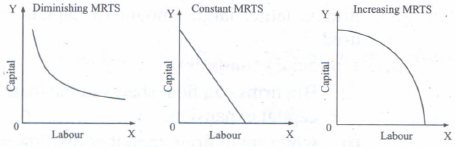
1. The isoquant curve has negative slope:
(i) Capital is being substituted by labour.
(ii) Isoquant has negative slope because of diminishing MRTS.
(iii) Constant MRTS (straight line) and increasing MRTS (concave) are also possible.
(iv) It depends on the nature of isoquant curve
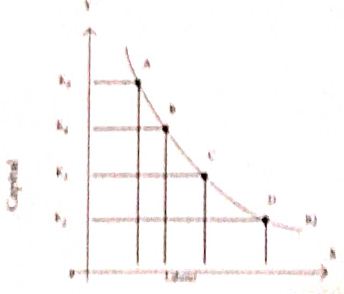
2. Isoquant curve is convex to origin:
The capital substituted per unit of labour goes on decreasing so the isoquant is convex to the origin.
3. Isoquant curves cannot intersect each other:
Point A lies on IQ1 and IQ2, Point C lies on IQ2, showing higher output Point B
lies on IQ1, showing lower output. C = A, B = A But C > B.
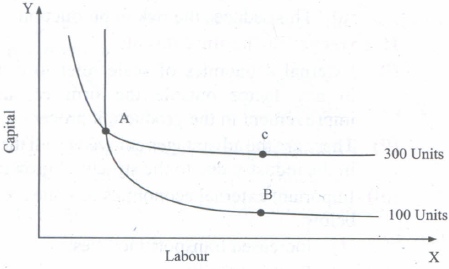
4. Upper isoquant curve represents a higher level of output:
Higher IQ2 shows higher output 200 units. Lower IQ1 shows lower output 100 units. IQ2 means the use of more factors than IQ1. Arrow shows increase in output with a right and upward shift of an isoquant curve.
5. Isoquant curve does not touch either x axis or y axis:
In IQ2 only capital is used and in IQ1 only labour is used.
.JPG)
Conclusion:
These are the properties of isoquant curves.
38.
39.
Introduction:
(i) In order to promote export and industrial growth SEZ was introduced in many countries.
(ii) India was one of the first in Asia to set up EPZ (Kandla, 1965).
(iii) SEZ covers free trade zones, export processing zones, industrial parks, economic and technology development zones, high-tech zones, science and innovation parks, free ports, enterprise zones.
Major objectives of SEZs
(i) To enhance foreign investment, to attract foreign direct investment and increase GDP.
(ii) To increase shares in global export.
(iii) To generate additional economic activity.
(iv) To create employment opportunities.
(v) To develop infrastructure facilities.
(vi) To exchange technology in the global market.
Characteristics:
(i) Geographically demarcated area with physical security.
(ii) administered by single authority.
(iii) Streamlined procedures.
(iv) Having separate customs area.
(v) Governed by more liberal economic laws.
(vi) Greater freedom to firms located in SEZs.
(vii) They need not respect the government's rules and regulations.
(viii) The social and environmental impacts were disastrous.
40.
41.
Large number of buyers and sellers:
(i) Since there are large number of buyers and sellers each individual buyer or seller buys or sells a very small quantity of the product found in the market.
(ii) So he has no power to fix the price of the product.
(iii) He is only a price taker.
Homogeneous product & uniform price:
(i) All the units of the product are perfectly substitutable - they are of the same size, shape, colour, quality.
(ii) So a uniform price prevails in the market.
Free entry and exit:
(i) In the short run, the very efficient producer can produce the product at a very low cost & earn super normal profit.
(ii) This attracts new firms to enter.
(iii) When there are more firms, supply increases, so price falls.
(iv) Inefficient producer faces loss & so quits the market.
Absence of transport cost:
The prevalence of the uniform price is also due to the absence of the transport cost.
Perfect knowledge of the market:
(i) All buyers and sellers have a thorough knowledge of the quality of the product, prevailing price.
No government intervention:
(i) No government regulation on supply of raw materials & in price determination.

11th Standard Syllabus & Materials
11th Standard
TN 11th Tamil பீடு பெற நில் - செய்யுள் - காவடிச்சிந்து Important Questions And Answers Study Material - QB365 Set A
NEW11th Standard
TN 11th Tamil பீடு பெற நில் - உரைநடை - மலை இடப்பெயர்கள் : ஓர் ஆய்வு Important Questions And Answers Study Material - QB365 Set A
NEW11th Standard
TN 11th Tamil மாமழை போற்றுதும் - துணைப்பாடம் - யானை டாக்டர் Important Questions And Answers Study Material - QB365 Set A
NEW11th Standard
TN 11th Tamil மாமழை போற்றுதும் - செய்யுள் - ஐங்குறுநூறு Important Questions And Answers Study Material - QB365 Set A



Tamilnadu Stateboard 11th Standard Subjects

Maths

Commerce
Economics

Biology

Business Maths and Statistics

Accountancy

Computer Science

Physics

Chemistry
Maths
Biology
Economics
Physics
Chemistry

History
Business Maths and Statistics

Computer Science
Accountancy

Computer Applications
History
Computer Technology
Commerce
Computer Applications
Computer Technology

Tamil

English

French
Tamilnadu Stateboard Standards
