
 100% FREE ACCESS
11th Standard Syllabus & Materials
11th Standard
TN 11th Tamil இயற்கை வேளாண்மை,சுற்றுச்சூழல் -செய்யுள் - மனோன்மணீயம் Important Questions And Answers Study Material - QB365 Set A
NEW11th Standard
TN 11th Tamil என்னுயிர் என்பேன் -துணைப்பாடம் - இசைத்தமிழர் இருவர் Important Questions And Answers Study Material - QB365 Set A
NEW11th Standard
TN 11th Tamil மொழி கலை -செய்யுள் - ஒவ்வொரு புல்லையும் Important Questions And Answers Study Material - QB365 Set A
NEW11th Standard
TN 11th Tamil பீடு பெற நில் - இலக்கணம் - பகுபத உறுப்புகள் Important Questions And Answers Study Material - QB365 Set A
NEW11th Standard
TN 11th Tamil பீடு பெற நில் - துணைப்பாடம் - வாடிவாசல் Important Questions And Answers Study Material - QB365 Set A
NEW11th Standard
TN 11th Tamil பீடு பெற நில் - செய்யுள் - குறுந்தொகை Important Questions And Answers Study Material - QB365 Set A

Published on: 21/06/2018
MONTHLY TEST 1
Download Tamil Nadu 11th Standard Accountancy question papers, model tests, one-mark questions, important questions, and public exam papers in PDF format. Free study materials and answer keys for TN State Board students.
Questions + Answers key
Take MCQ Accountancy Test
1.
Matching concept is based on the_____________________
Accrual Concept
Going concern concept
Money measurement concept
Accounting Period Concept
2.
ASB stands for________________
Accounting Standard Board
Accounting Standard Business
Accounting Statistics Business
Accounting Standard Books
3.
The land is purchased for Rs. 5,00,000 and its market value is Rs. 8,00,000 at the time of preparing final accounts the land value is recorded only for _____________
Rs. 5,00,000
Rs. 8,00,000
Rs. 3,00,000
Rs. 6,50,000
4.
Assets = _______________.
Capital - Liability
Capital + Liability
Capital + Investments
Capital + Creditors
5.
Accounting works as a tool for measuring past performance of the___________ enterprises.
commerce
business
management
money
6.
All the business transactions are recorded in the book of _______________
accounts
book keeping
transactions
none of these
7.
According to _____________ concept only business transactions are recorded.
Dual aspect
Cost
Business entity
Money measurement
8.
_________________ is an art of recording business transactions based on certain principles.
Double entry
Single entry
Bookkeeping
Accounting
9.
___________ said "Bookkeeping is an art of recording business dealings in a set of books".
Norcot
J.R. Batliboi
R.N. Carter
Keynes
10.
_______________involves recording of transactions and events which are financial in nature.
Financial Accounting
Cost Accounting
Management Accounting
Human Resource Accounting
11.
_____________ provides the relevant data to make appropriate decisions.
Management
Accounting
Accountant
Leadership
12.
Accounting is not a modern concept and it is as old as _____________
money
goods
services
all of these
13.
_____________has rightly been termed as the language of the business.
Accounting
Book-keeping
Accountant
None of these
14.
In India, Accounting Standards are issued by
Reserve Bank of India
The Cost and Management Accountants of India
Supreme Court of India
The Institute of Chartered Accountants of India
15.
GAAPs are:
Generally Accepted Accounting Policies
Generally Accepted Accounting Principles
Generally Accepted Accounting Provisions
None of these
16.
17.
The proponent of double entry system of book-keeping is ___________
J. R. Batlibai
Luca Pacioli
Old Kesal
Menhar
18.
The business is liable to the proprietor of the business in respect of capital introduced by the person according to
Money measurement concept
Cost concept
Business entity concept
Dual aspect concept
19.
Who is considered to be the internal user of the financial information?
Creditor
Employee
Customer
Government
20.
21.
A company purchased goods for Rs. 10,00,000 and sold 80% of such goods during the year. The market value of remaining goods was Rs. 1,80,000. The company valued the closing stock at Rs. 2,00,000 i.e., cost. Is the statement correct?
22.
Mr. Suresh, an electronic good dealer, gifted a microwave of value Rs 40,000 to his friend Roshan and recorded it in books as drawings. Is he correct?
23.
A firm follows a practice of giving the figures of previous year along with the figures of current year. Now the accountant of the firm wants to discontinue this practice. Do you justify this decision?
24.
Write short notes on :
a) Debtors
b) Creditors
25.
What is bad debt?
26.
Who is a proprietor?
27.
Write a brief note on 'Consistency' assumption.
28.
Define Book Keeping.
29.
List any two functions of accounting.
30.
Define accounting.
31.
What is the need for accounting standards?
32.
Explain the process of Accounting cycle.
33.
What are the limitations of Book-keeping
34.
Explain the objectives of Accounting?
35.
Write short notes on
a) Capital
b) Assets
c) Liabilities
36.
Write a brief note on Accounting Standards.
37.
"Only monetary transactions are recorded in accounting". Explain the statement.
38.
What is matching concept? Why should a business concern follow this concept?
39.
Why are the following parties interested in accounting information?
(i) Investors
(ii) Government
40.
Explain briefly accounting conventions
41.
What are the differences between Book keeping and Accounting?
42.
What do you mean by accounting concepts? Explain any five concepts.
43.
Explain the advantages of Book-keeping.
44.
Explain the meaning of Book-keeping and its features
45.
Briefly explain the functions of accounting
46.
Explain the Accounting cycle
47.
Discuss the role of an accountant in the modern business world.
1.
(d)
Accounting Period Concept
2.
(a)
Accounting Standard Board
3.
(a)
Rs. 5,00,000
4.
(b)
Capital + Liability
5.
(b)
business
6.
(a)
accounts
7.
(c)
Business entity
8.
(c)
Bookkeeping
9.
(b)
J.R. Batliboi
10.
(a)
Financial Accounting
11.
(b)
Accounting
12.
(a)
money
13.
(a)
Accounting
14.
(d)
The Institute of Chartered Accountants of India
15.
(b)
Generally Accepted Accounting Principles
16.
(b)
17.
(b)
Luca Pacioli
18.
(c)
Business entity concept
19.
(b)
Employee
20.
(c)
21.
No, the principle of conservatism is being violated. Here the closing stock should have been valued at Rs. 1,80,000 i.e., lower of cost or Net Realisable Value (NRV) whichever is less.
22.
Yes, he is correct, it will be treated as drawings and will be recorded in the books.
23.
No, comparability of current year figures with that of previous year is a qualitative characteristic of financial information. Discontinuation of this practice will result in discontinuation of a good practice being followed by the firm.
24.
a) Debtors :
A person who receives a benefit without giving money or money's worth immediately, but liable to pay in future or in due course of time.
b) Creditors :
A person who gives a benefit without receiving money or money's worth immediately but to claim in future
25.
Bad debt is a loss to the business arising out of failure of a debtor in payment of his dues
26.
(i) A person who owns the business is called proprietor.
(ii) He contributes capital to the business with the intention of earning profit.
27.
(i) The Consistency convention implies that the Accounting practice should remain the same from one year to another.
(ii) The results of different years will be comparable only when same accounting methods are followed from year to year.
(iii) The firm should modify the method of charging the depreciation from one to another.
(iv) If any change has to be incorporated, valid reasons for such a change should be emphasised.
28.
According to R.N. Carter, "Book keeping is the science and art of recording correctly in the books of account all those business transactions of money or money's worth".
29.
(i) Measurement:
1. The main function of accounting is to keep a systematic record of business transactions, post them to the ledger and ultimately to prepare the final accounts.
2. It also shows the current financial position of the business enterprises.
(ii) Comparison:
1. Accounting helps to compare the actual performance with the planned performance.
2. It is also possible to compare with the accounting policies.
30.
American Accounting Association has defined accounting as "the process of identifying, measuring and communicating economic information to permit informed judgments and decisions by users of the information".
31.
The need for accounting standards is as follows:
1. To promote better understanding of financial statements.
2. To help accountants to follow uniform policies and practices.
3. To facilitate meaningful comparison of financial statements of two or more entities.
4. To enhance reliability of financial statements.
5. To meet the legal requirements effectively.
32.
Process of Accounting cycle
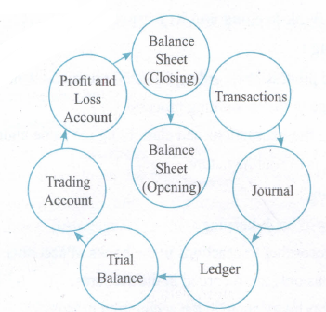
(i) When a businessman starts his business activities, he records the day-to-day transactions in the journal.
(ii) From the journal the transactions move further to the ledger where accounts are written up.
(iii) Preparation of trading and profit and loss account is the next step.
(iv) The balancing of profit and loss account gives the net result of the business transactions.
(v) Thus this cyclic movement of the transactions through the books of accounts (accounting cycle) is a continuous process.
33.
Book-keeping has the following limitations.
(i) Only monetary transactions are recorded in the books of accounts.
(ii) Effect of price level changes is not considered.
(iii) Financial data recorded are historical in nature, i.e., only past data are recorded.
34.
Following are the objectives of accounting:
(i) To keep a systematic record of financial transactions and events
(ii) To ascertain the profit or loss of the business enterprise
(iii) To ascertain the financial position or status of the enterprise
(iv) To provide information to various stakeholders for their requirements
(v) To protect the properties of an enterprise and
(vi) To ascertain the solvency and liquidity position of an enterprise
35.
a) Capital:
(i) Capital is the amount invested by the owner in an organisation.
(ii) This amount is increased by the profit of the business and the amount of additional capital introduced.
b) Assets:
(i) Any physical thing or right owned that has a monetary value is called assets.
(ii) Assets can be classified into tangible and intangible.
(iii) Tangible assets are those having physical existence. It can be seen and touched.
(iv) Intangible assets are those assets having no physical existence. It cannot be seen and touched.
c) Liabilities:
(i) Liabilities refers to the financial obligations of a business.
(ii) For example, loans from banks or other persons, creditors for goods supplied, bills payable, outstanding expenses, bank overdraft etc
36.
(i) Accounting Standards provide the framework and norms so that the financial statements of different enterprises become comparable.
(ii) It becomes necessary to standardise the accounting principles and policies to ensure consistency, comparability, adequacy and reliability of financial reporting.
(iii) Accounting standards in India are issued by the Institute of Chartered Accountants of India (ICAI).
Definition:
In the words of Kohler, "Accounting standards are codes of conduct imposed by customs, law or professional bodies for the benefit of public accountants and accountants generally".
37.
(i) Only financial transactions are to be recorded because it is due to Money Measurement concept, which states that only those transactions are to be recorded in the books of accounts which consist of cash.
(ii) Hence it is concerned with the Nominal value not the real value.
(iii) For example Mohan purchases television for Rs.12,000. So this will be recorded in journal entry book as it has cash transactions.
38.
(i) According to this concept, revenues during an accounting period are matched with expenses incurred during that period to earn the revenue during that period.
(ii) This concept is based on accrual concept and periodicity concept.
(iii) Periodicity concept fixes the time frame for measuring performance and determining financial status.
(iv) All expenses paid during the period are not considered, but only the expenses related to the accounting period are considered.
39.
(i) Investors :
1. Persons who are interested in investing their surplus funds should know about the financial condition of a business unit while making their investment decisions.
2. They are more concerned about future earnings and risk bearing capacity of the organisation which will affect the return to the investors.
(ii) Government :
1. The scarce resources of the country are used by business enterprises.
2. Information about performance of business units in different industries helps the government in policy formulation for development of trade and industry, allocation of scarce resources, grant of subsidy, etc.
3. Government also administers prices of certain commodities.
40.
(i) Accounting Conventions:
1. The word convention refers to traditions or customs. The accounting convention describes the customs or traditions followed as a guide to the preparation of accounting statements.
2. Modern business world has accepted the utility of these Accounting conventions in making financial statements more realistic, reliable, and useful to all concerned parties. The following four conventions are generally adopted over a period of time.
(ii) Convention of consistency:
1. The consistency convention implies that the Accounting practice should remain the same from one year to another. The results of different years will be comparable only when same accounting methods are followed from year to year.
2. For Example: If a firm follows the original or fixed installment method of charging depreciation since its purchase/construction, the method should be followed without any change.
(iii) Convention of full disclosure:
1. The accounts must disclose all material information. The Accounting reports should disclose full and fair information to the related parties. The financial position and performance should be disclosed very honestly to all the users.
2. All the information should be relevant, reliable, comparable and understood by all the concerned authorities.
(iv) Convention of conservatism or prudence:
It is a policy of caution or playing safe. While recording the business transactions one has to anticipate no income but provide for all possible losses.
41.
| S.No | Basis of distinction | Book-keeping | Accounting |
| 1 | Scope | It is concerned with recording and classification of the business transaction | It is concerned with recording, classification, summarising, analysing and interpreting the financial data |
| 2 | Stage | Book-keeping is the primary stage in accounting. It is the base for Accounting. | Apart from the primary stage, it includes secondary stage of analysis and interpretation. |
| 3 | Nature of job | It is routine and clerical in nature. | It is analytical in nature |
| 4 | Knowledge required | It requires basic knowledge of the principles of journalising and posting | It requires thorough knowledge of accounting principles, procedures, and practices. |
| 5 | Skill required | Analytical skill is not required for book-keeping. | It requires analytical skill |
42.
(i) Accounting principles are the rules of action or conduct which are adopted by the accountants universally. Such accounting principles are known as Generally Accepted Accounting Principles (GAAP).
(ii) Accounting concepts are bye-laws whereas conventions are guidelines based upon customs or usage. The important Accounting concepts are listed out below :
1. Business entity concept:
a) This concept implies that a business unit is separate and distinct from the persons who supply capital to it.
b) Based on this concept, accounts are prepared from the point of view of the business and not from the owner's point of view. Hence, the capital contributed by the owner is treated as a liability of the business.
c) This concept helps in keeping business affairs free from the influence of personal affairs of the owner.
2. Money measurement concept:
a) This concept implies that in Accounting, every transaction, or happening or event is recorded in terms of money.
b) In other words, only those transactions, which can be expressed in terms of money, are recorded in the accounts.
3. Going concern concept:
a) It is the basic assumption that business will continue for a quite long time and it will go on and will not be closed down or stopped for quite a long time.
b) Going concern concept influences Accounting practices in relation to valuation of assets and liabilities, depreciation of the fixed assets, treatment of outstanding and prepaid expenses and incomes.
4) Cost concept:
a) As asset is recorded in the books at the value of price paid for it at the time of its purchase and the cost paid will be the base for all further Accounting.
b) It is recorded at cost at the time of its purchase, but is systematically reduced in its value by charging depreciation.
5) Accounting period concept:
a) The true profit or loss earned by a business unit can be ascertained only when the business is liquidated.
b) But many persons such as proprietors, investors, creditors, employees and the government are interested in knowing the performance of the business unit.
43.
Book-keeping has the following advantages:
(i) Transactions are recorded systematically in chronological order in the book of accounts. Thus, book-keeping provides a permanent and reliable record for all business transactions.
(ii) Book-keeping is useful to get the financial information.
(iii) It helps to have control over various business activities.
(iv) Records provided by business serve as a legal evidence in case of any dispute.
(v) Comparison of financial information over the years is possible. Also comparison of financial information of different business units is facilitated.
(vi) Book-keeping is useful to find out the tax liability.
44.
Meaning of Book-keeping:
(i) Book-keeping is the process of recording financial transactions in the books of accounts.
(ii) It is the primary stage in the accounting process.
(iii) It includes recording the transactions and classifying the same under proper heads.
(iv) Book-keeping work is of routine nature.
Features of Book-keeping :
Following are the features of Book-keeping :
(i) It is the process of recording transactions in the books of accounts.
(ii) Monetary transactions only are recorded in the accounts.
(iii) Book-keeping is the primary stage in the accounting process.
(iv) Book-keeping includes journalising and ledger processing.
45.
The main functions of accounting are as follows:
(i) Measurement:
1. The main function of accounting is to keep systematic record of business transactions, post them to the ledger and ultimately to prepare the final accounts.
2. Accounting works as a tool for measuring past performance of the business enterprises.
(ii) Forecasting:
With the help of the various tools of accounting, future performance and financial position of the business enterprises can be forecasted.
(iii) Comparison:
1. Accounting helps to assess the actual performance with the targets.
2. It also discloses the accounting policies.
(iv) Decision making:
1. Accounting assists the management in planning, evaluation of performance, control and decision making by providing required information to various users of accounts.
2. This will help them to take various decisions on cost, price, sales, volume, etc.
(v) Control:
1. As accounting works as a tool of control, the strengths and weaknesses are identified to provide feedback on various measures adopted.
2. It serves as a tool for evaluating compliance of business policies and programmes.
(vi) Assistance to Government regulations:
Government needs full information on the financial aspects of the business, so that proper tax can be levied on the income earned by the enterprises.
46.
Accounting cycle is the sequence of steps involved in the accounting process. Accounting cycle starts with the identification and recording of financial transactions of an organisation and ends with the preparation of final accounts for the accounting year. The steps involved are:
(i) Identifying the transactions and journalising :
(1) The first step in the accounting process is identifying the financial transactions of a business.
(2) All the monetary transactions are recorded in the books of original entry called journals.
(ii) Posting and balancing:
(1) Transferring the entries from the journal to the ledger is called posting.
(2) In the ledger, entries are made in each account after classifying them under common heads. Finding the difference between the total of the debit column and credit column of all the ledger accounts is called balancing.
(iii) Preparation of trial balance:
(1) The list of ledger balances namely trial balance is prepared as the next step.
(2) On the basis of ledger balances the financial statements are prepared.
(iv) Preparation of trading account:
(1) Next step is preparation of trading account for a particular accounting period.
(2) All the direct revenues and direct expenses are transferred to trading account.
(3) The balance in the trading account is the gross profit or gross loss.
(v) Preparation of profit and loss account:
(1) Profit and loss account is prepared next for a particular accounting period.
(2) All the indirect revenues and indirect expenses along with gross profit or gross loss are transferred to profit and loss account.
(3) The balance in the profit and loss account is the net profit or net loss.
(vi) Preparation of balance sheet:
(1) A statement showing the balances of assets and liabilities namely balance sheet is prepared as the final step in the accounting process.
(2) It is prepared on a particular date, normally, on the last day of the accounting period.
47.
An accountant designs the accounting procedures for an enterprise. He plays several roles in an organisation as follows:
(i) Record keeper :
1. The accountant maintains a systematic record of financial transactions.
2. He also prepares the financial statements and other financial reports.
(ii) Provider of information to the management :
The accountant assists the management by providing financial information required for decision making and for exercising control.
(iii) Protector of business assets :
The accountant maintains records of assets owned by the business which enables the management to protect and exercise control over these assets.
(iv) Financial advisor :
The accountant analyses financial information and advises the business managers regarding investment opportunities, strategies for cost savings, capital budgeting, provision for future growth and development, expansion of enterprise, etc.
(v) Tax Manager :
1. The accountant ensures that tax returns are prepared and filed correctly on time and payment of tax is made on time.
2. The accountant can advise the managers regarding tax management, reducing tax burden, availing tax exemptions, etc.
(vi) Public relations officer :
The accountant provides accounting information to various interested users for analysis as per their requirements.

11th Standard Syllabus & Materials
11th Standard
TN 11th Tamil பீடு பெற நில் - செய்யுள் - காவடிச்சிந்து Important Questions And Answers Study Material - QB365 Set A
NEW11th Standard
TN 11th Tamil பீடு பெற நில் - உரைநடை - மலை இடப்பெயர்கள் : ஓர் ஆய்வு Important Questions And Answers Study Material - QB365 Set A
NEW11th Standard
TN 11th Tamil மாமழை போற்றுதும் - துணைப்பாடம் - யானை டாக்டர் Important Questions And Answers Study Material - QB365 Set A
NEW11th Standard
TN 11th Tamil மாமழை போற்றுதும் - செய்யுள் - ஐங்குறுநூறு Important Questions And Answers Study Material - QB365 Set A



Tamilnadu Stateboard 11th Standard Subjects

Maths

Commerce

Economics

Biology

Business Maths and Statistics
Accountancy

Computer Science

Physics

Chemistry
Maths
Biology
Economics
Physics
Chemistry

History
Business Maths and Statistics

Computer Science
Accountancy

Computer Applications
History
Computer Technology
Commerce
Computer Applications
Computer Technology

Tamil

English

French
Tamilnadu Stateboard Standards
