
 100% FREE ACCESS
11th Standard Syllabus & Materials
11th Standard
TN 11th Tamil இயற்கை வேளாண்மை,சுற்றுச்சூழல் -செய்யுள் - மனோன்மணீயம் Important Questions And Answers Study Material - QB365 Set A
NEW11th Standard
TN 11th Tamil என்னுயிர் என்பேன் -துணைப்பாடம் - இசைத்தமிழர் இருவர் Important Questions And Answers Study Material - QB365 Set A
NEW11th Standard
TN 11th Tamil மொழி கலை -செய்யுள் - ஒவ்வொரு புல்லையும் Important Questions And Answers Study Material - QB365 Set A
NEW11th Standard
TN 11th Tamil பீடு பெற நில் - இலக்கணம் - பகுபத உறுப்புகள் Important Questions And Answers Study Material - QB365 Set A
NEW11th Standard
TN 11th Tamil பீடு பெற நில் - துணைப்பாடம் - வாடிவாசல் Important Questions And Answers Study Material - QB365 Set A
NEW11th Standard
TN 11th Tamil பீடு பெற நில் - செய்யுள் - குறுந்தொகை Important Questions And Answers Study Material - QB365 Set A

Published on: 19/02/2019
11th Second Revision Test 2019 Important Question
Download Tamil Nadu 11th Standard Accountancy question papers, model tests, one-mark questions, important questions, and public exam papers in PDF format. Free study materials and answer keys for TN State Board students.
Questions + Answers key
Take MCQ Accountancy Test
1.
An asset worth Rs. 1,00,000 is sold for Rs. 75,000 the capital loss amounts to __________
Rs.1,75,000
Rs.1,00,000
Rs.75,000
Rs.25,000
2.
Under which method of depreciation, interest is also taken into consideration?
Revaluation method
Depletion method
Annuity method
None of the above
3.
When goods meant for resale are sold it is called as ______
Purchases
Sales
Income
4.
The Trial Balance as on 31-03-2016 shows capital Rs.5,00,000. Interest on capital at 6% p.a. is ______
Rs.5,00,000
Rs.30,000
Rs.5,30,000
Rs.2,50,000
5.
________ accounts give the net amount due to creditor and the net amount due from debtors.
Real
Personal
Nominal
Ledger
6.
Customised accounting software is suitable for _______.
Small, conventional business
Large, medium business
Large, typical business
None of the above
7.
Depreciation is provided on ____________
Fixed assets
Current assets
Outstanding charges
All assets
8.
The difference in trial balance is taken to _______.
The capital account
The trading account
The suspense account
The profit and loss account
9.
Goodwill is classified as _______.
A current asset
A liquid asset
A tangible asset
An intangible asset
10.
A time gap between the depositing of the ________________ and the collection by the bank.
cash
cheques
petty Cash
none of these
11.
When money is withdrawn from bank, the bank _______.
Credits customer's account
Debits customer's account
Debits and credits customer's account
None of these
12.
Madhan spent Rs.2,000 as repair on purchases of machine from scrap dealer. The transaction will ____
Increase and decrease Asset
Decrease Assets and Capital
Increase and decrease Asset
Increase and Decrease Liability
13.
A Bill is drawn on 1.4.2004 for 2 months, its due date is _____
1.6.2004
3.6.2004
4.6.2004
4.4.2005
14.
The incorrect accounting equation
Assets = Liabilities + Capital
Assets = Capital + Liabilities
Liabilities = Assets + Capital
Capital = Assets - Liabilities
15.
If the debit and credit aspects of a transaction are recorded in the cash book, it is ______.
Contra entry
Compound entry
Single entry
Simple entry
16.
Sales book is used to record _____
all sales of goods
all credit sales of assets
all credit sales of goods
all sales of assets and goods
17.
18.
If the total of the debit side of an account exceeds the total of its credit side, it means
Credit Balance
Debit Balance
Nil Balance
Debit and Credit Balance
19.
The proponent of double entry system of book-keeping is ___________
J. R. Batlibai
Luca Pacioli
Old Kesal
Menhar
20.
Which one of the following is not a branch of accounting?
Financial accounting
Management accounting
Human resources accounting
None of the above
21.
Classify the following receipts under capital and revenue.
i) Rs.3,00,000 worth of debentures are issued for raising loan.
ii) Rs.5,000 received as dividend from the investment on shares.
iii) Gokul started business with Rs.4,00,000.
iv) A machinery costing Rs.50,000 was sold for Rs.50,000.
v) Creditors allowed discount Rs.30,000.
22.
Deepak is a dealer in stationery items. From the following transactions, pass journal entries for the month of January and February, 2018
| Jan | Rs | |
| 1 | Commenced bussiness with cash | 2,00,000 |
| 2 | Opened a bank account by deposited cash | 1,00,000 |
| 3 | 'A 4 paper' sold on credit to Padmini and Co | 60,000 |
| 4 | Bills received from Padmini and Co. for the amount due | |
| 5 | Bills received from Padmini and Co. discounted with the bank | 58,000 |
| Feb | ||
| 15 | Bills of Pad mini and Co. dishonoured |
23.
Prepare a analytical petty cash book from the following information on the imprest system:
| 2017 | Rs | |
| Jan 1 | Received for petty cash | 500 |
| Jan 2 | Paid rickshaw charges | 5 |
| Paid cartage | 12 | |
| Jan 3 | Paid for postage | 15 |
| Paid wages to casual labourer | 66 | |
| Jan 4 | Paid for stationery | 134 |
| Paid for auto charges | 18 | |
| Jan 5 | Paid for repairs | 65 |
| Paid for bus fare | 11 | |
| Paid for cartage | 24 |
24.
Pass journal entries for the following transactions and post them in the ledger accounts.
| 2017 June 1 |
Basu started business with cash Rs. 50,000 |
| 4 | Purchased furniture by paying cash for Rs. 6,000 |
| 7 | Purchased machinery on credit from Harish Rs. 10,000 |
| 10 | Bought goods for cash Rs 4,000 |
| 18 | Paid insurance premium Rs 100 |
25.
Enter the following transactions in the double column cash book of Mr. Srinivasan.
| 2002 May | Particulras | Rs |
|---|---|---|
| 1 | Cash in hand | 50,000 |
| 3 | Cash Paid to Rajan | 6,000 |
| Discount allowed by him | 100 | |
| 6 | Cash Purchases | 10,000 |
| 10 | Received cash from Arun Rs 2,900 and allowed hime discount | 100 |
| 13 | Cash Sales | 15,000 |
| 15 | Electricity charges paid | 1,000 |
| 18 | Paid for miscellaneous expenses | 2,000 |
| 20 | Received cash from Murali | 3,450 |
| Discount allowed | 50 |
26.
Given below are the balances of Pandian as on 31st March, 2016.
| Particulars | Debit Rs. | Credit Rs. |
|---|---|---|
| Capital | 1,20,000 | |
| Sundry debtors and creditors | 22,000 | 22,500 |
| Sales | 59,700 | |
| Drawings | 2,000 | |
| Cash in hand | 8,200 | |
| Cash at bank | 30,000 | |
| Wages | 2,500 | |
| Purchases | 10,000 | |
| Opening stock | 30,000 | |
| Business premises | 60,000 | |
| Bills receivable | 14,500 | |
| Office telephone expenses | 3,500 | |
| General expenses | 9,000 | |
| Goodwill | 10,500 | |
| 2,02,200 | 2,02,200 |
Adjustments:
(a) The stock value at the end of the accounting period was Rs. 5,000
(b) Interest on capital at 6% is to be provided
(c) Interest on drawing at 5% is to be provided
(d) Write off bad debts amounting to Rs. 2,000
(e) Create provision for bad and doubtful debts on sundry debtors @ 10%
Prepare final accounts for the year ended 31st March, 2016.
27.
Calculate depreciation under Straight Line Method using Spreadsheet based on the details given below.
| A | B | C | D | E | F |
|---|---|---|---|---|---|
| Asset | Cost of purchase Rs |
Installation charge Rs |
Transportation charge Rs |
Salvage value Rs | Life in years |
| 1. Machinery | 200000 | 20000 | 5000 | 25000 | 10 |
| 2. Furniture | 50000 | 4000 | 2000 | 5000 | 8 |
28.
A manufacturing company purchased on 1 April, 2010, a plant and machinery for Rs. 4,50,000 and spent Rs. 50,000 on its installation. After having used it for three years, it was sold for Rs. 3,85,000. Depreciation is to be provided every year at the rate of 15% per annum on the fixed instalment method. Accounts are closed on 31st March every year. Calculate profit or loss on sale of machinery.
29.
Pass journal entries to rectify the following errors located after the preparation of the trial balance. Assume that there exists a suspense account.
(a) The total of sales book was undercast by Rs. 2,000.
(b) The purchase of machinery for Rs. 3,000 was entered in the purchases book.
(c) A credit sale of goods for Rs. 450 to Mathi was posted in his account as Rs. 540.
(d) The purchases returns book was overcast by Rs. 200.
(e) The total of sales book Rs. 1,122 were wrongly posted in the ledger as Rs. 1,222.
30.
From the following information, prepare trading account for the year ending 31st December 2017.
| Particulars | Rs | Particulars | Rs |
|---|---|---|---|
| Opening stock | 50,000 | Dock charges on purchases | 4,000 |
| Cost of goods manufactured | 12,000 | Import duty on purchases | 3,500 |
| Cash purchases | 60,000 | Wages | 11,000 |
| Cash sales | 85,000 | Sales returns | 3,000 |
| Purchases returns | 2,000 | Credit purchases | 35,000 |
| Carriage inwards | 4,000 | Credit sales | 60,000 |
| Freight outwards | 3,000 | Other direct expenses | 7,000 |
| Coal and fuel | 2,500 |
31.
From the following information, prepare the necessary subsidiary books for Nalanda Book Stores.
| 2017 Dec. 1 | Bought from M/s. Umadevi on credit |
| 100 copies Business Statistics Book @ Rs. 80 each | |
| 100 copies Accountancy Book @ Rs. 150 each | |
| Dec. 7 | Sold to Sridevi & Co., on credit |
| 240 copies Business Statistics @ Rs. 90 each | |
| 250 copies Accountancy books @ Rs. 170 each | |
| Dec. 10 | Bought from Subha & Co., |
| 40 Copies Economics books @ Rs. 80 each | |
| Less: 15% Trade Discount | |
| Dec. 15 | Returned to Mis. Vma Devi 10 copies of damaged Accountancy book for which cash is not received |
| Dec. 18 | Sold to Gupta Bros., on credit |
| 200 copies of Economics book @ Rs. 95 each | |
| Dec. 26 | Returned 6 copies of Economics books to Subha & Co., |
32.
From the following information, prepare bank reconciliation statement as on 31st December, 2017 to find out the balance as per bank statement.
| Particulars | Rs |
|---|---|
| (i) Bank overdraft as per cash book | 20,000 |
| (ii) Cheques deposited but not yet credited | 4,000 |
| (iii) Cheque issued but not yet presented for payment | 1,000 |
| (iv) Rent collected by the bank as per standing instruction | 500 |
| (v) Interest on overdraft debited by bank | 2,000 |
| (vi) Amount wrongly debited by bank | 300 |
| (vii) Cheque issued on 30th December 2017 dishonoured by the bank | 5,000 |
| (viii) A customer's cheque deposited in the bank dishonoured by bank not recorded in the book | 2,000 |
33.
Prepare the trial balance from the following information:
| Name of the account | Rs | Name of the account | Rs |
|---|---|---|---|
| Bank Loan | 2,00,000 | Purchases | 1,80,000 |
| Bills Payable | 1,00,000 | Sales | 3,00,000 |
| Stock | 70,000 | Debtors | 4,00,000 |
| Capital | 2,50,000 | Bank | 2,00,000 |
34.
Explain the Accounting cycle
35.
Discuss the role of an accountant in the modern business world.
36.
What are the various types of subsidiary books?
37.
Opening stock Rs. 30,000, Purchases Rs. 54,600, Expenses Rs. 6,000, Sales Rs.90,000, Expenses on sales Rs. 3,000, Closing stock Rs. 36,000. Calculate Cost of goods sold and Gross profit.
38.
Enter the following transactions in a simple cash book of Kuna
| 2017 | ||
|---|---|---|
| Jan | Rs | |
| 1 | Cash in hand | 11,200 |
| 5 | Received from ramesh | 300 |
| 7 | Pain Rent | 30 |
| 8 | Sold goods for cash | 300 |
| 10 | Paid mohan | 700 |
| 27 | Purchased furniture for cash | 200 |
| 31 | Paid salaries | 100 |
39.
State the input and output devices of a computer system.
40.
Sundry debtors as per trial balance as on 31st March, 2016 is Rs. 10,000.
Adjustment: Write off bad debts amounting to Rs. 300.
Give adjusting entry and show how these appear in the final accounts as on 31st March, 2016.
41.
The following errors were located after the preparation of the trial balance. Assume that there exists a suspense account. Rectify them.
(a) Sale of goods on credit to Arun for Rs. 152 posted to his account as Rs. 125.
(b) Bought goods from Lakshmi on credit for Rs. 550, credited to her account as Rs. 505.
(c) Purchase of furniture from Abirupa for Rs. 404 on credit was debited to furniture account as Rs. 440.
(d) Purchased machinery for cash Rs. 200 was not posted to machinery account.
(e) The total of purchases book Rs. 89 was carried forward as Rs. 98.
42.
Indicate the nature of normal balance in the following accounts.
(a) Cash (b) Creditors (c) Sales (d) Furniture (e) Commission received (f) Debtors (g) purchases (h) Capital (i) Salaries and (j) Computer
43.
What is the accounting treatment for insurance premium paid on the life of the proprietor?
44.
What are the basic concepts of accounting?
45.
Explain the principle on which the agreement of trial balance is based.
46.
What is solvency?
47.
How will the following adjustment appear in the balance sheet as on 31-12-2010?
Sundry Debtors Rs.21,000
Bad debts to be written off Rs.1,000
Provide 5% provision for bad and doubtful debts and 2% provision for discount on debtors.
48.
What is a computer?
49.
What is annuity method?
50.
State the account/s affected in each of the following errors:
(a) Goods sold to Vasu on credit for Rs.1,000 was not recorded in the sales book.
(b) The total of sales book Rs.2,500 was posted twice.
51.
What is meant by revenue expenditure?
52.
Who prepares a bank statement?
53.
How are personal accounts classified?
54.
What is credit note?
1.
(c)
Rs.75,000
2.
(c)
Annuity method
3.
(b)
Sales
4.
(b)
Rs.30,000
5.
(b)
Personal
6.
(b)
Large, medium business
7.
(a)
Fixed assets
8.
(c)
The suspense account
9.
(d)
An intangible asset
10.
(b)
cheques
11.
(b)
Debits customer's account
12.
(a)
Increase and decrease Asset
13.
(c)
4.6.2004
14.
(c)
Liabilities = Assets + Capital
15.
(a)
Contra entry
16.
(c)
all credit sales of goods
17.
(c)
18.
(b)
Debit Balance
19.
(b)
Luca Pacioli
20.
(d)
None of the above
21.
| S.No. | Transactions | Classification |
|---|---|---|
| i) | Rs.3,00,000 worth of debentures are issued for raising loan. | Capital receipt |
| ii) | Rs.5,000 received as dividend from the investment on shares. | Revenue receipt |
| iii) | Gokul started business with Rs.4,00,000. | Capital receipt |
| iv) | A machinery costing Rs.50,000 was sold for Rs.50,000. | Capital receipt |
| v) | Creditors allowed discount Rs.30,000. | Revenue receipt |
22.
| Date | Particulars | L.F | Debit Rs | Credit Rs |
|---|---|---|---|---|
| 2018 | ||||
| Jan 1 | Cash A/c Dr | 2,00,000 | ||
| To Deepak's Capital A/c | 2,00,000 | |||
| (Capital contributed by Deepak) | ||||
| 2 | Bank A/c Dr | 1,00,000 | ||
| To Cash A/c | 1,00,000 | |||
| (Cash deposited with the bank) | ||||
| 3 | Padmini and Co. A/c Dr | 60,000 | ||
| To Sales A/c | 60,000 | |||
| (Credit sales to Padmini and Co.) | ||||
| 4 | Bills receivable A/c Dr | 60,000 | ||
| To Padmini and Co. Alc | 60,000 | |||
| (Bills received for the amount due) | ||||
| 5 | Bank A/c Dr | 58,000 | ||
| Discount A/c | 2,000 | |||
| To Bills receivable A/c | 60,000 | |||
| (Bills receivable discounted with the bank) | ||||
| Feb 15 | Padmini and Co. A/c Dr | 60,000 | ||
| To Bank A/c | 60,000 | |||
| (Bill discounted with the bank dishonoured) |
23.
| Receipts | C.B F.N |
Date | Particulars | V.N. | Total Payments | Coveyance | Cartage | Stationery | Postage | Wages | Sundries | L.F. |
|---|---|---|---|---|---|---|---|---|---|---|---|---|
| 2017 | ||||||||||||
| 500 | Jan. 1 | To Cash | ||||||||||
| Jan. 2 | By Conveyance | 5 | 5 | |||||||||
| By Cartage | 12 | 12 | ||||||||||
| Jan. 3 | By Postage | 15 | 15 | |||||||||
| By Wages | 66 | 66 | ||||||||||
| Jan. 4 | By Stationery | 134 | 134 | |||||||||
| By Conveyance | 18 | 18 | ||||||||||
| Jan. 5 | By Repairs | 65 | 65 | |||||||||
| By Conveyance | 11 | 11 | ||||||||||
| By Cartage | 24 | 24 | ||||||||||
| Total expenses | 350 | 34 | 36 | 134 | 15 | 66 | 65 | |||||
| Jan. 6 | By Balance c/d | 150 | ||||||||||
| 500 | 500 | |||||||||||
| 150 | Jan. 6 | To Balance b/d | ||||||||||
| 350 | Jan. 6 | To Cash |
24.
| Date | Particulars | L.F | Debit Rs | Cresit Rs | |
|---|---|---|---|---|---|
| 2017 June 1 |
Cash A/c To Basu's capital A/c (Started business with cash) |
Dr. | 50,000 | 50,000 |
|
| June 4 | Furniture s A/c To Cash A/c (Furniture bought for cash) |
Dr. | 6,000 | 6,000 |
|
| June 7 | Machinery A/c To Harish A/c (Machinery bought on credit from Harish) |
Dr. | 10,000 | 10,000 |
|
| June 10 | Purchase A/c To Cash A/c (Goods bought for cash) |
Dr. | 4,000 | 4,000 |
|
| June 18 | Insurance premium A/c To Cash A/c (Insurance premium paid) |
Dr. | 100 | 100 |
Ledger accounts
| Date | Particulars | J.F. | Rs | Date | Particulars | J.F. | Rs |
|---|---|---|---|---|---|---|---|
| 2017 June 1 |
To Basu's capital A/c |
50,000 |
2017 June 4 10 18 |
By Furniture A/c By Purchases A/c By Insurance premium A/c. |
6,000 4,000 100 |
| Date | Particulars | J.F. | Rs | Date | Particulars | J.F. | Rs |
|---|---|---|---|---|---|---|---|
| 2017 June 1 |
By Cash A/c |
50,000 |
| Date | Particulars | J.F. | Rs | Date | Particulars | J.F. | Rs |
|---|---|---|---|---|---|---|---|
| 2017 June 4 |
To Cash A/c |
6,000 |
| Date | Particulars | J.F. | Rs | Date | Particulars | J.F. | Rs |
|---|---|---|---|---|---|---|---|
| 2017 June 7 |
To Harish A/c |
10,000 |
| Date | Particulars | J.F. | Rs | Date | Particulars | J.F. | Rs |
|---|---|---|---|---|---|---|---|
| 2017 June 7 |
By Machinery A/c |
10,000 |
| Date | Particulars | J.F. | Rs | Date | Particulars | J.F. | Rs |
|---|---|---|---|---|---|---|---|
| 2017 June 10 |
To Cash A/c |
4,000 |
| Date | Particulars | J.F. | Rs | Date | Particulars | J.F. | Rs |
|---|---|---|---|---|---|---|---|
| 2017 June 18 |
To Cash A/c |
100 |
25.
| Date | Receipts | RN | LF | Amount Rs | Date | Payments | VN | LF | Amount Rs | ||
|---|---|---|---|---|---|---|---|---|---|---|---|
| Discount Allowed | Cash | Discount Received | Cash | ||||||||
| 2002 May 1 | To Balance b/d | 50000 | 2002 May 3 | By Rajan A/c | 100 | 6000 | |||||
| 10 | To Arun A/c | 100 | 2900 | 6 | By Purchases A/c | 10000 | |||||
| 13 | To Sales A/c | 15000 | 15 | By Electricity Charges A/c | 1000 | ||||||
| 20 | To Murali A/c | 50 | 3450 | 18 | By Miscellaneous Expenses A/c | 2000 | |||||
| 31 | By Balance c/d | 52350 | |||||||||
| 150 | 71350 | 100 | 71350 | ||||||||
| June 1 | To Balance b/d | 52350 | |||||||||
26.
| Particulars | Rs. | Rs. | Particulars | Rs. | Rs. |
|---|---|---|---|---|---|
| To Opening stock | 30,000 | By Sales | 59,700 | ||
| To Purchases | 10,000 | By Closing Stock | 5,000 | ||
| To Wages | 2,500 | ||||
| To Gross Profit c/d | 22,200 | ||||
| 64,700 | 64,700 | ||||
| To Office telephone expenses | 3,500 | By Gross profit b/d | 22,200 | ||
| To General expenses | 9,000 | By Interest on drawings (2000 x 5/100) | 100 | ||
| To Interest on capital (1,20,000 x 6/100) | 7,200 | By Net loss (transferred to capital account) | 1,400 | ||
| To Bad debts | 2,000 | ||||
| To Provision for bad and doubtful debts | 2,000 | ||||
| 23,700 | 23,700 |
| Liabilities | Rs. | Rs. | Assets | Rs. | Rs. |
|---|---|---|---|---|---|
| Capital | 1,20,000 | Goodwill | 10,500 | ||
| Less: Net loss | 1,400 | Business premises | 60,000 | ||
| 1,18,600 | Stock in trade | 5,000 | |||
| Add: Interest on capital | 7,200 | Sundry debtors | 22,000 | ||
| 1,25,800 | Less: Bad debts | 2,000 | |||
| Less: Drawings and Interest on drawings (2000+100) | 2,100 | 1,23,700 | 20,000 | ||
| Sundry creditors | 22,500 | Less: Provision for bad and doubtful debts (20,000 x 10/100) | 2,000 | 18,000 | |
| Bills receivable | 14,500 | ||||
| Cash at bank | 30,000 | ||||
| Cash in hand | 8,200 | ||||
| 1,46,200 | 1,46,200 |
27.
Procedure and answer
(i) Open a new spreadsheet in MS-EXCEL
(ii) Enter labels and values in the cells as given above
(iii) Write total cost in G1 and annual depreciation in H1
(iv) Calculate total cost in the cell G2 by the formula
= Sum(B2:D2) and copy formula to cell G3
(v) Calculate annual depreciation in the cell H2 by the formula
= SLN(G2,E2,F2) and copy formula to cell H3
Output
| A | B | C | D | E | F | G | H |
|---|---|---|---|---|---|---|---|
| Asset | Cost of purchase Rs |
Installation charge Rs |
Transportation charge Rs |
Salvage value Rs | Life in years |
Total cost Rs |
Annual depreciation Rs |
| 1. Machinery | 200000 | 20000 | 5000 | 25000 | 10 | 225000 | 20,000 |
| 2. Furniture | 50000 | 4000 | 2000 | 5000 | 8 | 56000 | 6,375 |
28.
| Particulars | Amount Rs. |
|---|---|
| Cost price | 4,50,000 |
| Add : Installation charges | 50,000 |
| 5,00,000 | |
| Less : Depreciation for 2010 - 11 | 75,000 |
| \(\left(5,00,000\times{15\over 100}\right)\) | |
| 4,25,000 | |
| Less: Depreciation for 2011 - 12 | 75,000 |
| \(\left(5,00,000\times{15\over 100}\right)\) | |
| 3,50,000 | |
| Less: Depreciation for. 2012 - 13 | 75,000 |
| \(\left(5,00,000\times{15\over 100}\right)\) | |
| Book value on the date of sale | 2,75,000 |
| Less: Selling price | 3,85,000 |
| Profit on sale | 1,10,000 |
The selling price is more than the book value on the date of sale of machinery. Hence, the difference 1,10,000 is profit on sale of machinery.
29.
| Particulars | L.F. | Dr. | Cr. | ||
|---|---|---|---|---|---|
| a | Suspense A/c | Dr | 2,000 | ||
| To Sales A/c | 2,000 | ||||
| (Under casting in the sales book rectified) | |||||
| b | Machinery A/c | Dr | 3,000 | ||
| To Purchases A/c | 3,000 | ||||
| (Purchase of machinery wrongly entered in the purchases book rectified) | |||||
| c | Suspsense A/c | Dr | 9 | ||
| To Mathi A/c | 9 | ||||
| (Excess amount posted to the debit of Mathi rectified) | |||||
| d | Purchase returns A/c | Dr | 200 | ||
| To Suspense A/c | 200 | ||||
| (Overcasting in the purchase returns book rectified) | |||||
| e | Sales A/c | Dr | 100 | ||
| To Suspense A/c | 100 | ||||
| (Excess amount carried forward in the sales book rectified) |
30.
| Particulars | Rs | Rs | Particulars | Rs | Rs |
|---|---|---|---|---|---|
| To Opening stock | 50,000 | By Sales: | |||
| To Cost of goods manufactured | 12,000 | Cash | 85,000 | ||
| Credit | 60,000 | ||||
| To Purchases: | 1,45,000 | ||||
| Cash | 60,000 | Less: Sales returns | 3,000 | 1,42,000 | |
| Credit | 35,000 | By Gross loss c/d | 45,000 | ||
| 95,000 | |||||
| Less: Purchases returns | 2,000 | 93,000 | |||
| To Carriage inwards | 4,000 | ||||
| To Coal and fuel | 2,500 | ||||
| To Dock charges on Purchases | 4,000 | ||||
| To Import duty on Purchases | 3,500 | ||||
| To Wages | 11,000 | ||||
| To Other direct expenses | 7,000 | ||||
| 1,87,000 | 1,87,000 |
Note: Freight outwards will not appear in trading account as it is not a direct expense.
31.
| Date | Particulars | Inward Invoice No. | L.F | Amount | |
|---|---|---|---|---|---|
| Details (Rs) | Total (Rs) | ||||
| 2017 Dec 1 | M/s. Umadevi 100 copies Business statistics Book @ Rs. 80 each 100 copies Accountancy Book @ 150 each |
8,000 15,000 |
23,000 |
||
| Dec 10 | Subha & Co., 40 copies Economics book @ 80 each Less : Trade Discount @ 15% |
3,200 480 |
2,720 | ||
| Purchases A/c Dr. | 25,720 | ||||
| Date | Particulars | Inward Invoice No. | L.F | Amount | Remarks | |
|---|---|---|---|---|---|---|
| Details (Rs) | Total (Rs) | |||||
| 2017 Dec 15 | M/s. Umadevi 10 copies of Accountancy book @ Rs. 150 each |
1,500 | Damaged | |||
| Dec 26 | Subha & Co., 6 Copies of Economis @ Rs. 80 each Less; 15% Trade Discount |
480 72 |
408 | |||
| Purchases return A/c Cr. | 1,908 | |||||
| Date | Particulars | Id Invoice No. | L.F | Amount | |
|---|---|---|---|---|---|
| Details (Rs) | Total (Rs) | ||||
| 2017 Dec 7 | Sridevi & Co. 240 copies Business Statistics @ Rs. 90 each 250 copies Accountancy books @ Rs. 170 each |
21,600 42,500 |
64,100 | ||
| Dec 18 | Gupta Bros., 200 copies Economics books @ Rs. 95 each |
19,000 | |||
| Sales A/c Cr. | 83,100 | ||||
32.
| Particulars | Amount Rs |
Amount Rs |
|---|---|---|
| Bank overdraft as per cash book | 20,000 | |
| Add: Cheque deposited but not yet credited | 4,000 | |
| Interest on overdraft | 2,000 | |
| Amount wrongly debited by bank | 300 | |
| Cheque deposited but dishonoured | 2,000 | 8,300 |
| 28,300 | ||
| Less: Cheques issued but not yet credited | 1,000 | |
| Rent collected by bank | 500 | |
| Cheque issued but dishonoured | 5,000 | 6,500 |
| Overdraft as per bank statement | 21,800 |
33.
Trial Balance
| S.No | Name of account | L.F | Debit Balance | Credit Balance |
|---|---|---|---|---|
| 1 | Bank Loan | 2,00,000 | ||
| 2 | Bills Payable | 1,00,000 | ||
| 3 | Stock | 70,000 | ||
| 4 | Capital | 2,50,000 | ||
| 5 | Purchases | 1,80,000 | ||
| 6 | Sales | 3,00,000 | ||
| 7 | Debtors | 4,00,000 | ||
| 8 | Bank | 2,00,000 | ||
| Total | 8,50,000 | 8,50,000 |
34.
Accounting cycle is the sequence of steps involved in the accounting process. Accounting cycle starts with the identification and recording of financial transactions of an organisation and ends with the preparation of final accounts for the accounting year. The steps involved are:
(i) Identifying the transactions and journalising :
(1) The first step in the accounting process is identifying the financial transactions of a business.
(2) All the monetary transactions are recorded in the books of original entry called journals.
(ii) Posting and balancing:
(1) Transferring the entries from the journal to the ledger is called posting.
(2) In the ledger, entries are made in each account after classifying them under common heads. Finding the difference between the total of the debit column and credit column of all the ledger accounts is called balancing.
(iii) Preparation of trial balance:
(1) The list of ledger balances namely trial balance is prepared as the next step.
(2) On the basis of ledger balances the financial statements are prepared.
(iv) Preparation of trading account:
(1) Next step is preparation of trading account for a particular accounting period.
(2) All the direct revenues and direct expenses are transferred to trading account.
(3) The balance in the trading account is the gross profit or gross loss.
(v) Preparation of profit and loss account:
(1) Profit and loss account is prepared next for a particular accounting period.
(2) All the indirect revenues and indirect expenses along with gross profit or gross loss are transferred to profit and loss account.
(3) The balance in the profit and loss account is the net profit or net loss.
(vi) Preparation of balance sheet:
(1) A statement showing the balances of assets and liabilities namely balance sheet is prepared as the final step in the accounting process.
(2) It is prepared on a particular date, normally, on the last day of the accounting period.
35.
An accountant designs the accounting procedures for an enterprise. He plays several roles in an organisation as follows:
(i) Record keeper :
1. The accountant maintains a systematic record of financial transactions.
2. He also prepares the financial statements and other financial reports.
(ii) Provider of information to the management :
The accountant assists the management by providing financial information required for decision making and for exercising control.
(iii) Protector of business assets :
The accountant maintains records of assets owned by the business which enables the management to protect and exercise control over these assets.
(iv) Financial advisor :
The accountant analyses financial information and advises the business managers regarding investment opportunities, strategies for cost savings, capital budgeting, provision for future growth and development, expansion of enterprise, etc.
(v) Tax Manager :
1. The accountant ensures that tax returns are prepared and filed correctly on time and payment of tax is made on time.
2. The accountant can advise the managers regarding tax management, reducing tax burden, availing tax exemptions, etc.
(vi) Public relations officer :
The accountant provides accounting information to various interested users for analysis as per their requirements.
36.
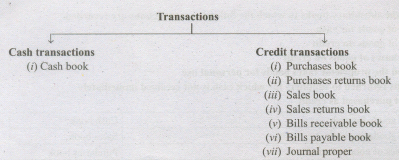
The number of subsidiary books may vary according to the requirements of each business. Based on the nature of business and the volume of transactions, the following subsidiary books are maintained:
37.
Cost of Goods sold Opening stock + Purchases + Expenses on purchases - Closing stock
= Rs.30,000 + Rs. 54,600 + Rs. 6,000 -Rs. 36,600
= Rs. 54,000
Gross profit Net Sales - Cost of Goods sold
= Rs. 90,000 - Rs. 54,000
= Rs. 36,000
38.
| Date | Particulars | L.F | Amount Rs | Date | Payments | L.F | Amount Rs |
|---|---|---|---|---|---|---|---|
| 2017 | 2017 | ||||||
| Jan.1 | To Balance b/d | 11,200 | Jan.7 | By rent A/c | 30 | ||
| Jan.5 | To Ramesh A/c | 300 | Jan.10 | By Mohan A/c | 700 | ||
| Jan.8 | To Sales A/c | 300 | Jan.27 | by Furniture | 200 | ||
| Jan.31 | By Salaries A/c | 100 | |||||
| Jan.31 | By Balance C/d | 10,770 | |||||
| 11,800 | 11,800 | ||||||
| Feb.1 | To Balance B/d | 10,770 |
39.
(i) Input Devices:
(a) Keyboard
(b) Optical scanner
(c) Mouse
(d) Joystick
(ii) Output Devices:
(a) Monitor
(b) Printer
40.
| Date | Particulars | L.F. | Debit Rs | Credit Rs |
|---|---|---|---|---|
| 2016 | Bad debts A/c Dr. | 300 | ||
| March 31 | To Sundry debtors A/c | 300 | ||
| (Bad debts written off) |
Dr. Profit and loss account for the year ended 31st March, 2016 Cr.
| Particulars | Rs | Rs | Particulars | Rs | Rs |
|---|---|---|---|---|---|
| To Bad debts | 300 |
| Liabilities | Rs | Rs | Liabilities | Rs | Rs |
|---|---|---|---|---|---|
| Sundry debtors | 10,000 | ||||
| Less: Bad debts | 300 | 9,700 |
41.
| Particulars | L.F. | Dr. | Cr. | ||
|---|---|---|---|---|---|
| a | Arun A/c | Dr. | 27 | 27 | |
| To Suspense A/c | |||||
| (Wrong amount posted to Arun account rectified) | |||||
| b | Suspense A/c | Dr. | 45 | ||
| To Lakshmi A/c | 45 | ||||
| (Short credit to Lakshmi account rectified) | |||||
| c | Suspense A/c | Dr. | 36 | ||
| To Furniture A/c | 36 | ||||
| (Excess debit to furniture account rectified) | |||||
| d | Machinery A/c | Dr | 200 | ||
| To Suspense A/c | 200 | ||||
| (Omission to debit machinery account rectified) | |||||
| e | Suspense A/c | Dr | 9 | ||
| To Purchases A/c | 9 | ||||
| (Excess amount carried forward to purchases account rectified) |
42.
Debit balance : Cash, Furniture, Debtors, Purchases, Salaries paid, Computer
Credit balance : Creditors, Sales, Commission received, Capital
43.
(i) Insurance premium paid on the life of the proprietor is a personal account.
(ii) It is spent for the personal use of the proprietor not for the business purpose. Hence Drawings A/c should be debited.
The entry is
| Drawings A/c Dr | xxxx | |
| To Cash A/c | xxx |
44.
The following are the basic concepts of accounting:
(i) Business entity concept
(ii) Money measurement concept
(iii) Going concern concept
(iv) Cost concept
(v) Dual aspect concept
(vi) Accounting period concept
(vii) Matching concept
(viii) Realisation concept
(ix) Verifiable and objective evidence concept
(x) Accrual concept.
45.
Basis for the trial balance agreement: The fundamental principle of the double entry system is that every debit has a corresponding credit of equal amount and vice-versa.
Therefore, the total of all debit balances in different accounts must be equal to the total of all credit balances in different accounts, (Le.,) the total of the two columns should tally (agree).
46.
Solvency is the capability of a person or an enterprise to pay the debts.
47.
| Liabilities | Amount Rs |
Amount Rs |
Assets | Amount Rs |
Amount Rs |
|---|---|---|---|---|---|
| Sundry debtors | 21,000 | ||||
| Less: Bad debts written off | 1,000 | ||||
| 20,000 | |||||
| Less: Provision for bad and doubtful debts |
1,000 | ||||
| [20,000 x 5 / 100] | 19,000 | ||||
| Less: Provision for Discount on debtors |
380 | ||||
| [19,000 x 2/100] | 18,620 |
48.
A computer can be described as an electronic device designed to accept raw data as input, processes them and produce meaningful information as output. It has the abitity to perform arithmetic and logical operations as per given set of instructions called program.
49.
(i) Under this method, the amount spent on the purchase of an asset is regarded as an investment. As such, the interest at a certain rate is calculated on the opening balance of the asset account each year and debited to the asset account.
(ii) The amount of depreciation written off is ascertained by- referring to the annuity table. Annual depreciation is uniform throughout the working life of the asset.
50.
| S.No. | Particulars | L.F. | Debit Rs | Credit Rs | |
|---|---|---|---|---|---|
| (a) | Vasu A/c | Dr. | 1,000 | ||
| To Sales A/c | 1,000 | ||||
| (Being the sale of goods to Vasu was recorded in the Sales Book) | |||||
| (b) | Sales A/c | Dr. | 2,500 | ||
| To Suspense A/c | 2,500 | ||||
| (Being the sale of goods to Vasu was recorded in the Sales Book) |
51.
The expenditure incurred for day to day running of the business or for maintaining the earning capacity of the business is known as revenue expenditure. It is recurring in nature.
52.
The bank passbook or the bank statement of accounts is prepared by the bank
53.
Personal accounts can be classified into natural, artificial and representative personal accounts
54.
(i) A credit note is prepared by the seller and sent to the buyer when goods are returned indicating that the buyer's account is credited in respect of goods returned.
(ii) Credit note is a statement prepared by a trader who receives back from his customer the goods sold.
(iii) It contains details such as the description of goods returned by the buyer, quantity returned and also their value.

11th Standard Syllabus & Materials
11th Standard
TN 11th Tamil பீடு பெற நில் - செய்யுள் - காவடிச்சிந்து Important Questions And Answers Study Material - QB365 Set A
NEW11th Standard
TN 11th Tamil பீடு பெற நில் - உரைநடை - மலை இடப்பெயர்கள் : ஓர் ஆய்வு Important Questions And Answers Study Material - QB365 Set A
NEW11th Standard
TN 11th Tamil மாமழை போற்றுதும் - துணைப்பாடம் - யானை டாக்டர் Important Questions And Answers Study Material - QB365 Set A
NEW11th Standard
TN 11th Tamil மாமழை போற்றுதும் - செய்யுள் - ஐங்குறுநூறு Important Questions And Answers Study Material - QB365 Set A



Tamilnadu Stateboard 11th Standard Subjects

Maths

Commerce

Economics

Biology

Business Maths and Statistics
Accountancy

Computer Science

Physics

Chemistry
Maths
Biology
Economics
Physics
Chemistry

History
Business Maths and Statistics

Computer Science
Accountancy

Computer Applications
History
Computer Technology
Commerce
Computer Applications
Computer Technology

Tamil

English

French
Tamilnadu Stateboard Standards
