
 100% FREE ACCESS
11th Standard Syllabus & Materials
11th Standard
TN 11th Tamil இயற்கை வேளாண்மை,சுற்றுச்சூழல் -செய்யுள் - மனோன்மணீயம் Important Questions And Answers Study Material - QB365 Set A
NEW11th Standard
TN 11th Tamil என்னுயிர் என்பேன் -துணைப்பாடம் - இசைத்தமிழர் இருவர் Important Questions And Answers Study Material - QB365 Set A
NEW11th Standard
TN 11th Tamil மொழி கலை -செய்யுள் - ஒவ்வொரு புல்லையும் Important Questions And Answers Study Material - QB365 Set A
NEW11th Standard
TN 11th Tamil பீடு பெற நில் - இலக்கணம் - பகுபத உறுப்புகள் Important Questions And Answers Study Material - QB365 Set A
NEW11th Standard
TN 11th Tamil பீடு பெற நில் - துணைப்பாடம் - வாடிவாசல் Important Questions And Answers Study Material - QB365 Set A
NEW11th Standard
TN 11th Tamil பீடு பெற நில் - செய்யுள் - குறுந்தொகை Important Questions And Answers Study Material - QB365 Set A

Published on: 13/05/2022
QB365 provides detailed and simple solution for every
Creative Questions in class 11 Accountancy Subject. It
will helps to get more idea about question pattern in every Creative questions with solution.
Download Tamil Nadu 11th Standard Accountancy question papers, model tests, one-mark questions, important questions, and public exam papers in PDF format. Free study materials and answer keys for TN State Board students.
Questions + Answers key
Take MCQ Accountancy Test
1.
Write a short note on Machine hour rate method.
2.
Following errors are discovered in the Books of Sita Ram. Make the necessary entries to rectify them.
(i) Purchases journal was Rs. 2,150.
(ii) Rs. 500 received from K. Krishna was debited to his account.
(iii) An amount of Rs. 3,000 withdrawn by the Proprietor of the firm for his personal use was posted to the Traveling expense account.
(iv) An amount of Rs. 175 for a credit sale to R. Gopalan correctly entered in the sale book, has been debited to his account as Rs. 157.
3.
Explain the differences arising due to errors in recording the entries
4.
State the different approaches in recording business transactions.
5.
What are the features of a bill of exchange?
6.
'Ledger is a principal Book of a Business' - Explain.
7.
What are the importance of cash book?
8.
From the following balances extracted from the books of Mr Kannan at trader on automobiles, prepare trial balance as on 31st March 2017.
| Rs | Rs | ||
| Cash in hand | 5,500 | Direct expenses | 5,000 |
| Discount received | 300 | Carriage outwards | 3,500 |
| Creditors | 15,000 | Capital | 45,000 |
| Buildings | 50,000 | Purchases | 49,700 |
| Opening stock | 6,000 | Sales | 59,000 |
9.
Explain the Process of Accounting cycle.
10.
Write short notes on
a) Income
b) Expense
C) Revenue
1.
Machine hour rate Method:
(i) Under this method, depreciation per machine hour is calculated.
(ii) The cost of the machinery after deducting, the residual value, if any, is divided by the estimated working hours of the machine to find the depreciation per hour.
(iii)The actual depreciation for any given period depends upon the working hours during that year.
The following formula is used to determine the rate of depreciation:
Rate of Depreciation per Machine Hour = \(\frac { Original\quad cost-Estimated\quad Scrap\quad value }{ Life\quad of\quad the\quad asset\quad in\quad hours } \)
2.
| S.No. | Particulars | L.F. | Debit Rs | Credit Rs | |
|---|---|---|---|---|---|
| (i) | Purchases A/c | Dr. | 2,150 | ||
| To Suspense A/c | 2,150 | ||||
| (Being Purchases book undercast, now rectified) | |||||
| (ii) | Suspense A/c | Dr. | 1,000 | ||
| To Krishna A/c | 1,000 | ||||
| (Being received from Krishna was wrongly debited, now rectified) | |||||
| (iii) | Drawings A/c | Dr. | 3,000 | ||
| To Travelling expenses A/c | 3,000 | ||||
| (Being amount withdrawn by proprietor for personal use Wrongly posted to travelling expenses account, now rectified) | |||||
| (iv) | Gopalan A/c | Dr. | 18 | ||
| To Suspense A/c | 18 | ||||
| (Being Gopalan's account was debited by Rs. 157 insead of Rs. 175, now rectified) |
3.
1. Errors committed in recording the transactions by the business:
(i) Sometimes errors may be committed in the cash book. For example, omission or wrong recording of transaction relating to cheques deposited or issued, wrong balancing, etc.
(ii) In these cases, obviously, there will be differences between bank balance as per bank statement and bank balance as per cash book.
2. Errors committed in recording the transactions by the bank
(i) Sometimes errors may be committed in the banker's book. For example, omission or wrong recording of transaction relating to cheques deposited and wrong balancing.
(ii) In these cases, obviously, there will be differences between bank balance as per bank statement and bank balance as per cash book.
4.
There are two approaches for recording business transactions, namely,
i) Accounting equation approach and
ii) Traditional approach
(i) Accounting Equation approach :
(a) The relationship of assets with that of liabilities to outsiders and to owners in the equation form is known as accounting equation.
(b) Under the Double entry system of book keeping, every transaction has two fold effects, which causes the changes in assets and liabilities or capital in such a way that an accounting equation is completed and equated
Equity + Liabilities =Assets
(ii) Traditional approach :
(a) Under this approach, the two fold aspects (Debit and Credit) in each transaction are recorded in the journal under double entry system.
(b) For the purpose of recording, the transactions are classified into three categories as
i) Transactions relating to persons,
ii) Transactions relating to assets, properties and liabilities and
iii) Transactions relating to expenses, losses, incomes and gains.
5.
The important features of a bill of exchange are as follows :
(i) It is a written document.
(ii) It is an unconditional order.
(iii) It is an order to pay a certain sum of money.
(iv) It is signed by the drawer.
(v) It bears stamp or it is drafted on a stamp paper.
(vi) It is to be accepted by the acceptor.
(vii) The amount of the bill is paid to the drawer or the endorsee.
6.
(i) Ledger is known as the principal book of accounts because it is very useful for a business enterprise.
(ii) It is a book which contains all sets of accounts, namely, personal, real and nominal accounts.
(iii) Account-wise Balance can be determined from the Ledger.
(iv) The Ledger Accounts are opened or maintained based on journal entries passed.
(v) The balances in the ledger accounts show the net effect of transactions during a particular period in various accounts.
(vi) The personal accounts give the net amount due to creditors and the net amount due from debtors, real accounts show the values of assets and nominal accounts will show sources of incomes and expenses.
(vii) The financial statements can be prepared from the ledger balances.
7.
Importance of cash book is discussed below:
(i) Serves as both journal and ledger: When cash book is maintained; it is not necessary to open a separate cash account in the ledger. Thus, cash book serves the purpose of a journal and a ledger.
(ii) Saves time and labour: When cash transactions are recorded through journal entries, a lot of time and labour will be involved. To avoid this, all cash transactions are straightaway recorded in the cash book, which saves time and labour.
(iii) Shows the cash and bank balance: It helps to know the cash and bank balance at any point of time by comparing the total cash receipts and cash payments.
(iv) Benefit of division of labour: As cash book is a separate subsidiary book, an independent person can maintain it. Hence, the business can get the benefit of division of labour.
8.
| S.No | Name of account | L.F. | Debit balance Rs |
Credit balance Rs |
| 1 | Cash in hand | 5,500 | ||
| 2 | Discount received | 300 | ||
| 3 | Creditors | 15,000 | ||
| 4 | Buildings | 50,000 | ||
| 5 | Opening stock | 6,000 | ||
| 6 | Direct expenses | 5,000 | ||
| 7 | Carriage outwards | 3,500 | ||
| 8 | Capital | 45,000 | ||
| 9 | Purchases | 49,700 | ||
| 10 | Sales | 59,400 | ||
| Total | 1,19,700 | 1,19,700 |
9.
Process of Accounting cycle
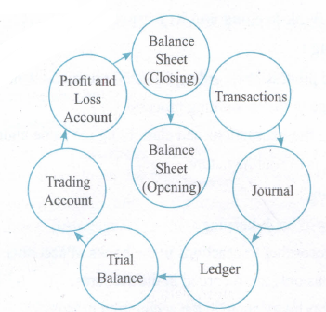
(i) When a businessman starts his business activities, he records the day-to-day transactions in the journal.
(ii) From the journal the transactions move further to the ledger where accounts are written up.
(iii) Preparation of trading and profit and loss account is the next step.
(iv) The balancing of profit and loss account gives the net result of the business transactions.
(v) Thus this cyclic movement of the transactions through the books of accounts (accounting cycle) is a continuous process.
10.
a) Income:
Income is the difference between revenue and expense.
b) Expense:
(i) Expenses is the amount spent in order to produce and sell the goods and services.
(ii) For example, purchase of raw materials, payment of salaries, wages etc.
c) Revenue:
Revenue means the amount receivable or realised from sale of goods and earnings from interest, dividend, commission, etc.

11th Standard Syllabus & Materials
11th Standard
TN 11th Tamil பீடு பெற நில் - செய்யுள் - காவடிச்சிந்து Important Questions And Answers Study Material - QB365 Set A
NEW11th Standard
TN 11th Tamil பீடு பெற நில் - உரைநடை - மலை இடப்பெயர்கள் : ஓர் ஆய்வு Important Questions And Answers Study Material - QB365 Set A
NEW11th Standard
TN 11th Tamil மாமழை போற்றுதும் - துணைப்பாடம் - யானை டாக்டர் Important Questions And Answers Study Material - QB365 Set A
NEW11th Standard
TN 11th Tamil மாமழை போற்றுதும் - செய்யுள் - ஐங்குறுநூறு Important Questions And Answers Study Material - QB365 Set A



Tamilnadu Stateboard 11th Standard Subjects

Maths

Commerce

Economics

Biology

Business Maths and Statistics
Accountancy

Computer Science

Physics

Chemistry
Maths
Biology
Economics
Physics
Chemistry

History
Business Maths and Statistics

Computer Science
Accountancy

Computer Applications
History
Computer Technology
Commerce
Computer Applications
Computer Technology

Tamil

English

French
Tamilnadu Stateboard Standards


