
 100% FREE ACCESS
11th Standard Syllabus & Materials
11th Standard
TN 11th Tamil இயற்கை வேளாண்மை,சுற்றுச்சூழல் -செய்யுள் - மனோன்மணீயம் Important Questions And Answers Study Material - QB365 Set A
NEW11th Standard
TN 11th Tamil என்னுயிர் என்பேன் -துணைப்பாடம் - இசைத்தமிழர் இருவர் Important Questions And Answers Study Material - QB365 Set A
NEW11th Standard
TN 11th Tamil மொழி கலை -செய்யுள் - ஒவ்வொரு புல்லையும் Important Questions And Answers Study Material - QB365 Set A
NEW11th Standard
TN 11th Tamil பீடு பெற நில் - இலக்கணம் - பகுபத உறுப்புகள் Important Questions And Answers Study Material - QB365 Set A
NEW11th Standard
TN 11th Tamil பீடு பெற நில் - துணைப்பாடம் - வாடிவாசல் Important Questions And Answers Study Material - QB365 Set A
NEW11th Standard
TN 11th Tamil பீடு பெற நில் - செய்யுள் - குறுந்தொகை Important Questions And Answers Study Material - QB365 Set A

Published on: 13/05/2022
QB365 provides detailed and simple solution for every
Creative Questions in class 11 Accountancy Subject. It will helps to get more idea about question pattern in every Creative questions with solution.
Download Tamil Nadu 11th Standard Accountancy question papers, model tests, one-mark questions, important questions, and public exam papers in PDF format. Free study materials and answer keys for TN State Board students.
Questions + Answers key
Take MCQ Accountancy Test
1.
Is accounting an art or a Science?
2.
Non-monetary transactions are not recorded in the books of accounts. Give reason and explain
3.
What is the process of accounting?
4.
Explain the objectives of Accounting?
5.
What are the informational needs of internal users?
1.
Accounting is both an art as well as Science.
(i) Art:
1. Art is the technique of achieving some predetermined objectives.
2. And accounting is also an art of recording, classifying and summarising financial transactions
(ii) Science:
1. Science is an organised knowledge based on certain basic principles.
2. Therefore, Accounting is also a Science as it is an organised knowledge based on certain principles.
2.
Accounting records only those transactions and events which can be expressed in terms of money such as sale or purchase of goods, salary paid etc.
(ii) Non-monetary transactions i.e. those transactions which cannot be expressed in terms of money are not recorded in the books of accounts.
(iii) Example of such transactions are value of human resources, appointment of a new managing director, etc.
(iv) These transactions may be important for the business but these are not recorded in the books of accounts. Because these cannot be measured in monetary terms.
3.
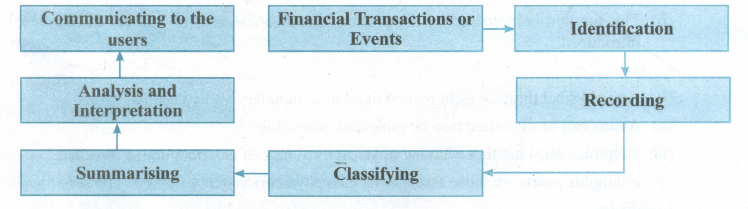
(i) Accounting process starts with identifying financial transactions, involves recording, classifying, and summarising and ends with interpreting accounting information to various concerned parties.
(ii) Accounting process can be explained with the help of the diagram given below.
4.
Following are the objectives of accounting:
(i) To keep a systematic record of financial transactions and events
(ii) To ascertain the profit or loss of the business enterprise
(iii) To ascertain the financial position or status of the enterprise
(iv) To provide information to various stakeholders for their requirements
(v) To protect the properties of an enterprise and
(vi) To ascertain the solvency and liquidity position of an enterprise
5.
The internal users comprise of owners, management and employees who are within the organisation.
(i) Owners:
1. The owners of a business furnish capital to be used for the purpose of business.
2. They are interested to know whether the business has earned a profit or loss during a particular period and also its financial position on a particular date.
(ii) Management:
1. Accounting data are the basis for most of the decisions made by the management.
2. The trends in sales and purchases, relationship of expenses to the turnover, productivity of workers, comparative profitability of different products and divisions etc.
(iii) Employees:
1. The employees are interested in the profit earning capacity of the business which will affect their salary, bonus, incentives and working conditions.
2. Labour unions use the accounting data in their bargaining strategies with the management.

11th Standard Syllabus & Materials
11th Standard
TN 11th Tamil பீடு பெற நில் - செய்யுள் - காவடிச்சிந்து Important Questions And Answers Study Material - QB365 Set A
NEW11th Standard
TN 11th Tamil பீடு பெற நில் - உரைநடை - மலை இடப்பெயர்கள் : ஓர் ஆய்வு Important Questions And Answers Study Material - QB365 Set A
NEW11th Standard
TN 11th Tamil மாமழை போற்றுதும் - துணைப்பாடம் - யானை டாக்டர் Important Questions And Answers Study Material - QB365 Set A
NEW11th Standard
TN 11th Tamil மாமழை போற்றுதும் - செய்யுள் - ஐங்குறுநூறு Important Questions And Answers Study Material - QB365 Set A



Tamilnadu Stateboard 11th Standard Subjects

Maths

Commerce

Economics

Biology

Business Maths and Statistics
Accountancy

Computer Science

Physics

Chemistry
Maths
Biology
Economics
Physics
Chemistry

History
Business Maths and Statistics

Computer Science
Accountancy

Computer Applications
History
Computer Technology
Commerce
Computer Applications
Computer Technology

Tamil

English

French
Tamilnadu Stateboard Standards


