
 100% FREE ACCESS
11th Standard Syllabus & Materials
11th Standard
TN 11th Tamil இயற்கை வேளாண்மை,சுற்றுச்சூழல் -செய்யுள் - மனோன்மணீயம் Important Questions And Answers Study Material - QB365 Set A
NEW11th Standard
TN 11th Tamil என்னுயிர் என்பேன் -துணைப்பாடம் - இசைத்தமிழர் இருவர் Important Questions And Answers Study Material - QB365 Set A
NEW11th Standard
TN 11th Tamil மொழி கலை -செய்யுள் - ஒவ்வொரு புல்லையும் Important Questions And Answers Study Material - QB365 Set A
NEW11th Standard
TN 11th Tamil பீடு பெற நில் - இலக்கணம் - பகுபத உறுப்புகள் Important Questions And Answers Study Material - QB365 Set A
NEW11th Standard
TN 11th Tamil பீடு பெற நில் - துணைப்பாடம் - வாடிவாசல் Important Questions And Answers Study Material - QB365 Set A
NEW11th Standard
TN 11th Tamil பீடு பெற நில் - செய்யுள் - குறுந்தொகை Important Questions And Answers Study Material - QB365 Set A

Published on: 26/02/2019
11-Std Third Revision Question answer 2019
Download Tamil Nadu 11th Standard Accountancy question papers, model tests, one-mark questions, important questions, and public exam papers in PDF format. Free study materials and answer keys for TN State Board students.
Questions + Answers key
Take MCQ Accountancy Test
1.
When cheque is not paid by the bank it is called as_______
Honoured
Endorsed
Dishonoured
None of these
2.
Merchandise stolen by someone should be debited to_______
Sales account
Purchases account
Loss by theft account
None of the above
3.
On 1st January 2013, Chandran draws a bill on Sundar for 3 months, its due date is___________.
31st March 2013
1st April 2013
4th April 2013
4.
Capital account is classified under________.
Personal A/c
Real A/c
Nominal A/c
5.
The term TDS in taxation refers to _______
Tax Dissolved
Tax Deducted Source
Both
6.
Transaction which provide benefit to the business for more than one year is called as ___________
Capital transaction
Revenue transaction
Neither of the two
None of these
7.
Outstanding expense account is a representative ______ account.
Personal
Real
Both 'a' and 'b'
None of these
8.
____________ method is appropriate for the fixed assets having certain period of working life.
Diminishing balance
Sinking fund
Straight line
Depreciation fund
9.
One of the limitations of computerised accounting system is _______.
System failure
Accuracy
Versatility
Storage
10.
If the total charge of depreciation and maintenance cost are considered, the method that provides a uniform charge is ____.
Straight line method
Diminishing balance method
Annuity method
Insurance policy method
11.
A credit purchase of furniture from Athiyaman was debited to purchases account. Which of the following accounts should be debited while rectifying this error?
Purchases account
Athiyaman account
Furniture account
None of these
12.
Balance sheet shows the ________ of the business.
Profitability
Financial position
Sales
Purchases
13.
Balance as per bank statement is Rs. 1,000. Cheque deposited, but not yet credited by the bank is Rs. 2,000. What is the balance as per bank column of the cash book?
Rs. 3,000 overdraft
Rs. 3,000 favourable
Rs. 1,000 overdraft
Rs. 1,000 favourable
14.
In double entry system of book keeping, every business transaction affects
Minimum of two accounts
Same account on two different dates
Two sides of the same account
Minimum three accounts
15.
Cash book is a _______
Subsidiary book
Principal book
Journal proper
Both subsidiary book and principal book
16.
Purchases of fixed assets on credit basis is recorded in _______
Purchases book
Sales book
Purchases returns book
Journal proper
17.
The trial balance contains the balances of_____
Only personal accounts
Only real accounts
Only nominal accounts
All accounts
18.
J. F. means ___________
Ledger page number
Journal page number
Voucher number
Order number
19.
In India, Accounting Standards are issued by
Reserve Bank of India
The Cost and Management Accountants of India
Supreme Court of India
The Institute of Chartered Accountants of India
20.
Who is considered to be the internal user of the financial information?
Creditor
Employee
Customer
Government
21.
Enter the following transactions in the single column cash book of Mrs. Lalitha.
| 2012, August | Rs. |
|---|---|
| 1. Cash in hand | 46,000 |
| 3 Paid into Bank | 12,000 |
| 4 Cash sales | 24,000 |
| 5 Credit sales to Mani | 3,000 |
| 7 Printing charges | 3,000 |
| 9 Received cheque from Natesan | 8,000 |
| 12 Dividend received | 2,000 |
| 14 Computer purchased | 35,000 |
| 17 Cash received from Mani | 3,000 |
| 24 Cash withdrawn from bank | 2,000 |
22.
Classify the following into capital and revenue.
i) Rs.300 paid for carriage on goods purchased.
ii) Rs.700 paid for repairs on second hand machinery as soon as it was purchased.
iii) Rs.1000 paid for repairs on a machinery for maintenance.
iv) Second hand asset purchased for Rs.10,000
v) Rent paid to the landlord Rs.8,000
23.
From the following balances extracted from the books of Ashok, a merchant of Chennai, prepare trial balance as on 31st December, 2017.
| Particulars | Rs | Particulars | Rs |
|---|---|---|---|
| Buildings | 20,000 | Conveyance charges | 3,500 |
| Bills payable | 3,000 | Salary | 5,600 |
| Debtors | 20,000 | Capital | 40,000 |
| Cash at bank | 16,800 | Furniture | 10,000 |
| Insurance paid | 1,600 | Motor vehicles | 5,000 |
| Rent received | 5,000 | Patents | 2,000 |
| Donation given | 2,500 | Goodwill | 3,000 |
| Loan borrowed | 42,000 |
24.
Following are the extracts from the trial balance.
| Particulars | Debit Rs. | Credit Rs. |
|---|---|---|
| Sundry debtors | 50,000 | |
| Discount on debtors | 1,000 | |
| Bad debts | 3,000 | |
| Provision for doubtful debts | 5,000 | |
| Provision for discount on debtors | 2,000 |
Additional information:
(a) Additional bad debts Rs. 1,000
(b) Create a provision for doubtful debts @ 5% on sundry debtors.
(c) Create a provision for discount on debtors @ 2% on sundry debtors.
You are required to pass necessary journal entries and show how these items will appear in the final accounts.
25.
From the Trial balance, given by Saif, prepare final accounts for the year ended 31st March 2018 in his books.
| Debit Balances | Rs | Credit Balances | Rs |
|---|---|---|---|
| Land | 40,000 | Purchases returns | 15,000 |
| Opening stock | 40,000 | Bill payable | 7,000 |
| Machinery | 66,000 | Capital | 1,50,000 |
| Purchases | 1,30,000 | Sales | 2,20,000 |
| Wages | 35,000 | Creditors | 60,000 |
| Interest paid | 13,000 | ||
| Cash | 2,300 | ||
| Debtors | 80,000 | ||
| Bill receivable | 15,000 | ||
| Office rent paid | 12,700 | ||
| Furniture | 3,000 | ||
| Drawings | 5,000 | ||
| Sales returns | 10,000 | ||
| 4,52,000 | 4,52,000 |
Closing stock (31-12-2017) Rs. 14,500.
26.
Calculate depreciation under Straight Line Method using Spreadsheet based on the details given below.
| A | B | C | D | E | F |
|---|---|---|---|---|---|
| Asset | Cost of purchase Rs |
Installation charge Rs |
Transportation charge Rs |
Salvage value Rs | Life in years |
| 1. Machinery | 200000 | 20000 | 5000 | 25000 | 10 |
| 2. Furniture | 50000 | 4000 | 2000 | 5000 | 8 |
27.
An asset is purchased on 1.1.2016 for Rs. 25,000. Depreciation is to be provided annually according to straight line method. The useful life of the asset is 10 years and its residual value is Rs. 1,000. Accounts are closed on 31st December every year. You are required to find out the rate of depreciation and give journal entries for first two years.
28.
A book-keeper finds that the debit column of the trial balance is short by Rs.308 and the difference is put to a suspense account. Subsequently, the following errors were located.
(a) An entry for sale of goods on credit for Rs.102 to Mekala was posted to her account as Rs.120.
(b) Rs.100 being the monthly total of discount allowed to customers was credited to discount received account in the ledger.
(c) Rs.275 paid by Mannan was credited to Kannan account.
(d) Rs. 26 appearing in the cash book as paid for the purchase of stationery for office use has not been posted to ledger.
(e) The purchases book was undercast by Rs.100.
Rectify the errors and prepare suspense account.
29.
Enter the following transactions of Fathima in the cash book with cash, bank and discount columns for the month of May, 2017
| 2017 May | Particulars | Rs |
|---|---|---|
| 1 | Cash balance | 17,200 |
| Bank balance | 43,000 | |
| 4 | Received from Rajkumar by cheque on account | 6,500 |
| 9 | Sold goods to Kumar for cash | 12,000 |
| 15 | Bought laptop for business use and payment made through NEFT | 21,000 |
| 17 | Withdrawn cash from Bank | 9,600 |
| 24 | Goods purchased for cash Rs 12,400 and by cheque | 18,200 |
| 25 | Deposited cash with bank | 14,000 |
| 28 | Paid staff salaries by cheque | 8,000 |
| 29 | Dividend received in cash | 4,700 |
| 30 | Paid office rent in cash | 12,000 |
30.
From the following particulars, ascertain the cash book balance as on 31st December, 2016.
(i) Overdraft balance as per bank statement Rs.1,26,640
(ii) Interest on overdraft entered in the bank statement, but not yet recorded in cash book Rs. 3,200
(iii) Bank charges entered in bank statement, but not found in cash book Rs. 600
(iv) Cheques issued, but not yet presented for payment Rs. 23,360
(v) Cheques deposited into the bank but not yet credited Rs. 43,400
(vi) Interest on investment collected by the bank Rs. 24,000.
31.
Record the following transactions in the sales book and sales returns book of M/s. Ponni & Co., and post them to ledger.
| 2017 Aug 1 | Sold goods to Senthil as per Invoice No. 68 for Rs. 20,500 on credit |
| Aug 4 | Sold goods to Madhavan as per Invoice No. 74 for Rs. 12,800 on credit |
| Aug 7 | Sold goods to Kanagasabai as per Invoice No. 78 for Rs. 7,500 on credit |
| Aug 15 | Returns inward by Senthil as per Credit Note no. 7 for Rs. 1,500 for which cash is not paid |
| Aug 20 | Sold goods to Selvam for Rs. 13,300 for cash |
| Aug 25 | Sales returns of Rs. 1,800 by Madhavan as per Credit Note No. 11 for which cash is not paid |
32.
Karthick opened a provisions store on 1st April, 2017. Journalise the following transactions in his books:
| 2017 April | Rs | |
|---|---|---|
| 1 | Paid into bank for opening a current account | 2,00,000 |
| 3 | Goods purchased by cheque | 40,000 |
| 5 | Investments made in securities | 40,000 |
| 6 | Goods sold to Radha for Rs.20,000 and cheque received and deposited into bank | |
| 7 | Amount withdrawn from bank for office use | 15,000 |
| 10 | Purchased goods from Kamala and cash deposited in CDM | 10,000 |
| 12 | Sold goods to Vanitha who paid through debit card | 10,000 |
| 15 | Interest on securities directly received by the bank | 1,000 |
| 20 | Insurance paid by the bank as per standing instructions | 2,000 |
| 25 | Sales made to Kunal who made payment through CDM | 6,000 |
33.
Journalise the following transactions and post them to Ledger.
| 2016 Jan | Rs. | |
| 1 | Started business with cash | 10,000 |
| 5 | Paid into bank | 5,000 |
| 7 | Purchased goods from Ram for cash | 1,000 |
34.
Briefly explain the functions of accounting
35.
Discuss briefly the branches of accounting.
36.
Explain the posting of a compound journal entry with an example.
37.
Opening stock Rs. 30,000, Purchases Rs. 54,600, Expenses Rs. 6,000, Sales Rs.90,000, Expenses on sales Rs. 3,000, Closing stock Rs. 36,000. Calculate Cost of goods sold and Gross profit.
38.
Explain any three advantages of subsidiary books.
39.
Explain how closing stock is treated in final accounts.
40.
The following errors were located after the preparation of trial balance. The difference in trial balance has been taken to suspense account. Rectify them.
(a) The total of purchases book was carried forward Rs.70 less.
(b) The total of sales book was carried forward Rs.340 more.
(c) The total of purchases book was carried forward Rs.150 more.
(d) The total of sales book was carried forward Rs.200 less.
(e) The total of purchase returns book was carried forward Rs.350 less
41.
Mr. Vivek took a loan of Rs.2,00,000 from State Bank of India, Chennai and number of instalments is 84 months. Calculate the rate assuming payments Rs.3,300 per month using the appropriate function.
42.
Show the accounting equation on the basis of the following transactions:
i) Ramya started business with Cash Rs.25,000
ii) Purchases goods from Harsha Rs.20,000
iii) Sold goods to Amala costing Rs.18,000 Rs.25,000
iv) Ramya withdrew from business Rs.5,000
43.
Briefly explain about contra entry with examples.
44.
What are the limitations of Book-keeping
45.
What is credit transaction?
46.
Give adjusting entry for depreciation at 10% p.a. on machinery of Rs.25,000.
47.
Analyse the Trial Balance. Can you identify accounts that have only debit balances/credit balances always?
48.
Name any two accounting packages.
49.
A firm purchased a plant for Rs. 40,000. Erection charges amounted to Rs. 2,000. Effective life of the plant is 5 years. Calculate the amount of depreciation per year under straight line method
50.
Pass necessary journal entries to rectify the following errors located after the preparation of trial balance:
(a) Sales book was undercast by Rs.1,000.
(b) A amount of Rs.500 paid for wages was wrongly posted to machinery Account.
51.
State whether the following are capital, revenue or deferred revenue expenditure.
i) Carriage of Rs.1,000 spent on machinery purchased and installed.
ii) Office rent paid Rs.2,000.
iii) Wages of Rs.5,000 paid to machine operators.
iv) Hire charges for the use of motor vehicle, hired for five years, but paid yearly.
52.
Which values are involved in the preparation of bank reconciliation statements?
53.
Write any one transaction which:
a) Decreases the assets and decreases the liabilities
b) Increases one asset and decreases another asset
54.
What is purchases returns book?
1.
(c)
Dishonoured
2.
(c)
Loss by theft account
3.
(c)
4th April 2013
4.
(a)
Personal A/c
5.
(b)
Tax Deducted Source
6.
(a)
Capital transaction
7.
(a)
Personal
8.
(c)
Straight line
9.
(a)
System failure
10.
(b)
Diminishing balance method
11.
(c)
Furniture account
12.
(b)
Financial position
13.
(b)
Rs. 3,000 favourable
14.
(a)
Minimum of two accounts
15.
(d)
Both subsidiary book and principal book
16.
(d)
Journal proper
17.
(d)
All accounts
18.
(b)
Journal page number
19.
(d)
The Institute of Chartered Accountants of India
20.
(b)
Employee
21.
| Date | Particulars (Receipts) |
R.N. | L.F. | Amount Rs. | Date | Particulars (Payments) |
V.N. | L.F. | Amount Rs. |
|---|---|---|---|---|---|---|---|---|---|
| 1.8.12 | To Balance b/d | 46,000 | 3.8.12 | By Bank A/c | 12,000 | ||||
| 4.8.12 | To Sales A/c | 24,000 | 7.8.12 | By Printing charges A/c | 3,000 | ||||
| 9.8.12 | To Natesan A/c | 8,000 | 14.8.12 | By Computer A/c | 35,000 | ||||
| 12.8.12 | To Dividend A/c | 2,000 | 31.8.12 | By Balance c/d | 35,000 | ||||
| 17.8.12 | To Mani A/c | 3,000 | |||||||
| 24.8.12 | To Bank A/c | 2,000 | |||||||
| 85,000 | 85,000 | ||||||||
| 1.9.12 | To Balance b/d | 35,000 |
22.
| S.No. | Transactions | Classification |
|---|---|---|
| i) | Rs.300 paid for carriage on goods purchased. | Revenue expenditure |
| ii) | Rs.700 paid for repairs on second hand machinery as soon as it was purchased. | Capital expenditure |
| iii) | Rs.1000 paid for repairs on a machinery for maintenance. | Revenue expenditure |
| iv) | Second hand asset purchased for Rs.10,000 | Capital expenditure |
| v) | Rent paid to the landlord Rs.8,000 | Revenue expenditure |
23.
In the books of Ashok Trial balance as on 31st March, 2017
| S.No. | Name of the account | L.F. | Debit balance Rs. |
Credit balance Rs. |
|---|---|---|---|---|
| 1. | Building | 20,000 | ||
| 2. | Bills payable | 3,000 | ||
| 3. | Debtors | 20,000 | ||
| 4. | Cash in bank | 16,800 | ||
| 5. | Insurance paid | 1,600 | ||
| 6. | Rent received | 5,000 | ||
| 7. | Donation given | 2,500 | ||
| 8. | Loan borrowed | 42,000 | ||
| 9. | Conveyance charges | 3,500 | ||
| 10. | Salary | 5,600 | ||
| 11. | Capital | 40,000 | ||
| 12. | Furniture | 10,000 | ||
| 13. | Motor vehicles | 5,000 | ||
| 14. | Patents | 2,000 | ||
| 15. | Goodwill | 3,000 | ||
| Total | 90,000 | 90,000 |
24.
| Date | Particulars | L.F. | Debit Rs | Credit Rs | |
|---|---|---|---|---|---|
| Bad debts A/c | Dr | 1,000 | |||
| To Sundry debtors A/c | 1,000 | ||||
| (Adjusting entry made) | |||||
| Profit and loss A/c | 1,000 | ||||
| To Bad debts A/c | 1,000 | ||||
| (Bad debts transferred to Profit and loss A/c) | |||||
| Profit and Loss A/c | Dr | 1,450 | |||
| To Provision for bad and doubtful debts A/c | 1,450 | ||||
| (Provision for Bad and doubtful debts 49,000 x \(5\over 100\)) | |||||
| Profit and loss A/c | Dr | 69 | |||
| To Provision for discount on debtors A/c | 69 | ||||
| (Provision for discount on debtors) |
| Particulars | Amount Rs | Amount Rs | Particulars | Amount Rs | Amount Rs |
|---|---|---|---|---|---|
| To Provision for bad and doubtful debts (Adj.) | 2,450 | ||||
| Add : Bad debts | 3,000 | ||||
| 5,450 | |||||
| Add: Additional bad debts | 1,000 | ||||
| 6,450 | |||||
| Less: Provision for bad and doubtful debts | 5,000 | 1,450 | |||
| To discount allowed | 1,000 | ||||
| Add: Provision for discount | 931 | ||||
| 1,931 | |||||
| Less : Old provision for discount | 2,000 | ||||
| 69 |
| Liabilities | Amount Rs | Amount Rs | Assets | Amount Rs | Amount Rs |
|---|---|---|---|---|---|
| Sundry Debtor | 50,000 | ||||
| Less : Additional bad debts | 1,000 | ||||
| 49,000 | |||||
| Less : Provision for doubtful debts 5% | 2,450 | ||||
| 46,550 | |||||
| Less : Provision for discount on debtors 2% | 937 | ||||
| 45,619 |
25.
| Deblt Balances | Rs. | Rs. | Credit Balances | Rs. | Rs. |
|---|---|---|---|---|---|
| To Opening stock | 40,000 | By Sales | 2,20,000 | ||
| To Wages | 35,000 | Less: Sales returns | 10,000 | 2,10,000 | |
| To Purchases | 1,30,000 | By Closing stock | 14,500 | ||
| Less: Purchases returns | 15,000 | 1,15,000 | |||
| To Gross profit c/d | 34,500 | ||||
| 2,24,500 | 2,24,500 | ||||
| To Office rent | 12,700 | By Gross profit b/d | 34,500 | ||
| To Interest paid | 13,000 | ||||
| To Net profit c/d | 8,800 | ||||
| (Transferred to Capital accounts) | |||||
| 34,500 | 34,500 |
| Liabilities | Rs. | Rs. | Assets | Rs. | Rs. |
|---|---|---|---|---|---|
| Bills payable | 7,000 | Land | 40,000 | ||
| Capital | 1,50,000 | Machinery | 66,000 | ||
| Add: Net profit | 8,800 | Cash | 2,300 | ||
| 1,58,800 | Debtors | 80,000 | |||
| Less: Drawings | 5,000 | 1,53,800 | Bills receivable | 15,000 | |
| Creditors | 60,000 | Furniture | 3,000 | ||
| Closing stock | 14,500 | ||||
| 2,20,800 | 2,20,800 |
26.
Procedure and answer
(i) Open a new spreadsheet in MS-EXCEL
(ii) Enter labels and values in the cells as given above
(iii) Write total cost in G1 and annual depreciation in H1
(iv) Calculate total cost in the cell G2 by the formula
= Sum(B2:D2) and copy formula to cell G3
(v) Calculate annual depreciation in the cell H2 by the formula
= SLN(G2,E2,F2) and copy formula to cell H3
Output
| A | B | C | D | E | F | G | H |
|---|---|---|---|---|---|---|---|
| Asset | Cost of purchase Rs |
Installation charge Rs |
Transportation charge Rs |
Salvage value Rs | Life in years |
Total cost Rs |
Annual depreciation Rs |
| 1. Machinery | 200000 | 20000 | 5000 | 25000 | 10 | 225000 | 20,000 |
| 2. Furniture | 50000 | 4000 | 2000 | 5000 | 8 | 56000 | 6,375 |
27.
Amount of depreciation = \({(Price\ of\ the\ Asset + Installation\ charges)-Scrap value\over Estimated\ life\ of\ the\ Asset}\)
\(=-{25,000-1,000\over 10}={24,000\over 10} \)
= Rs.2,400
Rate of Depreciation = \({Amount\ of\ depreciation\over Original\ Cost}\times100\)
\(={2,400\over 25,000}\times100=9.6\%\)
| Date | Particulars | L.F. | Debit Rs | Credit Rs | |
|---|---|---|---|---|---|
| 2016 January 1 | Asset A/c | Dr | .25,000 | ||
| To Bank A/c | .25,000 | ||||
| (Asset bought) | |||||
| December 31 | Depreciation A/c | Dr | 2,400 | ||
| To Depreciation A/c | 2,400 | ||||
| (Depreciation transferred to profit and loss account) | |||||
| 2017 December 31 | Depreciation A\/ | Dr | 2,400 | ||
| To Asset A/c | 2,400 | ||||
| (Depreciation provided) | |||||
| December 31 | Profit and loss A/c | Dr | 2,400 | ||
| To Asset A/c | 2,400 | ||||
| (Depreciation provided) | |||||
| December 31 | Profit and loss A/c | Dr | 2,400 | ||
| To Depreciation A/c | 2,400 | ||||
| (Depreciation transferred to profit and loss account) |
28.
| Particulars | L.F. | Dr. Rs | Cr. Rs | ||
|---|---|---|---|---|---|
| a | Suspense A/c | Dr | 18 | ||
| To Mekala A/c | 18 | ||||
| (Excess amount posted to Mekala account rectified) | |||||
| b | Discount allowed A/c | Dr | 100 | ||
| Discount received A/c | Dr | 100 | |||
| To Suspense A/c | 200 | ||||
| (Discount allowed wrongly posted to discount received account rectified) | |||||
| c | Kannan A/c | Dr | 275 | ||
| To Mannan A/c | 275 | ||||
| (Wrong credit to Kannan account instead of Mannan account rectified) | |||||
| d | Stationery A/c | Dr | 26 | ||
| To Suspense A/c | 26 | ||||
| (Purchase of stationery not posted to stationery account rectified) | |||||
| e | Purchases A/c | Dr | 100 | ||
| To Suspense A/c | 100 | ||||
| (Undercasting in the purchases book rectified) |
| Particulars | Rs | Particulars | Rs |
|---|---|---|---|
| To Balance b/d | 308 | By Discount allowed A/c | 100 |
| To Mekala A/c | 18 | By Discount received A/c | 100 |
| By Stationery A/c | 26 | ||
| By Purchases A/c | 100 | ||
| 326 | 326 |
29.
| Date | Receipts | R.N. | L.F. | Amount | Date | Payments | V.N. | L.F. | Amount | |||||
|---|---|---|---|---|---|---|---|---|---|---|---|---|---|---|
| Discount allowed (Rs) | Cash (Rs) | Bank (Rs) | Discount Received (Rs) | Cash (Rs) | Bank (Rs) | |||||||||
| 2017 May | 2017 May | |||||||||||||
| 1 | To Balance b/d | 17,200 | 43,000 | 15 | By Laptop A/c | 21,000 | ||||||||
| 4 | To Rajkumar A/c | 6,500 | 17 | By Cash A/c | 'C' | 9,600 | ||||||||
| 9 | To Sales A/c | 12,000 | 24 | By Purchases A/c | 12,400 | 18,200 | ||||||||
| 17 | To Bank A/c | 'C' | 9,600 | 25 | By Bank A/c | 'C' | 14,000 | |||||||
| 25 | To Cash A/c | 'C' | 14,000 | 28 | By Salary A/c | 8,000 | ||||||||
| 29 | To Dividend A/c | 4,700 | 30 | By Office Rent A/c | 12,000 | |||||||||
| 31 | By Balance c/d | 11,600 | 200 | |||||||||||
| - | 50,000 | 57,000 | - | 50,000 | 57,000 | |||||||||
| June 1 | To Balance b/d | 11,600 | 200 | |||||||||||
30.
| Particulars | Amount Rs |
Amount Rs |
|---|---|---|
| Overdraft balance as per bank statement | 1,26,640 | |
| Add: Cheques issued but not presented | 23,360 | |
| Interest on Investment collected by the bank | 24,000 | 47,360 |
| 1,74,000 | ||
| Less: Interest on overdraft but not recorded | 3,200 | |
| Bank charges entered | 600 | |
| Cheque deposited but not credited | 43,400 | 47,200 |
| Overdraft as per Cashbook | 1,26,800 |
31.
| Date | Particulars | Outward Invoice No. | L.F. | Amount | |
|---|---|---|---|---|---|
| Details (Rs) | Total (Rs) | ||||
| 2017 Aug 1 | Senthil | 68 | 20,500 | ||
| Aug 4 | Madhavan | 74 | 12,800 | ||
| Aug 7 | Kanagasabai | 78 | 7,500 | ||
| Sales A/cCr. | 40,800 | ||||
| Date | Particulars | J.F | Amount Rs. | Date | Particulars | J.F. | Amount Rs. |
|---|---|---|---|---|---|---|---|
| 2017 Aug 31 | By Sundries as per Sales Book | 40,800 |
| Date | Particulars | J.F | Amount Rs. | Date | Particulars | J.F. | Amount Rs. |
|---|---|---|---|---|---|---|---|
| 2017 Aug 1 | To Sales A/c | 20,500 |
| Date | Particulars | J.F | Amount Rs. | Date | Particulars | J.F. | Amount Rs. |
|---|---|---|---|---|---|---|---|
| 2017 Aug 4 | To Sales A/c | 12,800 |
| Date | Particulars | J.F | Amount Rs. | Date | Particulars | J.F. | Amount Rs. |
|---|---|---|---|---|---|---|---|
| 2017 Aug 7 | To Sales A/c | 7,500 |
| Date | Particulars | Credit Note No. | L.F. | Amount | Remarks | |
|---|---|---|---|---|---|---|
| Details (Rs) | Total (Rs) | |||||
| 2017 Aug 15 Aug 25 |
Senthil |
7 11 |
1,500 1,800 |
|||
| Sales return A/c Dr. | 3,300 | |||||
| Date | Particulars | J.F | Amount Rs. | Date | Particulars | J.F. | Amount Rs. |
|---|---|---|---|---|---|---|---|
| 2017 Aug 31 | To Sundries as per Sales return Book | 3,300 |
| Date | Particulars | J.F | Amount Rs. | Date | Particulars | J.F. | Amount Rs. |
|---|---|---|---|---|---|---|---|
| 2017 Aug 31 | By Sales Return A/c | 1,500 |
| Date | Particulars | J.F | Amount Rs. | Date | Particulars | J.F. | Amount Rs. |
|---|---|---|---|---|---|---|---|
| 2017 Aug 25 | By Sales return A/c | 1,800 |
32.
| Date | Particulars | L.F | Debit Rs | Credit Rs | |
|---|---|---|---|---|---|
| 2017 April 1 | BankA/c | Dr | 2,00,000 | ||
| To Cash A/c | 2,00,000 | ||||
| (Opening a current account) | |||||
| 3 | Purchases A/c | Dr | 40,000 | ||
| To Bank A/c | 40,000 | ||||
| (Goods purchased by cheque) | |||||
| 5 | Investments A/c | Dr | 40,000 | ||
| To Karthick capital A/c | 40,000 | ||||
| (Being investments made) | |||||
| 6 | Cash A/c | Dr | 20,000 | ||
| To Sales A/c | 20,000 | ||||
| (Sales made and cheque received). | |||||
| Bank A/c | Dr | 20,000 | |||
| To Cash A/c | 20,000 | ||||
| (Cheque received from Radha and deposited in the CDM) | |||||
| 7 | Cash A/c | Dr | 15,000 | ||
| To Bank A/c | 15,000 | ||||
| (Amount withdrawn from bank for office use) | |||||
| 10 | Purchases A/c | Dr | 10,000 | ||
| To Bank A/c | 10,000 | ||||
| (Cash deposited in CDM) | |||||
| 12 | Bank A/c | Dr | 10,000 | ||
| To Sales A/c | 10,000 | ||||
| (Sales made and money credited through debit card) | |||||
| 15 | Bank A/c | Dr | 1,000 | ||
| To Interest on securities A/c | 1,000 | ||||
| (Interest on securities received by the bank) | |||||
| 20 | Insurance A/c | Dr | 2,000 | ||
| To Bank A/c | 2,000 | ||||
| (Insurance paid by the bank) | |||||
| 25 | Bank A/c | Dr | 6,000 | ||
| To Sales A/c | 6,000 | ||||
| (Sales made and money received through CDM) |
33.
Journal Entries
| Date | Particulars | L.F. | Debit (Rs.) | Credit (Rs.) |
|---|---|---|---|---|
| 2016 Jan 1 | Cash A/C Dr. To Capital A/C (started business with cash) |
10,000 | 10,000 | |
| 5 | Bank A/C Dr. To cash A/C (Amount paid into Bank) |
5,000 | 5,000 | |
| 7 | Purchase A/C Dr. To Cash A/C (Cash purchases) |
1,000 | 1,000 |
Dr. Ledger Account Cash Account Cr.
| Date | Particulars | J.F. | Amount (Rs.) | Date | Particulars | J.F. | Amount (Rs.) |
|---|---|---|---|---|---|---|---|
| 2016 Jan 1 | To Capital A/c | 10,000 | 2016 Jan 5 | By Bank A/C | 5,000 | ||
| 7 | By Purchases A/C | 1,000 | |||||
| 31 | By Balance c/d | 4,000 | |||||
| 10,000 | 10,000 | ||||||
| 2016 Feb 1 | To Balance b/d | 4,000 |
Dr. Bank Account Cr.
| Date | Particulars | J.F. | Amount (Rs.) | Date | Particulars | J.F. | Amount (Rs.) |
|---|---|---|---|---|---|---|---|
| 2016 Jan 1 | To Capital A/C | 5,000 | 2016 Jan 31 | By Bank c/d | 5,000 | ||
| 5,000 | 5,000 | ||||||
| 2016 Feb 1 | To Balance b/d | 5,000 |
Dr. Capital Account Cr.
| Date | Particulars | J.F. | Amount (Rs.) | Date | Particulars | J.F. | Amount (Rs.) |
|---|---|---|---|---|---|---|---|
| 2016 Jan 31 | To Balance c/d | 10,000 | 2016 Jan 1 | By cash A/c | 10,000 | ||
| 10,000 | 10,000 | ||||||
| 2016 Feb 1 | By Balance b/d | 10,000 |
Dr. Purchases A Account Cr.
| Date | Particulars | J.F. | Amount (Rs.) | Date | Particulars | J.F. | Amount (Rs.) |
|---|---|---|---|---|---|---|---|
| 2016 Jan 7 | To Cash A/c | 1,000 | 2016 Jan 31 | By Balance c/d | 1,000 | ||
| 1,000 | 1,000 | ||||||
| 1,000 |
34.
The main functions of accounting are as follows:
(i) Measurement:
1. The main function of accounting is to keep systematic record of business transactions, post them to the ledger and ultimately to prepare the final accounts.
2. Accounting works as a tool for measuring past performance of the business enterprises.
(ii) Forecasting:
With the help of the various tools of accounting, future performance and financial position of the business enterprises can be forecasted.
(iii) Comparison:
1. Accounting helps to assess the actual performance with the targets.
2. It also discloses the accounting policies.
(iv) Decision making:
1. Accounting assists the management in planning, evaluation of performance, control and decision making by providing required information to various users of accounts.
2. This will help them to take various decisions on cost, price, sales, volume, etc.
(v) Control:
1. As accounting works as a tool of control, the strengths and weaknesses are identified to provide feedback on various measures adopted.
2. It serves as a tool for evaluating compliance of business policies and programmes.
(vi) Assistance to Government regulations:
Government needs full information on the financial aspects of the business, so that proper tax can be levied on the income earned by the enterprises.
35.
The various branches of accounting are
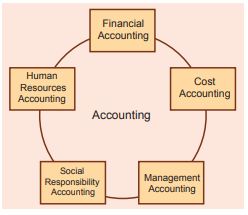
(i) Financial Accounting :
1. It involves recording of financial transactions and events.
2. It provides financial information to the users for taking decisions.
3. It ends up with the preparation of trading and profit and loss account and balance sheet,
(ii) Cost Accounting :
It involves the collection, recording, classification and appropriate allocation of expenditure for the determination of the costs of products or services and for the presentation of data for the purposes of cost control and managerial decision making.
(iii) Management Accounting :
It is concerned with the presentation of accounting information in such a way as to assist management in decision making and in the day-to-day operations of an enterprise.
(iv) Social Responsibility Accounting :
It is concerned with presentation of accounting information from the viewpoint of the society by showing the social costs and social benefits.
(v) Human Resource Accounting :
It is concerned with identification, quantification, and reporting of investments made in human resources of an enterprise.
36.
Posting of a Compound Journal Entry: Compound or Combined journal entry is one where more than one transactions are recorded by passing only one journal entry instead of passing several journal entries. Since every debit must have the corresponding equal amount of credit, special care must be taken in posting the compound journal entry, where there may be only one debit aspect but many corresponding credit aspects of equal value or vice versa.
Example: Jan. 15,2018, Cash Sales Rs. 10,000 cash received from Kannan Rs. 5,000 and commission earned Rs. 2,500.
| Date | Particulars | L.F. | Debit Rs. | Credit Rs. | |
|---|---|---|---|---|---|
| 15.1.18 | Cash A/c | Dr. | 17,500 | ||
| To Sales A/c | 10,000 | ||||
| To Kannan A/c | 5,000 | ||||
| To Commission A/c | 2,500 | ||||
| (Received cash for sale, from Kannan & as commission) |
| Date | Particulars | J.F. | Amount Rs. | Date | Particulars | J.F. | Amount Rs. |
|---|---|---|---|---|---|---|---|
| 15.1.18 | To Sales A/c | 10,000 | 31.1.18 | By Balance c/d | 17,500 | ||
| To Kannan A/c | 5,000 | ||||||
| To Commission A/c | 2,500 | ||||||
| 17,500 | 17,500 | ||||||
| 1,2,18 | To Balance b/d | 4,000 |
| Date | Particulars | J.F. | Amount Rs | Date | Particulars | J.F. | Amount Rs |
|---|---|---|---|---|---|---|---|
| 31.1.18 | To Balance c/d | 10,000 | 15.1.18 | By Cash A/c | 10,000 | ||
| 10,000 | 10,000 | ||||||
| 1.2.18 | By Balance b/d | 10,000 |
| Date | Particulars | J.F. | Amount Rs. | Date | Particulars | J.F. | Amount Rs. |
|---|---|---|---|---|---|---|---|
| 31.1.18 | To Balance c/d | 5,000 | 15.1.18 | By Cash A/c | 5,000 | ||
| 5,000 | 5,000 | ||||||
| 1.2.18 | By Balance b/d | 5,000 |
| Date | Particulars | J.F. | Amount Rs. | Date | Particulars | J.F. | Amount Rs. |
|---|---|---|---|---|---|---|---|
| 31.1.18 | To Balance c/d | 2,500 | 15.1.18 | By Cash A/c | 2,500 | ||
| 2,500 | 2,500 | ||||||
| 1.2.18 | By Balance b/d | 2,500 |
37.
Cost of Goods sold Opening stock + Purchases + Expenses on purchases - Closing stock
= Rs.30,000 + Rs. 54,600 + Rs. 6,000 -Rs. 36,600
= Rs. 54,000
Gross profit Net Sales - Cost of Goods sold
= Rs. 90,000 - Rs. 54,000
= Rs. 36,000
38.
(i) Division of work: As journal is sub-divided, the work will be subdivided and different persons can work on different books at the same time and the work can be speedily completed.
(ii) Efficiency: The sub-division of work gives same work is done by a person repeatedly, the person becomes efficient in handling it. Thus, specialization leads to efficiency in accounting work.
(iii) Prevents errors and frauds: Internal check becomes more effective as the work can be divided in such a manner that the work of one person is automatically checked by another person. With the use of internal check, the possibility of occurrence of errors or fraud may be avoided or minimised.
(iv) Saving in time: As there are many subsidiary books, work of entering can be done simultaneously by many person. Thus it saves time and accounting work can be completed quickly.
(v) Detailed informations available: As all transactions relating to a particular item are entered in a subsidiary book, it gives detailed information. It is easy to arrive at monthly or quarterly totals.
39.
(i) The unsold goods in stock at the end of the accounting period is termed as closing stock. The stock is valued at cost price or not realisable value whichever is lower.
(ii) The valuation principle is based on the convention of conservatism.
| Date | Particulars | L.F. | Debit Rs | Credit Rs | |
|---|---|---|---|---|---|
| Closing Stock A/c | Dr | xxxxxx | |||
| To Trading A/c | xxxxxx | ||||
| (Closing Stock brought into Account) |
Value of Closing Stock will appear :
(a) On the credit side of trading account and
(b) On the assets side of balance sheet.
40.
| S.No. | Particulars | L.F. | Debit Rs | Credit Rs | |
|---|---|---|---|---|---|
| (a) | Purchases A/c | Dr. | 70 | ||
| To Suspense A/c | 70 | ||||
| (Being purchases book was carried forward Rs 70 less, now rectified) | |||||
| (b) | Sales A/c | Dr. | 340 | ||
| To Suspense A/c | 340 | ||||
| (Being sales book was carried forward Rs 340 more, now rectified) | |||||
| (c) | SuspenseA/c | Dr. | 150 | ||
| To Purchases A/c | 150 | ||||
| (Being purchases book was carried forward Rs 50 more, now rectified) | |||||
| (d) | Suspense A/c | Dr. | 200 | ||
| To Sales A/c | 200 | ||||
| (Being sales book was carried forward 200 less, now rectified) | |||||
| (e) | Suspense A/c | Dr. | 350 | ||
| To Purchase return A/c | 350 | ||||
| (Being purchase return book was cast short, now rectified) |
41.
Procedure
(i) Open a new spreadsheet in MS-Excel
(ii) Enter values in the cells as given below
| A | B | |
| 1 | Number of instalments (nper) | 84 |
| 2 | Periodic payment (pmt) | 3300 |
| 3 | Loan amount (pv) | -200000 |
| 4 | FV | 0 |
| 5 | Type | 0 |
(iii) Compute RATE in the cell B6 by the formula
=RATE(B1,B2,B3,B4,B5)*12
Answer 10%
42.
| S.no | Transaction | Cash | Stock | Debtors | Total Assets | Total Liabilities | Capital | Creditors | |
|---|---|---|---|---|---|---|---|---|---|
| i) | Ramya started business | +25,000 | - | - | +25,000 | ||||
| Balance | +25,000 | +25,000 | |||||||
| Equation | +25,000 | = | +25,000 | ||||||
| ii) | Credit purchases | +20,000 | +20,000 | ||||||
| Balance | +25,000 | +20,000 | +25,000 | +20,000 | |||||
| Equation | +45,000 | = | +45,000 | ||||||
| ii) | Credit Sales | -18,000 | +25,000 | +,7000 | |||||
| Balance | +25,000 | +2,000 | +25,000 | +32,000 | +20,000 | ||||
| Equation | +52,000 | = | +52,000 | ||||||
| iv) | Cash withdraw for personal use | -5,000 | -5,000 | ||||||
| Balance | +20,000 | +2,000 | +25,000 | +27,000 | +20,000 | ||||
| Equation | +47,000 | = | +47,000 |
43.
When the two accounts involved in a transaction are cash account and bank account, then both the aspects are entered in cash book itself. As both the debit and credit aspects of a transaction are recorded in the cash book, such entries are called contra entries.
Example:
(i) When cash is paid into bank, it is recorded in the bank column on the debit side and in the cash column on the credit side of the cash book.
(ii) When cash is drawn from bank for office use, it is entered in cash column on the debit side and in the bank column on the credit side of the cash book.
44.
Book-keeping has the following limitations.
(i) Only monetary transactions are recorded in the books of accounts.
(ii) Effect of price level changes is not considered.
(iii) Financial data recorded are historical in nature, i.e., only past data are recorded.
45.
Credit transaction is a transaction in which cash is not received or paid immediately, but will be received or paid later
46.
| Date | Particulars | L.F. | Debit Rs. | Credit Rs. | |
|---|---|---|---|---|---|
| Depreciation A/c | Dr. | 2,500 | |||
| To Machinery A/c (Depreciation provided 10% on machinery at Rs.25,000) |
2,500 |
47.
(a) All assets, expenses and lossed have debit balance.
(b) All liabilities, gains and incomes have credit balance.
48.
(i) Readymade Software
(ii) Customised Software
49.
Purchase price of plant = 4000
Erection charges = 2,000
Odginal cost = Ptuchase price + Installation charges
(i.e 40,000) + 2,000 =42000)
Effective life of the plant = 5 years
Estimated scrap value = Nil
\(\text { Amount of Depreciaion }=\frac{\text { Original cost - Estimated scrap value }}{\text { Estimated useful life of the asset in years }}\)
= \(\frac{42000-0}{5 \text { years }}\)
= Rs.8,400
50.
| S.No. | Particulars | L.F. | Debit Rs. | Credit Rs | |
|---|---|---|---|---|---|
| (a) | Suspense A/c | Dr. | 1,000 | ||
| To Sales A/c | 1,000 | ||||
| (Being the under casting in the Sales book rectified) | |||||
| (b) | Wages A/c | Dr. | 500 | ||
| To Machinery A/c | 500 | ||||
| (Being wages was wrongly posted to machinery account, now rectified) |
51.
i) Carriage of Rs.1,000 spent on machinery purchased and installed is capital expenditure.
ii) Office rent paid Rs.2,000 is revenue expenditure.
iii) Wages of Rs.5,000 paid to machine operators is revenue expenditure.
iv) Hire charges for the use of motor vehicle, hired for five years, but paid yearly is revenue expenditure.
52.
The values involved in the preparation of bank reconciliation statement are
(i) Prevention of fraud
(ii) Identifying errors
(iii) Fulfilment of commitment on time by finding out reasons of undue delay in clearance of cheque
53.
(a) Cash withdrawn by proprietor - Decrease in Cash and decrease in capital.
(b) Purchase of furniture for cash - Increase in furniture and decrease in cash
54.
(i) Transactions relating to previously purchased goods returned to the suppliers are recorded in a separate subsidiary book which is called purchases returns book.
(ii) Since goods are 'going out' to the suppliers, they are also known as 'returns outward' and the book is called as 'returns outward book or returns outward journal'.

11th Standard Syllabus & Materials
11th Standard
TN 11th Tamil பீடு பெற நில் - செய்யுள் - காவடிச்சிந்து Important Questions And Answers Study Material - QB365 Set A
NEW11th Standard
TN 11th Tamil பீடு பெற நில் - உரைநடை - மலை இடப்பெயர்கள் : ஓர் ஆய்வு Important Questions And Answers Study Material - QB365 Set A
NEW11th Standard
TN 11th Tamil மாமழை போற்றுதும் - துணைப்பாடம் - யானை டாக்டர் Important Questions And Answers Study Material - QB365 Set A
NEW11th Standard
TN 11th Tamil மாமழை போற்றுதும் - செய்யுள் - ஐங்குறுநூறு Important Questions And Answers Study Material - QB365 Set A



Tamilnadu Stateboard 11th Standard Subjects

Maths

Commerce

Economics

Biology

Business Maths and Statistics
Accountancy

Computer Science

Physics

Chemistry
Maths
Biology
Economics
Physics
Chemistry

History
Business Maths and Statistics

Computer Science
Accountancy

Computer Applications
History
Computer Technology
Commerce
Computer Applications
Computer Technology

Tamil

English

French
Tamilnadu Stateboard Standards
