
 100% FREE ACCESS
11th Standard Syllabus & Materials
11th Standard
TN 11th Tamil இயற்கை வேளாண்மை,சுற்றுச்சூழல் -செய்யுள் - மனோன்மணீயம் Important Questions And Answers Study Material - QB365 Set A
NEW11th Standard
TN 11th Tamil என்னுயிர் என்பேன் -துணைப்பாடம் - இசைத்தமிழர் இருவர் Important Questions And Answers Study Material - QB365 Set A
NEW11th Standard
TN 11th Tamil மொழி கலை -செய்யுள் - ஒவ்வொரு புல்லையும் Important Questions And Answers Study Material - QB365 Set A
NEW11th Standard
TN 11th Tamil பீடு பெற நில் - இலக்கணம் - பகுபத உறுப்புகள் Important Questions And Answers Study Material - QB365 Set A
NEW11th Standard
TN 11th Tamil பீடு பெற நில் - துணைப்பாடம் - வாடிவாசல் Important Questions And Answers Study Material - QB365 Set A
NEW11th Standard
TN 11th Tamil பீடு பெற நில் - செய்யுள் - குறுந்தொகை Important Questions And Answers Study Material - QB365 Set A

Published on: 08/06/2021
QB365 provides detailed and simple solution for every book back questions in class 11 Biology subject.It will helps to get more idea about question pattern in every book back questions with solution.
Download Tamil Nadu 11th Standard Biology question papers, model tests, one-mark questions, important questions, and public exam papers in PDF format. Free study materials and answer keys for TN State Board students.
Questions + Answers key
Take MCQ Biology Test1.
Describe the Features of DNA
2.
Write the characteristic features of DNA.
3.
What are the factors affecting the rate of enzyme reaction?
4.
Describe the types of RNA.
5.
Briefly outline the classification of enzymes.
1.
| Feature | B-DNA | A-DNA | Z-DNA |
|---|---|---|---|
| Type of helix | Right-handed | Right-handed | Left-handed |
| Helical diameter (nm) | 2.37 | 2.55 | 1.84 |
| Rise per base pair (nm) | 0.34 | 0.29 | 0.37 |
| Distance per complete turn (pitch) (nm) | 3.4 | 3.2 | 4.5 |
| Number of base pairs per complete turn | 10 | 11 | 12 |
| Topology of major groove | Wide, deep | Narrow, deep | Flat |
| Topology of minor groove | Narrow, shallow | Broad, shallow | Narrow, deep |
2.
Features of DNA:
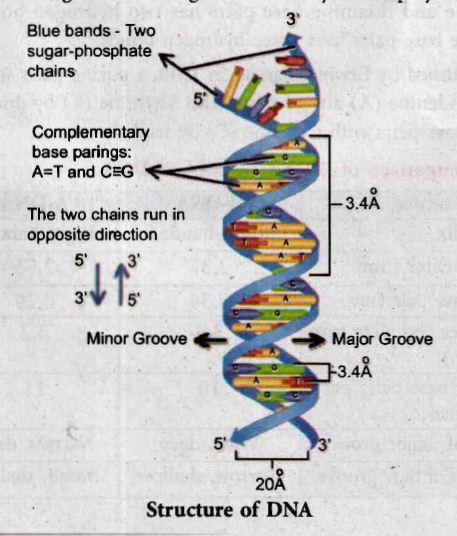
1. If one strand runs in the 5'- 3' direction, the other runs in 3'- 5' direction and thus are antiparallel (they run in opposite direction). The 5' end has the phosphate group and 3' end has the OH group.
2. The angle at which the two sugars protrude from the base pairs is about 120°, for the narrow angle and 240° for the wide angle. The narrow-angle between the sugars generates a minor groove and the large angle on the other edge generates major groove.
3. Each base is 0.34 nm apart and a complete turn of the helix comprises 3.4 nm or 10 base pairs per turn in the predominant B form of DNA.
4. DNA helical structure has a diameter of 20 A° and a pitch of about 34 A°. X-ray crystal study of DNA takes a stack of about 10 bp to go completely around the helix (360°).
5. Thermodynamic stability of the helix and specificity of base pairing includes
(i) the hydrogen bonds between the complementary bases of the double helix
(ii) stacking interaction between bases tend to stack about each other perpendicular to the direction of helical axis. Electron cloud interactions ((Π – Π)) between the bases in the helical stacks contribute to the stability of the double helix.
6. The phosphodiester linkages gives an inherent polarity to the DNA helix. They form strong covalent bonds, gives the strength and stability to the polynucleotide chain.
7. Plectonemic coiling - The two strands of the DNA are wrapped around each other in a helix, making it impossible to simply move them apart without breaking the entire structure. Whereas in paranemic coiling the two strands simply lie alongside one another, making them easier to pull apart.
8. Based on the helix and the distance between each turns the DNA is of three forms - A DNA, B DNA and Z DNA.
3.
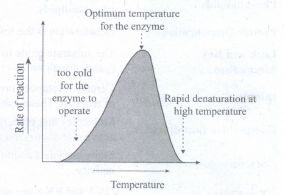
Factors affecting the rate of enzyme reactions: Enzymes are sensitive to environmental conditions. It could be affected by temperature, pH, substrate concentration and enzyme concentration. The rate of enzyme reaction is measured by the amount of substrate changed or amount of product formed, during a period of time.
1. Temperature: Heating increases molecular motion. Thus the molecules of the substrate and enzyme move more quickly resulting in a greater probability of a reaction occurring. The temperature that promotes maximum activity is referred to as optimum temperature.
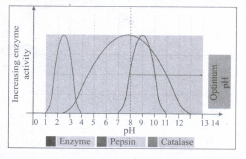
2. pH: The optimum pH is that at which the maximum rate of reaction occurs. Thus the pH change leads to an alteration of enzyme shape, including the active site. If extremes of pH are encountered by an enzyme, then it will be denatured.
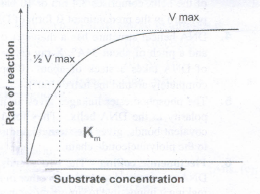
3. Substrate concentration: For a given enzyme concentration, the rate of an enzyme reaction increases with increasing substrate concentration.
4. Enzyme concentration: The rate of reaction is directly proportional to the enzyme concentration.
5. Michaelis-Menten Concept: When the initial rate of reaction of an enzyme is measured over a range of substrate concentrations (with a fixed amount of enzyme) and the results plotted on a graph. With increasing substrate concentration, the velocity increases - rapidly at lower substrate concentration.
6. Inhibitors of Enzyme: Certain substances present in the cells may react with the enzyme and lower the rate of reaction. These substances are called inhibitors. It is of two types competitive and non-competitive.
4.
Ribonucleic acid (RNA): Ribonucleic acid (RNA) is a polymeric molecule essential in various biological roles in coding, decoding, regulation and expression of genes. RNA is single stranded and is unstable when compared to DNA.
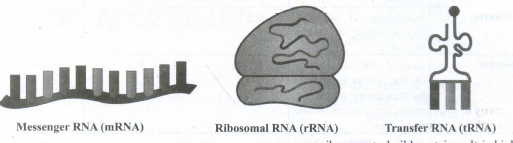
Types of RNA:
1. mRNA (messenger RNA) - Single stranded, carries a copy of instructions for assembling amino acids into proteins. It is very unstable and comprises 5% of total RNA polymer. Prokaryotic mRNA (Polycistronic) carry coding sequences for many polypeptides. Eukaryotic mRNA (Monocistronic) contains information for only one polypeptide.
2. tRNA (transfer RNA) - Translates the code from mRNA and transfers amino acids to the ribosome to build proteins. It is highly folded into an elaborate 3D structure and comprises about 15% of total RNA. It is also called as soluble RNA.
3. rRNA (ribosomal RNA) - Single stranded, metabolically stable, make up the two subunits of ribosomes. It constitutes 80% of the total RNA. It is a polymer with varied length from 120 - 3000 nucleotides and gives ribosomes their shape. Genes for rRNA are highly conserved and employed for phylogenetic studies.
5.
Classification of enzymes:
Enzymes are classified into six groups based on their mode of action.
| Enzymes | Mode of action | General scheme of reaction | Example |
|---|---|---|---|
| Oxidoreductase | Oxidation and reduction (redox) reactions. | Ared + Box \(\longrightarrow\)Aox + Bred | Dehydrogenase. |
| Transferase | Transfer a group of atoms from one molecule to another. | A - B + C \(\longrightarrow\) A + C - B | Transaminase, Phosphotransferase. |
| Hydrolases | Hydrolysis of substrate by addition of water molecule. | A - B + H2O \(\longrightarrow\) A - H + B - OH | Digestive enzymes. |
| Isomerase | Control the conversion of one isomer to another by transferring a group of atoms from one molecule to another. | A - B - C \(\longrightarrow\) A - C - B | Isomerase. |
| Lyase | Break chemical bond without addition of water | A - B \(\longrightarrow\) A + B | Decarboxylase. |
| Ligase | Formation of new chemical bonds using ATP as a source of energy | A + B + ATP \(\longrightarrow\) A - B + ADP + Pi | DNA ligase |

11th Standard Syllabus & Materials
11th Standard
TN 11th Tamil பீடு பெற நில் - செய்யுள் - காவடிச்சிந்து Important Questions And Answers Study Material - QB365 Set A
NEW11th Standard
TN 11th Tamil பீடு பெற நில் - உரைநடை - மலை இடப்பெயர்கள் : ஓர் ஆய்வு Important Questions And Answers Study Material - QB365 Set A
NEW11th Standard
TN 11th Tamil மாமழை போற்றுதும் - துணைப்பாடம் - யானை டாக்டர் Important Questions And Answers Study Material - QB365 Set A
NEW11th Standard
TN 11th Tamil மாமழை போற்றுதும் - செய்யுள் - ஐங்குறுநூறு Important Questions And Answers Study Material - QB365 Set A



Tamilnadu Stateboard 11th Standard Subjects

Maths

Commerce

Economics
Biology

Business Maths and Statistics

Accountancy

Computer Science

Physics

Chemistry
Maths
Biology
Economics
Physics
Chemistry

History
Business Maths and Statistics

Computer Science
Accountancy

Computer Applications
History
Computer Technology
Commerce
Computer Applications
Computer Technology

Tamil

English

French
Tamilnadu Stateboard Standards



