
 100% FREE ACCESS
11th Standard Syllabus & Materials
11th Standard
TN 11th Tamil இயற்கை வேளாண்மை,சுற்றுச்சூழல் -செய்யுள் - மனோன்மணீயம் Important Questions And Answers Study Material - QB365 Set A
NEW11th Standard
TN 11th Tamil என்னுயிர் என்பேன் -துணைப்பாடம் - இசைத்தமிழர் இருவர் Important Questions And Answers Study Material - QB365 Set A
NEW11th Standard
TN 11th Tamil மொழி கலை -செய்யுள் - ஒவ்வொரு புல்லையும் Important Questions And Answers Study Material - QB365 Set A
NEW11th Standard
TN 11th Tamil பீடு பெற நில் - இலக்கணம் - பகுபத உறுப்புகள் Important Questions And Answers Study Material - QB365 Set A
NEW11th Standard
TN 11th Tamil பீடு பெற நில் - துணைப்பாடம் - வாடிவாசல் Important Questions And Answers Study Material - QB365 Set A
NEW11th Standard
TN 11th Tamil பீடு பெற நில் - செய்யுள் - குறுந்தொகை Important Questions And Answers Study Material - QB365 Set A

Published on: 26/06/2021
QB365 provides detailed and simple solution for every Creative Questions in class 11 Biology Subject. It will helps to get more idea about question pattern in every Creative questions with solution.
Download Tamil Nadu 11th Standard Biology question papers, model tests, one-mark questions, important questions, and public exam papers in PDF format. Free study materials and answer keys for TN State Board students.
Questions + Answers key
Take MCQ Biology Test1.
Explain any two factors affecting the rate of enzyme reaction, with the help of graphical representation.
2.
What are the types of cofactors? Explain each of them.
3.
How are enzymes classified?
4.
What are enzyme Inhibitors? Explain the two types of inhibitors?
5.
Write a note on the Structure of proteins.
1.
Enzyme Reactions: Enzymes are sensitive to environmental condition. It could be affected by temperature, pH, substrate concentration and enzyme concentration. The rate of enzyme reaction is measured by the amount of substrate changed or amount of product formed, during a period of time.
Temperature: Heating increases molecular motion. Thus the molecules of the substrate and enzyme move more quickly resulting in a greater probability of occurrence of the reaction. The temperature that promotes maximum activity is referred to as optimum temperature.
.png)
pH: The optimum pH is that at which the maximum rate of reaction occurs. Thus the pH change leads to an alteration of enzyme shape, including the active site; If extremes of pH are encountered by an enzyme, then it will be denatured.
.png)
Substrate Concentration: For a given enzyme concentration, the rate of an enzyme reaction increases with increasing substrate concentration.
Enzyme Concentration: The rate of reaction is directly proportional to the enzyme concentration.
2.
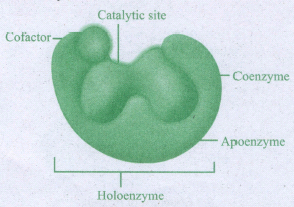
(i) Many enzymes require non-protein components called cofactors for their efficient activity. Cofactors may vary from simple inorganic ions to complex organic molecules. They are of three types: inorganic ions, prosthetic groups and coenzymes.
(ii) Holoenzyme: Active enzyme with its non-protein component.
(iii) Apoenzyme: The inactive enzyme without its non-protein component.
(iv) Inorganic ions help to increase the rate of reaction catalysed by enzymes. Example: Salivary amylase activity is increased in the presence of chloride ions.
(v) Prosthetic groups are organic molecules that assist in catalytic function of an enzyme. Flavin adenine dinucleotide (FAD) contains riboflavin (Vit B2), the function of which is to accept hydrogen. 'Haem' is an iron-containing prosthetic group with an iron atom at its centre.
(vi) Coenzymes are organic compounds which act as cofactors but do not remain attached to the enzyme. The essential chemical components of many coenzymes are vitamins. ego NAD, NADP, Coenzyme A, ATP.
3.
| Enzymes | Mode of action | General Scheme of reaction | Example |
| Oxidoreductase | Oxidation and reduction (redox) reactions | Ared + Box \(\rightarrow \) Aox + Bred | dehydrogenase |
| Transferase | Transfer a group of atoms from one molecule to another | A - B + C \(\rightarrow \) A + C - B | Transaminase, phosphotransferase |
| Hydrolases | Hydrolysis of substrate by addition of water molecule. | A - B + H20 \(\rightarrow \) A - H + B - OH | Digestive enzymes |
| Isomerase | Control the conversion of one isomer to another by transferring a group of atoms from one molecule to another. | A - B - C \(\rightarrow \) A - C - B | Isomerase |
| Lyase | Break chemical bond without addition of water | A - B \(\rightarrow \) A + B | Decarboxylase |
| Ligase | Formation of new chemical bonds using ATP as a source of energy | A + B + ATP \(\rightarrow \) A - B + ADP +Pi | DNA ligase |
4.
Certain substances present in the cells may react with the enzyme and lower the rate of reaction. These substances are called inhibitors. It is of two types competitive and non-competitive inhibitors.
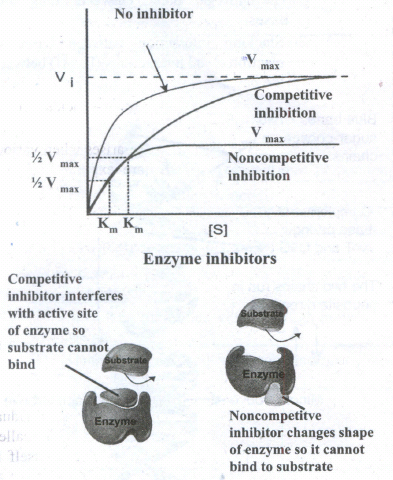
Competitive Inhibitor:
1. Molecules that resemble the shape of the substrate and may compete to occupy the active site of enzyme are known as competitive inhibitors.
2. Eg: The enzyme that catalyses the reaction between carbon dioxide and the CO2 acceptor molecule in photosynthesis, known as ribulose bisphosphate carboxylase oxygenase (RUBISCO) is competitively inhibited by oxygen/carbon-di-oxide in the chloroplast. The competitive inhibitor is malonate for succinic dehydrogenase.
Non-competitive Inhibitors:
1. There are certain inhibitors which may be unlike the substrate molecule but still combines with the enzyme.
2. This either blocks the attachment of the substrate to active site or change the shape so that it is unable to accept the substrate. Eg: The effect of the amino acids alanine on the enzyme pyruvate kinase in the final step of glycolysis.
(i) Certain non-reversible / irreversible inhibitors bind tightly and permanently to an enzyme and destroy its catalytic properties entirely. These could also be termed as poisons. Eg: Cyanide ions which blocks cytochrome oxidase in terminal oxidation in cell aerobic respiration.
5.
1. Based on the R group amino acids are classified as acidic, basic, polar, non-polar.
2. The amino group of one amino acid reacts with carboxyl group of other amino acid, forming a peptide bond.
3. Two amino acids can react together with the loss of water to form a dipeptide. Long strings of amino acids linked by peptide bonds are called polypeptides. In 1953 Fred Sanger first sequenced the Insulin protein.
Structure of Protein:
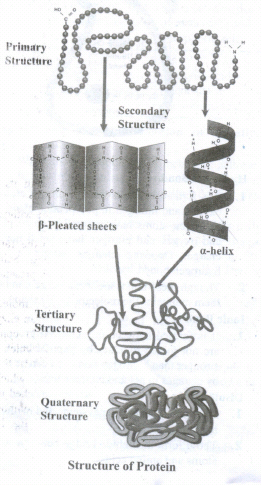
1. Protein is synthesised on the ribosome as a linear sequence of amino acids which are held together by peptide bonds.
2. After synthesis, the protein attains conformational change into a specific 3D form for proper functioning.
3. According to the mode of folding, four levels of protein organisation have been recognised namely primary, secondary, tertiary and quaternary
(i) The primary structure is linear arrangement of amino acids in a polypeptide chain.
(ii) Secondary structure arises when various functional groups are exposed on outer surface of the molecular interaction by forming hydrogen bonds. This causes the amino acid chain to twist into coiled configuration called a-helix or to fold into a flat \(\beta \) -pleated sheets.
(iii) Tertiary protein structure arises when the secondary level proteins fold into globular structure called domains.
(iv) Quaternary protein structure may be assumed by some complex proteins in which more than one polypeptide forms a large multi-unit protein. The individual polypeptide chains of the protein are called subunits and the active protein itself is called a multimer. Eg: Enzymes serve as catalyst for chemical reactions in cell and are non-specific. Antibodies are complex glycoproteins with specific regions of attachment for various organisms.

11th Standard Syllabus & Materials
11th Standard
TN 11th Tamil பீடு பெற நில் - செய்யுள் - காவடிச்சிந்து Important Questions And Answers Study Material - QB365 Set A
NEW11th Standard
TN 11th Tamil பீடு பெற நில் - உரைநடை - மலை இடப்பெயர்கள் : ஓர் ஆய்வு Important Questions And Answers Study Material - QB365 Set A
NEW11th Standard
TN 11th Tamil மாமழை போற்றுதும் - துணைப்பாடம் - யானை டாக்டர் Important Questions And Answers Study Material - QB365 Set A
NEW11th Standard
TN 11th Tamil மாமழை போற்றுதும் - செய்யுள் - ஐங்குறுநூறு Important Questions And Answers Study Material - QB365 Set A



Tamilnadu Stateboard 11th Standard Subjects

Maths

Commerce

Economics
Biology

Business Maths and Statistics

Accountancy

Computer Science

Physics

Chemistry
Maths
Biology
Economics
Physics
Chemistry

History
Business Maths and Statistics

Computer Science
Accountancy

Computer Applications
History
Computer Technology
Commerce
Computer Applications
Computer Technology

Tamil

English

French
Tamilnadu Stateboard Standards



