
 100% FREE ACCESS
11th Standard Syllabus & Materials
11th Standard
TN 11th Tamil இயற்கை வேளாண்மை,சுற்றுச்சூழல் -செய்யுள் - மனோன்மணீயம் Important Questions And Answers Study Material - QB365 Set A
NEW11th Standard
TN 11th Tamil என்னுயிர் என்பேன் -துணைப்பாடம் - இசைத்தமிழர் இருவர் Important Questions And Answers Study Material - QB365 Set A
NEW11th Standard
TN 11th Tamil மொழி கலை -செய்யுள் - ஒவ்வொரு புல்லையும் Important Questions And Answers Study Material - QB365 Set A
NEW11th Standard
TN 11th Tamil பீடு பெற நில் - இலக்கணம் - பகுபத உறுப்புகள் Important Questions And Answers Study Material - QB365 Set A
NEW11th Standard
TN 11th Tamil பீடு பெற நில் - துணைப்பாடம் - வாடிவாசல் Important Questions And Answers Study Material - QB365 Set A
NEW11th Standard
TN 11th Tamil பீடு பெற நில் - செய்யுள் - குறுந்தொகை Important Questions And Answers Study Material - QB365 Set A

Published on: 08/06/2021
QB365 provides detailed and simple solution for every book back questions in class 11 Biology subject.It will helps to get more idea about question pattern in every book back questions with solution.
Download Tamil Nadu 11th Standard Biology question papers, model tests, one-mark questions, important questions, and public exam papers in PDF format. Free study materials and answer keys for TN State Board students.
Questions + Answers key
Take MCQ Biology Test1.
How will you calculate net products of one sucrose molecule upon complete oxidation during aerobic respiration as per recent view?
2.
Describe the types of RNA.
3.
Briefly outline the classification of enzymes.
4.
How does molecular markers work to unlock the evolutionary history of organisms?
5.
Describe the mechanism of photoperiodic induction of flowering.
6.
Explain the reactions taking place in mitochondrial inner membrane.
7.
An artificial cell made of selectively permeable membrane immersed in a beaker (in the figure). Read the values and answer the following questions?
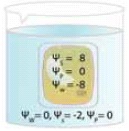
a. Draw an arrow to indicate the direction of water movement
b. Is the solution outside the cell isotonic, hypotonic or hypertonic?
c. Is the cell isotonic, hypotonic or hypertonic?
d. Will the cell become more flaccid, more turgid or stay in original size?
e. With reference to artificial cell state, the process is endosmosis or exosmosis? Give reasons.
8.
A transverse section of the trunk of a tree shows concentric rings which are known as growth rings. How are these rings formed? What are the significance of these rings?
9.
10.
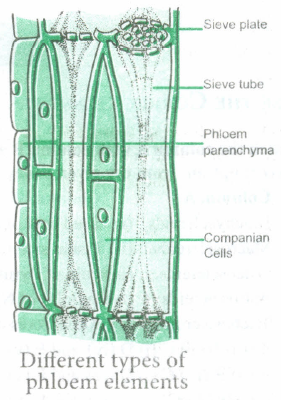
What are Sieve tubes ? Explain.
11.
Explain sclereids with their types.
12.
Write the similarities and difference between
a. Radicle buds and foliar buds
b. Phylloclade and cladode
13.
Draw the ultrastructure of plant cell.
14.
How will you distinguish Solanaceae members from Liliaceae members?
15.
Write about Pachytene and Diplotene of Prophase I.
1.
| Stages | ATP | NADH2 | FADH2 | Total ATPs |
| Glycolysis Link reaction Kreb's cycle |
2 - 2 |
2 \(\times\) 2.5 2 \(\times\) 2.5 6 \(\times\) 2.5 |
0 |
7 5 20 |
| 4 ATPs | 25 ATPs | 3 ATPs | 32 ATPs |
2.
Ribonucleic acid (RNA): Ribonucleic acid (RNA) is a polymeric molecule essential in various biological roles in coding, decoding, regulation and expression of genes. RNA is single-stranded and is unstable when compared to DNA.
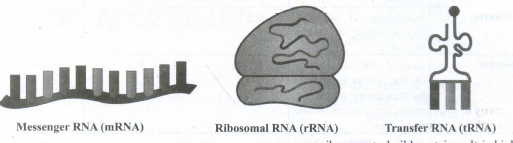
Types of RNA:
1. mRNA (messenger RNA) - Single-stranded, carries a copy of instructions for assembling amino acids into proteins. It is very unstable and comprises 5% of total RNA polymer. Prokaryotic mRNA (Polycistronic) carry coding sequences for many polypeptides. Eukaryotic mRNA (Monocistronic) contains information for only one polypeptide.
2. tRNA (transfer RNA) - Translates the code from mRNA and transfers amino acids to the ribosome to build proteins. It is highly folded into an elaborate 3D structure and comprises about 15% of total RNA. It is also called soluble RNA.
3. rRNA (ribosomal RNA) - Single-stranded, metabolically stable, makeS up the two subunits of ribosomes. It constitutes 80% of the total RNA. It is a polymer with varied length from 120 - 3000 nucleotides and gives ribosomes their shape. Genes for rRNA are highly conserved and employed for phylogenetic studies.
3.
Classification of enzymes:
Enzymes are classified into six groups based on their mode of action.
| Enzymes | Mode of action | General scheme of reaction | Example |
|---|---|---|---|
| Oxidoreductases | Oxidation and reduction (redox) reactions. | Ared + Box \(\longrightarrow\)Aox + Bred | Dehydrogenase. |
| Transferase | Transfer a group of atoms from one molecule to another. | A - B + C \(\longrightarrow\) A + C-B | Transaminase, Phosphotransferase. |
| Hydrolases | Hydrolysis of substrate by addition of water molecule. | A - B + H2O \(\longrightarrow\) A - H + B - OH | Digestive enzymes. |
| Isomerase | Control the conversion of one isomer to another by transferring a group of atoms from one molecule to another. | A - B - C \(\longrightarrow\) A - C-B | Isomerase. |
| Lyase | Break chemical bond without addition of water | A - B \(\longrightarrow\) A + B | Decarboxylase. |
| Ligase | Formation of new chemical bonds using ATP as a source of energy | A + B + ATP \(\longrightarrow\) A - B + ADP + Pi | DNA ligase |
4.
(i) It is a method to identify genetic markers using a randomly synthesized primer that will anneal (recombine (DNA) in the double stranded form) to complementary regions located in various locations of isolated DNA. If another complementary site is present on the opposing DNA strand at a distance that is not too great then the reaction will amplify this region of DNA.
(ii) RAPDs (Random Amplified Polymorphic DNA) like microsatellites may often be used for genetic studies within species but may also be successfully employed in phylogenetic studies to address relationships within a species or between closely related species.
5.
Photoperiodic induction
1) An appropriate photoperiod in 24 hours cycle constitutes one inductive cycle. Plants may require one or more inductive cycles for flowering.
2) The phenomenon of conversion of leaf primordia into flower primordia under the influence of suitable inductive cycles is called photoperiodic induction.
Example: Xanthium (SDP) - 1 inductive cycle and Plantago (LDP)- 25 inductive cycles.
Site of Photoinductive perception
1) Photoperiodic stimulus is perceived by the leaves.
2) Floral hormone is synthesised in leaves and translocated to the apical tip to promote flowering.
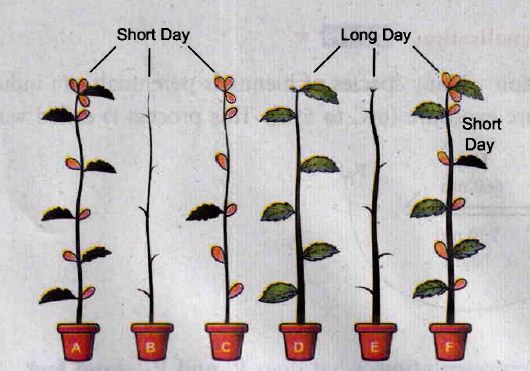
3) This can be explained by a simple experiment on Cocklebur (Xanthium pensylvanicum), a short day plant.
4) Usually Xanthium will flower under short day conditions. If the plant is defoliated and kept under short day conditions it will not flower.
5) Flowering will occur even when all the leaves are removed except one leaf.
6) If a cocklebur plant is defoliated and kept under long day conditions, it will not flower.
7) If one of its leaves is exposed to short day condition and rest are in long day condition, flowering will occur.
6.
Electron Transport Chain (ETC) (Terminal oxidation)
(i) During glycolysis, link reaction and Krebs cycle the respiratory substrates are oxidized at several steps and as a result many reduced coenzymes NADH + H+ and FADH2 are produced.
(ii) These reduced coenzymes are transported to inner membrane of mitochondria and are converted back to their oxidized forms produce electrons and protons.
(iii) In mitochondria, the inner membrane is folded in the form of finger projections towards the matrix called cristae.
(iv) In cristae many oxysomes (F1 particles) are present which have electron transport carriers are present.
(v) According to Peter Mitchell's Chemiosmotic theory this electron transport is coupled to ATP synthesis. Electron and hydrogen (proton) transport takes place across four multiprotein complexes (I-IV). They are:
a) Complex-I (NADH dehydrogenase)
(i) It contains a flavoprotein (FMN) and associated with non-heme iron Sulphur protein (Fe-S). This complex is responsible for passing electrons and protons from mitochondrial NADH (Internal) to Ubiquinone (UQ).
\(\mathrm{NADH}+\mathrm{H}^{+}+\mathrm{UQ} \rightleftharpoons \mathrm{NAD}^{+}+\mathrm{UQH}_{2}\)
(ii) In plants, an additional NADH dehydrogenase (External) complex is present on the outer surface of inner membrane of mitochondria which can oxidise cytosolic NADH + H+.
(iii) Because mitochondrial inner membrane cannot allow NADH molecules directly into the matrix. Ubiquinone (UQ) or Coenzyme Quinone (CoQ) is a small, lipid soluble electron, proton carrier located within the inner membrane of mitochondria.
b) Complex-II (Succinic dehydrogenase)
(i) It contains FAD flavoprotein is associated with non-heme iron Sulphur (Fe-S) protein.
(ii) This complex receives electrons and protons from succinate in Krebs cycle and is converted into fumarate and passes to ubiquinone.

c) Complex-III (Cytochrome bc1 complex)
(i) This complex oxidises reduced ubiquinone (ubiquinol) and transfers the electrons through Cytochrome bc1 Complex (Iron Sulphur center bc1 complex) to cytochrome c.
(ii) Cytochrome c is a small protein attached to the outer surface of inner membrane and act as a mobile carrier to transfer electrons between complex III to complex IV.
\(\mathrm{UQH}_{2}+2 \mathrm{CytC}_{\text {oxidised }} \rightleftharpoons \mathrm{UQ}+2 \mathrm{Cytc}_{\text {reduced }}+2 \mathrm{H}^{+}\)
d) Complex IV (Cytochrome c oxidase)
(i) This complex contains two copper centers (A and B) and cytochromes a and a3. Complex IV is the terminal oxidase and brings about the reduction of 1/2 O2 to H2O.Two protons are needed to form a molecule of H2O (terminal oxidation).
\(2 \mathrm{CytC}_{\text {oxidised }}+2 \mathrm{H}^{+}+1 / 2 \mathrm{O}_{2} \rightleftharpoons 2 \mathrm{CytC}_{\text {reduced }}+\mathrm{H}_{2} \mathrm{O}\)
(ii) The transfer of electrons from reduced coenzyme NADH to oxygen via complexes I to IV is coupled to the synthesis of ATP from ADP and inorganic phosphate (Pi) which is called Oxidative phosphorylation.
(iii) The F0F1- ATP synthase (also called complex V) consists of F0 and F1. F1 converts ADP and Pi to ATP and is attached to the matrix side of the inner membrane.
(iv) F0 is present in inner membrane and acts as a channel through which protons come into matrix.
7.
(a)
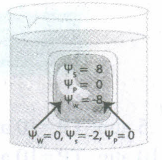
(b) Hypotonic
(c) Hypertonic
(d) More turgid
(e) Endosmosis, Because the cell is placed in pure water \(\left(\Psi_{\mathrm{W}}=0\right)\) or hypotonic solution. Hence the water enters into the artificial cell kept inside the beaker containing water.
8.
Annual Rings
(i) The activity of Vascular cambium is under the control of many physiological and environmental factors.
(ii) In temperate regions, the climatic conditions are not uniform throughout the year.
(iii) In the spring season, cambium is very active and produces a large number of xylary elements having Vessels/tracheids with wide lumen.
(iv) The wood formed during this season is called spring wood or early wood.
(v) The tracheary elements are fairly thin walled.
(vi) In winter, the cambium is less active and forms fewer xylary elements that have narrow vessels tracheids and this wood is called autumn wood or late wood.
(vii) The tracheary elements are with narrow lumen, very thick walled.
(viii) Spring wood is lighter in colour with lower density.
(ix) Autumn wood is darker and has higher density.
(x) Sometimes Annual rings are called growth rings but all growth rings are not annual rings.
(xi) In some trees more than one growth ring is formed within a year due to climatic change.
(xii) Additional growth rings are developed within a year due to adverse natural calamities like drought, frost, defoliation, flood, mechanical injury and biotic factors during the middle of a growing season, which results in the formation of more than one annual ring. Such rings are called pseudo or false-annual rings.
(xiii) Each annual ring corresponds to one year's growth and on the basis of these rings, the age of a particular plant can easily be calculated.
(xiv) The determination of the age of a tree by counting the annual rings is called dendrochronology.
9.
10.
(i) Sieve tubes are long tube like conducting elements in the phloem.
(ii) These are formed from a series of cells called sieve tube elements.
(iii) The sieve tube elements are arranged one above the other and form vertical sieve tube.
(iv) The end wall contains a number of pores and it looks like a sieve hence called as sieve plate.
(v) These elements show nacreous thickenings on their lateral walls with simple or compound sieve plates.
(vi) The function of sieve tubes are believed to be controlled by companion cells.
(vii) In mature sieve tube, Nucleus is absent and it contains a lining layer of cytoplasm with special protein called slime body in it.
(viii) In mature sieve tubes, the pores in the sieve plate are blocked by a substance called callose.
(ix) The conduction of food material takes place through cytoplasmic strands.
(x) Sieve tubes occur only in Angiosperms.
11.
Sclereids (Stone Cells)
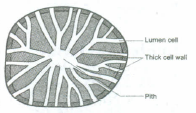
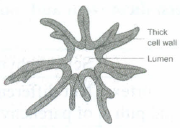
Sclereids are dead cells, usually these are isodiametric but some are elongated too. The cell wall is very thick due to lignification. Lumen is very much reduced. The pits may simple or branched. Sclereids are mechanical in function. They give hard texture to the seed coats, endosperms etc., Sclereids are classified into the following types.
Types of Sclereids
(a) Brachysclereids or Stone cells:
Isodiametric sclereids, with hard cell wall. It is found in bark, pith cortex, hard endosperm and fleshy portion of some fruits. Example: Pulp of Pyrus.
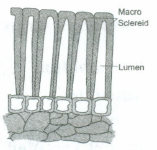
(b) Macrosclereids:
Elongated and rod shaped cells, found in the outer seed coat of leguminous plants. Example: Crotalaria and Pisum sativum.
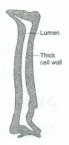
(c) Osteosclereids (Bone cells):
Rod shaped with dilated ends. They occur in leaves and seed coats. Example: seed coat of Pisum and Hakea
(d) Astrosclereids:
Star cells with lobes or arms diverging from a central body. They occur in petioles and leaves. Ex: Tea, Nymphaea and Trochodendron.
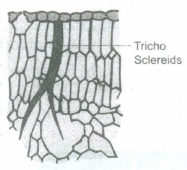
(e) Trichosclereids:
Hair like thin walled sclereids. Numerous small angular crystals are embedded in the wall of these sclereids, present in stems and leaves of hydrophytes. Example: Nymphaea leaf and Aerial roots of Monstera.
12.
| a | Radical buds | Foliar buds |
| Differences | Radicle buds arise from the lateral roots. Eg. Sweet potato | Foliar buds develop from veins or from margins of the leaves. Eg. Begonia |
| Similarities | It is a type of adventitious root | It is a type of adventitious root |
| b | Phylloclade | Cladode |
| Differences | Presence of series of nodes and internodes. Eg: Casuarina | Presence of one or two internodes only. Eg: Asparagus |
| Similarities | Phylloclade is a stem modification | Cladode is a stem modification |
13.
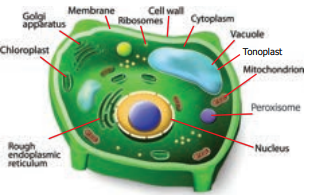
Ultrastructure of Plant Cell
14.
| S.No | Solanaceae | Liliaceae |
|---|---|---|
| 1. | It belongs to dicotyledons | It belongs to monocotyledons |
| 2. | Habit- mostly annual herbs, shrubs & small trees |
Mostly perennial herbs |
| 3. | Root- branched tap root | Adventitious & fibrous |
| 4. | Calyx & corolla present | Only perianth is present |
| 5. | Stamens 5, epipetalous | Stamens 6 arranged in 2 whorls of 3 each. |
| 6. | Bicarpellary, bilocular | Tricarpellary, trilocular |
| 7. | Capsule or berry | Septicidal or loculicidal capsule or a berry |
15.
(i) Pachytene:
1. At this stage bivalent chromosomes are clearly visible as tetrads. Bivalent of meiosis I consists of 4 chromatids and 2 centromeres.
2. Synapsis is completed and recombination nodules appear at a site where crossing over takes place between non-sister chromatids of homologous chromosomes.
3. Recombination of homologous chromosomes is completed by the end of the stage but the chromosomes are linked at the sites of crossing over. This is mediated by the enzyme recombinase.
(ii) Diplotene:
1. Synaptonemal complex disassembles and dissolves. The homologous chromosomes remain attached at one or more points where crossing over has taken place.
2. These points of attachment where 'X' shaped structures occur at the sites of crossing over is called Chiasmata. Chiasmata are chromatin structures at sites where recombination has taken place.

11th Standard Syllabus & Materials
11th Standard
TN 11th Tamil பீடு பெற நில் - செய்யுள் - காவடிச்சிந்து Important Questions And Answers Study Material - QB365 Set A
NEW11th Standard
TN 11th Tamil பீடு பெற நில் - உரைநடை - மலை இடப்பெயர்கள் : ஓர் ஆய்வு Important Questions And Answers Study Material - QB365 Set A
NEW11th Standard
TN 11th Tamil மாமழை போற்றுதும் - துணைப்பாடம் - யானை டாக்டர் Important Questions And Answers Study Material - QB365 Set A
NEW11th Standard
TN 11th Tamil மாமழை போற்றுதும் - செய்யுள் - ஐங்குறுநூறு Important Questions And Answers Study Material - QB365 Set A



Tamilnadu Stateboard 11th Standard Subjects

Maths

Commerce

Economics
Biology

Business Maths and Statistics

Accountancy

Computer Science

Physics

Chemistry
Maths
Biology
Economics
Physics
Chemistry

History
Business Maths and Statistics

Computer Science
Accountancy

Computer Applications
History
Computer Technology
Commerce
Computer Applications
Computer Technology

Tamil

English

French
Tamilnadu Stateboard Standards



