
 100% FREE ACCESS
11th Standard Syllabus & Materials
11th Standard
TN 11th Tamil இயற்கை வேளாண்மை,சுற்றுச்சூழல் -செய்யுள் - மனோன்மணீயம் Important Questions And Answers Study Material - QB365 Set A
NEW11th Standard
TN 11th Tamil என்னுயிர் என்பேன் -துணைப்பாடம் - இசைத்தமிழர் இருவர் Important Questions And Answers Study Material - QB365 Set A
NEW11th Standard
TN 11th Tamil மொழி கலை -செய்யுள் - ஒவ்வொரு புல்லையும் Important Questions And Answers Study Material - QB365 Set A
NEW11th Standard
TN 11th Tamil பீடு பெற நில் - இலக்கணம் - பகுபத உறுப்புகள் Important Questions And Answers Study Material - QB365 Set A
NEW11th Standard
TN 11th Tamil பீடு பெற நில் - துணைப்பாடம் - வாடிவாசல் Important Questions And Answers Study Material - QB365 Set A
NEW11th Standard
TN 11th Tamil பீடு பெற நில் - செய்யுள் - குறுந்தொகை Important Questions And Answers Study Material - QB365 Set A

Published on: 08/06/2021
QB365 provides detailed and simple solution for every book back questions in class 11 Biology subject.It will helps to get more idea about question pattern in every book back questions with solution.
Download Tamil Nadu 11th Standard Biology question papers, model tests, one-mark questions, important questions, and public exam papers in PDF format. Free study materials and answer keys for TN State Board students.
Questions + Answers key
Take MCQ Biology Test1.
2.
What is the name of alternate way of glucose breakdown? Explain the process involved in it?
3.
Continuous state of dividing tissue is called meristem. In connection to this, what is the role of lateral meristem?
4.
Distinguish the anatomy of dicot root from monocot root.
5.
Explain the different types of fleshy fruit with suitable example.
6.
Write the characteristic features of DNA.
7.
Give a general account on lichens.
8.
What are the factors affecting the rate of enzyme reaction?
9.
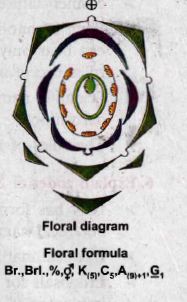
Give the floral characters of Clitoria ternatea.
10.
11.
12.
What are the parameters which control water potential?
13.
Write the physiological effects of Cytokinins.
14.
How will you calculate net products of one sucrose molecule upon complete oxidation during aerobic respiration as per recent view?
15.
In Botany class, teacher explains, Synthesis of one glucose requires 30 ATPs in C4 plants and only 18 ATPs in C3 plants. The same teacher explains C4 plants are more advantageous than C3 plants. Can you identify the reason for this contradiction?
1.
2.
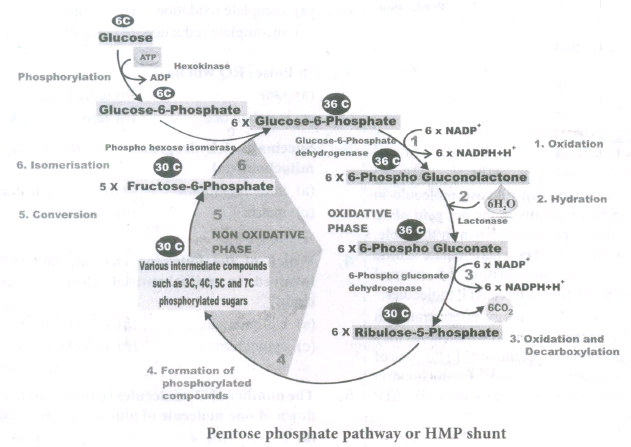
Pentose Phosphate pathway:
(i) It was described by Warburg, Dickens and Lipmann. Hence, it is also called Warburg - Dickens - Lipmann pathway.
(ii) It takes place in cytoplasm of mature plant cells.
(iii) It is an alternate way for breakdown of glucose.
(iv) It is also known as Hexose monophosphate shunt (HMP shunt) or Direct oxidative pathway.
(v) It consists of two phases, Oxidative Phase and non oxidative Phase
Oxidative Events:
(vi) 6 molecules of 6 carbon Glucose - 6 phosphate to 6 molecules of 5 carbon sugar Ribulose - 5 phosphate with loss of 6CO2 molecules and generation of 12 \(\mathrm{NADPH}+\mathrm{H}^{+}\)
Non-Oxidative Pathway:
(i) Convert Ribulose - 5 - phosphate molecules to various intermediates such as ribose 5 - phosphate (5C), Xylulose - 5 - phosphate (5C), Glyceraldehyde - 3 phosphate (3C), sedoheptulose - 7 - phosphate (7C) and Erythrose 4 - phosphate (4C). Finally 5 molecules of glucose - 6 - phosphate is regenerated.
(ii) The net result of complete oxidation of one glucose - 6 - phosphate yield 6CO2 and 12 NADPH + H+.
(iii) The oxidative pentose phosphate pathway is controlled by glucose - 6 - phosphate dehydrogenase enzyme which is inhibited by high ratio of NADPH to NADP+.
The over all reaction is:

3.
(i) Lateral meristem increases the girth in both stem and root
(ii) Secondary growth in dicots and gymnosperms is brought about by two lateral meristems
(iii) Vascular cambium
(iv) Cork Cambium
(v) Vascular cambium produces the secondary vascular tissues. i.e. Secondary xylem and Secondary phloem.
4.
| S.No. | Characters | Dicot root | Monocot root |
|---|---|---|---|
| 1. | Pericyle | Gives rise to lateral roots, phellogen and a part of vascular cambium. | Gives rise to lateral roots only. |
| 2. | Vascular tissue | Usually limited number of xylem and phloem strips. | Usually more number of xylem and phloem strips. |
| 3. | Conjunctive tissue | Parenchymatous; Its cells are differentiated into vascular cambium. | Mostly sclerenchymatous but sometimes parenchymatous. It is never differentiated in to vascular cambium. |
| 4. | Cambium | It appears as a secondary meristem at the time of secondary growth. | It is altogether absent. |
| 5. | Xylem | Usually tetrach | Usually polyarch |
5.
The fruits are derived from single pistil where the pericarp is fleshy, succulent and differentiated into epicarp, mesocarp and endocarp. It is subdivided into the following.
(i) Berry: Fruit develops from bicarpellary or multicarpellary, syncarpous ovary. Here the epicarp is thin, the mesocarp and endocarp remain undifferentiated. They form a pulp in which the seeds are embedded. Eg: Tomato, Grapes, Brinjal.
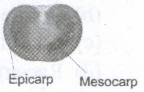
(ii) Drupe: Fruit develops from monocarpellary, superior ovary. It is usually one seeded. Pericarp is differentiated into outer skinny epicarp, fleshy and pulpy mesocarp and hard and stony endocarp around the seed. Eg: Mango, Coconut.
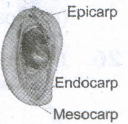
(iii) Pepo: Fruit develops from tricarpellary inferior ovary. Pericarp turns leathery or woody which encloses, fleshy mesocarp and smooth endocarp. Eg: Cucumber, Watermelon, Bottle gourd, Pumpkin.
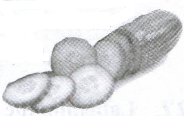
(iv) Hesperidium:Fruit develops from multicarpellary, multilocular, syncarpous, superior ovary. The fruit wall is differentiated into leathery epicarp with oil glands, a middle fibrous mesocarp. The endocarp forms distinct chambers, containing juicy hairs. Eg: Orange, Lemon.
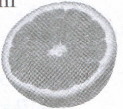
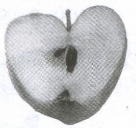
(v) Pome: It develops from multicarpellary, syncarpous, inferior ovary. The receptacle also develops along with the ovary and becomes fleshy, enclosing the true fruit. In pome the epicarp is thin skin like and endocarp is cartilaginous. Eg: Apple, Pear.
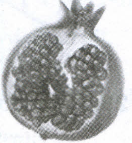
(vi) Balausta: A fleshy indehiscent fruit developing from multicarpellary, multilocular inferior ovary whose pericarp is tough and leathery. Seeds are attached irregularly with testa being the edible portion. Eg: Pomegranate.
6.
Features of DNA:
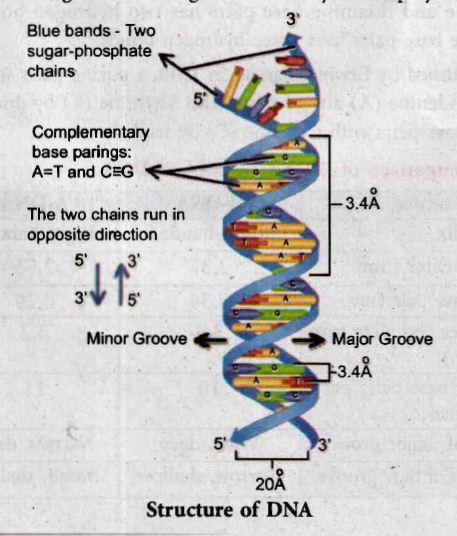
1. If one strand runs in the 5'- 3' direction, the other runs in 3'- 5' direction and thus are antiparallel (they run in opposite direction). The 5' end has the phosphate group and 3' end has the OH group.
2. The angle at which the two sugars protrude from the base pairs is about 120°, for the narrow angle and 240° for the wide angle. The narrow-angle between the sugars generates a minor groove and the large angle on the other edge generates major groove.
3. Each base is 0.34 nm apart and a complete turn of the helix comprises 3.4 nm or 10 base pairs per turn in the predominant B form of DNA.
4. DNA helical structure has a diameter of 20 A° and a pitch of about 34 A°. X-ray crystal study of DNA takes a stack of about 10 bp to go completely around the helix (360°).
5. Thermodynamic stability of the helix and specificity of base pairing includes
(i) the hydrogen bonds between the complementary bases of the double helix
(ii) stacking interaction between bases tend to stack about each other perpendicular to the direction of helical axis. Electron cloud interactions ((Π – Π)) between the bases in the helical stacks contribute to the stability of the double helix.
6. The phosphodiester linkages gives an inherent polarity to the DNA helix. They form strong covalent bonds, gives the strength and stability to the polynucleotide chain.
7. Plectonemic coiling - The two strands of the DNA are wrapped around each other in a helix, making it impossible to simply move them apart without breaking the entire structure. Whereas in paranemic coiling the two strands simply lie alongside one another, making them easier to pull apart.
8. Based on the helix and the distance between each turns the DNA is of three forms - A DNA, B DNA and Z DNA.
7.
(i) The symbiotic association between algae and fungi is called lichens.
(ii) The algal partner is called Phycobiont or Photobiont and the fungal partner is called Mycobiont.
(iii) Algae provide nutrition for fungal partner in turn fungi provide protection and also help to fix the thallus to the substratum through rhizinae.
(iv) Asexual reproduction takes place through fragmentation, Soredia and Isidia. Phycobionts reproduce by akinetes, hormogonia, aplanospore, etc., Mycobionts undergo sexual reproduction and produce ascocarps.
Classification:
(i) Based on the habitat lichens are classified into following types: Corticolous (on Bark) Lignicolous (on Wood) Saxicolous (on rocks) Terricolous (on ground) Marine (on siliceous rocks of sea) Fresh water(on siliceous rock of fresh water).
(ii) On the basis of morphology of the thallus they are divided into Leprose (a distinct fungal layer is absent) Crustose-crust like; Foliose-leaf like; Fruticose-branched pendulous shrub like.
(iii) The distribution of algal cells distinguishes lichens into two forms namely Homoiomerous (Algal cells evenly distributed in the thallus) and Heteromerous (a distinct layer of algae and fungi present)
(iv) If the fungal partner of lichen belongs to ascomycetes, it is called Ascolichen and if it is basidiomycetes it is called Basidiolichen.
8.
Factors affecting the rate of enzyme reactions: Enzymes are sensitive to environmental conditions. It could be affected by temperature, pH, substrate concentration and enzyme concentration. The rate of enzyme reaction is measured by the amount of substrate changed or amount of product formed, during a period of time.
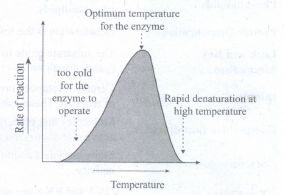
1. Temperature: Heating increases molecular motion. Thus the molecules of the substrate and enzyme move more quickly resulting in a greater probability of a reaction occurring. The temperature that promotes maximum activity is referred to as optimum temperature.
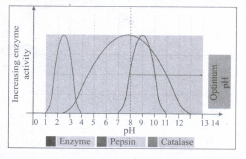
2. pH: The optimum pH is that at which the maximum rate of reaction occurs. Thus the pH change leads to an alteration of enzyme shape, including the active site. If extremes of pH are encountered by an enzyme, then it will be denatured.
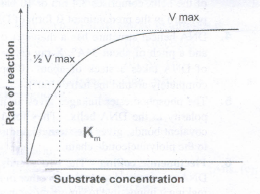
3. Substrate concentration: For a given enzyme concentration, the rate of an enzyme reaction increases with increasing substrate concentration.
4. Enzyme concentration: The rate of reaction is directly proportional to the enzyme concentration.
5. Michaelis-Menten Concept: When the initial rate of reaction of an enzyme is measured over a range of substrate concentrations (with a fixed amount of enzyme) and the results plotted on a graph. With increasing substrate concentration, the velocity increases - rapidly at lower substrate concentration.
6. Inhibitors of Enzyme: Certain substances present in the cells may react with the enzyme and lower the rate of reaction. These substances are called inhibitors. It is of two types competitive and non-competitive.
9.
Habit : Twining climber
Root : Branched tap root system having nodules.
Stem : Aerial, weak stem and a twiner
Leaf : Imparipinnately compound, alternate, stipulate showing reticulate venation. Leaflets are stipellate. Petiolate and stipels are pulvinated.
Inflorescence : Solitary and axillary
Flower : Bracteate, bracteolate, bracteoles usually large, pedicellate, heterochlamydeous, complete, bisexual, pentamerous, zygomorphic and hypogynous.
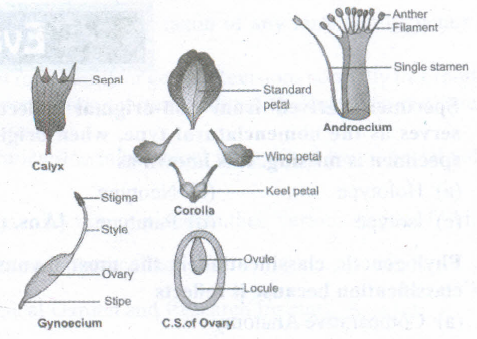
Calyx : Sepals 5, synsepalous, green showing valvate aestivation. Odd sepal is anterior in position.
Corolla : Petals 5, white or blue apopetalous, irregular papilionaceous corolla showing descendingly imbricate aestivation.
Androecium : Stamens 10, diadelphous (9)+1 nine stamens fused to form a bundle and the tenth stamen is free. Anthers are dithecous, basifixed, introse and dehiscing by longitudinal slits.
Gynoecium : Monocarpellary, unilocular, with many ovules on marginal placentation, ovary superior, style simple and incurved with feathery stigma.
Fruit : Legume
Seed : Non-endospermous, reniform.
10.
11.
12.
(1) Water potential \(\left(\Psi_{\mathrm{W}}\right)\) can be determined by,
(i) Solute concentration or Solute Potential \(\left(\Psi_{\mathrm{S}}\right)\)
(ii) Pressure potential \(\left(\Psi_{\mathrm{P}}\right)\)
(2) By correlating two factors, water potential is written as,
(3) Water potential = Solute potential + Pressure potential
(4) \(\Psi_{W}=\Psi_{S}+\Psi_{P}\)
13.
Physiological effect:
1) Cytokinin promotes cell division in the presence of auxin (IAA).
2) Induces cell enlargement associated with IAA and gibberellins
3) Cytokinin can break the dormancy of certain light-sensitive seeds like tobacco and induces seed germination.
4) Cytokinin promotes the growth of lateral bud in the presence of apical bud.
5) Application of cytokinin delays the process of aging by nutrient mobilization.
6) It is known as Richmond Lang effect.
7) Cytokinin
(i) increases rate protein synthesis
(ii) induces the formation of inter-fascicular cambium
(iii) overcomes apical dominance
(iv) induces formation of new leaves, chloroplast and lateral shoots.
8) Plants accumulate solutes very actively with the help of cytokinins.
14.
| Stages | ATP | NADH2 | FADH2 | Total ATPs |
| Glycolysis Link reaction Kreb's cycle |
2 - 2 |
2 \(\times\) 2.5 2 \(\times\) 2.5 6 \(\times\) 2.5 |
0 |
7 5 20 |
| 4 ATPs | 25 ATPs | 3 ATPs | 32 ATPs |
15.
C4 plants are more advantageous than C3 plants because increasing the proportion of C4 plants on earth could assist biosequestration of CO2 and represent an important cilmate change avoidance strategy.

11th Standard Syllabus & Materials
11th Standard
TN 11th Tamil பீடு பெற நில் - செய்யுள் - காவடிச்சிந்து Important Questions And Answers Study Material - QB365 Set A
NEW11th Standard
TN 11th Tamil பீடு பெற நில் - உரைநடை - மலை இடப்பெயர்கள் : ஓர் ஆய்வு Important Questions And Answers Study Material - QB365 Set A
NEW11th Standard
TN 11th Tamil மாமழை போற்றுதும் - துணைப்பாடம் - யானை டாக்டர் Important Questions And Answers Study Material - QB365 Set A
NEW11th Standard
TN 11th Tamil மாமழை போற்றுதும் - செய்யுள் - ஐங்குறுநூறு Important Questions And Answers Study Material - QB365 Set A



Tamilnadu Stateboard 11th Standard Subjects

Maths

Commerce

Economics
Biology

Business Maths and Statistics

Accountancy

Computer Science

Physics

Chemistry
Maths
Biology
Economics
Physics
Chemistry

History
Business Maths and Statistics

Computer Science
Accountancy

Computer Applications
History
Computer Technology
Commerce
Computer Applications
Computer Technology

Tamil

English

French
Tamilnadu Stateboard Standards



