
 100% FREE ACCESS
11th Standard Syllabus & Materials
11th Standard
TN 11th Tamil இயற்கை வேளாண்மை,சுற்றுச்சூழல் -செய்யுள் - மனோன்மணீயம் Important Questions And Answers Study Material - QB365 Set A
NEW11th Standard
TN 11th Tamil என்னுயிர் என்பேன் -துணைப்பாடம் - இசைத்தமிழர் இருவர் Important Questions And Answers Study Material - QB365 Set A
NEW11th Standard
TN 11th Tamil மொழி கலை -செய்யுள் - ஒவ்வொரு புல்லையும் Important Questions And Answers Study Material - QB365 Set A
NEW11th Standard
TN 11th Tamil பீடு பெற நில் - இலக்கணம் - பகுபத உறுப்புகள் Important Questions And Answers Study Material - QB365 Set A
NEW11th Standard
TN 11th Tamil பீடு பெற நில் - துணைப்பாடம் - வாடிவாசல் Important Questions And Answers Study Material - QB365 Set A
NEW11th Standard
TN 11th Tamil பீடு பெற நில் - செய்யுள் - குறுந்தொகை Important Questions And Answers Study Material - QB365 Set A

Published on: 13/05/2022
QB365 provides detailed and simple solution for every Creative Questions in class 11 Biology Subject. It will helps to get more idea about question pattern in every Creative questions with solution.
latest Creative QuestionsDownload Tamil Nadu 11th Standard Biology question papers, model tests, one-mark questions, important questions, and public exam papers in PDF format. Free study materials and answer keys for TN State Board students.
Questions + Answers key
Take MCQ Biology Test1.
What are the significances of Mitosis.
2.
Explain in detail about the various stages of Prophase I.
3.
Explain the various stages under Meiosis I-Reduction Division.
4.
Describe the process of Mitosis cell division.
5.
Draw the schematic diagram of anaphase promoting complex cyclosome and explain briefly.
1.
Exact copy of the parent cell is produced by mitosis (genetically identical).
1. Genetic stability - daughter cells are genetically identical to parent cells.
2. Growth - as multicellular organisms grow, the number of cells making up their tissue increases. The new cells must be identical to the existing ones.
3. Repair of tissues - damaged cells must be replaced by identical new cells by mitosis.
4. Asexual reproduction - asexual reproduction results in offspring that are identical to the parent. Example Yeast and Amoeba.
5. In flowering plants, structure such as bulbs, corms, tubers, rhizomes and runners are produced by mitotic division. When they separate from the parent, they form a new individual. The production of large numbers of offsprings in a short period of time, is possible only by mitosis. In genetic engineering and biotechnology, tissues are grown by mitosis (i.e. in tissue culture).
6. Regeneration - Arms of star fish
2.
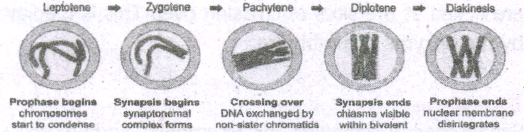
Prophase I - Prophase I is of longer duration and it is divided into 5 substages - Leptotene, Zygotene, Pachytene, Diplotene and Diakinesis.
Leptotene - Chromosomes are visible under light microscope. Condensation of chromosomes takes place. Paired sister chromatids begin to condense.
Zygotene - Pairing of homologous chromosomes takes place and it is known as synapsis. Chromosome synapsis is made by the formation of synaptonemal complex. The complex formed by the homologous chromosomes are called as bivalent (tetrads).
Pachytene - At this stage bivalent chromosomes are clearly visible as tetrads. Bivalent of meiosis I consists of 4 chromatids and 2 centromeres. Synapsis is completed and recombination nodules appear at a site where crossing over takes place between non-sister chromatids of homologous chromosome. Recombination of homologous chromosomes is completed by the end of the stage but the chromosomes are linked at the sites of crossing over. This is mediated by the enzyme recombinase.
Diplotene - Synaptonemal complex disassembled and dissolves. The homologous chromosomes remain attached at one or more points where crossing over has taken place. These points of attachment where 'X' shaped structures occur at the sites of crossing over is called Chiasmata. Chiasmata are chromatin structures at sites where recombination has been taken place. They are specialised chromosomal structures that hold the homologous chromosomes together. Sister chromatids remain closely associated whereas the homologous chromosomes tend to separate from each other but are held together by chiasmata. This substage may last for days or years depending OQ the sex and organism. The chromosomes are very actively transcribed in females as the egg stores up materials for use during embryonic development. In animals, the chromosomes have prominent loops called lampbrush chromosome.
Diakinesis - Terminalisation of chiasmata. Spindle fibres assemble. Nuclear envelope breaks down. Homologous chromosomes become short and condensed. Nucleolus disappears.
3.
Stages in Meiosis
Meiosis can be studied under two divisions i.e., meiosis I and meiosis II. As with mitosis, the cell is said to be in interphase when it is not dividing.
Prophase I
Prophase I is of longer duration and it is divided into 5 substages - Leptotene, Zygotene, Pachytene, Diplotene and Diakinesis.
Leptotene
Chromosomes are visible under light microscope. Condensation of chromosomes takes place. Paired sister chromatids begin to condense.
Zygotene
Pairing of homologous chromosomes takes place and it is known as synapsis. Chromosome synapsis is made by the formation of synaptonemal complex. The complex formed by the homologous chromosomes are called as bivalent (tetrads).
Pachytene
At this stage bivalent chromosomes are clearly visible as tetrads. Bivalent of meiosis I consists of 4 chromatids and 2 centromeres. Synapsis is completed and recombination nodules appear at a site where crossing over takes place between non-sister chromatids of homologous chromosome. Recombination of homologous chromosomes is. completed by the end of the stage but the chromosomes are linked at the sites of crossing over. This is mediated by the enzyme recombinase.
Diplotene
Synaptonemal .complex disassembled and dissolves. The homologous chromosomes remain attached at one or more points where crossing over has taken place. These points of attachment where 'X' shaped structures occur at the sites of crossing over is called Chiasmata. Chiasmata are chromatin structures at sites where recombination has been taken place. They are specialised chromosomal structures that hold the homologous chromosomes together. Sister chromatids remain closely associated whereas the homologous chromosomes tend to separate from each other but are held together by chiasmata. This substage may last for days or years depending on the sex and organism. The chromosomes are very actively. transcribed in females as the egg stores up materials for use during embryonic development. In animals, the chromosomes have prominent loops called lampbrush chremeseme.
Diakinesis
Termirialisation of chiasmata. Spindle fibres assemble. Nuclear envelope breaks down. Homologous chromosomes become short and condensed. Nucleolus disappears.
Metaphase I
Spindle fibres are attached to the centromeres of the two homologous chromosomes. Bivalent (pairs of homologous chromosomes) aligned at the equator of the cell known as metaphase plate. Each bivalent consists of two centromeres and four chromatids.The random distribution of homologous chromosomes in a cell in Metaphase I is called independent assortment.
Anaphase I
Hornoloqous chromosomes are separated from each other. Shortening of spindle fibers takes place. Each
homologous chromosomes with its two chromatids and undivided centromere move towards the opposite poles of the cells. The actual reduction rn the number of chromosomes takes place at this stage. Homologous chromosomes with move to the opposite poles are either paternal or maternal in origin. Sister chromatids remain attached with their centromeres.
Telophase I
Haploid set of chromosomes are present at each pole. The formation of two daughter cells, each with haploid number of chromosomes. Nuclei are reassembled. Nuclear envelope forms around the chromosome and the chromosomes becomes uncoiled. Nucleolus reappears. In plants, after karyokinesis cytokinesis takes place by which two daughter cells are formed by the cell plate between 2 groups of chromosomes known as dyad of cell (haploid). The stage between the two meiotic divisions is called interkinesis which is short-lived.
4.
Mitosis is divided into four stages prophase, metaphase, anaphase and telophase.
Prophase
Prophase is the longest phase in mitosis. Chromosomes. become visible as long thin thread like structure, condenses to form compact mitotic chromosomes. In plant: cells initiation of spindle fibres takes place, nucleolus disappears. Nuclear envelope breaks down. Golgi apparatus and endoplasmic reticulum are not seen.
In animal cell the centrioles extend a radial array of rnicrotubules (Figure 7.4) towards the plasma membrane when they reach the poles of the cell. This arrangement of micrdtubules is called an aster. Plant cells do not form asters.
Metaphase
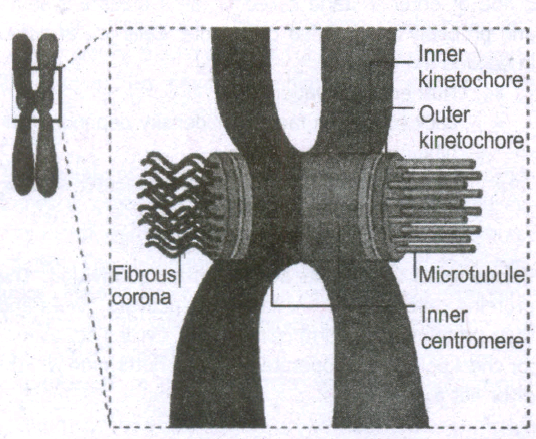
Chromosomes (two sister chromatids) are attached to the spindle ·fibres by- kinetochore of the centromere. The spindle fibres is made up of tubulin. The alignment of chromosome into compact group at the equator of the cell is known as metaphase plate. This is the stage where the chromosome morphology can be easily studied. Kinetochore is a DNA-Protein complex present in the centromere DNAwhere the microtubules are attached. It is a trilaminar disc like plate. The spindle assembly checkpoint which decides the cell to enter anaphase
Anaphase
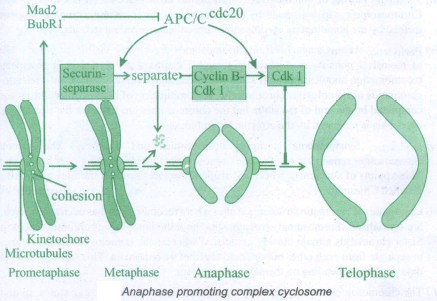
Each chromosome split simultaneously and two daughter chromatids begins to migrate towards two opposite poles of a cell. Each centromere splits longitudinally into two, freeing the two sister chromatids from each other. Shortening of spindle fi bre and longitudinal splitting of centromere creates a pull which divides chromosome into two halves. Eachhalf receive two chromatids (that is sister chromatids are separated). When the sister chromatids separate the actual partitioning of the replicated genome is complete. A ubiquitine ligase is activated called as the napha e-promotlng complex cyclosome (APC/C) leads to degradation of the key regulatory proteins at the transition of metaphase to anaphase. APC is a cluster of proteins that induces the breaking down of cohesion proteins which leads to the separation of chromatids during mitosis (Figure 7.5).
.png)
Telophase
Two sets of daughter chromosomes reach opposite poles of the cell, mitotic spindle disappears. Division of genetic material is com leted after this karyokinesis cytokinesis (division of cytoplasm) is completed, nucleolus and nuclear membranes reforms. Nuclear membranes form around each set of sister chromatids now called chromosomes, each has its own centromere. Now the chromosomes decondense. In plants, phragmoplast are formed between the daughter cells. Cell plate is formed between the two daughter cells, reconstruction of'cell wall takes place. Finally the cells are separated by the distribution of organelles, macromolecules into two newly formed daughter cells.
5.
Aubiquitine ligase is activated called as the anaphase-promoting complex cyclosome (APC/C) leads to degradation of the key regulatory proteins at the transition of metaphase to anaphase. APC is a cluster of proteins that induces the breaking down of cohesion proteins which leads to the separation of chromatids during mitosis.

11th Standard Syllabus & Materials
11th Standard
TN 11th Tamil பீடு பெற நில் - செய்யுள் - காவடிச்சிந்து Important Questions And Answers Study Material - QB365 Set A
NEW11th Standard
TN 11th Tamil பீடு பெற நில் - உரைநடை - மலை இடப்பெயர்கள் : ஓர் ஆய்வு Important Questions And Answers Study Material - QB365 Set A
NEW11th Standard
TN 11th Tamil மாமழை போற்றுதும் - துணைப்பாடம் - யானை டாக்டர் Important Questions And Answers Study Material - QB365 Set A
NEW11th Standard
TN 11th Tamil மாமழை போற்றுதும் - செய்யுள் - ஐங்குறுநூறு Important Questions And Answers Study Material - QB365 Set A



Tamilnadu Stateboard 11th Standard Subjects

Maths

Commerce

Economics
Biology

Business Maths and Statistics

Accountancy

Computer Science

Physics

Chemistry
Maths
Biology
Economics
Physics
Chemistry

History
Business Maths and Statistics

Computer Science
Accountancy

Computer Applications
History
Computer Technology
Commerce
Computer Applications
Computer Technology

Tamil

English

French
Tamilnadu Stateboard Standards



