
 100% FREE ACCESS
11th Standard Syllabus & Materials
11th Standard
TN 11th Tamil இயற்கை வேளாண்மை,சுற்றுச்சூழல் -செய்யுள் - மனோன்மணீயம் Important Questions And Answers Study Material - QB365 Set A
NEW11th Standard
TN 11th Tamil என்னுயிர் என்பேன் -துணைப்பாடம் - இசைத்தமிழர் இருவர் Important Questions And Answers Study Material - QB365 Set A
NEW11th Standard
TN 11th Tamil மொழி கலை -செய்யுள் - ஒவ்வொரு புல்லையும் Important Questions And Answers Study Material - QB365 Set A
NEW11th Standard
TN 11th Tamil பீடு பெற நில் - இலக்கணம் - பகுபத உறுப்புகள் Important Questions And Answers Study Material - QB365 Set A
NEW11th Standard
TN 11th Tamil பீடு பெற நில் - துணைப்பாடம் - வாடிவாசல் Important Questions And Answers Study Material - QB365 Set A
NEW11th Standard
TN 11th Tamil பீடு பெற நில் - செய்யுள் - குறுந்தொகை Important Questions And Answers Study Material - QB365 Set A

Published on: 26/06/2021
QB365 provides detailed and simple solution for every Creative Questions in class 11 Biology Subject. It will helps to get more idea about question pattern in every Creative questions with solution.
Download Tamil Nadu 11th Standard Biology question papers, model tests, one-mark questions, important questions, and public exam papers in PDF format. Free study materials and answer keys for TN State Board students.
Questions + Answers key
Take MCQ Biology Test1.
Explain the structure and movement of Eukaryotic flagella.
2.
Write in detail about the 3 types of centromere in eukaryotes.
3.
Describe the Structure of chromosome
4.
What are the structural elements of endoplasmic reticulum? Explain in detail.
5.
Describe the Fine Structure of a cell wall.
1.
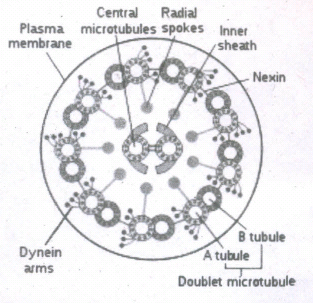
Structure: Eukaryotic Flagella are enclosed by unit membrane and it arises from a basal body. Flagella is composed of outer nine pairs of microtubules with two microtubules in its centre (9 + 2 arrangement). Flagella are microtubule projection of the plasma membrane. Flagellum is longer than cilium (as long as 200 m). The structure of flagellum has an axoneme made up microtubules and protein tubulin.
Movement: Outer microtubule doublet is associated with axonemal dynein which generates force for movement.The movement is ATP driven. The interaction between tubulin and dynein is the mechanism for the contraction of . cilia and flagella. Dynein molecules uses energy from ATP to shift the adjacent microtubules. This movement bends the cilium or flagellum.
2.
There are three types of centromere in Eukaryotes. They are as follows:
1. Point Centromere: The"type of centromere in which the kinetochore is assembled as a result of protein recognition of specific DNA sequences. Kinetochores assembled on point centromere bind a single microtubule. It is also called as localized centromere. It occurs in budding yeasts.
2. Regional Centromere: In regional centromere where the kinetochore is assembled on a variable array of repeated DNA sequences. Kinetochore assembled on regional centromeres bind multiple microtubules. It occurs in fission yeast cell, humans and so on.
3. Holocentromere: The microtubules bind all the along the mitotic chromosome. Example: Caenorhabditis elegans (transparent nematode) and many insects.
3.
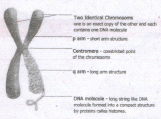
The chromosomes are composed of thread like strands called chromatin which is made up of DNA, protein and RNA. Each chromosome consists of two symmetrical structures called chromatids. During cell division the chromatids forms well organized chromosomes with definite size and shape. They are identical and are called sister chromatids. A typical chromosome has narrow zones called constrictions. There are two types of constrictions namely primary constriction and secondary constriction. The primary constriction is made up of centromere and kinetochore. Both the chromatids are united at centromere, whose number varies. The monocentric chromosome has one centromere and the polycentric chromosome has many centromeres. The centromere contains a complex system of protein fibres called kinetochore. Kinetochore is the region of chromosome which is attached to the spindle fibre during mitosis. Besides primary there are secondary constrictions, represented with few occurrence. Nucleoli develop from these secondary constrictions are called nucleolar organizers.Secondary constrictions contains the genes for ribosomal RNA which induce the formation of nucleoli and are called nucleolar organizer regions.
4.
The largest of the internal membranes is called the Endoplasmic Reticulum (ER). The name endoplasmic reticulum was given by K R. Porter (1948). It consists of double membrane. Morphologically the structure of endoplasmic reticulum consists of:
1.Cisternae are long, broad, flat, sac-like structures arranged in parallel bundles or stacks to form lamella. The space between membranes of cisternae is filled with fluid.
2.Vesicles are oval membrane bound vacuolar structure.
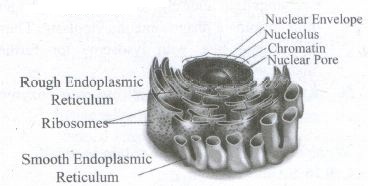
3.Tubules are irregular shaped, branched, smooth walled, enclosing a space.
(i) Endoplasmic reticulum is associated with nuclear membrane and cell surface membrane.
(ii) It forms a network in cytoplasm and gives mechanical support to the cell. Its chemical environment enables protein folding and undergo modification necessary for their function.
(iii) Misfolded proteins are pulled out and are degraded in endoplasmic reticulum. When ribosomes are present in the outer surface of the membrane it is called as Rough Endoplasmic Reticulum(RER), when the ribosomes are absent in the endoplasmic reticulum it is called as Smooth Endoplasmic Reticulum(SER).
(iv) Rough Endoplasmic reticulum is involved in protein synthesis and Smooth Endoplasmic reticulum are the sites of lipid synthesis.
(v) The smooth endoplasmic reticulum contains enzymes that detoxify lipid soluble drugs, certain chemicals and other harmful compounds.
5.
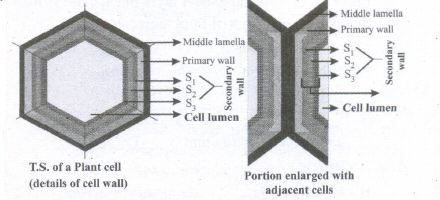
Cell wall is the outermost protective cover of cell. It was first observed by Robert Hooke. In plants it is made up of cellulose, hemicellulose, pectin, lignin, cutin. suberin and silica. In a plant cell wall shows J three distinct regions (a) Primary wall (b) Secondary wall (c) Middle lamellae
(a) Primary wall:
(i) It is the first layer inner to middle lamellae, primarily consisting of loose network of cellulose microfibrils in a gel matrix.
(ii) It is thin, elastic and extensible. In most plants the microfibrils are made up of cellulose oriented differently based on shape and thickness of the wall.
(iii) The matrix of the primary wall is composed of hemicellulose, pectin, glycoprotein and water.
(iv) Hemicellulose binds the microfibrils with matrix and glycoproteins control the orientation of microfibrils while pectin serves as filling material of the matrix.
(v) Cells such as parenchyma and meristems have only primary wall.
Plant Cell Wall
b. Secondary wall :
(i) Secondary wall is laid during maturation. It plays a key role in determining the shape of a cell. It is thick, inelastic and is made up of cellulose and lignin.
(ii) The secondary wall is divided into three sub layers termed as SI' S2 and S3 where the cellulose microfibrils are compactly arranged with different orientation forming a laminated structure and the cell wall strength is increased.
c. Middle lamellae:
(i) It is the outermost layer made up of calcium and magnesium pectate, deposited at the time of cytokinesis.
(ii) It is a thin amorphous layer which cements two adjacent cells. It is optically inactive (isotropic).
(iii) Plasmodesmata and Pits: Plasmodesmata act as a channel between the protoplasm of adjacent cells through which many substances pass through.
(iv) Moreover, at few regions the secondary wall layer is laid unevenly whereas the primary wall and middle lamellae are laid continuously such regions are called pits
(v) The pits of adjacent cells are opposite to each other. Each pit has a pit chamber and a pit membrane.
(vi) The pit membrane has many minute pores and thus they are permeable. The pits are of two types namely simple and bordered pit.

11th Standard Syllabus & Materials
11th Standard
TN 11th Tamil பீடு பெற நில் - செய்யுள் - காவடிச்சிந்து Important Questions And Answers Study Material - QB365 Set A
NEW11th Standard
TN 11th Tamil பீடு பெற நில் - உரைநடை - மலை இடப்பெயர்கள் : ஓர் ஆய்வு Important Questions And Answers Study Material - QB365 Set A
NEW11th Standard
TN 11th Tamil மாமழை போற்றுதும் - துணைப்பாடம் - யானை டாக்டர் Important Questions And Answers Study Material - QB365 Set A
NEW11th Standard
TN 11th Tamil மாமழை போற்றுதும் - செய்யுள் - ஐங்குறுநூறு Important Questions And Answers Study Material - QB365 Set A



Tamilnadu Stateboard 11th Standard Subjects

Maths

Commerce

Economics
Biology

Business Maths and Statistics

Accountancy

Computer Science

Physics

Chemistry
Maths
Biology
Economics
Physics
Chemistry

History
Business Maths and Statistics

Computer Science
Accountancy

Computer Applications
History
Computer Technology
Commerce
Computer Applications
Computer Technology

Tamil

English

French
Tamilnadu Stateboard Standards



