
 100% FREE ACCESS
11th Standard Syllabus & Materials
11th Standard
TN 11th Tamil இயற்கை வேளாண்மை,சுற்றுச்சூழல் -செய்யுள் - மனோன்மணீயம் Important Questions And Answers Study Material - QB365 Set A
NEW11th Standard
TN 11th Tamil என்னுயிர் என்பேன் -துணைப்பாடம் - இசைத்தமிழர் இருவர் Important Questions And Answers Study Material - QB365 Set A
NEW11th Standard
TN 11th Tamil மொழி கலை -செய்யுள் - ஒவ்வொரு புல்லையும் Important Questions And Answers Study Material - QB365 Set A
NEW11th Standard
TN 11th Tamil பீடு பெற நில் - இலக்கணம் - பகுபத உறுப்புகள் Important Questions And Answers Study Material - QB365 Set A
NEW11th Standard
TN 11th Tamil பீடு பெற நில் - துணைப்பாடம் - வாடிவாசல் Important Questions And Answers Study Material - QB365 Set A
NEW11th Standard
TN 11th Tamil பீடு பெற நில் - செய்யுள் - குறுந்தொகை Important Questions And Answers Study Material - QB365 Set A

Published on: 13/05/2022
QB365 provides detailed and simple solution for every Creative Questions in class 11 Biology Subject. It will helps to get more idea about question pattern in every Creative questions with solution.
latest Creative QuestionsDownload Tamil Nadu 11th Standard Biology question papers, model tests, one-mark questions, important questions, and public exam papers in PDF format. Free study materials and answer keys for TN State Board students.
Questions + Answers key
Take MCQ Biology Test1.
Describe the structure of Mitochondria.
2.
Describe the Special types of Chromosomes
3.
Describe the structure of nucleus with a suitable diagram.
4.
Write down the functions of Lysosomes.
5.
Who proposed the fluid mosaic model of plasma membrane? Describe the fluid mosaic model of plasma membrane with the help of labelled diagram.
1.
Structure of Mitochondria
1. It was first observed by A. Kolliker (1880), 1897, 1898 and named as mitochondria.
2. They are ovoid, rounded, rod-shaped and pleomorphic structures.
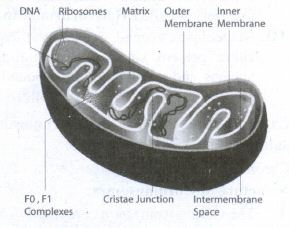
3. Mitochondrion consists of double membrane, the outer and inner membrane. The outer membrane is smooth, highly permeable to small molecules and it contains proteins called Porins, which form channels that allow free diffusion of molecules smaller than about 1000 daltons.
4. The inner membrane divides the mitochondrion into two compartments, outer chamber between two membranes and the inner chamber filled with matrix.
5. The inner membrane is convoluted (infoldings), called crista (plural: cristae). Cristae contain most of the enzymes for electron transport system.
6. Inner chamber of the mitochondrion is filled with proteinaceous material called mitochondrial matrix.
7. The inner membrane consists of stalked particles called elementary particles or Fernandez Moran particles, FI particles or Oxysomes. Each particle consists of a base, stem and a round head.
8. In the head ATP synthase is present for oxidative phosphorylation.
9. Inner membrane is impermeable to most ions, small molecules and maintains the proton gradient that drives oxidative phosphorylation Mitochondria contain 73% of proteins, 25-30% of lipids, 5-7% of RNA, DNA (in traces) and enzymes (about 60 types).
10. Mitochondria are called powerhouse of a cell, as they produce energy-rich ATP. All the enzymes of Kreb's cycle are found in the matrix except succinate dehydrogenase.
11. Mitochondria consist of circular DNA and 70S ribosome. They multiply by fission and replicate by strand displacement model. Because of the presence of DNA it is semi-autonomous organelle.
2.
Special types of Chromosomes:
1. Special types of Chromosomes are found only in certain special tissues. These Chromosomes are larger in size and are called giant Chromosomes in certain plants and they are found in the suspensors of the embryo.
2. The Polytene Chromosome and Lampbrush Chromosome occur in animals and are also called as Giant Chromosomes.
Polytene Chromosomes:
1. It is observed in the salivary glands of Drosophila (fruit fly) by C.G. Balbiani in 1881. In larvae of many flies, and some insects the interphase Chromosomes duplicates and reduplicates without nuclear division.
2. A single Chromosome which is present in multiple copies forms a structure called Polytene Chromosome which can be seen in light microscope.
3. They are genetically active. There are distinct alternating dark bands and light inter-bands. About 95% of DNA is present in bands and 5% in inter-bands.
4. The polytene Chromosome has extremely large puff called Balbiani rings which is seen in Chironomus larvae. It is also known as chromosomal puff. Puffing of bands is the sites of intense RNA synthesis.
5. As this Chromosome occurs in the salivary gland it is known as salivary gland Chromosomes. Polyteny is achieved by repeated replication of chromosomal DNA several times (endomitosis).
6. Gene expression, transcription of genes and RNA synthesis occurs in the bands along the Polytene Chromosomes.
Lampbrush Chromosomes:
1. It occurs at the diplotene stage of first meiotic prophase in oocytes of an animal Salamander and in giant nucleus of the unicellular alga Acetabularia.
2. It was first observed by Flemming in 1882. The highly condensed Chromosome forms the chromosomal axis, from which lateral loops of DNA extend as a result of intense RNA synthesis.
3.
Structure of Nucleus:
1. Nucleus is an important unit of cell which control all activities of the cell. Nucleus holds the hereditary information.
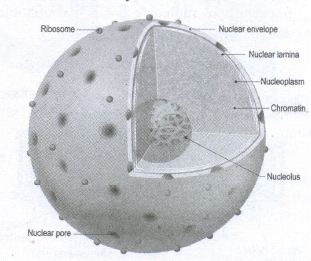
2. It is the largest among all cell organelles. It may be spherical, cuboidal, ellipsoidal or discoidal. It is surrounded by a double membrane structure called nuclear envelope, which has the inner and outer membrane.
3. The inner membrane is smooth without ribosomes and the outer membrane is rough by the presence of ribosomes and is continuous with irregular and infrequent intervals with the endoplasmic reticulum.
4. The membrane is perforated by pores known as nuclear pores which allow materials such as mRNA, ribosomal units, proteins and other macromolecules to pass in and out of the nucleus.
5. The pores enclosed by circular structures called annuli. The pore and annuli form the pore complex. The space between two membranes is called perinuclear space.
6. Nuclear space is filled with nucleoplasm, a gelatinous matrix has uncondensed chromatin network and conspicuous nucleoli. The chromatin network is the uncoiled, indistinct and remain thread-like during the interphase.
7. It has little amount of RNA and DNA bound to histone proteins in eukaryotic cells. During cell division chromatin is condensed into an organized form called Chromosome.
8. The portion of Eukaryotic Chromosome which is transcribed into mRNA contains active genes that are not tightly condensed during interphase is called Euchromatin.
9. The portion of a Eukaryotic Chromosome that is not transcribed into mRNA which remains condensed during interphase and stains intensely is called Heterochromatin.
10. Nucleolus is a small, dense, spherical structure either present singly or in multiples inside nucleus and it is not membrane-bound. Nucleoli possess genes for rRNA and tRNA
4.
Functions of Lysosomes:
1. Intracellular digestion: They digest carbohydrates, proteins and lipids present in cytoplasm.
2.Autophagy: During adverse condition they digest their own cell organelles like mitochondria and endoplasmic reticulum.
3. Autolysis: Lysosome causes self destruction of cell on onset of disease they destroy the cells.
4. Ageing: Lysosomes have autolytic enzymes that disrupt intracellular molecules.
5. Phagocytosis: Large cells or contents are engulfed and digested by macrophages, thus forming a phagosome in cytoplasm. This phagosome fuses with lysosome for further digestion.
6. Exocytosis: Lysosomes release their enzymes outside the cell to digest other cells.
5.
Fluid Mosaic Model:
Jonathan Singer and Garth Nicolson (1972) proposed fluid mosaic model.
1. It is made up of lipids and proteins together with a little amount of carbohydrate. The lipid membrane is made up of phospholipid. The phospholipid molecule has a hydrophobic tail and hydrophilic head.
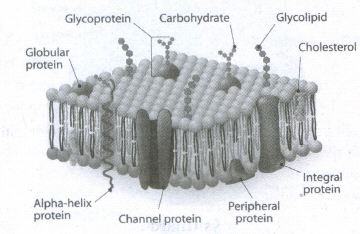
Model of Cell membrane
2. The hydrophobic tail repels water and hydrophilic head attracts water, The proteins of the membrane are globular proteins which are found intermingled between the lipid bilayer most of which are projecting beyond the lipid bilayer.
3. These proteins are called as integral proteins. Few are superficially attached on either surface of the lipid bilayer which are called as peripheral proteins.
4. The proteins are involved in transport of molecules across the membranes and also act as enzymes, receptors (or) antigens.
5. The carbohydrate molecules of cell membrane are short chain polysaccharides. These are either bound with 'glycoproteins' or 'glycolipids' and form a 'glycocalyx'.
6. The movement of membrane lipids from one side of the membrane to the other side by vertical movement is called flip-flopping or flip flop movement. This movement takes place more slowly than lateral diffusion of lipid molecule.
7. The phospholipids can have flip flop movement because the phospholipids have smaller polar regions, whereas the proteins cannot flip flop because the polar region is extensive.

11th Standard Syllabus & Materials
11th Standard
TN 11th Tamil பீடு பெற நில் - செய்யுள் - காவடிச்சிந்து Important Questions And Answers Study Material - QB365 Set A
NEW11th Standard
TN 11th Tamil பீடு பெற நில் - உரைநடை - மலை இடப்பெயர்கள் : ஓர் ஆய்வு Important Questions And Answers Study Material - QB365 Set A
NEW11th Standard
TN 11th Tamil மாமழை போற்றுதும் - துணைப்பாடம் - யானை டாக்டர் Important Questions And Answers Study Material - QB365 Set A
NEW11th Standard
TN 11th Tamil மாமழை போற்றுதும் - செய்யுள் - ஐங்குறுநூறு Important Questions And Answers Study Material - QB365 Set A



Tamilnadu Stateboard 11th Standard Subjects

Maths

Commerce

Economics
Biology

Business Maths and Statistics

Accountancy

Computer Science

Physics

Chemistry
Maths
Biology
Economics
Physics
Chemistry

History
Business Maths and Statistics

Computer Science
Accountancy

Computer Applications
History
Computer Technology
Commerce
Computer Applications
Computer Technology

Tamil

English

French
Tamilnadu Stateboard Standards



