
 100% FREE ACCESS
11th Standard Syllabus & Materials
11th Standard
TN 11th Tamil இயற்கை வேளாண்மை,சுற்றுச்சூழல் -செய்யுள் - மனோன்மணீயம் Important Questions And Answers Study Material - QB365 Set A
NEW11th Standard
TN 11th Tamil என்னுயிர் என்பேன் -துணைப்பாடம் - இசைத்தமிழர் இருவர் Important Questions And Answers Study Material - QB365 Set A
NEW11th Standard
TN 11th Tamil மொழி கலை -செய்யுள் - ஒவ்வொரு புல்லையும் Important Questions And Answers Study Material - QB365 Set A
NEW11th Standard
TN 11th Tamil பீடு பெற நில் - இலக்கணம் - பகுபத உறுப்புகள் Important Questions And Answers Study Material - QB365 Set A
NEW11th Standard
TN 11th Tamil பீடு பெற நில் - துணைப்பாடம் - வாடிவாசல் Important Questions And Answers Study Material - QB365 Set A
NEW11th Standard
TN 11th Tamil பீடு பெற நில் - செய்யுள் - குறுந்தொகை Important Questions And Answers Study Material - QB365 Set A

Published on: 28/06/2021
QB365 provides detailed and simple solution for every Creative Questions in class 11 Biology Subject. It will helps to get more idea about question pattern in every Creative questions with solution.
Download Tamil Nadu 11th Standard Biology question papers, model tests, one-mark questions, important questions, and public exam papers in PDF format. Free study materials and answer keys for TN State Board students.
Questions + Answers key
Take MCQ Biology Test1.
How do archaebacteria thrive at extreme temperatures and against lytic agents?
2.
How Gram positive and Gram negative bacteria react on Gram staining process?
3.
What are plasmids? How it helps the bacteria?
4.
What do you understand by the term developmental heterophylly?
5.
Certain plants like Aloe and Agave can survive in extreme dry conditions. How?
6.
Mention any three Pteridophytes and their economic value.
7.
Name the three classes of Bryophytes, according to Proskauer.
8.
Write any three differences between chlorophyceae and phaeophyceae members?
9.
Write the characters of Class Monotyledonae.
10.
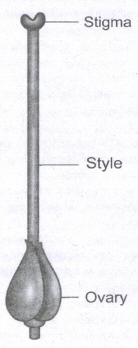
Discuss the structure of Gynoecium with diagram.
11.
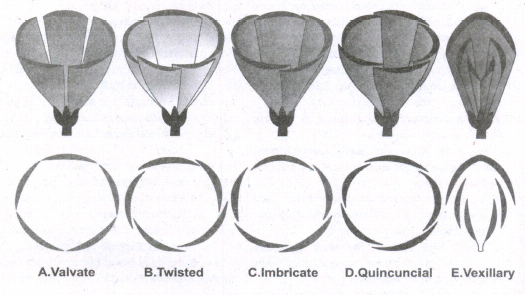
Draw and label the parts of types of aestivation.
12.
Describe the step of Synthesis in lytic cycle of phages.
13.
Describe the step of Adsorption in lytic cycle of phages.
14.
List out the classification of viruses.
15.
Describe the salient features of floral diagram
16.
What is the meant by anther dehiscence? Explain the different kinds of anther dehiscence
17.
Explain the term '' Hypanthodium" with suitable example
18.
List some viral diseases which occur in plants.
19.
What are actinomycetes ? Give example.
20.
What is Fimbriae or Pili?
21.
What is Sheathing leaf base?
22.
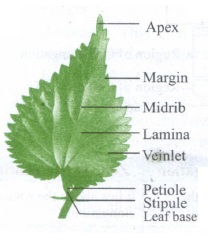
Draw a leaf and label the parts.
23.
Differentiate Runner and Offset
24.
What is Monograph?
25.
What is binomial nomenclature?
1.
The unique feature of archaebacteria is the presence of lipids like glycerol and isopropyl ethers in their cell membrane. Due to the unique chemical composition the cell membrane show resistance against cell wall antibiotics and lytic agents.
E.g., Methanobacterium.
2.
The Gram positive bacteria retain crystal violet and appear dark violet, whereas Gram negative type loose the crystal violet and when counterstained by safranin appear red under a microscope.
3.
Plasmids are extrachromosomal double stranded , circular, self-replicating, autonomous elements. They contain genes for fertility, antibiotic resistant and heavy metals. It also help in the production of bacteriocins and toxins which are not found in bacterial chromosome.
4.
In plants like Ficus, heterophylla leaves vary from entire to variously lobed structures during different developmental stages. Young leaves are usually lobed or dissected and the mature leaves are entire. Such type is known as developmental heterophylly.
5.
Aloe and Agave are Xerophytes. They develop fleshy and swollen leaves. These succulent leaves store water, mucilage and food. They also resist desiccation.
6.
Economic importance of Pteridophyte
| S.no | Pteridophyte | Uses |
| 1 | Marsilea | Food |
| 2 | Azolla | Biofertilizer |
| 3 | Pteris vittata | Removal of heavy metals from soils - Bioremediation |
7.
Hepaticopsida, Anthocerotopsida and Bryopsida.
8.
| Chlorophyceae | Phaeophyceae | |
| (a) | Commonly called as green algae | Commonly called as brown algae |
| (b) | Chlorophyll 'a' and 'b' are the major photosynthetic pigments | Chlorophyll a, c carotenoid, Xanthophylls are the photosynthetic pigments |
| (c) | Reserve food in starch | Reserve food in mannitol and laminarin starch |
9.
1. Plants contain only one cotyledon in their seed, leaves with parallel venation, fibrous root system and trimerous flowers come under this class.
2.The Monocotyledonae has 7 series and 34 families.
3. The Bentham and Hooker system of classification is still supposed to be the best system of classification.
4. It has been widely practiced in colonial countries and herbaria of those countries were organised based on this system and is still used as a key for the identification of plants in some herbaria of the world due to the following reasons: Description of plants is quite accurate and reliable, because it is mainly based on personal studies from actual specimens and not mere comparisons of known facts.
5. As it is easy to follow, it is used as a key for the identification of plants in several herbaria of the world. Though it is a natural system, this system was not intended to be phylogenetic.
10.
1. Gynoecium or pistil is the female reproductive part of the flower.
2. A pistil consists of an expanded basal portion called the ovary, an elongated section called a style and an apical structure that receives pollen called a stigma. Ovary with stipe is called stipitate ovary.
3.Carpel: They are components of a gynoecium. Gynoecium is made of one or more carpels.
11.
12.
1. This step involves the degradation of bacterial chromosome, protein synthesis and DNA replication. The phage nucleic acid takes over the host biosynthetic machinery.
2. Host DNA gets inactivated and breaks down. Phage DNA suppresses the synthesis of bacterial protein and directs the metabolism of the cell to synthesis the proteins of the phage particles and simultaneously replication of Phage DNA also takes place.
13.
1. Phage (T4) particles interact with cell wall of host (E.coli). The phage tail makes contact between the two, and tail fibres recognize the specific receptor sites present on bacterial cell surface.
2. The lipopolysaccharides of tail fibres act as receptor in phages.
14.
| Different Classes of viruses | |
| Class | Example |
| Class 1 - Viruses with dsDNA | Adenoviruses |
| Class 2 - Viruses with (+) sense ssDNA | Parvo viruses |
| Class 3 - Viruses with dsRNA | Reo viruses |
| Class 4 - Viruses with (+) sense ssRNA | Toga viruses |
| Class 5 - Viruses with (-) antisense ssRNA | Rhabdo viruses |
| Class 6 - Viruses with (+) sense ss RNA - RT that replicate with DNA intermediate in life cycle | Retro viruses |
| Class 7 - Viruses with ds DNA - RT that replicate with RNA intermediate in life cycle | Hepadna viruses |
15.
A floral formula is a simple way to explain the salient features of a flower. The floral diagram is a representation of the cross-section of the flower. It represents floral whorls arranged as viewed from above. Floral diagram shows the number and arrangement of bract, bracteoles and floral parts, fusion, overlapping and placentation.
16.
It refers ~oopening of another to disperse pollen grains.
(i) Longitudinal: Anther dehisces along a suture parallel to long axis of each. anther lobe. ego Datura, china rose, cotton.
(ii) Transverse: Anther dehisces at right angles to the long axis of another lobe. ego Malvaceae.
(iii) Poricidal: Anther dehisces through pores at one end of the thecae. ego Ericaceae, Solanum, potato, brinjal, Cassia.
(iv) Valvular: Anther dehisces through a pore covered by a flap of tissue. ego Lauraceae, Cinnamomum.
17.
Receptacle is a hollow, globose structure 'consisting unisexual flowers present on the inner wall of the receptacle: Receptacle is closed except a small opening called ostiole which is covered by a series of bracts. Male flowers are present nearer to the ostiole, female and neutral flowers are found in a mixed manner from middle below. ego Ficus sp. (Banyan and Pipal).
18.
Plant Diseases:
1. Tobacco Mosaic Disease.
2. Cauliflower Mosaic Disease.
3. Sugarcane Mosaic Disease.
4. Potato leaf roll.
5. Bunchy top of banana.
6. Leaf curl of papaya.
7. Vein clearing of Lady's finger.
8. Rice tungro disease.
9. Cucumber Mosaic Disease.
10. Tomato spotted wilt Disease.
19.
1. Actinomycetes or 'Ray fungi' are anaerobic or facultative anaerobic microorganisms.
2. They show mycelia like growth.
3. Eg: Streptomyces.
20.
1. Pili or Fimbriae are hair like appendages found on surface of cell wall of gram-negative bacteria.
Eg: Enterobacterium.
2. The pili are 0.2 to 20 11m long with a diameter of about 250A
3. In addition to normal pili there are special type of pili which help in conjugation called sex pili are also found.
21.
In many monocot families such as Arecaceae, Musaceae, Zingiberaceae and Poaceae the leaf base extends into a sheath and clasps part or whole of the internode. Such leaf base also leaves permanent scars on the stem when they fall. Eg: Arecaceae.
22.
23.
Runner and Offset are Subaerial stems
| S.No | Runner | Offset |
|---|---|---|
| 1 | Slender, prostrate branch creeping on the ground and produce roots at nodes. | Short, horizontal thickened branches which produces leaves above and roots below at nodes. It is a shorter and Stouter than runner. |
| 2 | Eg: Oxalis (Wood sorrel). | Eg: Pistia (Water lettuce). |
24.
1. A Monograph is a complete global account of a taxon of any rank - family, genus or species at a given time.
2. This includes the existing taxonomic knowledge and all relevant information about the group concerned such as anatomy, chemistry, palynology, chromosome number etc.
3. Eg: Family Lentibulariaceae M.K. Janarthanam and A.N. Henry.
25.
Binomial: Binomial nomenclature
1. Binomial nomenclature was first introduced by Gaspard Bauhin and it was implemented by Carolus Linnaeus.
2. Scientific name of a species consists of two words and according to binomial nomenclature, the first one is called genus name and second one is specific epithet.
3. Eg: Mangifera indica. Mangifera IS a genus name and indica is specific epithet.

11th Standard Syllabus & Materials
11th Standard
TN 11th Tamil பீடு பெற நில் - செய்யுள் - காவடிச்சிந்து Important Questions And Answers Study Material - QB365 Set A
NEW11th Standard
TN 11th Tamil பீடு பெற நில் - உரைநடை - மலை இடப்பெயர்கள் : ஓர் ஆய்வு Important Questions And Answers Study Material - QB365 Set A
NEW11th Standard
TN 11th Tamil மாமழை போற்றுதும் - துணைப்பாடம் - யானை டாக்டர் Important Questions And Answers Study Material - QB365 Set A
NEW11th Standard
TN 11th Tamil மாமழை போற்றுதும் - செய்யுள் - ஐங்குறுநூறு Important Questions And Answers Study Material - QB365 Set A



Tamilnadu Stateboard 11th Standard Subjects

Maths

Commerce

Economics
Biology

Business Maths and Statistics

Accountancy

Computer Science

Physics

Chemistry
Maths
Biology
Economics
Physics
Chemistry

History
Business Maths and Statistics

Computer Science
Accountancy

Computer Applications
History
Computer Technology
Commerce
Computer Applications
Computer Technology

Tamil

English

French
Tamilnadu Stateboard Standards



