
 100% FREE ACCESS
11th Standard Syllabus & Materials
11th Standard
TN 11th Tamil இயற்கை வேளாண்மை,சுற்றுச்சூழல் -செய்யுள் - மனோன்மணீயம் Important Questions And Answers Study Material - QB365 Set A
NEW11th Standard
TN 11th Tamil என்னுயிர் என்பேன் -துணைப்பாடம் - இசைத்தமிழர் இருவர் Important Questions And Answers Study Material - QB365 Set A
NEW11th Standard
TN 11th Tamil மொழி கலை -செய்யுள் - ஒவ்வொரு புல்லையும் Important Questions And Answers Study Material - QB365 Set A
NEW11th Standard
TN 11th Tamil பீடு பெற நில் - இலக்கணம் - பகுபத உறுப்புகள் Important Questions And Answers Study Material - QB365 Set A
NEW11th Standard
TN 11th Tamil பீடு பெற நில் - துணைப்பாடம் - வாடிவாசல் Important Questions And Answers Study Material - QB365 Set A
NEW11th Standard
TN 11th Tamil பீடு பெற நில் - செய்யுள் - குறுந்தொகை Important Questions And Answers Study Material - QB365 Set A

Published on: 13/05/2022
QB365 provides detailed and simple solution for every Creative Questions in class 11 Biology Subject. It will helps to get more idea about question pattern in every Creative questions with solution.
latest Creative QuestionsDownload Tamil Nadu 11th Standard Biology question papers, model tests, one-mark questions, important questions, and public exam papers in PDF format. Free study materials and answer keys for TN State Board students.
Questions + Answers key
Take MCQ Biology Test1.
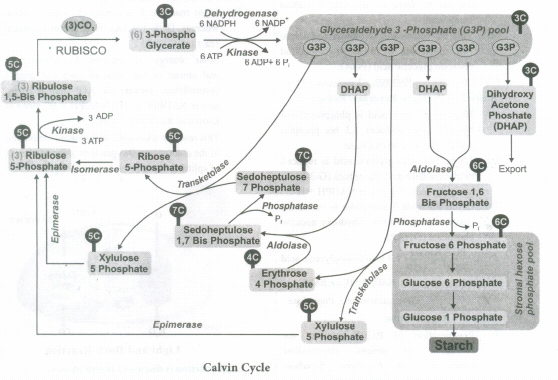
Draw the schematic representation of Calvin Cycle?
2.
Explain Calvin Cycle/ C3 Cycle.
3.
Why do plants such as maize and sugarcane have dimorphic chloroplasts. Explain photosynthetic carbon cycle in such plants?
4.
Why do cut leaves dipped in cytokinins stay green for longer duration?
5.
What is seed dormancy? Explain the methods of breaking dormancy.
6.
Explain the physiological effects and agricultural role of Auxin.
7.
Explain 'senescence'.
8.
Explain Cytochrome pump theory?
9.
(a) Define osmosis
(b) Explain the types
(c) Demonstrate an experiment to prove osmosis.
10.
Define phyllotaxy. Explain its types
11.
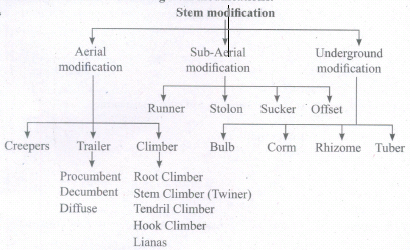
Draw a flowchart illustrating stem modifications.
12.
Describe the Angiosperm phylogeny group (APG) classification.
13.
Describe the Herbarium - Preparation and uses
14.
Describe the structure and function of Lysosomes (Suicidal Bags of Cell)
15.
Explain the Fluid Mosaic Model
16.
Describe the Features of DNA
17.
Describe the Enzymes
18.
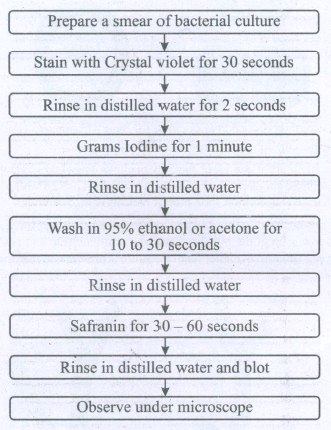
Describe the various steps in Gram's staining procedure.
19.
Why are some bryophytes are called liverworts?
20.
Angiosperms support pollinators to carry out pollination in contrast to gymnosperms. Give reasons.
21.
Describe Allium cepa in botanical terms.
22.
Write down the economic importance of Family Fabaceae.
23.
List out the uses of Herbarium.
24.
Explain the different methods of asexual reproduction in fungi.
25.
Write down the general characteristic features of Bacteria.
1.
2.
Biosynthetic Phase or Photosynthetic Carbon Reduction Cycle (Per) :
1) Biosynthetic Phase of Photosynthesis utilises assimilatory powers (ATP and NADPH + H+) produced during light reaction. They are used to fix and reduce carbon dioxide into carbohydrates.
2) This reaction does not require light. Therefore, it is named Dark reaction. Ribulose 1,5 bisphosphate (RUBP) act as acceptor molecule of carbon dioxide and fix the CO2 by RUBISCO enzyme.
3) The first product of the pathway is a 3- carbon compound (Phospho Glyceric Acid) and so it is also called as C3 Cycle or Calvin Cycle. It takes place in the stroma of the Chloroplast. It was discovered Melvin Calvin.
4) Dark reaction is temperature dependent and so it is also called Thermo-Chemical Reaction. It consists of three phases.
a) Phase 1- Carboxllation (Fixation)
i) The acceptor molecule Ribulose 1,5 Bisphosphate (RUBP) a 5 carbon compound with the help of RUBP carboxylase oxygenase (RUBISCO) enzyme accepts one molecule of carbon dioxide to form an unstable 6 carbon compound.
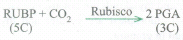
ii) This 6C compound is broken down into two molecules of 3-carbon compound phospho glyceric acid (PGA).
RUBP + CO2\(\xrightarrow{Rubisco}\) 2 molecules PGA
b) Phase 2 - Glycolytic Reversal/Reduction
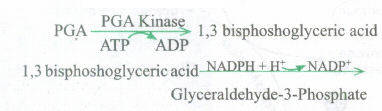
i) Phospho glyceric acid is phosphorylated by ATP and produces 1,3 bis phospho glyceric acid by PGA kinase.
ii) 1,3 bis phospho glyceric acid is reduced to glyceraldehyde 3 Phosphate (G-3-P) by using the reducing power NADPH + H+.
iii) Glyceraldehyde 3 phosphate is converted into its isomeric form dihydroxy acetone phosphate (DHAP).
c) Phase 3 - Regeneration
i) Regeneration of RUBP involves the formation of several intermediate
compounds of 6-carbon , 5-carbon, 4-carbon and 7- carbon skeleton.
ii) Fixation of one carbon dioxide requires 3 ATPs and 2 NADPH + H+ , and for the fixation of 6 CO2 requires 18 ATPs and 12 NADPH + H+ during C3 cycle. One 6 carbon compound is the net gain to form hexose sugar.

Overall equation for dark reaction:
6C02 + 18ATP + 12NADPH + H+\(\rightarrow\) C6 H12 06 + 6H20 + 18ADP+ 18Pi + 12NADP+
3.
Maize and sugarcane have dimorphic chloroplasts. They have C4 or Hatch and slack pathway for carbon di oxide fixation.
Dimorphic chloroplast: Bundle sheath chloroplast are larger and thylakoids are not arranged in granum. Mesophyll chloroplast are smaller and thylakoilds are arrangd in granum.
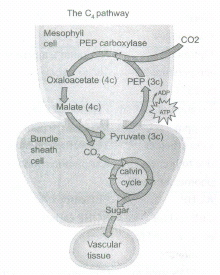
1) C4 pathway is completed in two phases, first phase takes place in stroma of mesophyll cells, where the CO2 acceptor molecule is 3-Carhon compound, Phospho Enol Pyruvate (PEP) to form 4-Carbon Oxalo A cetic Acid (OAA).
2) The first product is a 4-Carbon and so it is named as C4 cycle. Oxalo Acetic Acid is a dicarboxylic acid and hence this cycle is also known as Dicarboxylic Acid Pathway
Stage:I Mesophyll Cells
Phospho enol Pyruvate 1 CO2
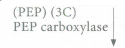
Oxaloacetic acid (OAA) (4C)
Oxaloacetic acid (OAA) is converted into Malic acid or Aspartic acid and is transported to the bundle sheath cells through plasmodesmata.
Stage:II Bundle Sheath Cells:
Malic acid undergoes decarboxylation and produces a 3 carbon compound Pyruvic acid and CO2, The released CO2 combines with RUBP and follows the Calvin Cycle and finally sugar is released to the phloem. Pyruvic acid is transported to the mesophyll cells.
Carbon dioxide fixation takes place in two places one in mesophyll and another in bundle sheath cell (Di Carboxylation Pathway). It is the adaptation of Tropical and Sub Tropical plants growing in warm and dry condition. Fixation of CO2 with minimal loss is due to photorespiration. C4 plants require 5 ATP and 2 NADPH + H+ to fix one molecule of CO2,
4.
Ageing of plant organs is retarded by cytokinins. They help in protein synthesis and mobilises nutrient resources.
5.
The condition of a seed when it' fails to germinate even in suitable environmental condition is called seed dormancy. There are two .main reasons for the development of dormancy: Imposed dormancy and innate dormancy.
Methods of breaking dormancy:
The dormancy of seeds can, be broken by different methods. These are:
1. Scarification: Mechanical and chemical treatments like cutting or chipping of hard tough seed coat and use of organic solvents to remove waxy or fatty compounds are called as Scarification.
2. Impaction: In some seeds water and oxygen are unable to penetrate micropyle due to blockage by cork cells. These seeds are shaken vigorously to remove the plug which is called Impaction
3. Stratification: Seeds of rosa ceo us plants (Apple, Plum, Peach and Cherry) will not germinate! until they have been exposed to well aerated, moist condition under low temperature (0°C to 10°C) for weeks to months. Such treatment is called Stratification.
4. Alternating temperatures: Germination of some seeds is strongly promoted by alternating daily temperatures. An alternation of low and high temperature improves the germination of seeds
5. Light: The dormancy of photoblastic seeds can be broken by exposing them to red light.
6.
Auxin is a phytohormone - Physiological effects
1. They promote cell elongation in stem and coleoptile.
2. At higher concentrations auxins inhibit the elongation of roots but induce more lateral roots. Promotes growth of root only at extremely low concentrations.
3. Suppression of growth in lateral bud by apical 'buddue to auxin produced by apical bud is termed as apical dominance,
4. Auxin prevents abscission.
5. It is responsible for initiation and promotion of cell division in cambium, which is responsible for the secondary growth and tumor. This property of induction cell division has been exploited for tissue culture techniques and for the formation of callus.
6. Auxin stimulates respiration.
7. Auxin induces vascular differentiation.
Agricultural role:
1) It is used to eradicate weeds. Example: 2,4-D and 2, 4, 5 - T.
2) Synthetic auxins are used in the formation of seedless fruits (Parthenocarpic fruit).
3) It is used to break the dormancy in seeds.
4) Induce flowering in Pineapple by NAA & 2, 4 - D.
5) Increase the number of female flowers and fruits in cucurbits.
7.
old age is called" senescence 'in plants, senescence refers to all col1ective, progressive and deteriorative processes which ultimately lead to complete loss of organization and 'function.'
Four types of senescence:
I) Overall senescence
2) Top senescence
3) Deciduous senescence ,
4) Progressive senescence
Overall senescencer This kind of senescence occurs in annual plants when entire plant get 'affected and dies . Eg: Wheat and Soybean. It also occurs in few perennials also'. Eg: Agave and Bamboo.
Top senescence: It occurs in aerial parts of plants. It 'is common in perennials, underground and root system remains viable. Eg: Banana and Gladiolus.
Deciduous senescence: It is common in deciduous plants and occurs only in leaves of plants, bulk of the stein and root system remains alive. Eg: Elm and Maple.
Progressive senescence: This kind of senescence is gradual. First it occurs in old leaves followed by new leaves then stem and' finally root system. It is common in annuals.
Physiology of Senescence:
1) Cells undergo changes in structure.
2) Vacuole of the cell acts as lysosome and secretes hydrolytic enzymes.
3) The starch content is decreased in the cells.
4) Photosynthesis is reduced due to loss of chlorophyll accompanied by synthesis and accumulation of anthocyanin pigments therefore the leaf becomes red .
5) There is a marked decrease in protein content in the senescing organ.
6) RNA content of the leaf particularly rRNAlevel is decreased in the cells due to increased activity of the enzyme RNA ase.
7) DNA molecules in senescencing leaves degenerate by the increased activity of enzyme DNA ase.
Factors affecting Senescence:
1) ABA and ethylene accelerate senescence while auxin and cytokinin retard senescence.
2) Nitrogen deficiency increases . senescence whereas nitrogen supply retards senescence.
3) High temperature. accelerates senescence but low temperature retards senescence.'
4) Senescence is rapid in dark'than iti light.
5) Water stress 'leads to accumulation of ABA leading to senescence.
Programned cell death:
Senescence is controlled by plants own genetic programme. Death of the plant or plant part consequent to senescence is called programmed cell Death. In short senescence of an individual cell is called PCD.
8.
Lundegardh's Cytochrome Pump Theory:
Lundegardh and Burstrom (1933) observed a correlation between respiration and anion absorption. When a plant is transferred from water to a salt solution the rate of respiration increases which is called as anion respiration or salt respiration. Based on this observation Lundegardh (1950,1954) proposed cytochrome pump theory which is based on the following assumptions:
1. The mechanism of anion and cation absorption is different.
2. Anions are absorbed through cytochrome chain by an active process. Cations are absorbed passively.
3. An oxygen gradient responsible for oxidation at the outer surface of the membrane and reduction at the inner surface.
According to this theory, the enzyme dehydrogenase on the inner surface is responsible for the formation of protons (H+) and electrons (e-). As the electrons pass outward through the electron transport chain there is a corresponding inward passage of anions. The anions are picked up by oxidized cytochrome oxidase and are transferred to the other members of the chain as they transfer the electron to the next component.
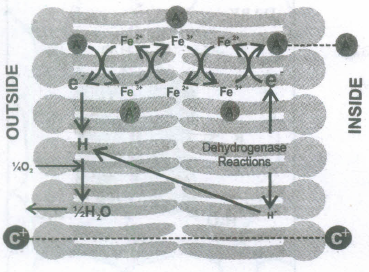
The theory assumes that the cations (C+) move passively along the electrical gradient created by the accumulation of the anions (A-) at the inner surface of the membrane.
Main defects of the above theory are:
1. Cations also induce respiration.
2. This theory fails to explain the selective uptake of ions.
3. It explains absorption of anions only.
9.
(a) Osmosis:
(i) Osmosis (Latin:Osmos = impulse, urge) is a special type of diffusion
(ii) It represents the movement of water or solvent molecules through a selectively permeable membrane from the place of its higher concentration (high water potential to the place of its lower concentration (low water potential).
(b) Types of osmosis :
(i) Based on the direction of movement of water or solvent in an osmotic system, two types of osmosis can occur, they are Endosmosis and Exosmosis.
(ii) Endosmosis: Endosmosis is defined as the osmotic entry of solvent into a cell or a system when it is placed in a pure water or hypotonic solution. For example dry raisins (high solute and low solvent) placed in the water, it swells up due to turgidity.
(iii) Exosmosis:Exosmosis is defined as the osmotic withdrawal of water from a cell or system when it is placed in a hypertonic solution. Exosmosis in a plant cell leads to plasmolysis.
(c) Thistle funnel experiment:
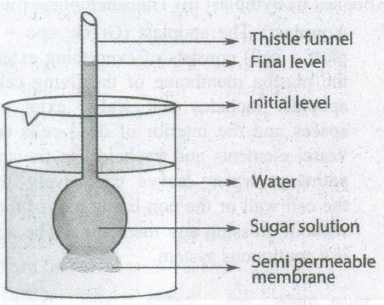
(i) Mouth of a thistle funnel is tied with goat bladder. It acts as a semipermeable membrane.
(ii) Pour concentrated sugar solution in the thistle funnel and mark the level of solution.
(iii) Place this in a beaker of water. After some time, water level in the funnel rises up steadily.
(iv) This is due to the inward diffusion of water molecules through the semipermeable membrane.
10.
The mode of arrangement of leaves on the stem is known as phyllotaxy (Greek. Phyllon = leaf; taxis = arrangement). Phyllotaxy is to avoid overcrowding of leaves and expose the leaves maximum to the sunlight for photosynthesis. The four main types of phyllotaxy are: (1) Alternate (2) Opposite (3) Ternate and (4) Whorled.
1. Alternate phyllotaxy: In this type, there is only one leaf per node and the leaves on the successive nodes are arranged alternately to each other. Spiral arrangement of leaves shows vertical rows are called orthostichies. They are two types:
(a) Alternate spiral In which the leaves are arranged alternately in a spiral manner.
e.g., Hibiscus and Ficus.
(b) Alternate distichous or Bifarious: In which the leaves are organized alternatively in two rows on either side of the stem. e.g., Monoon longifolium (Polyalthia longifolia).
2. Opposite phyllotaxy: In this type, each node possesses two leaves opposite to each other. They are organized in two different types:
(i) Opposite superposed: The pair of leaves arranged in succession are in the same direction, that is two opposite leaves at a node lie exactly above those at the lower node. e.g., Psidium (Guava), Eugenia jambolana (Jamun) and Quisqualis (Rangoon creeper).
(ii) Opposite decussate: In this type of phyllotaxy one pair of leaves is placed at right angles to the next upper or lower pair of leaves. e.g., Calotropis, Zinnia and Ocimum
3. Ternate phyllotaxy: In this type, there are three leaves attached at each node. e.g., Nerium.
4. Whorled (verticillate) type of phyllotaxy: In this type more than three leaves. are present in a whorl at each node forming a circle or whorl. e.g., Allamanda and Alstonia scholaris.
11.
12.
The most recent classification' of flowering plants based on phylogenetic data was set in the last decade of twentieth century. Four versions of Angiosperm Phylogenetic g group classification (APG I, APG II, APG III & APG IV) have been published in 1998, 2003, 2009 and 2016 respectively. Each version supplants the previous version. Recognition of monophyletic group based on the information received from various disciplines such as gross Morphology, Anatomy, Embryology, Palynology, Karyology, Phytochemistry and more strongly on molecular data with respect to DNA sequences of two chloroplast genes (atpB and rbcL) and one nuclear gene (nuclear ribosomal 18s DNA). The most recent updated version, APG IV (2016) recognised 64 orders and 416families. Of these, 416 families H 259 are represented in India.
The outline of APG IV classification is given below.
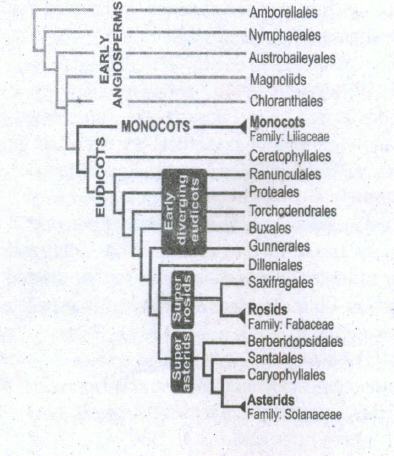
Angiosperms are classified into three clades early angiosperms, monocots and eudicots. Early angiosperms are classified into 8 orders and 26 families (ANA-grade + magnoliids + Chloranthales)
Amborellales
Nymphaeales
Austrobaileyales
1. Seeds always with two cotyledons.
2. Presence of ethereal oils.
3. leaves are always simple net-veined.
4. Each floral whorls with many parts.
5. Perianth usually spirally arranged or parts in threes.
6. Stamens with broad filaments.
7. Anthers tetrasporangiate.
8. Pollen monosulcate.
9. Nectaries are rare.
10. Carpels usually free and.
11. Embryo very small.
Monocots are classified into 11 orders and 77 families (basal monocots + liIioids + commelinids)
1. Seeds with single cotyledon.
2. Primary root short-lived.
3. Single adaxial prophyll.
4. Ethereal oils rarely present.
5. Mostly herbaceous, absence of vascular cambium.
6. Vascular bundles are scattered in the stem.
7. leaf simple with parallel-veined.
8. Floral parts usually in threes.
9. Perianth often composed of tepals.
10. Pollen monosulcate.
11. Styles normally hollow and.
12. Successive microsporogenesis
Eudicots are divided into 45 orders and 33 families (early diverging eudicots + super rosids +superasterids).
1. Seeds with always two cotyledons.
2. Nodes trilacunar with three leaf traces.
3. Stomata anomocytic.
4. Ethereal oils rarely present.
5. Woody or herbaceous plants.
6. leaves simple or compound, usually net-veined.
7. Flower parts mostly in twos, fours or fives.
8. Microsporogenesis simultaneous.
9. Style solid and.
10.Pollen tricolpate.
13.
Herbaria are store houses of preserved plant collections. Plants are preserved in the form of pressed and dried specimens mounted on a sheet of paper. Herbaria act as a centre for research and function as sources of material for systematic work.
Preparation of herbarium Specimen
herbarium specimens defined as a pressed and dried plant sample that is permanently glued or strapped to a sheet of paper along with a documentation label. Preparation of herbarium specimen includes the following steps.
1. Plant collection: Documentation of field site data
2. Preparation of plant specimen
3. Mounting herbarium specimen
4. Herbarium labels.
5. Protection of herbarium sheets against mold and insects
Plant Collection
Plant specimen with flower or fruit is collected. Field collection, Liquid preserved collection, Living collection, Collection for molecular studies.
Documentation of field site data
Certain data are to be recorded at the time of plant collection. It includes date, time, country, state, city, specific locality information, latitude, longitude, elevation and land mark information. These data will be typed onto a herbarium label.
Preparation of plant specimen
Plant specimen collected from the field is pressed immediately with the help of portable field plant press. plant specimen is transferred to a standard plant press (12" x 18'') which between two outer 12" x 18" frames and secured by two straps
Mounting herbarium specimen
The standard size of herbarium sheet is used for mounting the specimen (29cm x 41cm). specimens are affixed to herbarium sheet with standard white glue or solution of Methyl cellulose.
Herbarium label
Herbarium label size is generally 4-5" wide and 2-3"tall. A typical label contains all in- formation like habit, habitat, vegetation type, land mark information, latitudelon- gitude, image document, collection number, date of collection and name of the collect
Protection of herbarium sheets against mold and insects
Applycation of 2% Mercuric chloride, Naphthalene, DOT, carbon disulphide. Fu- migation using formaldehyde Presently deep freezing(-20°C) method is followed through- out the world.
Uses of Herbarium
1. Herbarium provides resource material for systematic research and studies
2. It is a place for orderly arrangement of voucher specimens.
3. Voucher specimen serves as a reference for comparing doubtful newly collected fresh specimens
4. Voucher specimens play a role in studies like floristic diversity, environmental assessment, ecological mechanisms and survey of unexplored areas.
5. Herbarium provides opportunity for documenting biodiversity and studies related to the field of ecology and conservation biology.
14.
Lysosomes were discovered by Christian de Duve (1953), these are known as suicidal bags. They are spherical bodies enclosed by a single unit membrane. They are found in eukaryotic cell. Lysosomes are small vacuoles formed when small pieces of golgi body are pinched off from its tubules. They contain a variety of hydrolytic enzymes, that can digest material within the cell. The membrane around lysosome prevent these enzymes from digesting the cell itself.
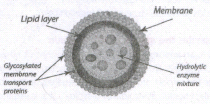
Functions:
1. Intracellular digestion: They digestcarbohydrates, proteins and Iipids present in ytoplasm.
2. Autophagy: During adverse conditionthey digest their own cell organelles like mitochondria and endoplasmic reticulum.
3. Autolysis: Lysosome causes selfdestruction of cell on insight of diseasethey destroy the cells.
4. Ageing: Lysosomes have autolyticenzymes that disrupts intracellularmolecules.
5.Phagocytosis: Large cells or contentsare engulfed and digested by macrophages, thus forming a phagosome in cytoplasm. These phagosome fusewith lysosome for further digestion.
6. Exocytosis: Lysosomes release theirenzvmes outerside the cell to digestother cells.
15.
Jonathan Singer and Garth Nicolson (1972) proposed fluid mosaic model. It is made up of lipids and proteins together with a little amount of carbohydrate. The lipid membrane is made up of phospholipid. The phospholipid molecule has a hydrophobic tail and hydrophilic head. The hydrophobic tail repels water and hydrophilic head . attracts water. The proteins of the membrane are globular proteins which are found intermingled between the lipid bilayer most of which are projecting beyond the lipid bilayer. These proteins are called as integral proteins. Few are superficially attached on either surface of the lipid bilayer which are called as peripheral proteins. The proteins are involved in transport of molecules across the membranes and also act as enzymes, receptors (or) antigens. The Carbohydrate molecules of cell membrane are short chain polysaccharides. These are either bound with 'glycoproteins' or 'glycolipids' and form a 'glyoca- Iyx'). The movement of membrane lipids from one side of the membrane to the other side by vertical movement .s called flip flopping or flip flop movement. This movement takes place more slowly than lateral diffusion of lipid molecule. The phospholipids can have flip flop movement because the phospholipids have smaller polar regions, whereas the proteins cannot flip flop because the polar region is extensive.
16.
| Feature | B-DNA | A-DNA | Z-DNA |
|---|---|---|---|
| Type of helix | Right-handed | Right-handed | Left-handed |
| Helical diameter (nm) | 2.37 | 2.55 | 1.84 |
| Rise per base pair (nm) | 0.34 | 0.29 | 0.37 |
| Distance per complete turn (pitch) (nm) | 3.4 | 3.2 | 4.5 |
| Number of base pairs per complete turn | 10 | 11 | 12 |
| Topology of major groove | Wide, deep | Narrow, deep | Flat |
| Topology of minor groove | Narrow, shallow | Broad, shallow | Narrow, deep |
17.
Enzymes are globular proteins that catalyse the many thousands of metabolic reactions taking place within cells and organism. The molecules involved in such reactions are metabolites. Metabolism consists of chains and cycles
of enzyme-catalysed reactions, such as respiration, photosynthesis, protein synthesis and other pathways.
These reactions are classified as
anabolic (building up of organic molecules). Synthesis of proteins from amino acids and synthesis of polysaccharides from simple sugars are examples of anabolic reactions.
catabolic (breaking down of larger molecules). Digestion of complex foods and the breaking down of sugar in respiration are examples of catabolic reactions. Enzymes can be extracellular enzyme as secreted and work externally exported from cells. Eg. digestive enzymes; or intracellular enzymes that remain within cells and work there. These are found inside organelles or within cells. Eg. insulin
18.
19.
Some bryophytes are called liverworts because their gametophyte resembles with lobes of the liver.
20.
1. In gymnosperms, pollination is carried out only by wind.
2. Flowers in angiosperms have showy petals, nectaries, scent glands and several other devices to attract the insects, birds and other animals including man to help them to get pollinated.
21.
Vegetative Characters:
1. Habit: Perennial herb with bulb.
2. Root: Fibrous adventitious root system.
3. Stem: Underground bulb.
4. Leaf: A cluster of radical leaves emerges from the underground bulb, cylindrical and fleshy having sheathy leaf bases with parallel venation.
Floral Characters:
1. Inflorescence: Scapigerous, i.e. the inflorescence axis (peduncle) arising from the ground bearing a cluster of flowers at its apex. Pedicels are of equal length, arising from the apex of the peduncle, which brings all flowers at the same level.
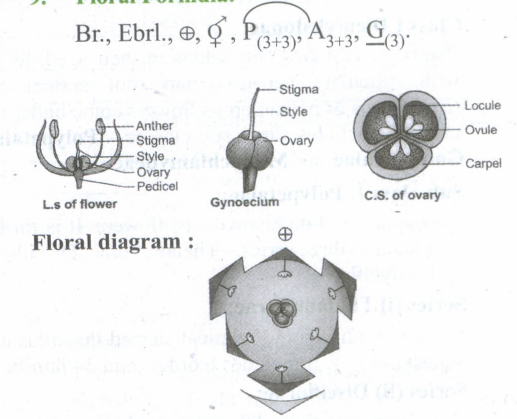
2. Flower: Small, white, bracteate, ebracteolate, pedicellate, complete, trimerous, actinomorphic and hypogynous. Flowers are protandrous.
3. Perianth: Tepals 6, white, arranged in two whorls of three each, syntepalous showing valvate aestivation.
4. Androecium: Stamens 6, arranged in two whorls of three each, epiphyllous, valvate aestivation and opposite to tepals. Anthers dithecous, basifixed, introse, and dehiscing longitudinally.
5. Gynoecium: Tricarpellary and syncarpous. Ovary superior, trilocular with two ovules in each locule on axile placentation. Style simple, slender with simple stigma.
6. Fruit: A loculicidal capsule.
7. Seed: Endospermous.
8. Floral Formula:
22.
| Economic importance | Binomial | Useful part | Uses |
| Pulses | Cajanus cajan (Pigeon Pea) Phaseolus vulgaris (French bean) |
Seeds | Sources of protein and starch of our food |
| Food plants | Sesbania grandiflora (agathi, vegetable humming bird) Cyamopsis tetragonoloba (cluster bean) |
Leaves Tender fruits |
Greens Vegetable |
| Oil Plants | Arachis hypogaea (Ground nut) Pongamia pinnata (Pungam) |
Seeds Seeds |
Oil extracted from the seeds is edible and used for cooking. |
| Timber Plants | Dalbergia latifolia (rose wood) Pterocarpus santalinus (red sandalwood) |
Timber | Timber is used for making furniture, cabinet articles and as building materials. |
| Medicinal Plants | Crotalaria albida Mucuna pruriens |
Roots Seeds |
Used as purgative Neurological remedy |
| Fibre Plants | Crotalaria juncea (sunhemp), Sesbania aegyptiaca (sesban) | Stem fibres (Bast) | Used for making ropes |
| Dye Plants | Indigofera tinctoria (Avuri) | Leaves | Indigo dye obtained from leaves is used to colour printing and in paints. Blue dye is obtained. |
| Green Manuring | Indigofera tinctoria Tephrosea purpurea Gliricidia sepium |
Entire plant | Used as green manure because of the presence of nitrogen fixing bacteria in the lateral roots. |
| Ornamental Plants | Butea frondosa (Flame of the forest), Clitoria ternatea, Lathyrus odoratus (Sweet pea) and Lupinus hirsutus (Lupin) |
Entire plant | Grown as ornamental plants |
23.
Uses of Herbarium:
1. Herbarium provides resource material for systematic research and studies.
2. It is a place for orderly arrangement of voucher specimens.
3. Voucher specimen serves as a reference for comparing doubtful newly collected fresh specimens.
4. Voucher specimens play a role in studies like floristic diversity, environmental assessment, ecological mechanisms and survey of unexplored areas.
5. Herbarium provides opportunity for documenting biodiversity and studies related to the field of ecology and conservation biology.
24.
Asexual reproduction in Fungi:
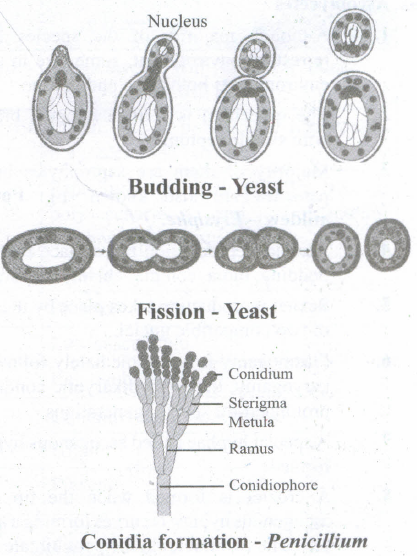
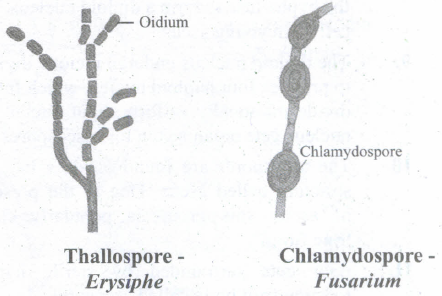
1. Zoospores : They are flagellate structures produced in zoosporangia. Eg : Chytrids.
2. Conidia : The spores produced on conidiophores. Eg: Aspergillus.
3. Oidia/Thallospores : The hypha divides and develop into spores called oidia. Eg : Erysiphe.
4. Fission : The vegetative cell divides into 2 daughter cells. Eg: Schizosaccharomyces- Yeast.
5. Budding: A small outgrowth is developed on parent cell, which gets detached and becomes independent. Eg: Saccharomyces - Yeast.
6. Chlamydospore: Thick walled resting spores are called chlamydospores Eg: Fusarium.
25.
General characteristic features of Bacteria :
1. They are prokaryotic organisms and lack nuclear membrane and membrane-bound organelles.
2. The genetic material is called nucleoid or genophore or incipient nucleus.
3. The cell wall is made up of polysaccharides and proteins.
4. Most of them lack chlorophyll, hence they are heterotrophic but some are autotrophic and possess Bacteriochlorophyll.
5. They reproduce vegetatively by fission and endospore formation.
6. They exhibit variations which are due to genetic recombination and are achieved through conjugation, transformation and transduction.
7. The shape and flagellation of the bacteria varies in different types of bacteria

11th Standard Syllabus & Materials
11th Standard
TN 11th Tamil பீடு பெற நில் - செய்யுள் - காவடிச்சிந்து Important Questions And Answers Study Material - QB365 Set A
NEW11th Standard
TN 11th Tamil பீடு பெற நில் - உரைநடை - மலை இடப்பெயர்கள் : ஓர் ஆய்வு Important Questions And Answers Study Material - QB365 Set A
NEW11th Standard
TN 11th Tamil மாமழை போற்றுதும் - துணைப்பாடம் - யானை டாக்டர் Important Questions And Answers Study Material - QB365 Set A
NEW11th Standard
TN 11th Tamil மாமழை போற்றுதும் - செய்யுள் - ஐங்குறுநூறு Important Questions And Answers Study Material - QB365 Set A



Tamilnadu Stateboard 11th Standard Subjects

Maths

Commerce

Economics
Biology

Business Maths and Statistics

Accountancy

Computer Science

Physics

Chemistry
Maths
Biology
Economics
Physics
Chemistry

History
Business Maths and Statistics

Computer Science
Accountancy

Computer Applications
History
Computer Technology
Commerce
Computer Applications
Computer Technology

Tamil

English

French
Tamilnadu Stateboard Standards



