
 100% FREE ACCESS
11th Standard Syllabus & Materials
11th Standard
TN 11th Tamil இயற்கை வேளாண்மை,சுற்றுச்சூழல் -செய்யுள் - மனோன்மணீயம் Important Questions And Answers Study Material - QB365 Set A
NEW11th Standard
TN 11th Tamil என்னுயிர் என்பேன் -துணைப்பாடம் - இசைத்தமிழர் இருவர் Important Questions And Answers Study Material - QB365 Set A
NEW11th Standard
TN 11th Tamil மொழி கலை -செய்யுள் - ஒவ்வொரு புல்லையும் Important Questions And Answers Study Material - QB365 Set A
NEW11th Standard
TN 11th Tamil பீடு பெற நில் - இலக்கணம் - பகுபத உறுப்புகள் Important Questions And Answers Study Material - QB365 Set A
NEW11th Standard
TN 11th Tamil பீடு பெற நில் - துணைப்பாடம் - வாடிவாசல் Important Questions And Answers Study Material - QB365 Set A
NEW11th Standard
TN 11th Tamil பீடு பெற நில் - செய்யுள் - குறுந்தொகை Important Questions And Answers Study Material - QB365 Set A

Published on: 28/06/2021
QB365 provides detailed and simple solution for every Creative Questions in class 11 Biology Subject. It will helps to get more idea about question pattern in every Creative questions with solution.
Download Tamil Nadu 11th Standard Biology question papers, model tests, one-mark questions, important questions, and public exam papers in PDF format. Free study materials and answer keys for TN State Board students.
Questions + Answers key
Take MCQ Biology Test1.
What is chemical warfare?
2.
Will a defoliated plant respond to photoperiodic cycle? Give reasons.
3.
Explain the physiological effects of ABA.
4.
Explain 'senescence'.
5.
Write a note an ethylene.
6.
Explain terminal oxidation' in Respiration / Chemiosmotic theory.
7.
Explain Munch Mass flow, hypothesis and its applications to plants
8.
List the differences between Sap wood and Heart wood?
9.
10.
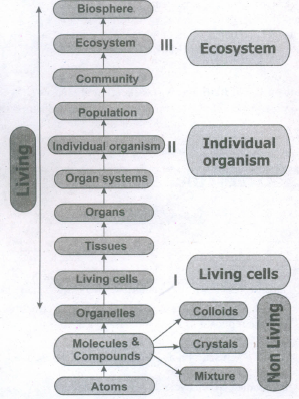
Draw a flow chart representing the various levels of organisation and integration in living organisms.
11.
Point out the characters of Early angiosperm according to APG Classification.
12.
Compare the location, cellular types and the functions of different zones of root.
13.
List out the features common for both Gymnosperms & Angiosperms.
14.
Describe the salient features of Chlorophyceae members.
15.
Write the significance G1 phase.
16.
Describe the Mixed inflorescence.
17.
Write a short note on Leaf symmetry.
18.
Difference between plant and animal cells.
19.
Describe the Electron Microscope.
20.
Describe the method of preparation of herbarium specimen
21.
Discuss the role of bacteria in soil fertility.
22.
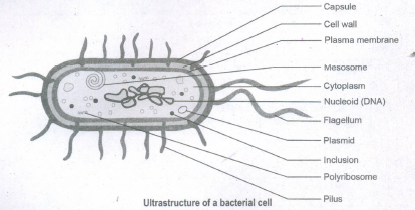
Describe the Respiration life processes in Bacteria.
23.
Write a note on Basidiomycetes.
24.
Describe a papilionaceous corolla.
25.
Describe the Fine Structure of a cell wall.
1.
Chemical warfare (CW) involves using the toxic properties of chemical substances as weapons. This type of warfare is distinct from nuclear warfare, biological warfare and radiological warfare, which together make up CBRN, the military acronym for chemical, biological, radiological, and nuclear (warfare or weapons), all of which are considered "weapons of mass destruction" (WMDS), a term that contrasts with conventional weapons.
2.
No. a defoliated plant will not respond to photoperiodic cycle because the hormonal substance responsible for flowering is found in the leaves of the plant.
3.
ABA - Abscisic acid is a phytohormone
Physiological effects:
1) It helps in reducing transpiration rate by closii stomata. It inhibits K+ uptake by guard cells and promotes the leakage of malic acid. It results in closure of stomata.
2) It spoils chlorophylls, proteins and nucleic acids of leaves making them yellow.
3) Inhibition of cell division and cell elongation,
4) ABA is a powerful growth inhibitor. It causes 50% inhibition of growth in Oat coleoptile.
5) It induces bud and seed dormancy.
6) It promotes the abscission of leaves, flowers and fruits by forming abscission layers.
7) ABA plays an important role in plants during water stress and during drought conditions. It results in loss of turgor and closure of stomata.
8) It has anti-auxin and anti-gibberellin property.
9) Abscisic acid promotes senescence in leaves by causing loss of chlorophyll pigment decreasing the rate of photosynthesis and changing the rate of proteins and nucleic acid synthesis.
4.
old age is called" senescence 'in plants, senescence refers to all col1ective, progressive and deteriorative processes which ultimately lead to complete loss of organization and 'function.'
Four types of senescence:
I) Overall senescence
2) Top senescence
3) Deciduous senescence ,
4) Progressive senescence
Overall senescencer This kind of senescence occurs in annual plants when entire plant get 'affected and dies . Eg: Wheat and Soybean. It also occurs in few perennials also'. Eg: Agave and Bamboo.
Top senescence: It occurs in aerial parts of plants. It 'is common in perennials, underground and root system remains viable. Eg: Banana and Gladiolus.
Deciduous senescence: It is common in deciduous plants and occurs only in leaves of plants, bulk of the stein and root system remains alive. Eg: Elm and Maple.
Progressive senescence: This kind of senescence is gradual. First it occurs in old leaves followed by new leaves then stem and' finally root system. It is common in annuals.
Physiology of Senescence:
1) Cells undergo changes in structure.
2) Vacuole of the cell acts as lysosome and secretes hydrolytic enzymes.
3) The starch content is decreased in the cells.
4) Photosynthesis is reduced due to loss of chlorophyll accompanied by synthesis and accumulation of anthocyanin pigments therefore the leaf becomes red .
5) There is a marked decrease in protein content in the senescing organ.
6) RNA content of the leaf particularly rRNAlevel is decreased in the cells due to increased activity of the enzyme RNA ase.
7) DNA molecules in senescencing leaves degenerate by the increased activity of enzyme DNA ase.
Factors affecting Senescence:
1) ABA and ethylene accelerate senescence while auxin and cytokinin retard senescence.
2) Nitrogen deficiency increases . senescence whereas nitrogen supply retards senescence.
3) High temperature. accelerates senescence but low temperature retards senescence.'
4) Senescence is rapid in dark'than iti light.
5) Water stress 'leads to accumulation of ABA leading to senescence.
Programned cell death:
Senescence is controlled by plants own genetic programme. Death of the plant or plant part consequent to senescence is called programmed cell Death. In short senescence of an individual cell is called PCD.
5.
Almost all plant tissues produce ethylene gas In minute quantities.
Discovery:
(i) In 1924, Denny found that ethylene stimulates the ripening of lemons.
(ii) Cocken et al identified ethylene as a natural plant hormone.
Occurrence: Maximum synthesis occurs during climacteric ripening of fruits and tissues undergoing senescence.
Precursor: It is a derivative of amino acid methionine, linolenic acid and fumaric acid.
Physiological Effects:
i) Ethylene stimulates respiration and ripening in fruits.
ii) It stimulates radial growth in stem and root and inhibits linear growth.
iii) It breaks the dormancy of buds, seeds and : storage organs.
iv) It stimulates formation of abscission zone : in leaves, flowers and fruits. This makes the leaves to shed prematurely.
v) Inhibition of stem elongation (shortening the: internode).
vi) In low concentration, ethylene helps in root : initiation.
vii) Growth of lateral roots and root hairs. This I increases the absorption surface of the plant : roots.
viii) The growth of fruits is stimulated by ethylene in some plants. It is more marked in climacteric : fruits.
ix) Ethylene causes epinasty.
Agricultural role:
i) Ethylene normally reduces flowering in plants except in Pine apple and Mango.
ii) It increases the number of female flowers and decreases the number of male flowers.
iii) Ethylene spray in cucumber crop produces female flowers and increases the yield.
6.
1) During glycolysis, link reaction and Krebs cycle the respiratory substrates are oxidised at several : steps and as a result many reduced coenzymes : NADH+ H+ and FADH2 are produced.
2) These reduced coenzymes are transported to inner membrane of mitochondria which are converted back to their oxidised forms produce electrons and protons.
3) In mitochondria, the inner membrane is folded in the form of finger projections towards the matrix called cristae. In cristae many oxysomes (F1 particles) are present which have electron transport carriers are present. According to Peter Mitchell's Chemiosmotic theory this I electron transport is coupled to ATP synthesis. : Electron and hydrogentproton) transport takes I place across four multiprotein complexes(I-IV).They are
1. Complex-I (NADH dehydrogenase):
i) It contains a flavoprotein(FMN) and I associated with non-heme iron Sulphur protein (Fe-S). This complex is responsible: for passing electrons and protons from : mitochondrial NADH (Internal) to Ubiquinone(UQ).
NADH + H+ + UQ⇌NAD+ + UQH2
ii) In plants, an additional NADH dehydrogenase (External) complex is present on the outer surface of inner membrane of mitochondria which can oxidise cytosolic NADH + H+.
2. Complex-Il (Succinic dehydrogenase) i) It contains FAD flavoprotein is associated with non-heme iron Sulphur (Fe-S) protein. ii) This complex receives electrons and protons from succinate in Krebs cycle and is converted into fumarate and passes to ubiquinone.
Succinate + UQ⟶ Fumarate + UQH2
3. Complex-Ill (C) tochrome bCI complex) This complex oxidises reduced ubiquinone (ubiquinol) and transfers the electrons through Cytochrome bc, Complex (Iron Sulphur center bCI complex) to cytochrome c.
UQH2+2Cyt coxidised⇌UQ+2Cyt creduced+2H+
4. Complex IV (Cytochrome c oxidase) i) This complex contains two copper centers (A and B) and cytochromes a and a3. Complex IV is the terminal oxidase and brings about the reduction of 1/2 O2 to H2O. Two protons are needed to form a molecule of H2O (terminal oxidation).
2Cyt coxidised+2H++1/2O2⇌2Cyt creduced+H2O
ii) The transfer of electrons from reduced coenzyme NADH to oxygen via complexes I to IV is coupled to the synthesis of ATP from ADP and inorganic phosphate (Pi) which is called Oxidative phosphorylation. This occurs during Aerobic respiration Fof, - ATP synthase (also called complex V) consists of F0 and F1. F1 converts ADP and Pi to ATP and is attached to the matrix side of the inner membrane. F0 is present in inner membrane and acts as a channel through which protons come into matrix.
a) Oxidation of one molecule of NADH + H+ = 3 molecules of ATP
b) oxidation of one molecule of FADH2 = 2 molecules of ATP
iii) But the Mechanism of mitochondrial ATP synthesis is based on Chemiosmotic hypothesis. According to this theory electron carriers present in the inner mitochondrial membrane allow for the transfer of protons (H+).
iv) For the production of single ATP, 3 protons (H+) are needed. The terminal oxidation of external NADH bypasses the first phosphorylation site and hence only two ATP molecules are produced per external NADH oxidised through mitochondrial electron transport chain. Complete oxidation of a glucose molecule in aerobic respiration results in the net gain of 36 ATP molecules in plants.
7.
Munch Mass Flow hypothesis:
(i) The mass flow theory was first proposed by Munch (1930) and elaborated by Crafts (1938).
(ii) According to this hypothesis, organic substances or solute move from the region of high osmotic pressure (from mesophyll) to the region of low osmotic pressure along the turgor pressure gradient.
(iii) The principle involved in this hypothesis can be explained by a simple physical system as shown Two chambers "A" and "B" made up of semipermeable membranes are connected by tube "T" interested in a reservoir of water. Chamber "A" contains highly concentrated sugar solution while chamber "B" contains dilute sugar solution. The following changes were observed in the system,
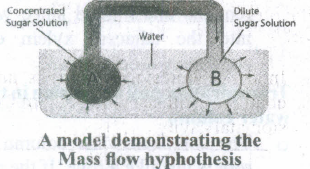
(a) The high concentration sugar solution of chamber "A" is in a hypertonic state which draws water from there servoir by endosmosis.
(b) Due to the continuous entry of water into chamber "A", turgor pressure is increased.
(c) Increase in turgor pressure in chamber "A" force,the mass flow of sugar solution to chamber "B" through the tube "T" along turgor pressure gradient.
(d) The movement of solute will continue till the solution in both the chambers attains the state of isotonic condition and the system becomes inactive.
(e) However, if a new sugar solution is added in chamber "A", the system will start to run again
A similar analogous system as given ID the experiment exists in plants:
i) Chamber "A" is analogous to mesophyll cells of the leaves which contain a higher concentration of food material insoluble form. In short "A" is the production point called "source".
ii) Chamber,"B" is analogous to cells of stem and roots where the food material is utilized. In short "B" is the consumption end called "sink".
iii) Tube "T" is analogous to the sieve tube of phloem.
iv) Mesophyll cells draw water from the xylem (reservoir of the experiment) of the leaf by endosmosis leading to an increase in the turgor pressure of mesophyll cells.
v) The turgor pressure in the cells of stem and the roots are comparatively low and hence, the soluble organic solutes begin to flow en masse from mesophyll through the phloem to the cells of stem and roots along with the gradient turgor pressure.
vi) In the cells of stem and roots, the organic solutes are either consumed or converted into insoluble form and the excess water is released into xylem (by turgor pressure gradient) through cambium.
8.
| SapWood (Alburnum) | Heart wood (Duramen) | |
| 1. | Living part of the wood. | Dead part of the wood. |
| 2. | It is situated on the outer side of wood | It is situated in the centre part of wood |
| 3. | It is less dark in colour | It is dark in colour |
| 4. | Very soft in nature | Hard in nature |
| 5. | Tyloses are absent | Tyloses are present |
| 6. | It is not durable and not resistant to microorganisms | It is more durable and resists microorganisms |
9.
10.
11.
1. Seeds always with two cotyledons.
2. Presence of ethereal oils.
3. Leaves are always simple net-veined
4. Each floral whorls with many parts
5. Perianth usually spirally arranged or parts in threes
6, Stamens with broad filaments
7. Anthers tetrasporangiate
8. Pollen mono sulcate
9. Nectaries are rare
10. Carpels usually free and
11. Embryo very small
12.
| S.No | Feature | Meristematic Zone | Zone of elongation | Zone of maturation |
| 1 | Position | It lies just above the root cap | It lies just above the meristematic zone | It lies above the zone of elongation. |
| 2 | Types of cells | Meristematic cells, actively divide and continuously increase a number |
Elongated cells | Mature differentiated cells |
| 3 | Functions | This is the main growing tip of the root | The cells increase the length and cause enlargement of the root. | The cells differentiate into various tissues like epidermis, cortex and vascular bundles. It also produces root hairs which absorb water and minerals from the soil |
13.
Gymnosperms resemble with angiosperms in the following features
(i) Presence of well organised plant body which is differentiated into roots, stem and leaves
(ii) Polyembryony (presence of many embryo). The naked ovule develops into seed. The endosperm is haploid and develop before fertilization:
(iii) The life cycle shows alternation of generation. The sporophytic phase is dominant and gametophytic phase is highly reduced.
(iv) Presence of cambium in gymnosperms as in dicotyledons.
(v) Flowers in Gnetum resemble to the angiosperm male flower. The Zygote represent the first cell of sporophyte.
(vi) Presence of integument around the ovule
(vii) Both plant groups produce seeds.
(viii) Pollen tube helps in the transfer of male nucleus in both.
(ix) Presence of Eustele.
14.
1. Chlorophyceae commonly called as green algae.
2. Mostly aquatic (fresh water or marine), few terrestrial.
3. Shape of chloroplast differs. It may be cup shaped (Chlamydomonas) or girdle-shaped or reticulate, or stellate etc.
4. Chlorophyll 'a' and 'b' are photosynthetic pigments.
5. Pyrenoids store starch & also proteins.
6. Outer cell wall is made of pectin and inner is cellulose.
7. Vegetative reproduction is by fragmentation.
8. Asexual reproduction by zoospores, aplanospores and akinetes.
9. Sexual reproduction may be isogamous, anisogamous or oogamous.
e.g., Chlamydomonas, Volvox and Spirogyra
15.
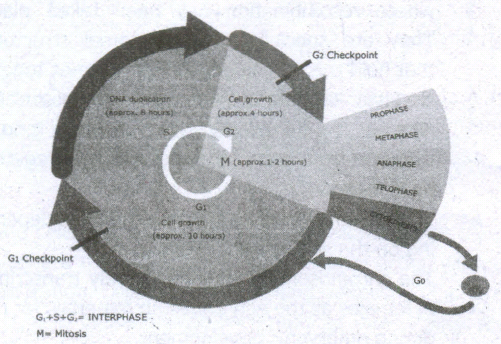
The first gap phase - 2C amount of DNA in cells of G1. The cells become metabolically active and grows by producing proteins, lipids, carbohydrates and cell organelles including mitochondria and endoplasmic reticulum. Many checkpoints control the cell cycle. The checkpoint called the restriction point at the end of G1, determines a cells fate whether it will continue in the cell cycle and divide or enter a stage called Go as a quiescent stage and probably as specified cell or die. Cells are arrested in G1 due to:
(i) Nutrient deprivation
(ii) Lack of qrowth factors or density dependant inhibition.
(iii) Undergo metabolic changes and enter into Go state.
Biochemicals inside cells activates the cell division. The proteins called kinases and cydlns activate genes and their proteins to perform cell division. Cyclins act as major checkpoint which operates in Gl to determine whether or not a cell divides.
16.
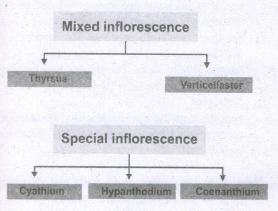
Inflorescences in which both racemose and cymose patterns of development occur in a mixed manner. It is of the following two types.
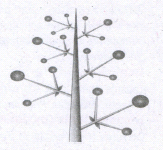
Thyrsus:
It is a 'Raceme of cymes'. Indefinite central axis bears lateral pedicellate cymes, (simple or compound. dichasia). Example: Ocimum, Anisomelus.
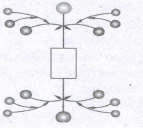
Verticil or Verticillaster:
Main axis bears two opposite lateral sessile cymes at the axil of. the node each of it produces monochasial scorpioid lateral branches so that flowers are crowded around the node. Example: Leonetis, Leucas.
17.
Dorsiventral leaf
When the leaf is flat, with the blade placed horizontally, showing a distinct upper surface and a lower surface, as in most dicotyledons, it is said to be dorsiventral. Example: Tridax .
Isobilateral leaf
When the leaf is directed vertically upwards, as in many monocotyledons, it IS said to be isobilateral leaf. Example: Grass.
Centric leaf
When the leaf. is more or less cylindrical and directed upwards or downwards, as in pine, onion, etc, the leaf is said to be centric.
Heterophylly
i) Occurrence of two different kinds of leaves in the same plant is called heterophylly. Heterophylly is found in many aquatic plants.
ii) Here, the floating or aerial leaves' and the submerged leaves are of different kinds.
iii) The former are generally broad, often fully expanded, and undivided or merely lobed, while the latter are narrow, ribbon-shaped, linear or much dissected.
iv) Heterophylly in water plants is, thus, an adaptation to two different conditions of the environment. Example: water crowfoot (Ranunculus aquatilis), water plantain (Alisma plantago), arrowhead (Sagittaria), Limnophila heterophylla.
v) Terrestrial (land) plants also exhibit this phenomenon. Among them Sterculia villosa, jack (in early stages), Ficus heterophylla show leaves varying from entire to variously lobed structures during different developmental stages.
vi) Young leaves are usually lobed or dissected and the mature leaves are entire. Such type is known as developmental heterophylly .
Example: Eucalyptus, Artocarpus heterophyllus.
18.
| S. No | Plant cell | Animal Cell |
| 1 | Usually they are larger than animal cells | Usually smaller than plant cells |
| 2 | Cell wall present in addition to plasma membrane and consists of middle lamellae, primary and secondary walls |
Cell wall absent |
| 3 | Plasmodesmata present | Plasmodesmata absent |
| 4 | Chloroplast present | Chloroplast absent |
| 5 | Vacuole large and permanent | Vacuole small and temporary |
| 6 | Tonoplast present around vacuole | Tonoplast absent |
| 7 | Centrioles absent except motile cells of lower plants |
Centrioles present |
| 8 | Nucleus present along the periphery of the cell |
Nucleus at the centre of the cell |
| 9 | Lysosomes are rare | Lysosomes present |
| 10 | Synthesis amino acids, coenzymes and vitamins required by them | Cannot synthesis aminoacids, coenzymes and vitamins required by them |
| 11 | Storage material is starch grains | Storage material is a glycogen granules |
19.
Electron Microscope was first introduced by Ernest Ruska (1931) and developed by G Binning and H Roher (1981). It is used to analyse the fine details of the cell, and organelles called ultra structure. It uses beam of accelerated electrons as source of illumination and therefore the resolving power is 1,00,000 times than that of light microscope. The specimen to be viewed under electron microscope is dehydrated and impregnated with electron opaque chemicals like gold or palladium. This is essential for with standing electrons and also for ontrast of the image. There are two kinds of electron microscopes namely
1. Transmission Electron Microscope (TEM)
2. Scanninq Electron Microscope (SEM)
1. Transmission electron microscope:
This is the most commonly used electron microscope which provides two dimensional image. The components of the microscope are as follows:
a. Electron Generating System
b. Electron Condensor
c. Specimen Objective
d. Tub Lens
e. Projector
A beam of electron passes through the specimen to form an image on fluorescent screen. The magnification is 1:-3 lakhs times and resolving power is 2-10 A. It is used for studying detailed structrue of viruses, mycoplasma, cellular organelles, etc
20.
(i) Plant Collection: Plant specimen with flower or fruit is collected.
(ii) Documentation of field site data: Certain data are to be recorded at the time of plant collection. It includes date, time, country, state, city, specific locality information, latitude, longitude, elevation and land mark information. These data will be typed onto a herbarium label.
(iii) Preparation of plant specimen: Plant specimen collected from the field is pressed immediately with the help of portable field plant press. Plant specimen is transferred to a standard plant press (12" x 18") which between two outer 12" x 18" frames and secured by two straps.
(iv) Mounting herbarium specimen: The standard size of herbarium sheet is used for mounting the specimen (29cm x 41cm). specimens are affixed to herbarium sheet with standard white glue or solution of Methylcellulose.
(v) Herbarium label: Herbarium label size is generally 4-5" wide and 2-3" tall. A typical label contains all information like habit, habitat, vegetation type, land mark information, latitude, longitude, image document, collection number, date of collection and name of the collector.
(vi) Protection of herbarium sheets against mold and insects: Application of 2% Mercuric chloride, Naphthalene, DDT, carbon disulphide. Fumigation using formaldehyde. Presently deep freezing(-20°C) method is followed throughout the world.
21.
Soil fertility :
1. The Ammonifying bacteria like Bacillus ramosus and Bacillus mycoides convert complex proteins in the dead bodies of plants and animals into ammonia which is later converted into ammonium salt.
2. The Nitrifying bacteria such as Nitrobacter, Nitrosomonas convert ammonium salts into nitrites and nitrates.
3. Nitrogen fixing bacterial such as Azotobacter, Clostridium and Rhizobium (a symbiotic bacterium) are capable of Converting atmospheric nitrogen into organic nitrogen.
4. The nitrogenous compounds are also oxidized to nitrogen. All these activities of bacteria increase soil fertility.
22.
Respiration:
Two types of respiration is found in Bacteria. They are
1. Aerobic respiration
2. Anaerobic respiration
1. Aerobic respiration:
These bacteria require oxygen as terminal acceptor and will not grow under anaerobic conditions (i.e. in the absence of O2)
Eg: Streptococcus
Obligate aerobes :
Some Micrococcus species are obligate aerobes (i.e. they must have oxygen to survive).
2. Anaerobic respiration:
These bacteria do not use oxygen for growth and metabolism but obtain their energy from fermentation reactions. Eg : Clostridium
a) Facultative anaerobes:
(i) There are bacteria that can grow either using oxygen as a terminal electron acceptor or anaerobically using fermentation reaction to obtain energy.
(ii) Facultative anaerobes are often termed "aerobes".
(iii) When a facultative anaerobes such as E. coli is present at a site of infection like an abdominal abscess, it can rapidly consume all available O2 and change to anaerobic metabolism producing an anaerobic environment and thus allow the anaerobic bacteria that are present to grow and cause disease.
Eg: Escherichia coli and Salmonella.
b) Capnophilic Bacteria:
(i) Bacteria which require CO2 for their growth are called as capnophilic bacteria.
(ii) Eg : Campylobacter
23.
1. Basidiomycetes include Puff balls, toadstools, Bird nest's fungi, Bracket fungi, stinkhorns, Rusts and Smuts.
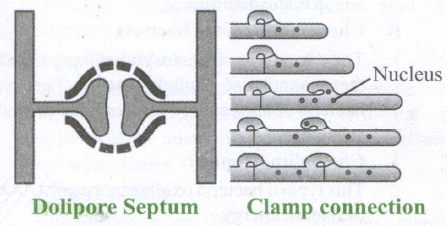
2. The members are terrestrial and lead a saprophytic and parasitic mode of life.
3. The mycelium is well developed, septate with dolipore septum (bracket like). Three types of mycelium, namely Primary, Secondary and Tertiary are found.
4. Clamp connections are formed to maintain dikaryotic condition.
5. Asexual reproduction is by means of conidia, oidia or budding.
6. Sexual reproduction is present but sex organs are absent. Somatogamy or spermatisation results in plasmogamy.
7. Karyogamy is delayed and dikaryotic phase is prolonged. Karyogamy takes place in basidium and it is immediately followed by meiotic division.
8. The four nuclei thus formed are transformed into basidiospores which are borne on sterigmata outside the basidium (Exogenous).
9. The basidium is club shaped with four basidiospores. Thus this group of fungi is popularly called club fungi. The fruit body formed is called Basidiocarp.
24.
1. Petals 5, apopetalous, unequal and papilionaceous, vexillary or descendingly imbricate aestivation. All petals have a claw at the base.
2. The outermost petal is large called standard petal or vexillum. Lateral 2 petals are lanceolate and curved. They are called wing petals or alae.
3. Anterior two petals are partly fused and are called keel petals or carina which encloses the stamens and pistil. It is said to be butterfly shaped.
25.
Cell wall is the outermost protective cover of cell. It was first observed by Robert Hooke. In plants it is made up of cellulose, hemicellulose, pectin, lignin, cutin, suberin and silica. In a plant cell wall shows three distinct regions (a) Primary wall (b) Secondary wall (c) Middle lamellae
(a) Primary wall:
(i) It is the first layer inner to middle lamellae, primarily consisting of loose network of cellulose microfibrils in a gel matrix.
(ii) It is thin, elastic and extensible. In most plants the microfibrils are made up of cellulose oriented differently based on shape and thickness of the wall.
(iii) The matrix of the primary wall is composed of hemicellulose, pectin, glycoprotein and water.
(iv) Hemicellulose binds the microfibrils with matrix and glycoproteins control the orientation of microfibrils while pectin serves as filling material of the matrix.
(v) Cells such as parenchyma and meristems have only primary wall.
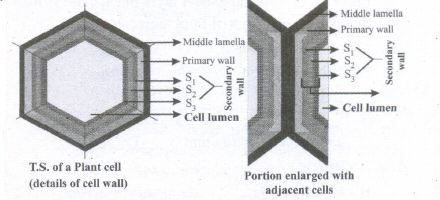
Plant Cell Wall
b. Secondary wall :
(i) Secondary wall is laid during maturation. It plays a key role in determining the shape of a cell. It is thick, inelastic and is made up of cellulose and lignin.
(ii) The secondary wall is divided into three sub layers termed as SI' S2 and S3 where the cellulose microfibrils are compactly arranged with different orientation forming a laminated structure and the cell wall strength is increased.
c. Middle lamellae:
(i) It is the outermost layer made up of calcium and magnesium pectate, deposited at the time of cytokinesis.
(ii) It is a thin amorphous layer which cements two adjacent cells. It is optically inactive (isotropic).
(iii) Plasmodesmata and Pits: Plasmodesmata act as a channel between the protoplasm of adjacent cells through which many substances pass through.
(iv) Moreover, at few regions the secondary wall layer is laid unevenly whereas the primary wall and middle lamellae are laid continuously such regions are called pits
(v) The pits of adjacent cells are opposite to each other. Each pit has a pit chamber and a pit membrane.
(vi) The pit membrane has many minute pores and thus they are permeable. The pits are of two types namely simple and bordered pit.

11th Standard Syllabus & Materials
11th Standard
TN 11th Tamil பீடு பெற நில் - செய்யுள் - காவடிச்சிந்து Important Questions And Answers Study Material - QB365 Set A
NEW11th Standard
TN 11th Tamil பீடு பெற நில் - உரைநடை - மலை இடப்பெயர்கள் : ஓர் ஆய்வு Important Questions And Answers Study Material - QB365 Set A
NEW11th Standard
TN 11th Tamil மாமழை போற்றுதும் - துணைப்பாடம் - யானை டாக்டர் Important Questions And Answers Study Material - QB365 Set A
NEW11th Standard
TN 11th Tamil மாமழை போற்றுதும் - செய்யுள் - ஐங்குறுநூறு Important Questions And Answers Study Material - QB365 Set A



Tamilnadu Stateboard 11th Standard Subjects

Maths

Commerce

Economics
Biology

Business Maths and Statistics

Accountancy

Computer Science

Physics

Chemistry
Maths
Biology
Economics
Physics
Chemistry

History
Business Maths and Statistics

Computer Science
Accountancy

Computer Applications
History
Computer Technology
Commerce
Computer Applications
Computer Technology

Tamil

English

French
Tamilnadu Stateboard Standards



