
 100% FREE ACCESS
11th Standard Syllabus & Materials
11th Standard
TN 11th Tamil இயற்கை வேளாண்மை,சுற்றுச்சூழல் -செய்யுள் - மனோன்மணீயம் Important Questions And Answers Study Material - QB365 Set A
NEW11th Standard
TN 11th Tamil என்னுயிர் என்பேன் -துணைப்பாடம் - இசைத்தமிழர் இருவர் Important Questions And Answers Study Material - QB365 Set A
NEW11th Standard
TN 11th Tamil மொழி கலை -செய்யுள் - ஒவ்வொரு புல்லையும் Important Questions And Answers Study Material - QB365 Set A
NEW11th Standard
TN 11th Tamil பீடு பெற நில் - இலக்கணம் - பகுபத உறுப்புகள் Important Questions And Answers Study Material - QB365 Set A
NEW11th Standard
TN 11th Tamil பீடு பெற நில் - துணைப்பாடம் - வாடிவாசல் Important Questions And Answers Study Material - QB365 Set A
NEW11th Standard
TN 11th Tamil பீடு பெற நில் - செய்யுள் - குறுந்தொகை Important Questions And Answers Study Material - QB365 Set A

Published on: 25/06/2021
QB365 provides detailed and simple solution for every Creative Questions in class 11 Biology Subject. It will helps to get more idea about question pattern in every Creative questions with solution.
Download Tamil Nadu 11th Standard Biology question papers, model tests, one-mark questions, important questions, and public exam papers in PDF format. Free study materials and answer keys for TN State Board students.
Questions + Answers key
Take MCQ Biology Test1.
Write down the salient features of cyanophyceae.
2.
Explain the different methods of asexual reproduction in fungi.
3.
Write down the general characteristic features of Bacteria.
4.
Explain Lysogenic cycle of a phage.
5.
Describe the structure of Tobacco Mosaic Virus.
1.
Salient features:
1. The members of this group are prokaryotes and lack motile reproductive structures.
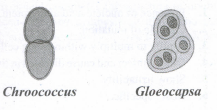
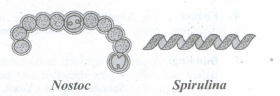
2. The thallus is unicellular in Chroococcus, colonial in Gloeocapsa and filamentous trichome in Nostoc.
3. The protoplasm is differentiated into a centroplasm and a chromatophore bearing chromoplasm.
4. The photosynthetic pigments include c-phycocyanin and c-phycoerythrin along with myxoxanthin and myxoxanthophyll.
5. The reserve food material is Cyanophycean starch.
6. They reproduce only through vegetative methods and produce Akinetes, Hormogones, Endospores, Nanocysts.
7. Sexual reproduction is absent.
2.
Asexual reproduction in Fungi:
1. Zoospores : They are flagellate structures produced in zoosporangia. Eg : Chytrids.
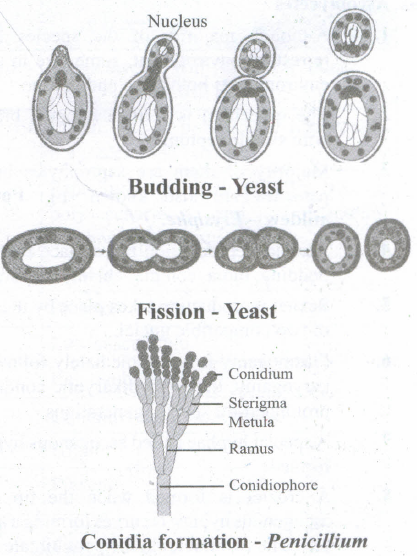
2. Conidia : The spores produced on conidiophores. Eg: Aspergillus.
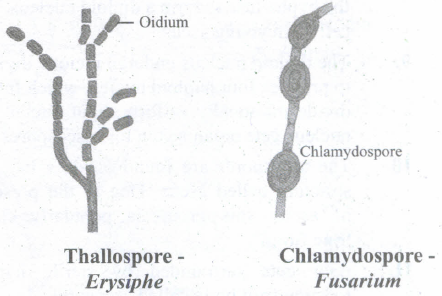
3. Oidia/Thallospores : The hypha divides and develop into spores called oidia. Eg : Erysiphe.
4. Fission : The vegetative cell divides into 2 daughter cells. Eg: Schizosaccharomyces- Yeast.
5. Budding: A small outgrowth is developed on parent cell, which gets detached and becomes independent. Eg: Saccharomyces - Yeast.
6. Chlamydospore: Thick walled resting spores are called chlamydospores Eg: Fusarium.
3.
General characteristic features of Bacteria :
1. They are prokaryotic organisms and lack nuclear membrane and membrane-bound organelles.
2. The genetic material is called nucleoid or genophore or incipient nucleus.
3. The cell wall is made up of polysaccharides and proteins.
4. Most of them lack chlorophyll, hence they are heterotrophic but some are autotrophic and possess Bacteriochlorophyll.
5. They reproduce vegetatively by fission and endospore formation.
6. They exhibit variations which are due to genetic recombination and are achieved through conjugation, transformation and transduction.
7. The shape and flagellation of the bacteria varies in different types of bacteria
4.
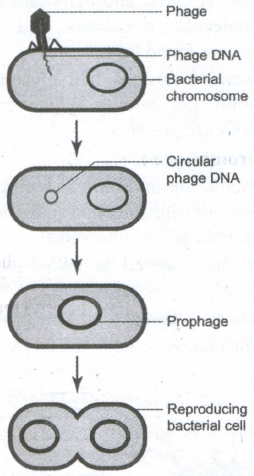
1. In the lysogenic cycle the phage DNA gets integrated into the DNA of the host cell and gets multiplied along with nucleic acid of the host. No independent viral particle is formed.
2. As soon as the phage injects its linear DNA into the host cell it becomes circular and integrates into the bacterial chromosome by recombination. The integrated phage DNA is now called prophage.
3. The activity of the prophage gene is repressed by two repressor proteins which are synthesized by phage genes. This checks the synthesis of new phages within the host cell.
4. However, each time the bacterial cell divides, the prophage multiplies along with the bacterial chromosome.
5. On exposure to UV radiation and chemicals the excision of phage DNA may occur and results in lytic cycle.
5.
Tobacco mosaic virus was discovered in 1892 by Dmitri Ivanovsky from Tobacco plant.
Structure of Tobacco mosaic virus:
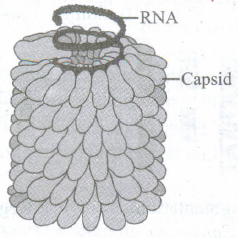
1. TMV is a rod-shaped helical virus measuring about 280 x 150\(\mu\)m with a molecular weight of 39 x 106 Daltons.
2. The virion is made up of two constituents, a protein coat called capsid and a core called nucleic acid.
3. The capsid is made up of approximately 2130 identical protein subunits called capsomeres.
4. The Nucleic acid consists of central single stranded RNA molecule.
5. The genetic information necessary for the formation of a complete TMV particle is contained in its RNA. It has 6,500 nucleotides.

11th Standard Syllabus & Materials
11th Standard
TN 11th Tamil பீடு பெற நில் - செய்யுள் - காவடிச்சிந்து Important Questions And Answers Study Material - QB365 Set A
NEW11th Standard
TN 11th Tamil பீடு பெற நில் - உரைநடை - மலை இடப்பெயர்கள் : ஓர் ஆய்வு Important Questions And Answers Study Material - QB365 Set A
NEW11th Standard
TN 11th Tamil மாமழை போற்றுதும் - துணைப்பாடம் - யானை டாக்டர் Important Questions And Answers Study Material - QB365 Set A
NEW11th Standard
TN 11th Tamil மாமழை போற்றுதும் - செய்யுள் - ஐங்குறுநூறு Important Questions And Answers Study Material - QB365 Set A



Tamilnadu Stateboard 11th Standard Subjects

Maths

Commerce

Economics
Biology

Business Maths and Statistics

Accountancy

Computer Science

Physics

Chemistry
Maths
Biology
Economics
Physics
Chemistry

History
Business Maths and Statistics

Computer Science
Accountancy

Computer Applications
History
Computer Technology
Commerce
Computer Applications
Computer Technology

Tamil

English

French
Tamilnadu Stateboard Standards



