
 100% FREE ACCESS
11th Standard Syllabus & Materials
11th Standard
TN 11th Tamil இயற்கை வேளாண்மை,சுற்றுச்சூழல் -செய்யுள் - மனோன்மணீயம் Important Questions And Answers Study Material - QB365 Set A
NEW11th Standard
TN 11th Tamil என்னுயிர் என்பேன் -துணைப்பாடம் - இசைத்தமிழர் இருவர் Important Questions And Answers Study Material - QB365 Set A
NEW11th Standard
TN 11th Tamil மொழி கலை -செய்யுள் - ஒவ்வொரு புல்லையும் Important Questions And Answers Study Material - QB365 Set A
NEW11th Standard
TN 11th Tamil பீடு பெற நில் - இலக்கணம் - பகுபத உறுப்புகள் Important Questions And Answers Study Material - QB365 Set A
NEW11th Standard
TN 11th Tamil பீடு பெற நில் - துணைப்பாடம் - வாடிவாசல் Important Questions And Answers Study Material - QB365 Set A
NEW11th Standard
TN 11th Tamil பீடு பெற நில் - செய்யுள் - குறுந்தொகை Important Questions And Answers Study Material - QB365 Set A

Published on: 25/06/2021
QB365 provides detailed and simple solution for every Creative Questions in class 11 Biology Subject. It will helps to get more idea about question pattern in every Creative questions with solution.
Download Tamil Nadu 11th Standard Biology question papers, model tests, one-mark questions, important questions, and public exam papers in PDF format. Free study materials and answer keys for TN State Board students.
Questions + Answers key
Take MCQ Biology Test1.
Describe the various steps in Gram's staining procedure.
2.
Write down the salient features of Ascomycetes.
3.
Explain the ultrastructure of bacterial cell.
4.
Tabulate the comparison of kingdoms in the Five Kingdom classification based on the criteria used.
5.
Give a concise account on virulent cycle / Explain Lytic cycle of a phage.
1.
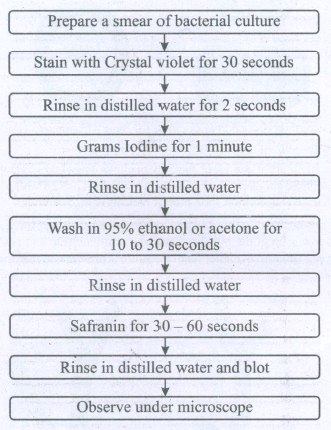
2.
Ascomycetes:
1. Although majority of the species live in terrestrial environment, some live in aquatic environments both fresh and marine.
2. The mycelium is well developed, branched with simple septa.
3. Majority of them are saprophytes but few parasites are also known. Eg: Powdery mildew - Erysiphe,
4. Asexual reproduction takes place by fission, budding, oidia, conidia, chlamydospore.
5. Sexual reproduction takes place by the fusion of two compatible nuclei.
6. Plasmogamy is not immediately followed by karyogamy. Instead a dikaryotic condition is prolonged for several generations.
7. A special hyphae called ascogenous hyphae is formed.
8. A crozier is formed when the tip of the ascogenous hyphae recurve forming a hooked cell. The two nuclei in the penultimate cell of the hypha fuse to form a diploid nucleus. This cell forms young ascus.
9. The diploid nucleus undergoes meiotic division to produce four haploid nuclei, which further divide mitotically to form eight nuclei. The nucleus gets organised into 8 ascospores.
10. The ascospores are found inside a bag like structure called ascus. Due to the presence of ascus, this group is popularly called 'Sac fungi'.
11. Asci get surrounded by sterile hyphae forming fruit body called ascocarp.
12. There are 4 types of ascocarps namely Cleistothecium (Completely closed), Perithecium (Flask shaped with ostiole), Apothecium (Cup shaped, open type) and Pseudothecium. Eg : Yeast, Cup Fungi.
3.
The bacterial cell reveals three layers
1. Capsule/Glycocalyx
2. Cell wall and
3. Cytoplasm
Capsule/Glycocalyx :
1. A thick layer of glycocalyx bound tightly to the cell wall is called capsule.
2. It protects cell from desiccation and antibodies.
3. It helps to retain the nutrients in bacterial cell.
Cell wall :
1. The bacterial cell wall is granular and is rigid. It provides protection and gives shape to the cell.
2. The chemical composition of cell wall is rather complex and is made up of Peptidoglycan or mucopeptide.
3. One of the most abundant polypeptide called porin is present and it helps in the diffusion of solutes.
Plasma membrane :
1. The plasma membrane is made up of lipoprotein.
2. It controls the entry and exit of small molecules and ions.
3. Respiratory chain and the photosystems used in photosynthesis are present in the plasma membrane.
Cytoplasm:
1. Cytoplasm is thick and semitransparent. The DNA molecule, ribosomes and other cell inclusions are found here.
2. Cytoplasmic inclusions like glycogen, poly-P hydroxybutyrate granules, sulphur granules and gas vesicles are present.
Bacterial chromosome:
1. The bacterial chromosome is a single circular DNA molecule, tightly coiled and is not enclosed in a membrane as in Eukaryotes.
2. This genetic material is called Nucleoid or Genophore.
3. The DNA is not bound to histone proteins.
4. The single chromosome or the DNA molecule is circular.
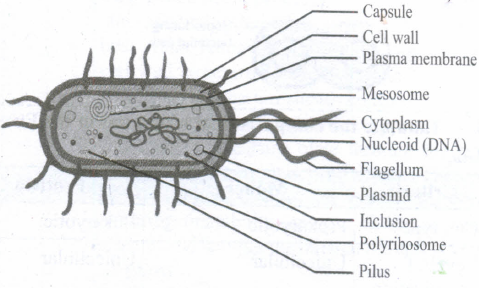
Ultrastructure of bacterial cell
Plasmid :
1. Plasmids are extra chromosomal double stranded, circular, self-replicating, autonomous elements. They contain genes for fertility, antibiotic resistance and heavy metals.
2. It also helps in the production of bacteriocins and toxins which are not found in bacterial chromosome. (The size of a plasmid varies from 1 to 500 kb).
3. Plasmids are classified into Different types based on the function.
4. Some of them are F(Fertility) factor, R (resistance) plasmids, Col(Colicin) plasmids, Ri(Root inducing) plasmids and Ti(Tumour inducing plasmids).
Mesosomes :
1. These are localized infoldings of plasma membrane into the cytoplasm in the form of vesicles, tubules and lamellae.
2. They are folded together to maximize their surface area and helps in respiration and in Binary fission
Polysomes:
The ribosomes are 70 S type. The ribosomes are held together by mRNA and form polyribosomes or polysomes and help in protein synthesis.
Flagella:
1. Certain motile bacteria have numerous thin hair-like processes of variable length emerge from the cell wall called flagella.
2. Each flagellum in bacteria is made up of a single fibril. Flagella are used for locomotion.
3. Based on the number and position of flagella there are different types of bacteria.
Fimbriae or Pili :
1. Pili or Fimbriae are hair-like appendages found on the surface of the cell wall of Gram-negative bacteria (Eg : Enterobacterium).
2. Pili which helps in conjugation are called sex pili.
4.
| Criteria | Monera | Protista | Fungi | Plantae | Animalia |
|---|---|---|---|---|---|
| Cell type | Prokaryotic | Eukaryotic | Eukaryotic | Eukaryotic | Eukaryotic |
| Level of organization | Unicellular | Unicellular | Multicellular and Unicellular | Tissue/Organ | Tissue/Organ/Organ system. |
| Cell wall | Present (made up of Peptidoglycan and Mucopeptides). |
Present in some (made up of cellulose), absent in others. |
Present (made up of chitin). | Present (made up of cellulose). | Absent. |
| Nutrition | Autotrophic, (Phototrophic, Chemoautotrophic) Heterotrophic (Parasitic and Saprophytic). |
Autotrophic - Photosynthetic. Heterotrophic. |
Heterotrophic Parasitic or Saprophytic. | Autotrophic (Photosynthetic). | Heterotrophic (Holozoic). |
| Motility | Motile or Non-motile | Motile or Non-motile | Non-motile | Mostly Non-motile | Mostly Motile |
| Organisms | Archaebacteria, Eubacteria, Cyanobacteria, Actinomycetes and Mycoplasma. |
Chrysophytes, Dinoflagellates, Euglenoids, Slime molds, Amoeba, Plasmodium, Trypanosoma, Paramecium |
Yeast, Mushrooms and Molds. | Algae, Bryophytes, Pteridophytes, Gymnosperms and Angiosperms. |
Sponges, Invertebrates and Vertebrates. |
5.
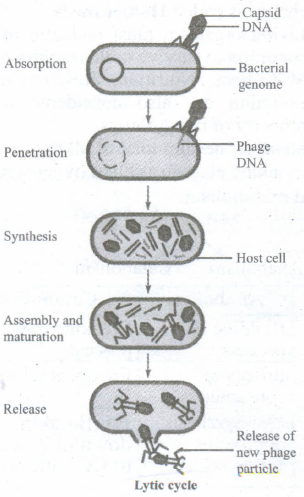
Lytic Cycle :
During lytic cycle of the phage the disintegration of host bacterial cell occurs and the progeny virions are released The steps involved in the lytic cycle are as follows:
1. Adsorption:
(i) Phage (T4) particles interact with cell wall of host (E.coli).
(ii) The phage tail makes contact between the two, and tail fibres recognize the specific receptor sites present on bacterial cell surface.
(iii) The lipopolysaccharides of tail fibres act as receptor in phages.
(iv) The process involving the recognition of phage to bacterium is called landing. Once the contact is established between tail fibres and bacterial cell, tail fibres bend to anchor the pins and base plate to the cell surface.
(v) This step is called pinning.
2. Penetration:
(i) The penetration process involves mechanical and enzymatic digestion of the cell wall of the host.
(ii) At the recognition site phage digests certain cell wall structure by viral enzyme (lysozyme).
(iii) After pinning the tail sheath contracts (by using ATP) and appears shorter and thicker.
(iv) After contraction the base plate enlarges through which DNA is injected into the cell wall without using metabolic energy.
(v) The step involving injection of DNA particle alone into the bacterial cell is called Transfection.
(vi) The empty protein coat leaving the outside of the cell is known as 'ghost'.
3. Synthesis:
(i) This step involves the degradation of bacterial chromosome, protein synthesis and DNA replication.
(ii) The phage nucleic acid takes over the host biosynthetic machinery. Host DNA gets inactivated and breaks down.
(iii) Phage DNA suppresses the synthesis of bacterial protein and directs the metabolism of the cell to synthesize the proteins of the phage particles and simultaneously replication of phage DNA also takes place.
4. Assembly and Maturation:
(i) The DNA of the phage and protein coat are synthesized separately and are assembled to form phage particles.
(ii) The process of assembling the phage particles is known as maturation.
(iii) After 20 minutes of infection about 300 new phages are assembled.
5. Release:
The phage particles get accumulated inside the host cell and are released by the lysis of host cell wall.

11th Standard Syllabus & Materials
11th Standard
TN 11th Tamil பீடு பெற நில் - செய்யுள் - காவடிச்சிந்து Important Questions And Answers Study Material - QB365 Set A
NEW11th Standard
TN 11th Tamil பீடு பெற நில் - உரைநடை - மலை இடப்பெயர்கள் : ஓர் ஆய்வு Important Questions And Answers Study Material - QB365 Set A
NEW11th Standard
TN 11th Tamil மாமழை போற்றுதும் - துணைப்பாடம் - யானை டாக்டர் Important Questions And Answers Study Material - QB365 Set A
NEW11th Standard
TN 11th Tamil மாமழை போற்றுதும் - செய்யுள் - ஐங்குறுநூறு Important Questions And Answers Study Material - QB365 Set A



Tamilnadu Stateboard 11th Standard Subjects

Maths

Commerce

Economics
Biology

Business Maths and Statistics

Accountancy

Computer Science

Physics

Chemistry
Maths
Biology
Economics
Physics
Chemistry

History
Business Maths and Statistics

Computer Science
Accountancy

Computer Applications
History
Computer Technology
Commerce
Computer Applications
Computer Technology

Tamil

English

French
Tamilnadu Stateboard Standards



