
 100% FREE ACCESS
11th Standard Syllabus & Materials
11th Standard
TN 11th Tamil இயற்கை வேளாண்மை,சுற்றுச்சூழல் -செய்யுள் - மனோன்மணீயம் Important Questions And Answers Study Material - QB365 Set A
NEW11th Standard
TN 11th Tamil என்னுயிர் என்பேன் -துணைப்பாடம் - இசைத்தமிழர் இருவர் Important Questions And Answers Study Material - QB365 Set A
NEW11th Standard
TN 11th Tamil மொழி கலை -செய்யுள் - ஒவ்வொரு புல்லையும் Important Questions And Answers Study Material - QB365 Set A
NEW11th Standard
TN 11th Tamil பீடு பெற நில் - இலக்கணம் - பகுபத உறுப்புகள் Important Questions And Answers Study Material - QB365 Set A
NEW11th Standard
TN 11th Tamil பீடு பெற நில் - துணைப்பாடம் - வாடிவாசல் Important Questions And Answers Study Material - QB365 Set A
NEW11th Standard
TN 11th Tamil பீடு பெற நில் - செய்யுள் - குறுந்தொகை Important Questions And Answers Study Material - QB365 Set A

Published on: 13/05/2022
QB365 provides detailed and simple solution for every Creative Questions in class 11 Biology Subject. It will helps to get more idea about question pattern in every Creative questions with solution.
latest Creative QuestionsDownload Tamil Nadu 11th Standard Biology question papers, model tests, one-mark questions, important questions, and public exam papers in PDF format. Free study materials and answer keys for TN State Board students.
Questions + Answers key
Take MCQ Biology Test1.
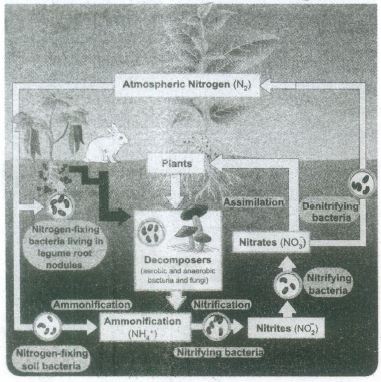
Give the schematic represntation of N2 cycle?
2.
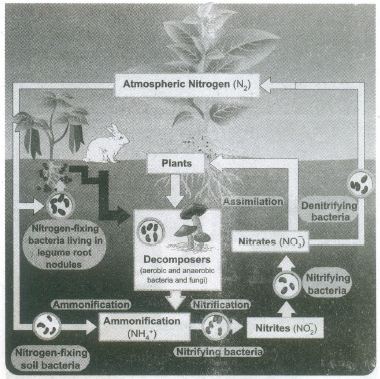
Explain the stages involved in nitrogen cycle.
3.
Describe biological nitrogen fixation with reference to Rhizobium and Legume.
4.
Explain Micronutrients, their role and deficiency diseases.
5.
Explain Macronutrients, their role and deficiency diseases.
1.
2.
Nitrogen cycle and nitrogen metabolism
I. Nitrogen cycle : This cycle consists of following stages:
Nitrogen Fixation :
(i) Di-nitrogen molecule from the atmosphere progressively gets reduced by addition of a pair of hydrogen atoms to form Ammonia.
(ii) Nitrogen fixation process requires Nitrogenase enzyme complex, Minerals (Mo, Fe and S), Anaerobic condition, ATP, e- and H+ donor glucose 6 phosphate.
(iii) Nitrogenase enzyme is active only in anaerobic condition. To create this anaerobic condition a pigment known as leghaemoglobin is synthesized in the nodules which acts as oxygen scavenger and removes the oxygen.
(iv) Nitrogen fixing bacteria in root nodules appears pinkish due to the presence of this leghaemoglobin pigment.
Overall equation:
N2 + 8e-+ 8H + 16ATP \(\rightarrow\) 2NH3+H2+16ADP+16 Pi
2. Nitrification :
(NH3+) Ammonia is converted into Nitrite
(NO2-) by Nitrosomonas bacterium. Nitrite
(NO2-)is then converted into Nitrate (NO3-) by Nitrobacter bacterium
2 NH3+ + 3O2 \(\overset { Nitrosomonas }{ \longrightarrow } \) 2 NO2- + 2H+ + 2H2 O
2 NO2- + O2 \(\overset { Nitrobacter }{ \longrightarrow } \)2 NO3-
3. Nitrate Assimilation :
The process by which nitrate is reduced to ammonia is called nitrate assimilation and occurs during nitrogen cycle.
NO3- \(\overset { Nitrate\ reductase }{ \underset { Mo }{ \longrightarrow } } \)NO2-
NO2- \(\overset { Nitrate\ reductase }{ \underset { Mo }{ \longrightarrow } } \) NH3+
4. Ammonification :
Decomposition of organic nitrogen from dead plants and animals into ammonia is called ammonification. organisms involved in this process are Bacillus ramosus and Bacillus vulgaris.
5. Denitrification:
Nitrates in the soil are converted back into atmospheric nitrogen by a process called denitrification. Bacteria involved in this process are Pseudomonas; Thiobacillus and Bacillus subtilis.
Nitrate \(\overset { Pseudomonas }{ \longrightarrow } \) Molecular Nitrogen
(NO3-) (N2)
3.
The process of converting Atmospheric Nitrogen into Ammonia is termed as Nitrogen fixation.
Biological nitrogen fixation:
Symbiotic bacterium like Rhizobium fixes atmospheric nitrogen. Cyanobacteria found in Lichens, Anthoceros, Azolla and coralloid roots of Cycas also fix nitrogen. Non- Symbiotic (Free living bacteria) like Clostridium also fix nitrogen.
a. Symbiotic nitrogen fixation :
Nitrogen fixation with nodulation
(i) Rhizobium bacterium is found in leguminous plants and fix atmospheric nitrogen.
(ii) This kind of symbiotic association is beneficial for both the bacterium and plant. Root nodules are formed due to bacterial infection.
(iii) Rhizobium enters into the host cell and proliferates, it remains separated from the host cytoplasm by a membrane
b. Stages of Root nodule formation:
1. Legume plants secretes phenolics which attracts Rhizobium.
2. Rhizobium reaches the rhizosphere and enters into the root hair, infects the root hair and leads to curling of root hairs.
3. Infection thread grows inwards and separates the infected tissue from normal tissue.
4. A membrane bound bacterium is formed inside the nodule and is called bacteroid.
5. Cytokinin from bacteria and auxin from host plant promotes cell division and leads to nodule formation.
Nitrogenase enzyme complex, Minerals (Mo, Fe and S), anaerobic condition, ATP, electron and glucose 6 phosphate as H+ donor, Nitrogenase enzyme is active only in anaerobic condition. To create this anaerobic condition a pigment known as leghaemoglobin is synthesized in the nodules which acts as oxygen scavenger and removes the oxygen. Nitrogen fixing bacteria-In root nodules appears pinkish due to the presence of this leghaemoglobin pigment.
4.
Functions, mode of absorption and deficiency symptoms of micronutrients
Essential minerals which are required in low concentrations are called Micro nutrients.
Micronutrients even though required in trace amounts are essential for the metabolism of plants. They play key roles in many plants.
1. Iron (Fe): Iron is required lesser than macronutrient level and larger than micronutrients level, hence, it can be placed in anyone of the groups. Synthesis of Chlorophyll and carotenoids, component of Cytochrome, Ferredoxin, Flavoprotein, formation of Chlorophyll, porphyrin, activation of Catalase, Peroxidase enzymes.Absorbed as ferrous (Fe2+) and ferric (Fe3+) ions. Mostly fruit trees are sensitive to Iron.
Deficiency: InterveinalChlorosis, short and slender stalk and inhibition of chlorophyll formation.
2. Manganese (Mn): Activator of Carboxylases, Oxidases, Dehydrogenases and Kinases, involved in splitting of water to liberate oxygen (Photolysis). Absorbed as Manganous Mn2+ ions.
Deficiency: Interveinalchlorosis, grey spot on Oats leaves and poor root system.
3. Copper (Cu): Constituent of Plastocyanin, component of Phenolases, Tyrosinase, enzymes involved in redox reactions, synthesis of ascorbic acid, maintains Carbohydrate and Nitrogen balance, part of oxidase and cytochrome oxidase. Absorbed as Cupric (Cu2+) ions.
Deficiency: Die back of Citrus, Reclamation disease of cereals and legumes, Chlorosis, Necrosis and Exanthema in Citrus.
4. Zinc (Zn): Essential for the synthesis of Indole Acetic Acid (Auxin) Activator of carboxylases, alcohol dehydrogenase, lactic dehydrogenase, glutamic acid dehydrogenase, carboxy peptidases and tryptophan synthetase. Absorbed as Zn2+ ions.
Deficiency: Little leaf and mottle leaf due to deficiency of auxin, Interveinalchlorosis, stunted growth, Necrosis and Khaira disease of rice.
5. Boron (B): Translocation of Carbohydrates, uptake of and utilisation of Ca++, pollen germination, nitrogen metabolism, fat metabolism, cell elongation and differentiation. absorbed as Borate BO3- ions.
Deficiency: Death of root and shoot tips, premature fall of flowers and fruits, Brown heart of Beet root, internal cork of apple and fruit cracks.
Molybdenum (Mo): Component of nitrogenase, nitrate reductase, involved in Nitrogen metabolism, and Nitrogen fixation. Absorbed as Molybdate (Mo2+) ions.
Deficiency: Chlorosis, Necrosis, delayed flowering, retarded growth and Whip tail disease of cauliflower.
Chlorine (CI): It is involved in Anion - Cation balance, Cell division, Photolysis of water. Absorbed as Cl- ions.
Deficiency: Wilting of leaf tips
8. Nickel (Ni): Cofactor for enzyme Urease and Hydrogenase.
Deficiency: Necrosis of leaf tips.
5.
Functions, mode of absorption and deficiency symptoms of macronutrients :
Essential minerals which are required in higher concentrations are called Macro nutrients. Their mode of absorption, deficiency symptoms and diseases are described below.
1. Nitrogen (N): Required by the Plants in greatest amount. It is an essential component of Proteins, Nucleic acids, Amino acids, Vitamins, Hormones, Alkaloids, Chlorophyll and Cytochrome. Absorbed by the plants as Nitrates (NO3).
Deficiency: Chlorosis, Stunted growth, Anthocyanin formation.
2. Phosphorus (P): Constituent of Cell membrane, Proteins, Nucleic acids, ATP, NADP, Phytin and as Sugar Phosphate. Absorbed as H2PO4+ and HP\({ O }_{ 4 }^{ + }\) ions.
Deficiency: Stunted growth, Anthocyanin formation, Necrosis, Inhibition of Cambial activity, affect root growth and fruit ripening.
3. Potassium (K): Maintains Turgidity and Osmotic Potential of the Cell, Opening and Closing of stomata, Phloem Translocation, stimulate activity of enzymes, Denzymes, anion and cation balance by ion-exchange. Absorbed as K+ ions.
Defieteney: Marginal Chlorosis, Necrosis, low Cambial activity, Loss of Apical Dominance, Lodging in Cereals and Curled leaf margin.
4. Calcium (Ca): It is involved in synthesis of Calcium Pectate in Middle LamelJa,Mitotic Spindle formation, Mitotic cell division, Permeability of cell membrane, lipid metabolism, activation of phospholipase, ATPase, amylase and activator of adenyl kinase. Absorbed as Ca2+ exchangeable ions.
Deficiency: Chlorosis, necrosis, stunted growth, premature fall of leaves & flowers, inhibit seed formation, Black heart of Celery etc.
5. Magnesium (Mg): It is a constituent of Chlotophyll Activator of enzymes of carbohydrate metabolism (RUBP Carboxylase and PEP Carboxylase) and involved in the synthesis of DNA and RNA. Essential for binding of ribosomal sub units.Absorbed as Mg2+ ions.
Deficiency: Interveinalchlorosis, necrosis, Anthocyanin (purple) formation and Sand drown of tobacco.
6. Sulphur (S): Essential component of amino acids like cystine, cysteine and methionine, constituent of Coenzyme A, Vitamins like Biotin and Thiamine, Constituent of Proteins and ferredoxin. Plants utilise sulphur as sulphate (S\({ o }_{ 4 }^{ - }\)) ions.
Deficiency: Chlorosis, anthocyanin formation, stunted growth, rolling of leaf tip and reduced nodulation in legumes.

11th Standard Syllabus & Materials
11th Standard
TN 11th Tamil பீடு பெற நில் - செய்யுள் - காவடிச்சிந்து Important Questions And Answers Study Material - QB365 Set A
NEW11th Standard
TN 11th Tamil பீடு பெற நில் - உரைநடை - மலை இடப்பெயர்கள் : ஓர் ஆய்வு Important Questions And Answers Study Material - QB365 Set A
NEW11th Standard
TN 11th Tamil மாமழை போற்றுதும் - துணைப்பாடம் - யானை டாக்டர் Important Questions And Answers Study Material - QB365 Set A
NEW11th Standard
TN 11th Tamil மாமழை போற்றுதும் - செய்யுள் - ஐங்குறுநூறு Important Questions And Answers Study Material - QB365 Set A



Tamilnadu Stateboard 11th Standard Subjects

Maths

Commerce

Economics
Biology

Business Maths and Statistics

Accountancy

Computer Science

Physics

Chemistry
Maths
Biology
Economics
Physics
Chemistry

History
Business Maths and Statistics

Computer Science
Accountancy

Computer Applications
History
Computer Technology
Commerce
Computer Applications
Computer Technology

Tamil

English

French
Tamilnadu Stateboard Standards



