
 100% FREE ACCESS
11th Standard Syllabus & Materials
11th Standard
TN 11th Tamil இயற்கை வேளாண்மை,சுற்றுச்சூழல் -செய்யுள் - மனோன்மணீயம் Important Questions And Answers Study Material - QB365 Set A
NEW11th Standard
TN 11th Tamil என்னுயிர் என்பேன் -துணைப்பாடம் - இசைத்தமிழர் இருவர் Important Questions And Answers Study Material - QB365 Set A
NEW11th Standard
TN 11th Tamil மொழி கலை -செய்யுள் - ஒவ்வொரு புல்லையும் Important Questions And Answers Study Material - QB365 Set A
NEW11th Standard
TN 11th Tamil பீடு பெற நில் - இலக்கணம் - பகுபத உறுப்புகள் Important Questions And Answers Study Material - QB365 Set A
NEW11th Standard
TN 11th Tamil பீடு பெற நில் - துணைப்பாடம் - வாடிவாசல் Important Questions And Answers Study Material - QB365 Set A
NEW11th Standard
TN 11th Tamil பீடு பெற நில் - செய்யுள் - குறுந்தொகை Important Questions And Answers Study Material - QB365 Set A

Published on: 13/05/2022
QB365 provides detailed and simple solution for every Creative Questions in class 11 Biology Subject. It will helps to get more idea about question pattern in every Creative questions with solution.
latest Creative QuestionsDownload Tamil Nadu 11th Standard Biology question papers, model tests, one-mark questions, important questions, and public exam papers in PDF format. Free study materials and answer keys for TN State Board students.
Questions + Answers key
Take MCQ Biology Test1.
Justify the role of RUBISCO enzyme which acts as Carboxylase and Oxygenase?
2.
A Science teacher told students that "Don't put the plant in green light for long time". What happens if a plant is exposed to green light for a long time.
3.
Explain Calvin Cycle/ C3 Cycle.
4.
Describe the structure of chloroplast.
5.
1.
RUBISCO - RUBP carboxylase oxygenase enzyme is the most abundant protein found an earth and forms 16% of chloroplast protein. It acts as carboxylase in presence of CO2 and in the absence of CO2, it functions as oxygenase.
1) In C3 phtosynthesis it facilitates fixation of carbon di oxide molecule from the air by Ribulose 1,5 Bisphosphate (RUBP) to form a six carbon compound. In C4 cycle RUBISCO operates in the Bundle sheath cells in the second phase.
2) Photorespiration is the excess respiration taking place in photosynthetic cells due to absence of CO2 and and increase of oxygen. This condition changes the carboxylase role of RUBISCO into oxygenase. Photo respiration or C2 cycle takes place in chloroplast, Peroxisome and Mitochondria. RUBP is converted into PGA and a 2C compound Phosphoglycolate by Rubisco enzyme in chloroplast. The C2 cycle does not yield any free energy in the form of ATP. Under certain conditions 50% of the photosynthetic potential is lost because of photo respiration.
3) Thus RUBISCO can interfere with C3 and C2 cycles based on availability of carbondioxide and oxygen in the atmosphere.
2.
The green wave length of light has low energy levels and is not useful for photosynthesis. So if plants get response of green light for long, They may not carry out photosynthesis that might lead plant cell to starvation and death.
3.
Biosynthetic Phase or Photosynthetic Carbon Reduction Cycle (Per) :
1) Biosynthetic Phase of Photosynthesis utilises assimilatory powers (ATP and NADPH + H+) produced during light reaction. They are used to fix and reduce carbon dioxide into carbohydrates.
2) This reaction does not require light. Therefore, it is named Dark reaction. Ribulose 1,5 bisphosphate (RUBP) act as acceptor molecule of carbon dioxide and fix the CO2 by RUBISCO enzyme.
3) The first product of the pathway is a 3- carbon compound (Phospho Glyceric Acid) and so it is also called as C3 Cycle or Calvin Cycle. It takes place in the stroma of the Chloroplast. It was discovered Melvin Calvin.
4) Dark reaction is temperature dependent and so it is also called Thermo-Chemical Reaction. It consists of three phases.
a) Phase 1- Carboxllation (Fixation)
i) The acceptor molecule Ribulose 1,5 Bisphosphate (RUBP) a 5 carbon compound with the help of RUBP carboxylase oxygenase (RUBISCO) enzyme accepts one molecule of carbon dioxide to form an unstable 6 carbon compound.
ii) This 6C compound is broken down into two molecules of 3-carbon compound phospho glyceric acid (PGA).
RUBP + CO2\(\xrightarrow{Rubisco}\) 2 molecules PGA
b) Phase 2 - Glycolytic Reversal/Reduction
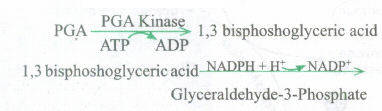
i) Phospho glyceric acid is phosphorylated by ATP and produces 1,3 bis phospho glyceric acid by PGA kinase.
ii) 1,3 bis phospho glyceric acid is reduced to glyceraldehyde 3 Phosphate (G-3-P) by using the reducing power NADPH + H+.
iii) Glyceraldehyde 3 phosphate is converted into its isomeric form dihydroxy acetone phosphate (DHAP).
c) Phase 3 - Regeneration
i) Regeneration of RUBP involves the formation of several intermediate
compounds of 6-carbon , 5-carbon, 4-carbon and 7- carbon skeleton.
ii) Fixation of one carbon dioxide requires 3 ATPs and 2 NADPH + H+ , and for the fixation of 6 CO2 requires 18 ATPs and 12 NADPH + H+ during C3 cycle. One 6 carbon compound is the net gain to form hexose sugar.

Overall equation for dark reaction:
6C02 + 18ATP + 12NADPH + H+\(\rightarrow\) C6 H12 06 + 6H20 + 18ADP+ 18Pi + 12NADP+
4.
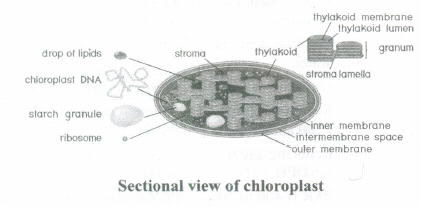
Chloroplast are the main site of photosynthesis.
1) It is a double wall membrane bounded organelles, discoid or lens shaped, 4-10 Mm is diameter and 1-33 Mm is thickness.
2) The proteinaceous matrix is called stroma.
3) A sac like membranous system called thylakoid is present in stroma and are arranged one above the other like a stack called granum. 40-80 grana occur in each chloroplast. 5-30 thylakoids occur is each granum.
4) Fret membrane connects grana.
5) PSI is located is outer thylakoid membrane facing stroma and PSII is located on inner membrane towards the lumen of thylakoid.
6) Chloroplast contains 30-35 prteins 20-30% phospholipids 5-10% chlorphyll caroteroids, 70s Ribosomes, circular DNA and starch grain.
7) Inner surface of lamellar membrane consists of small spherical structers called quantosomes.
8) Due to presence to 70s Ribosome and DNA they are considered to be semi autonomous organelles.
9) Thylakoids contain pigment systems which help in light reaction of Photosynthesis.
10) Stroma contains enzymes for dark reaction.
5.

11th Standard Syllabus & Materials
11th Standard
TN 11th Tamil பீடு பெற நில் - செய்யுள் - காவடிச்சிந்து Important Questions And Answers Study Material - QB365 Set A
NEW11th Standard
TN 11th Tamil பீடு பெற நில் - உரைநடை - மலை இடப்பெயர்கள் : ஓர் ஆய்வு Important Questions And Answers Study Material - QB365 Set A
NEW11th Standard
TN 11th Tamil மாமழை போற்றுதும் - துணைப்பாடம் - யானை டாக்டர் Important Questions And Answers Study Material - QB365 Set A
NEW11th Standard
TN 11th Tamil மாமழை போற்றுதும் - செய்யுள் - ஐங்குறுநூறு Important Questions And Answers Study Material - QB365 Set A



Tamilnadu Stateboard 11th Standard Subjects

Maths

Commerce

Economics
Biology

Business Maths and Statistics

Accountancy

Computer Science

Physics

Chemistry
Maths
Biology
Economics
Physics
Chemistry

History
Business Maths and Statistics

Computer Science
Accountancy

Computer Applications
History
Computer Technology
Commerce
Computer Applications
Computer Technology

Tamil

English

French
Tamilnadu Stateboard Standards



