
 100% FREE ACCESS
11th Standard Syllabus & Materials
11th Standard
TN 11th Tamil இயற்கை வேளாண்மை,சுற்றுச்சூழல் -செய்யுள் - மனோன்மணீயம் Important Questions And Answers Study Material - QB365 Set A
NEW11th Standard
TN 11th Tamil என்னுயிர் என்பேன் -துணைப்பாடம் - இசைத்தமிழர் இருவர் Important Questions And Answers Study Material - QB365 Set A
NEW11th Standard
TN 11th Tamil மொழி கலை -செய்யுள் - ஒவ்வொரு புல்லையும் Important Questions And Answers Study Material - QB365 Set A
NEW11th Standard
TN 11th Tamil பீடு பெற நில் - இலக்கணம் - பகுபத உறுப்புகள் Important Questions And Answers Study Material - QB365 Set A
NEW11th Standard
TN 11th Tamil பீடு பெற நில் - துணைப்பாடம் - வாடிவாசல் Important Questions And Answers Study Material - QB365 Set A
NEW11th Standard
TN 11th Tamil பீடு பெற நில் - செய்யுள் - குறுந்தொகை Important Questions And Answers Study Material - QB365 Set A

Published on: 13/05/2022
QB365 provides detailed and simple solution for every Creative Questions in class 11 Biology Subject. It will helps to get more idea about question pattern in every Creative questions with solution.
latest Creative QuestionsDownload Tamil Nadu 11th Standard Biology question papers, model tests, one-mark questions, important questions, and public exam papers in PDF format. Free study materials and answer keys for TN State Board students.
Questions + Answers key
Take MCQ Biology Test1.
Why is the colour of a leaf kept in the dark frequently yellow or pale green? Which pigment do you think is more stable?
2.
"Photosynthesis protects us from harmful ultraviolet radiation of sun" comment on the statement
3.
Differentiate C3 Plants and C4 Plants.
4.
Explain Non cyclic photophosphorylation?
5.
Differentiate photosynthesis in plants and Bacterial photosynthesis.
1.
1) The leaves lack chlorophyll. In the absence of light, disintegration of chlorophyll pigment occurs. The carotene pigments are more stable. So leaves become pale.
2) The production of chlorophyll pigment is directly proportional to the amount of light available. When light is not available the colour of the leaf gradually changes to light green or yellow.
3) During this process Xanthophyll and carotenoid pigments become predominant and hence the colour.
4) Carotenoid pigment are accessory pigments and do not break down easily. They are said to be more stable than chlorophylls.
2.
1) Many plants use a group of chemicals called sinapate esters to defend against the sun. These aromatic compounds are found in the upper cell layers of the plant tissues and sinapoyl Malate provides bulk of the UV protection.
2) Thus when the green leaves of the plants are absorbing visible part of the spectrum for photosynthesis, the chemicals help to absorb the incident, UV radiation thus preventing the UV from affecting other living organisms. Thus photosynthesis protects us from harmful radiation of the sun.
3.
| C3 Plants | C4 Plants | |
| 1. | CO2 fixation Itakes place in mesophyll cells only | CO2 fixation takes place mesophyll and bundle sheath |
| 2. | CO2 acceptor is RUBP only | PEP in mesophyll and RUBP in bundle sheath cells |
| 3. | First product is 3C-PGA | First product is 4C- OAA |
| 4. | Kranz anatomy is not present | Kranz anatomy is present |
| 5. | Granum is present lin mesophyll cells | Granum present in mesophyll cells and absent in bundle sheath |
| 6. | Normal Chloroplast | Dimorphic chloroplast |
| 7. | Optimum temperature 20° to 25° C | Optimum temperature 30° C to 45° C |
| 8. | Fixation of CO2 at 50ppm | Fixation of CO2 even less than 10 ppm |
| 9. | Less efficient due to higher photorespiration | More efficient due to less photorespiration |
| 10. | RUBP carboxylase enzyme used for fixation | PEP carboxylase and RUBP carboxylase used |
| 11. | 18 ATPs used to synthesize one glucose | Consumes 30 ATPs to produce one glucose. |
| 12. | Efficient at low CO2 | Efficient at higher CO2 |
| 13. | Eg: Paddy,Wheat, Potato and so on. | Eg:- Sugar cane, Maize, Sorghum, Amaranthus and so on. |
4.
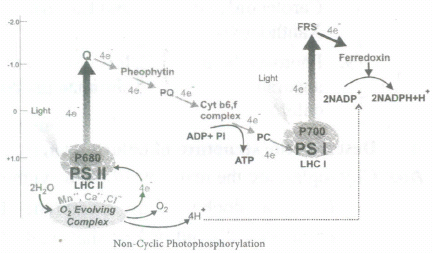
1) When photons are activated reaction centre of Pigment system II(P680), electrons are moved to the high energy level. Electrons from high energy state passes through series of electron carriers like Plastoquinone, Cytochrome complex, Plastocyanin and finally accepted by PSI (P700). During this movement of electrons from PS II to PS I ATP is generated.
2) PS I (P700) is activated by light, electrons are moved to high energy state and accepted by electron acceptor molecule Ferredoxin Reducing Substance (FRS). During the downhill movement through Ferredoxin, electrons are transferred to NADP+ and reduced into NADPH + H+ (H+ formed from splitting of water by light).
3) Electrons released from the Photosystem II are not cycled back. It is used for the reduction NADP+ in to NADPH + H+. During the electron transport it generates ATP and hence this type of photophosphorylation is called Non-Cyclic Photophosphorylation. The electron flow looks like the appearance of letter 'Z' and so known as Z scheme.
4) When there is availability of NADP+ for reduction and when there is splitting of water molecules both PS I and PS II are activated. Non-Cyclic electron transport PS I and PS II both are involved co-operatively to transport electrons from water to NADP+. In oxygenic species Non-cyclic electron transport takes place in three stages:
i) Electron transport from water to P 680: Splitting of water molecule produce electrons, protons and oxygen. Electrons lost by the PS II (P680) are replaced by electrons from splitting of water molecule.
ii) Electron transport from P 680 to P 700: Electron flow starts from P 680 through a series of electron carrier molecules like Plastoquinone (PQ), Cytochrome b6-f Complex, Plastocyanin (PC) and finally reaches P700 (PSI).
iii) Electron transport from P 700 to NADP+: PSI (P700) is excited now and the electrons pass to high energy level. When electron travels downhill through ferredoxin, NADP+ is reduced to NADPH+ H+.
5.
| Photosynthesis in Plants | Bacterial Photosynthesis | |
| 1. | Cyclic and Non-Cyclic phosphorylation takes place | Only Cyclic Phosphorylation takes place |
| 2. | Photosystem I and II involved | Photosystem I only involved |
| 3. | The electron donor is water | The electron donor is H2S |
| 4. | Oxygen is evolved | Oxygen is not evolved |
| 5. | Reaction centers are P700 and P680 | The reaction center is P890 |
| 6. | The reducing agent is NADPH + H+ | The reducing agent is NADH + H+ |
| 7. | PAR is 400 to 700 nm | PAR is above 700 nm |
| 8. | Chlorophyll, Carotenoid, and Xanthophyll | Bacteria chlorophyll and Bacteria viridin |
| 9. | Photosynthetic apparatus - chloroplast | It is chlorophyll and chromatophores. |

11th Standard Syllabus & Materials
11th Standard
TN 11th Tamil பீடு பெற நில் - செய்யுள் - காவடிச்சிந்து Important Questions And Answers Study Material - QB365 Set A
NEW11th Standard
TN 11th Tamil பீடு பெற நில் - உரைநடை - மலை இடப்பெயர்கள் : ஓர் ஆய்வு Important Questions And Answers Study Material - QB365 Set A
NEW11th Standard
TN 11th Tamil மாமழை போற்றுதும் - துணைப்பாடம் - யானை டாக்டர் Important Questions And Answers Study Material - QB365 Set A
NEW11th Standard
TN 11th Tamil மாமழை போற்றுதும் - செய்யுள் - ஐங்குறுநூறு Important Questions And Answers Study Material - QB365 Set A



Tamilnadu Stateboard 11th Standard Subjects

Maths

Commerce

Economics
Biology

Business Maths and Statistics

Accountancy

Computer Science

Physics

Chemistry
Maths
Biology
Economics
Physics
Chemistry

History
Business Maths and Statistics

Computer Science
Accountancy

Computer Applications
History
Computer Technology
Commerce
Computer Applications
Computer Technology

Tamil

English

French
Tamilnadu Stateboard Standards



