
 100% FREE ACCESS
11th Standard Syllabus & Materials
11th Standard
TN 11th Tamil இயற்கை வேளாண்மை,சுற்றுச்சூழல் -செய்யுள் - மனோன்மணீயம் Important Questions And Answers Study Material - QB365 Set A
NEW11th Standard
TN 11th Tamil என்னுயிர் என்பேன் -துணைப்பாடம் - இசைத்தமிழர் இருவர் Important Questions And Answers Study Material - QB365 Set A
NEW11th Standard
TN 11th Tamil மொழி கலை -செய்யுள் - ஒவ்வொரு புல்லையும் Important Questions And Answers Study Material - QB365 Set A
NEW11th Standard
TN 11th Tamil பீடு பெற நில் - இலக்கணம் - பகுபத உறுப்புகள் Important Questions And Answers Study Material - QB365 Set A
NEW11th Standard
TN 11th Tamil பீடு பெற நில் - துணைப்பாடம் - வாடிவாசல் Important Questions And Answers Study Material - QB365 Set A
NEW11th Standard
TN 11th Tamil பீடு பெற நில் - செய்யுள் - குறுந்தொகை Important Questions And Answers Study Material - QB365 Set A

Published on: 13/05/2022
QB365 provides detailed and simple solution for every book back questions in class 11 Biology subject.It will helps to get more idea about question pattern in every book back questions with solution.
latest Book back QuestionsDownload Tamil Nadu 11th Standard Biology question papers, model tests, one-mark questions, important questions, and public exam papers in PDF format. Free study materials and answer keys for TN State Board students.
Questions + Answers key
Take MCQ Biology Test1.
Write the physiological effects of Cytokinins.
2.
What is chemical warfare?
3.
Explain 'senescence'.
4.
5.
Describe the mechanism of photoperiodic induction of flowering.
1.
Physiological effect:
1) Cytokinin promotes cell division in the presence of auxin (IAA).
2) Induces cell enlargement associated with IAA and gibberellins
3) Cytokinin can break the dormancy of certain light-sensitive seeds like tobacco and induces seed germination.
4) Cytokinin promotes the growth of lateral bud in the presence of apical bud.
5) Application of cytokinin delays the process of aging by nutrient mobilization.
6) It is known as Richmond Lang effect.
7) Cytokinin
(i) increases rate protein synthesis
(ii) induces the formation of inter-fascicular cambium
(iii) overcomes apical dominance
(iv) induces formation of new leaves, chloroplast and lateral shoots.
8) Plants accumulate solutes very actively with the help of cytokinins.
2.
Chemical warfare (CW) involves using the toxic properties of chemical substances as weapons. This type of warfare is distinct from nuclear warfare, biological warfare and radiological warfare, which together make up CBRN, the military acronym for chemical, biological, radiological, and nuclear (warfare or weapons), all of which are considered "weapons of mass destruction" (WMDS), a term that contrasts with conventional weapons.
3.
old age is called" senescence 'in plants, senescence refers to all col1ective, progressive and deteriorative processes which ultimately lead to complete loss of organization and 'function.'
Four types of senescence:
I) Overall senescence
2) Top senescence
3) Deciduous senescence ,
4) Progressive senescence
Overall senescencer This kind of senescence occurs in annual plants when entire plant get 'affected and dies . Eg: Wheat and Soybean. It also occurs in few perennials also'. Eg: Agave and Bamboo.
Top senescence: It occurs in aerial parts of plants. It 'is common in perennials, underground and root system remains viable. Eg: Banana and Gladiolus.
Deciduous senescence: It is common in deciduous plants and occurs only in leaves of plants, bulk of the stein and root system remains alive. Eg: Elm and Maple.
Progressive senescence: This kind of senescence is gradual. First it occurs in old leaves followed by new leaves then stem and' finally root system. It is common in annuals.
Physiology of Senescence:
1) Cells undergo changes in structure.
2) Vacuole of the cell acts as lysosome and secretes hydrolytic enzymes.
3) The starch content is decreased in the cells.
4) Photosynthesis is reduced due to loss of chlorophyll accompanied by synthesis and accumulation of anthocyanin pigments therefore the leaf becomes red .
5) There is a marked decrease in protein content in the senescing organ.
6) RNA content of the leaf particularly rRNAlevel is decreased in the cells due to increased activity of the enzyme RNA ase.
7) DNA molecules in senescencing leaves degenerate by the increased activity of enzyme DNA ase.
Factors affecting Senescence:
1) ABA and ethylene accelerate senescence while auxin and cytokinin retard senescence.
2) Nitrogen deficiency increases . senescence whereas nitrogen supply retards senescence.
3) High temperature. accelerates senescence but low temperature retards senescence.'
4) Senescence is rapid in dark'than iti light.
5) Water stress 'leads to accumulation of ABA leading to senescence.
Programned cell death:
Senescence is controlled by plants own genetic programme. Death of the plant or plant part consequent to senescence is called programmed cell Death. In short senescence of an individual cell is called PCD.
4.
5.
Photoperiodic induction
1) An appropriate photoperiod in 24 hours cycle constitutes one inductive cycle. Plants may require one or more inductive cycles for flowering.
2) The phenomenon of conversion of leaf primordia into flower primordia under the influence of suitable inductive cycles is called photoperiodic induction.
Example: Xanthium (SDP) - 1 inductive cycle and Plantago (LDP)- 25 inductive cycles.
Site of Photoinductive perception
1) Photoperiodic stimulus is perceived by the leaves.
2) Floral hormone is synthesised in leaves and translocated to the apical tip to promote flowering.
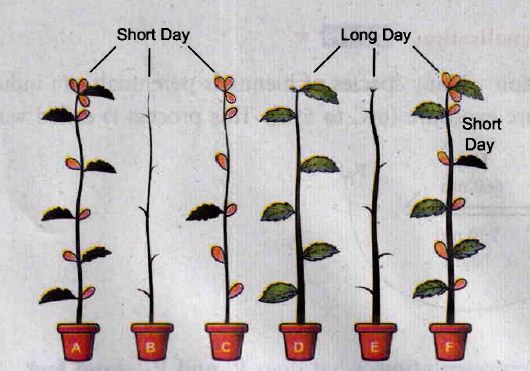
3) This can be explained by a simple experiment on Cocklebur (Xanthium pensylvanicum), a short day plant.
4) Usually Xanthium will flower under short day conditions. If the plant is defoliated and kept under short day conditions it will not flower.
5) Flowering will occur even when all the leaves are removed except one leaf.
6) If a cocklebur plant is defoliated and kept under long day conditions, it will not flower.
7) If one of its leaves is exposed to short day condition and rest are in long day condition, flowering will occur.

11th Standard Syllabus & Materials
11th Standard
TN 11th Tamil பீடு பெற நில் - செய்யுள் - காவடிச்சிந்து Important Questions And Answers Study Material - QB365 Set A
NEW11th Standard
TN 11th Tamil பீடு பெற நில் - உரைநடை - மலை இடப்பெயர்கள் : ஓர் ஆய்வு Important Questions And Answers Study Material - QB365 Set A
NEW11th Standard
TN 11th Tamil மாமழை போற்றுதும் - துணைப்பாடம் - யானை டாக்டர் Important Questions And Answers Study Material - QB365 Set A
NEW11th Standard
TN 11th Tamil மாமழை போற்றுதும் - செய்யுள் - ஐங்குறுநூறு Important Questions And Answers Study Material - QB365 Set A



Tamilnadu Stateboard 11th Standard Subjects

Maths

Commerce

Economics
Biology

Business Maths and Statistics

Accountancy

Computer Science

Physics

Chemistry
Maths
Biology
Economics
Physics
Chemistry

History
Business Maths and Statistics

Computer Science
Accountancy

Computer Applications
History
Computer Technology
Commerce
Computer Applications
Computer Technology

Tamil

English

French
Tamilnadu Stateboard Standards



