
 100% FREE ACCESS
11th Standard Syllabus & Materials
11th Standard
TN 11th Tamil இயற்கை வேளாண்மை,சுற்றுச்சூழல் -செய்யுள் - மனோன்மணீயம் Important Questions And Answers Study Material - QB365 Set A
NEW11th Standard
TN 11th Tamil என்னுயிர் என்பேன் -துணைப்பாடம் - இசைத்தமிழர் இருவர் Important Questions And Answers Study Material - QB365 Set A
NEW11th Standard
TN 11th Tamil மொழி கலை -செய்யுள் - ஒவ்வொரு புல்லையும் Important Questions And Answers Study Material - QB365 Set A
NEW11th Standard
TN 11th Tamil பீடு பெற நில் - இலக்கணம் - பகுபத உறுப்புகள் Important Questions And Answers Study Material - QB365 Set A
NEW11th Standard
TN 11th Tamil பீடு பெற நில் - துணைப்பாடம் - வாடிவாசல் Important Questions And Answers Study Material - QB365 Set A
NEW11th Standard
TN 11th Tamil பீடு பெற நில் - செய்யுள் - குறுந்தொகை Important Questions And Answers Study Material - QB365 Set A

Published on: 28/06/2021
QB365 provides detailed and simple solution for every Creative Questions in class 11 Biology Subject. It will helps to get more idea about question pattern in every Creative questions with solution.
Download Tamil Nadu 11th Standard Biology question papers, model tests, one-mark questions, important questions, and public exam papers in PDF format. Free study materials and answer keys for TN State Board students.
Questions + Answers key
Take MCQ Biology Test1.
What is chemical warfare?
2.
Explain the external conditions needed for growth
3.
Describe an experiment to measure the growth of a plant.
4.
Write a note on Vernalization.
5.
Write a note an ethylene.
1.
Chemical warfare (CW) involves using the toxic properties of chemical substances as weapons. This type of warfare is distinct from nuclear warfare, biological warfare and radiological warfare, which together make up CBRN, the military acronym for chemical, biological, radiological, and nuclear (warfare or weapons), all of which are considered "weapons of mass destruction" (WMDS), a term that contrasts with conventional weapons.
2.
Plant growth is influenced by a variety of external and internal factors. A brief account of these factors is given below:
External Factors:
1. Water: Water is essential for cell enlargement as well as growth in the size ofthe cell. Turgidity of cells helps in growth extension. Water provides the medium for enzymatic activities needed for growth.
2. Nutrition: Nutrition plays an important role in the formation of protoplasm. Macro and micro elements are very important as sources of energy. For example, carbon and oxygen in carbon-di-oxide and hydrogen in water are assimilated in photosynthesis.
3. Temperature: Temperature plays a significant role in the growth of the plant. Proper growth of a plant occurs at a about 28°C-30°C temperature and above 45°C will damage the protoplasm and hinders the growth.
4. Oxygen: Oxygen has a vital role in the growth of the plant. It helps in releasing metabolic energy essential for growth activities. It is necessary for respiration.
5. Light: Light has its own contribution in the growth of the plant. Light is important for growth and photosynthesis. Light stimulates healthy growth. Absence of light may lead to etiolation.
3.
The increase in the length of the stem tip can easily be measured by an arc auxanometer which consists of a small pulley to the axis of which is attached a long pointer sliding over a graduated arc. A thread one end of which is tied to the stem tip and another end to a weight passes over the pulley tightly. As soon as the stem tip increases in length, the pulley moves and the pointer slide over the graduated arc. The reading is taken. The actual increase in the length of the stem is then calculated by knowing the length of the pointer and the radius of the pulley. If the radius of the pulley is 4 inches and the length of pointer 20 inches the actual growth is measured as follows:
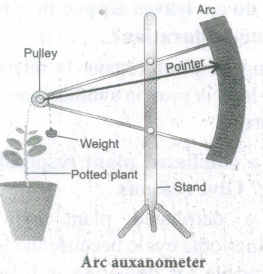
Actual growth in length
=\(\frac { Distance \ travelled \ by \ the \ pointer\times radius \ of \ the \ pulley }{ Length\ of \ the\ pointer } \)
For example, actual growth in length
\(=\frac { 10\times 4inches }{ 20 \ inches } =2 \ inches\)
4.
Certain plants require a low temperature exposure in their earlier stages for flowering. Many species of biennials and perennials are induced to flower by low temperature exposure (0°C to 5°C). This process is called Vernalization. The term Vernalization was first used byT. D. Lysenko (1938).
Mechanism of Vernalization:
Two main theories to explain the mechanism of Vernalization are:
1. Hypothesis of phasic development
2. Hypothesis of hormonal involvement
Hypothesis of phasic development:
According to Lysenko, development of an annual seed plant consists of two phases. First phase is thermo stage,which is vegetative phase, requiring low temperature and suitable moisture. Next phase is photo stage which requires high temperature for synthesis offlorigen (flowering hormone).
Hypothesis of hormonal involvement:
According to Purvis (1961), formation of a substance A from its precursor, is converted into B after chilling. The substance B is unstable. At suitable temperature B is converted into stable compound D called Vernalin. Vernalin is converted to F (Florigen:). Florigen induces flower formation. At high temperature B is converted to C and devernalizationoccurs.
Technique of Vernalization:
The seeds are first soaked in water and allowed to germinate.at lOoC to l2°C. Then seeds are transferred to low temperature (3°C to 5°C) from few days to 30 days. Germinated seeds after this treatment are allowed to dry and then sown. The plants will show I quick flowering when compared to untreated control plants.
Devernalization: Reversal of the effect of vernalization is called devernalization.
Practical applications:
1) Vernalization shortens the vegetative period and induces the plant to flower earlier. '
2) It increases the cold resistance of the plants.
3) It increases the resistance of plants to fungal disease.
4) Plant breeding can be accelerated.
5.
Almost all plant tissues produce ethylene gas In minute quantities.
Discovery:
(i) In 1924, Denny found that ethylene stimulates the ripening of lemons.
(ii) Cocken et al identified ethylene as a natural plant hormone.
Occurrence: Maximum synthesis occurs during climacteric ripening of fruits and tissues undergoing senescence.
Precursor: It is a derivative of amino acid methionine, linolenic acid and fumaric acid.
Physiological Effects:
i) Ethylene stimulates respiration and ripening in fruits.
ii) It stimulates radial growth in stem and root and inhibits linear growth.
iii) It breaks the dormancy of buds, seeds and : storage organs.
iv) It stimulates formation of abscission zone : in leaves, flowers and fruits. This makes the leaves to shed prematurely.
v) Inhibition of stem elongation (shortening the: internode).
vi) In low concentration, ethylene helps in root : initiation.
vii) Growth of lateral roots and root hairs. This I increases the absorption surface of the plant : roots.
viii) The growth of fruits is stimulated by ethylene in some plants. It is more marked in climacteric : fruits.
ix) Ethylene causes epinasty.
Agricultural role:
i) Ethylene normally reduces flowering in plants except in Pine apple and Mango.
ii) It increases the number of female flowers and decreases the number of male flowers.
iii) Ethylene spray in cucumber crop produces female flowers and increases the yield.

11th Standard Syllabus & Materials
11th Standard
TN 11th Tamil பீடு பெற நில் - செய்யுள் - காவடிச்சிந்து Important Questions And Answers Study Material - QB365 Set A
NEW11th Standard
TN 11th Tamil பீடு பெற நில் - உரைநடை - மலை இடப்பெயர்கள் : ஓர் ஆய்வு Important Questions And Answers Study Material - QB365 Set A
NEW11th Standard
TN 11th Tamil மாமழை போற்றுதும் - துணைப்பாடம் - யானை டாக்டர் Important Questions And Answers Study Material - QB365 Set A
NEW11th Standard
TN 11th Tamil மாமழை போற்றுதும் - செய்யுள் - ஐங்குறுநூறு Important Questions And Answers Study Material - QB365 Set A



Tamilnadu Stateboard 11th Standard Subjects

Maths

Commerce

Economics
Biology

Business Maths and Statistics

Accountancy

Computer Science

Physics

Chemistry
Maths
Biology
Economics
Physics
Chemistry

History
Business Maths and Statistics

Computer Science
Accountancy

Computer Applications
History
Computer Technology
Commerce
Computer Applications
Computer Technology

Tamil

English

French
Tamilnadu Stateboard Standards



