
 100% FREE ACCESS
11th Standard Syllabus & Materials
11th Standard
TN 11th Tamil இயற்கை வேளாண்மை,சுற்றுச்சூழல் -செய்யுள் - மனோன்மணீயம் Important Questions And Answers Study Material - QB365 Set A
NEW11th Standard
TN 11th Tamil என்னுயிர் என்பேன் -துணைப்பாடம் - இசைத்தமிழர் இருவர் Important Questions And Answers Study Material - QB365 Set A
NEW11th Standard
TN 11th Tamil மொழி கலை -செய்யுள் - ஒவ்வொரு புல்லையும் Important Questions And Answers Study Material - QB365 Set A
NEW11th Standard
TN 11th Tamil பீடு பெற நில் - இலக்கணம் - பகுபத உறுப்புகள் Important Questions And Answers Study Material - QB365 Set A
NEW11th Standard
TN 11th Tamil பீடு பெற நில் - துணைப்பாடம் - வாடிவாசல் Important Questions And Answers Study Material - QB365 Set A
NEW11th Standard
TN 11th Tamil பீடு பெற நில் - செய்யுள் - குறுந்தொகை Important Questions And Answers Study Material - QB365 Set A

Published on: 25/06/2021
QB365 provides detailed and simple solution for every Creative Questions in class 11 Biology Subject. It will helps to get more idea about question pattern in every Creative questions with solution.
Download Tamil Nadu 11th Standard Biology question papers, model tests, one-mark questions, important questions, and public exam papers in PDF format. Free study materials and answer keys for TN State Board students.
Questions + Answers key
Take MCQ Biology Test1.
Write the general characteristic features of Gymnosperms.
2.
List the salient features of Bryophytes.
3.
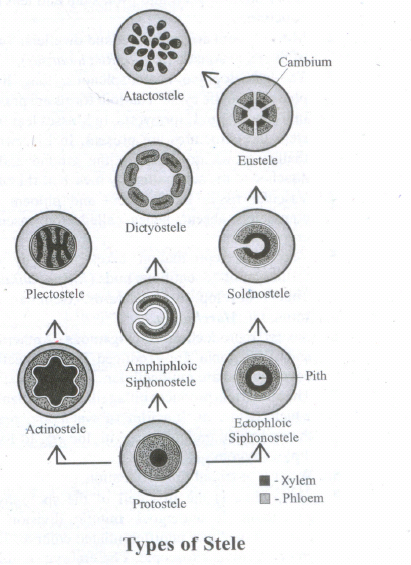
Write down the different types of steles.
4.
List out the Economic importance of Algae.
5.
Write down the characteristic features of Phaeophyceae.
1.
Gymnosperms are naked seed bearing plants.
Salient features of Gymnosperms:
1. Most of the gymnosperms are evergreen woody trees or shrubs. Some are lianas (Gnetum).
2. The plant body is sporophyte and is differentiated into root, stem and leaves.
3. A well developed Tap root system is present. Coralloid Roots of Cycas have symbiotic association with blue green algae. In Pinus the roots have mycorrhizae.
4. The stem is aerial, erect and branched or unbranched (Cycas) with leaf scars.
5. In conifers two types of branches namely branches of limited growth (Dwarf shoot) and Branches of unlimited growth (Long shoot) is present.
6. Leaves are dimorphic, foliage and scale leaves are present. Foliage leaves are green, photosynthetic and borne on branches of limited growth. They show xerophytic features.
7. The xylem consists of tracheids but in Gnetum and Ephedra Vessels are present.
8. Secondary growth is present. The wood may be Manoxylic (Porous, soft, more parenchyma with wide medullary ray -Cycas) or Pycnoxylic (compact with narrow medullary ray-Pinus).
9. They are Heterosporous. The plant may be monoecious (Pinus) or dioecious (Cycas).
10. Microsporangia and Megasporangia are produced on Microsporophyll and Megasporophyll respectively.
11. Male and female cones are produced.
12. Anemophilous pollination is present.
13. Fertilization is siphonogamous and pollen tube helps in the transfer of male nuclei
14. Polyembryony (presence of many embryo) is Present. The naked ovule develops into seed The endosperm is haploid and develop before fertilization.
15. The life cycle shows alternation of generation. The sporophytic phase is dominant and gametophytic phase is highly reduced.
2.
Salient features of Bryophytes :
1. The plant body of bryophyte is gametophyte and is not differentiated into root, stem and leaf like structure.
2. Most of them are primitive land dwellers. Some of them are aquatic (Riella, Ricciocarpus).
3. The gametophyte is conspicuous, long lived phase of the life cycle. Thalloid forms are present in liverworts and Hornworts. In Mosses leaf like, stem like structures are present. In Liverworts thallus grows prostrate on the, ground and is attached to the substratum by means of rhizoids.
4. Vascular tissue like xylem and phloem are completely absent, hence called Non vascular cryptogams.
5. Vegetative reproduction takes place by the formation of adventitious buds (Riccia fluitans. Tubers develop in Anthoceros. Gemmae are formed in Marchantia.
6. Sexual reproduction is Oogamous. Antheridia and Archegonia are produced in a protective covering and are multicellular.
7. The antheridia produces biflagellate antherozoids which swims in thin film or' water and reach the archegonium and fuse with the egg to form diploid zygote.
8. Water is essential for fertilization.
9. The zygote is the first cell of the sporophyte generation. It undergoes mitotic division to form multicellular undifferentiated embryo. The embryogeny is exoscopic. The embryo divides and give rise to sporophyte.
10. The sporophyte is dependent on gametophyte.
11. It is differentiated into three recognizable parts namely foot, seta and capsule. The foot is the basal portion and is embedded in the gametophyte through which water and nutrients are supplied for the sporophyte. The diploid spore mother cells found in the capsule region undergoes meiotic division and give rise to haploid spores. In some sporophytes Elaters are present and help in dispersal of spores Eg: Marchantia.
12. Bryophytes are homosporous.
13. The zygote, embryo and the sporogonium constitute sporophytic phase. The green long living haploid phase is called gametophytic phase The haploid gametophytic phase alternates with diploid and shows heterologous alternation of generation.
3.
The term stele refers to the central cylinder of vascular tissues consisting of xylem, phloem, pericycle and sometimes medullary rays with pith.
There are two types of steles,
1. Protostele
2. Siphonostele.
1.Protostele :
Protostele xylem surrounds phloem. The type includes Haplostele, Actinostele, Plectostele, and mixed protostele.
(i) Haplostele: Xylem surrounded by phloem is known as haplostele. Eg: Selaginella.
(ii) Actinostele: Star shaped xylem core is surrounded by phloem is known as actinostele. Eg: Lycopodium serratum.
(iii) Plectostele: Xylem plates alternates with phloem plates. Eg: Lycopodium clavatum.
(iv) Mixed protostele: Xylem groups uniformly scattered in the phloem. Eg: Lycopodium cernuum.
2. Siphonostele :
In siphonostele xylem is surrounded by phloem with pith at the centre. It includes Ectophloic siphonostele, Amphiphloic siphonostele, Solenostele, Eustele, Atactostele and Polycyclic stele.
(i) Ectophloic siphonostele: The phloem is restricted only on the external side of the xylem. Pith is in centre. Eg: Osmunda.
(ii) Amphiphloic siphonostele: The phloem is present on both the sides of xylem. The pith is in the centre. Eg: Marsilea.
(iii) Solenostele: The stele is perforated at a place or places corresponding the origin of the leaf trace.
(a) Ectophloic solenostele: - Pith is in the centre and the xylem is surrounded by phloem. Eg: Osmunda.
(b) Amphiphloic solenostele: - Pith is in the centre and the phloem is present on both sides of the xylem. Eg: Adiantum pedatum.
(c) Dictyostele: -The stele is separated into several vascular strands and each one is called meristele. Eg: Adiantum capillus-veneris.
(iv) Eustele: The stele is split into distinct collateral vascular bundles around the pith. Eg: Dicot stem.
(v) Atactostele: The stele is split into distinct collateral vascular bundles and are scattered in the ground tissue Eg: Monocot stem.
(vi) Polycyclic stele: The vascular tissues are present in the form of two or more concentric cylinders. Eg: Pteridium.
4.
| S.No. | Name of the Algae | Economic importance |
| 1. | Chlorella, Laminaria, Sargassum, Ulva, Enteromorpha | Food |
| 2. | Gracilaria, Gelidiella, Gigartina | Agar Agar - Cell wall material used for media preparation in the microbiology lab. Packing canned food, cosmetic, textile paper industry. |
| 3. | Chondrus crispus | Carrageenan - Preparation of tooth paste, paint, blood coagulant. |
| 4. | Laminaria, Ascophyllum | Alginate - icecream, paints, flame proof fabrics. |
| 5. | Laminaria, Sargassum, Ascophyllum, Fucus | Fodder |
| 6. | Diatom (Siliceous frustules) | Diatomaceous earth - water filters, insulation material, reinforcing agent in concrete and rubber |
| 7. | Lithophyllum, Chara, Fucus | Fertilizer |
| 8. | Chlorella | Chlorellin - Antibiotic Sewage disposal Pollution indicator. |
| Harmful Activity | ||
| 9. | Cephaleuros virescens | Red rust of coffee |
5.
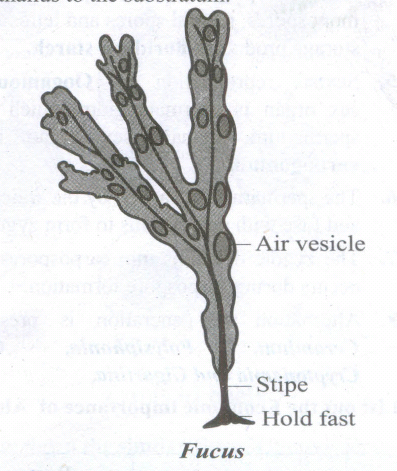
1. The members of this class are called 'Brown algae'. Majority of the forms are found in marine habitats. Pleurocladia is a freshwater form.
2. The thallus is filamentous (Ectocarpus) frond like (Dictyota) or maybe giant kelps (Laminaria: and Macrocystis).
3. The thallus is differentiated into leaf like photosynthetic part called fronds, a stalk like structure called stipe and a holdfast which attach thallus to the substratum.
4. The Pigments include Chlorophyll a, c, carotenoids and Xanthophylls. A golden brown pigment called fucoxanthin is present and it gives shades of colour from olive green to brown to the algal members of this group.
5. Mannitol and Laminarin are the reserve food materials.
6. Motile reproductive structures are present. Two laterally inserted unequal flagella are present.
7. Among these one is whiplash and another is tinsel. S. Although sexual reproduction ranges from isogamy to Oogamy, most of the forms show Oogamous type.
8. Alternation of generation is present (isomorphic, heteromorphic or diplontic). Eg: Sargassum, Laminaria, Fucus and Dictyota.

11th Standard Syllabus & Materials
11th Standard
TN 11th Tamil பீடு பெற நில் - செய்யுள் - காவடிச்சிந்து Important Questions And Answers Study Material - QB365 Set A
NEW11th Standard
TN 11th Tamil பீடு பெற நில் - உரைநடை - மலை இடப்பெயர்கள் : ஓர் ஆய்வு Important Questions And Answers Study Material - QB365 Set A
NEW11th Standard
TN 11th Tamil மாமழை போற்றுதும் - துணைப்பாடம் - யானை டாக்டர் Important Questions And Answers Study Material - QB365 Set A
NEW11th Standard
TN 11th Tamil மாமழை போற்றுதும் - செய்யுள் - ஐங்குறுநூறு Important Questions And Answers Study Material - QB365 Set A



Tamilnadu Stateboard 11th Standard Subjects

Maths

Commerce

Economics
Biology

Business Maths and Statistics

Accountancy

Computer Science

Physics

Chemistry
Maths
Biology
Economics
Physics
Chemistry

History
Business Maths and Statistics

Computer Science
Accountancy

Computer Applications
History
Computer Technology
Commerce
Computer Applications
Computer Technology

Tamil

English

French
Tamilnadu Stateboard Standards



