
 100% FREE ACCESS
11th Standard Syllabus & Materials
11th Standard
TN 11th Tamil இயற்கை வேளாண்மை,சுற்றுச்சூழல் -செய்யுள் - மனோன்மணீயம் Important Questions And Answers Study Material - QB365 Set A
NEW11th Standard
TN 11th Tamil என்னுயிர் என்பேன் -துணைப்பாடம் - இசைத்தமிழர் இருவர் Important Questions And Answers Study Material - QB365 Set A
NEW11th Standard
TN 11th Tamil மொழி கலை -செய்யுள் - ஒவ்வொரு புல்லையும் Important Questions And Answers Study Material - QB365 Set A
NEW11th Standard
TN 11th Tamil பீடு பெற நில் - இலக்கணம் - பகுபத உறுப்புகள் Important Questions And Answers Study Material - QB365 Set A
NEW11th Standard
TN 11th Tamil பீடு பெற நில் - துணைப்பாடம் - வாடிவாசல் Important Questions And Answers Study Material - QB365 Set A
NEW11th Standard
TN 11th Tamil பீடு பெற நில் - செய்யுள் - குறுந்தொகை Important Questions And Answers Study Material - QB365 Set A

Published on: 25/06/2021
QB365 provides detailed and simple solution for every Creative Questions in class 11 Biology Subject. It will helps to get more idea about question pattern in every Creative questions with solution.
Download Tamil Nadu 11th Standard Biology question papers, model tests, one-mark questions, important questions, and public exam papers in PDF format. Free study materials and answer keys for TN State Board students.
Questions + Answers key
Take MCQ Biology Test1.
Explain the various types of Schizocarpic fruit.
2.
Write the Flow Chart of Classification of Fruits
3.
Write a note on the special inflorescence. Explain any two types.
4.
Explain the types of racemose inflorescence with stick diagrams.
5.
Write a note on multiple / Composite fruits.
1.
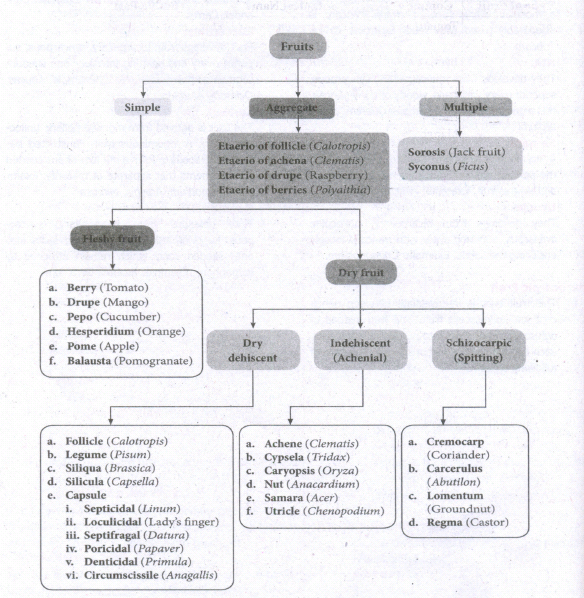
This fruit type of intermediate between dehiscent and indehiscent fruit. The fruit instead of dehiscing rather splits into number of segments, each containing one or more seeds. They are of following types:
(a) Cremocarp: Fruit develops from bicarpellary, syncarpous, inferior ovary and splitting into two one seeded segments known as mericarps. e.g., Coriander and Carrot.
(b) Carcerulus: Fruit develops from bicarpellary, syncarpous, superior ovary and splitting into four one seeded segments known as nutlets. e.g., Leucas, Ocimum and Abutilon.
(c) Lomentum: The fruit is derived from monocarpellary, unilocularovary.Aleguminous fruit, constricted between the seeds to form a number of one seeded compartments that separate at maturity. e.g., Desmodium, Arachis and Mimosa.
(d) Regma: They develops from tricarpellary, syncarpous, superior, trilocular ovary and splits into one-seeded cocci which remain attached to carpophore. e.g., Ricinus and Geranium.
2.
3.
Special Inflorescence: The inflorescences other than racemose, cymose and mixed types are coming under the special type of inflorescence.
(a) Cyathium:
1. Cyathium inflorescence consists of small unisexual flowers enclosed by a common involucre which mimics a single flower. Male flowers are organised in a scorpioid manner.
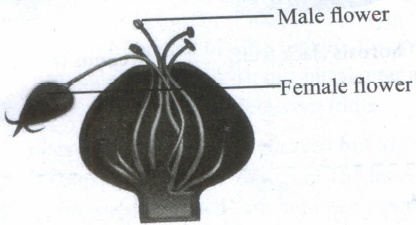
2. The female flower is solitary and centrally located on a long pedicel. The male flower is represented only by stamens and the female flower is represented only by pistil.
3. Cyathium may be actinomorphic (Eg: Euphorbia) or zygomorphic (Eg: Pedilanthus). Nectar is present in involucre.
(b) Hypanthodium:
1. The receptacle is a hollow, globose structure consisting of unisexual flowers present on the inner wall of the receptacle.
2. The receptacle is closed except a small opening called ostiole which is covered by a series of bracts.
3. Male flowers are present nearer to the ostiole, female and neutral flowers found in a mixed manner from middle below. Eg: Ficus sps.
(c) Coenanthium: Circular disc like fleshy open receptacle that bears pistillate flowers at the center and staminate flowers at the periphery. Eg: Dorstenia.
4.
Racemose Inflorescence: Main Axis is of unlimited growth and flowers are arranged in acropetal succession. Opening of flowers is centripetal.
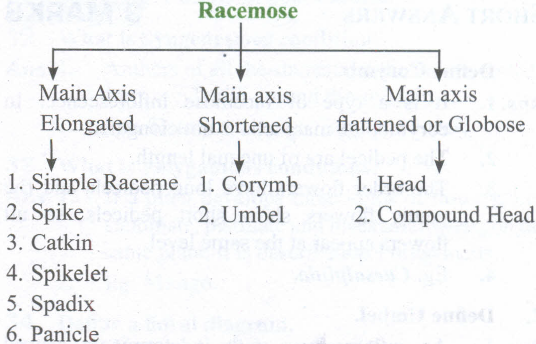
Main Axis Elongated: Axis of the inflorescence is elongated and flowers may be pedicellate or sessile.
Types:
1. Simple Raceme: Unbranched Main Axis has pedicellate flowers. Eg: Mustard.
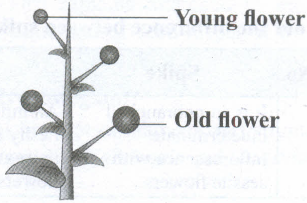
2. Spike: Unbranched Main axis with sessile flowers. Eg: Achyranthes.
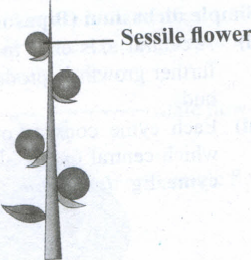
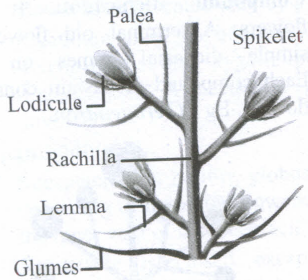
3. Spikelet: Small spike is called spikelet. The inflorescence axis has bracts at the base called glumes. Each flower has bract (lemma) and bracteole (palea). Eg: Sorghum.
4. Catkin: Pendulous spikes with long, drooping axis bearing small unisexual or bisexual flowers Eg: Acalypha hispida.
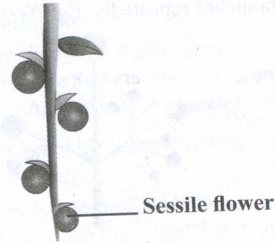
5. Spadix: Fleshy or thickened central axis with many unisexual flowers is acropetal succession. Entire inflorescence is covered by a brightly coloured bract called spathe. Eg: Colocasia.
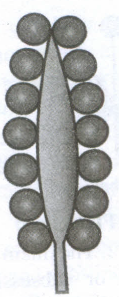
6. Panicle: A branched raceme is called panicle or compound raceme. Eg: Neem.
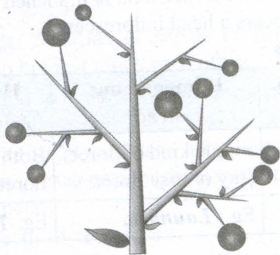
Main Axis Shortened: Inflorescence shows reduced growth of central axis.
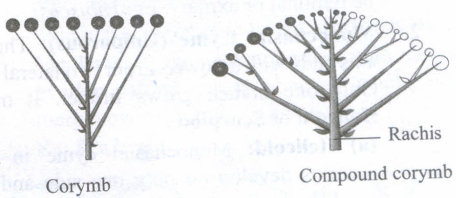
1. Corymb: Shorter pedicellate flowers at the top and longer pedicellate flowers at the bottom of the inflorescence. All flowers appear at the same level. Eg: Caesalpinia.
Compound Corymb: A branched corymb is called compound corymb. Eg: Cauliflower.
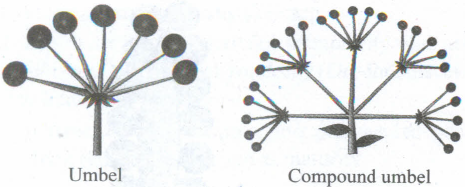
2. Umbel: Pedicellate flowers arise from tip of inflorescence axis from a common point. Eg: Allium cepa.
Compound umbel: It is a branched umbel. Each smaller unit is called umbellet. Eg: Daucus carota, Coriandrum sativum.
Main Axis Flattened:
1. Head: The Main Axis is a flattened group of sessile or subsessile flowers arising on the flattened receptacle forms a head inflorescence surrounded by involucre. Eg: Asteraceae.
2. Compound Head: In Lagasca mollis the inflorescence axis is branched and each branch bears a head inflorescence.
Types:
| S. No. | Homogamous head | Heterogamous head |
| 1 | Single kind of florets (ray or disc florets). | Both ray and disc florets are seen |
| 2 | Eg: Launaea | Eg. Tridax |
5.
A multiple or composite fruit develops from the whole inflorescence along with its peduncle on which they are borne.
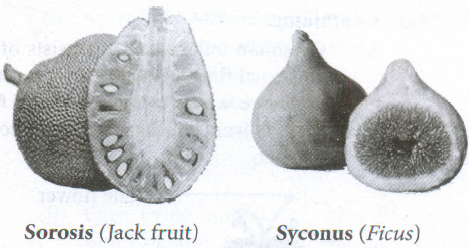
a) Sorosis: A fleshy multiple fruit which develops from a spike or spadix. The flowers fused together by their succulent perianth and at the same time, the axis bearing them become fleshy or juicy and the whole inflorescence forms a compact mass. Eg: Pineapple, Jackfruit, Mulberry
b) Syconus: A multiple fruit which develops from hypanthodium inflorescence. The receptacle develops further and converts into fleshy fruit which encloses a number of true fruit or achenes which develops from female flower of hypanthodium inflorescence. Eg: Ficus

11th Standard Syllabus & Materials
11th Standard
TN 11th Tamil பீடு பெற நில் - செய்யுள் - காவடிச்சிந்து Important Questions And Answers Study Material - QB365 Set A
NEW11th Standard
TN 11th Tamil பீடு பெற நில் - உரைநடை - மலை இடப்பெயர்கள் : ஓர் ஆய்வு Important Questions And Answers Study Material - QB365 Set A
NEW11th Standard
TN 11th Tamil மாமழை போற்றுதும் - துணைப்பாடம் - யானை டாக்டர் Important Questions And Answers Study Material - QB365 Set A
NEW11th Standard
TN 11th Tamil மாமழை போற்றுதும் - செய்யுள் - ஐங்குறுநூறு Important Questions And Answers Study Material - QB365 Set A



Tamilnadu Stateboard 11th Standard Subjects

Maths

Commerce

Economics
Biology

Business Maths and Statistics

Accountancy

Computer Science

Physics

Chemistry
Maths
Biology
Economics
Physics
Chemistry

History
Business Maths and Statistics

Computer Science
Accountancy

Computer Applications
History
Computer Technology
Commerce
Computer Applications
Computer Technology

Tamil

English

French
Tamilnadu Stateboard Standards



