
 100% FREE ACCESS
11th Standard Syllabus & Materials
11th Standard
TN 11th Tamil இயற்கை வேளாண்மை,சுற்றுச்சூழல் -செய்யுள் - மனோன்மணீயம் Important Questions And Answers Study Material - QB365 Set A
NEW11th Standard
TN 11th Tamil என்னுயிர் என்பேன் -துணைப்பாடம் - இசைத்தமிழர் இருவர் Important Questions And Answers Study Material - QB365 Set A
NEW11th Standard
TN 11th Tamil மொழி கலை -செய்யுள் - ஒவ்வொரு புல்லையும் Important Questions And Answers Study Material - QB365 Set A
NEW11th Standard
TN 11th Tamil பீடு பெற நில் - இலக்கணம் - பகுபத உறுப்புகள் Important Questions And Answers Study Material - QB365 Set A
NEW11th Standard
TN 11th Tamil பீடு பெற நில் - துணைப்பாடம் - வாடிவாசல் Important Questions And Answers Study Material - QB365 Set A
NEW11th Standard
TN 11th Tamil பீடு பெற நில் - செய்யுள் - குறுந்தொகை Important Questions And Answers Study Material - QB365 Set A

Published on: 25/06/2021
QB365 provides detailed and simple solution for every Creative Questions in class 11 Biology Subject. It will helps to get more idea about question pattern in every Creative questions with solution.
Download Tamil Nadu 11th Standard Biology question papers, model tests, one-mark questions, important questions, and public exam papers in PDF format. Free study materials and answer keys for TN State Board students.
Questions + Answers key
Take MCQ Biology Test1.
Write the Flow Chart of Edible Parts of Fruits
2.
Explain The Dry Fruit.
3.
Describe the Special Inflorescence.
4.
Explain different types of Aestivation.
5.
1.
| Edible Parts of fruit | |||
| Type of Fruit | Common Name | Botanical Name | Edible Part |
| Berry | Tomato | Lycopersicon esculentum |
Whole fruit |
| Brinjal | Solanum melongena |
Tender fruit | |
| Guava | Psidium guajava | Whole fruit | |
| date | Phoenix dactylifera | Pericarp | |
| Drupe | Mango | Mangifera indica | mesocarp |
| coconut | Cocos nucifera | Endosperm(both cellular and liquid) | |
| Pepo | Cucumber | Cucumis sativus | Whole fruit |
| Hesperidium | Citrus(Orange, Lemon) | citrus sinensis | Juicy hairs on the endocarp |
| Pome | Apple | Pyrus malus | Thalamus(false fruit) and a part of pericarp. |
| Balausta | Pomegranate | Punica granatum | Succulent testa of the seeds |
| Legume | Pea | Pisum sativum | seed |
| siliqua | Mustard | Brassica compestrisvar | seed |
| poricidal capsule | Poppy | Papaver somniferum | seeds |
| Loculicidal | Lady's finger | Abelmoschus | Tender fruit |
| Cypsela | sunflower | Helianthus annuus | seed(for oil) |
| caryopsis | Maize | Zea maize | Seed |
| Paddy | Oryza sativa | Seed | |
| Nut | Cashew nut | Anacardium occidentale |
Pedical (False fruit) and cotyledons (true fruit) |
| Cremocarp | Coriander | Coriander sativum | Mericarps |
| Lomentum | Groundnut | Arachis hypogea | Seed |
| Aggregate fruit | Custard apple | Annona squamosa | Pericarps |
| Composite fruits | |||
| Sorosis | Jackfruit | Artocarpus heterophyllus |
Perianth, seeds |
| Pineapple | Ananas comosus | Perianth, rachis | |
| Mulberry | Morus alba | Whole fruit | |
| Syconus | Fig | Ficus carica | Whole inflorescence |
2.
They develops from single ovary where the pericarp is l dry and not differentiated into epicarp, mesocarp and endocarp. It is further subdivided into two types.
Dry Dehiscent Fruit
Pericarp is dry and splits open along the sutures to liberate seeds. They can be classified into following types.
Follicle:
Fruit develops from monocarpellary, superior ovary and dehisces along one suture. Example: calotropis.
Legume or pod:
Fruit develops from monocarpellary, superior ovary and dehisces through both dorsal and ventral sutures. Example: Pisum.
Siliqua:
Fruit develops from bicarpellary, syncarpous, superior ovary initially one chambered but subsequently becomes two chambered due to the formation of false septum (replum). The fruit dehisces along two suture. Example: Brassica.
Silicula:
Fruit similar to sliqua but shorter and broader. Example: Capsella, Lepidium, Alyssum.
Capsule:
Fruit develops from multicarpellary, syncarpous, superior ovary. Based on the dehiscence pattern they are sub divided into.
Septicidal:
Capsule splitting along septa and valves remaining attached to septa. Example: Linum, Aristolochia.
Loculicidal:
Capsule splitting along locules and values remaining attached to septa. Example: Lady's finger. Septifragal:
Capsule splitting so that valves fall off leaving seeds attached to the centra. axis. Example: Datura. Poricidal:
Dehiscence through terminal pores. Example Papaver.
Denticidal:
Capsule opening at top exposing a number of teeth. Example: Primula, Cerastium. Circumscissile (pyxidium) Dehisces transversely so that top comes off as a lid or operculum. Example: Anagallis arvensis, Portulaca, Operculina.
Dry Indehiscent Fruit:
Dry fruit which does not split open at maturity. It is subdivided into.
Achene:
Single seeded dry fruit developing from single carpel with superior ovary. Achenes commonly develop from apocarpous pistil, Fruit wall is free from seed coat. Example: Clematis, Delphinium, Strawberry.
Cypsela:
Single seeded dry fruit, develops from bicarpellary, syncarpous, inferior ovary with reduced scales, hairy or feathery calyx lobes. Example: Tridax, Helianthus.
Caryopsis:
It is a one seeded fruit which develops from a monocarpellary, superior ovary. Pericarp is inseparably fused with seed. Example: Oryza, Triticum.
Nut:
They develops from mulicarpellary, syncarpous, superior ovary with hard, woody or bony pericarp. It is a one-seeded fruit. Example: Quercus, Anacardium.
Samara:
A dry indehiscent, one seeded fruit in which the pericarp devlops into thin winged structure around the fruit. Example: Acer, Pterocarpous.
Utricle:
They develop from. bicarpellary, unilocular, syncarpus, superior ovary with pericarp loosely enclosing the seeds. Example: Chenopodium.
Schizocarpic Fruit :
This fruit type is intermediate between dehiscent and indehiscent fruit. The fruit instead of dehiscing rather split into number of segments, each containing one or more seeds. They are of following types.
Cremocarp:
Fruit develops from bicarpellary, syncarpous, inferior ovary and splitting into two one seeded segments known as mericarps. Example: Coriander, Carrot.
Carcerulus:
Fruit develops from bicarpellary, syncarpous, superior ovary and splitting into four one seeded segments known as nutlets. Example: Leucas, Ocimum, Abutilon
Lomentum:
The fruit is derived from monocarpellary, unilocular ovary. A leguminous fruit, constricted between the seeds to form a number of one seeded compartment that separates at maturity. Example: Desmodium, Arachis, Mimosa
Regma:
They develops from tricarpellary, syncarpous, superior, trilocular ovary and splits into one- seeded cocci which remain attached to carpophore. Example: Ricinus, Geranium.
3.
The inflorescences do not show any of the development pattern types are classified under special type of inflorescence.
Cyathium:
Cyathium inflorescence consists of small unisexual flowers enclosed by .acommon involucre which mimics a single. flower. Male flowers are organised in a scorpioid manner. Female flower is solitary and centrally located on a long pedicel. Male flower is represented only by stamens and female flower is represented only by pistil. Cyathium may be actinomorphic (Example: Euphorbia) or zygomorphic (Example: Pedilanthus.) Nectar is present in involucre.
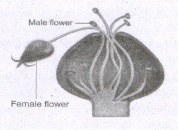
Hypanthodium:
Receptacle is a hollow, globose structure consisting unisexual flowers present on the inner wall of the receptacle. Receptacle is closed except a small opening called ostiole which is covered by a series of bracts. Male flowers are present nearer to the ostiole, female and neutral flowers are found in a mixed manner from middle below. Example: Ficus sp. (Banyan and Pipal). Coenanthium:
Circular disc like fleshy open receptacle that bears pistillate flowers at the center and staminate flowers at the periphery. Example: Dorstenia
4.
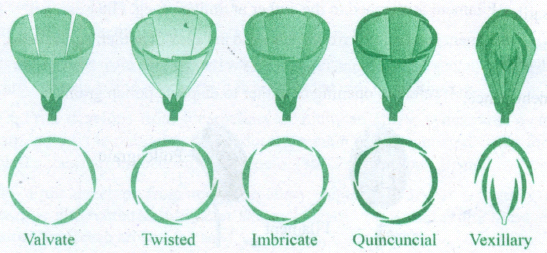
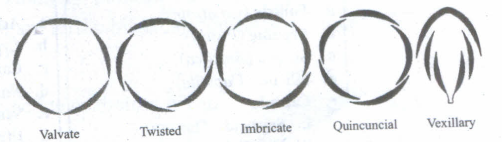
(i) Valvate: Margins of sepals or petals do not overlap but just touch each other. eg. Calyx in members of Malvaceae, Calotropis, Annona.
(ii) Twisted or convolute or contorted: One margin of each petal or sepal overlapping on the other petal. ego Petals of chinarose.
(iii) Imbricate: Sepals and petals irregularly overlap on each other; one member of the whorl is exterior, one interior and rest of the three having one margin exterior and the other interior. ego Cassia, Delonix. There are three types: (i) Ascendingly imbricate, (ii) Quincuncial, (iii) Vexillary.
(iv) Quincuncial: It is a type of imbricate aestivation in which two petals are external and two internal and one petal with one margin internal and the other margin external. ego Guava,calyx of Ipomoea, Catharanthus.
(v) Vexillary: Large posterior petals both margins overlap lateral petals. Lateral petals other margin overlaps anterior petals. eg. Pea, bean.
5.

11th Standard Syllabus & Materials
11th Standard
TN 11th Tamil பீடு பெற நில் - செய்யுள் - காவடிச்சிந்து Important Questions And Answers Study Material - QB365 Set A
NEW11th Standard
TN 11th Tamil பீடு பெற நில் - உரைநடை - மலை இடப்பெயர்கள் : ஓர் ஆய்வு Important Questions And Answers Study Material - QB365 Set A
NEW11th Standard
TN 11th Tamil மாமழை போற்றுதும் - துணைப்பாடம் - யானை டாக்டர் Important Questions And Answers Study Material - QB365 Set A
NEW11th Standard
TN 11th Tamil மாமழை போற்றுதும் - செய்யுள் - ஐங்குறுநூறு Important Questions And Answers Study Material - QB365 Set A



Tamilnadu Stateboard 11th Standard Subjects

Maths

Commerce

Economics
Biology

Business Maths and Statistics

Accountancy

Computer Science

Physics

Chemistry
Maths
Biology
Economics
Physics
Chemistry

History
Business Maths and Statistics

Computer Science
Accountancy

Computer Applications
History
Computer Technology
Commerce
Computer Applications
Computer Technology

Tamil

English

French
Tamilnadu Stateboard Standards



