
 100% FREE ACCESS
11th Standard Syllabus & Materials
11th Standard
TN 11th Tamil இயற்கை வேளாண்மை,சுற்றுச்சூழல் -செய்யுள் - மனோன்மணீயம் Important Questions And Answers Study Material - QB365 Set A
NEW11th Standard
TN 11th Tamil என்னுயிர் என்பேன் -துணைப்பாடம் - இசைத்தமிழர் இருவர் Important Questions And Answers Study Material - QB365 Set A
NEW11th Standard
TN 11th Tamil மொழி கலை -செய்யுள் - ஒவ்வொரு புல்லையும் Important Questions And Answers Study Material - QB365 Set A
NEW11th Standard
TN 11th Tamil பீடு பெற நில் - இலக்கணம் - பகுபத உறுப்புகள் Important Questions And Answers Study Material - QB365 Set A
NEW11th Standard
TN 11th Tamil பீடு பெற நில் - துணைப்பாடம் - வாடிவாசல் Important Questions And Answers Study Material - QB365 Set A
NEW11th Standard
TN 11th Tamil பீடு பெற நில் - செய்யுள் - குறுந்தொகை Important Questions And Answers Study Material - QB365 Set A

Published on: 13/05/2022
QB365 provides detailed and simple solution for every Creative Questions in class 11 Biology Subject. It will helps to get more idea about question pattern in every Creative questions with solution.
latest Creative QuestionsDownload Tamil Nadu 11th Standard Biology question papers, model tests, one-mark questions, important questions, and public exam papers in PDF format. Free study materials and answer keys for TN State Board students.
Questions + Answers key
Take MCQ Biology Test1.
Explain terminal oxidation' in Respiration / Chemiosmotic theory.
2.
Explain the Krebs Cycle. (Explanation (or) Flow Chart)
3.
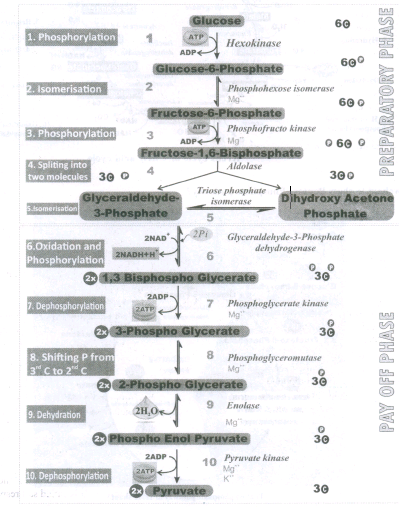
Outline the steps involved in glycolysis (Flow chart).
4.
What are the factors which influence respiration process? Explain.
5.
Differentiate aerobic respiration from anaerobic respiration.
1.
1) During glycolysis, link reaction and Krebs cycle the respiratory substrates are oxidised at several : steps and as a result many reduced coenzymes : NADH+ H+ and FADH2 are produced.
2) These reduced coenzymes are transported to inner membrane of mitochondria which are converted back to their oxidised forms produce electrons and protons.
3) In mitochondria, the inner membrane is folded in the form of finger projections towards the matrix called cristae. In cristae many oxysomes (F1 particles) are present which have electron transport carriers are present. According to Peter Mitchell's Chemiosmotic theory this I electron transport is coupled to ATP synthesis. : Electron and hydrogentproton) transport takes I place across four multiprotein complexes(I-IV).They are
1. Complex-I (NADH dehydrogenase):
i) It contains a flavoprotein(FMN) and I associated with non-heme iron Sulphur protein (Fe-S). This complex is responsible: for passing electrons and protons from : mitochondrial NADH (Internal) to Ubiquinone(UQ).
NADH + H+ + UQ⇌NAD+ + UQH2
ii) In plants, an additional NADH dehydrogenase (External) complex is present on the outer surface of inner membrane of mitochondria which can oxidise cytosolic NADH + H+.
2. Complex-Il (Succinic dehydrogenase) i) It contains FAD flavoprotein is associated with non-heme iron Sulphur (Fe-S) protein. ii) This complex receives electrons and protons from succinate in Krebs cycle and is converted into fumarate and passes to ubiquinone.
Succinate + UQ⟶ Fumarate + UQH2
3. Complex-Ill (C) tochrome bCI complex) This complex oxidises reduced ubiquinone (ubiquinol) and transfers the electrons through Cytochrome bc, Complex (Iron Sulphur center bCI complex) to cytochrome c.
UQH2+2Cyt coxidised⇌UQ+2Cyt creduced+2H+
4. Complex IV (Cytochrome c oxidase) i) This complex contains two copper centers (A and B) and cytochromes a and a3. Complex IV is the terminal oxidase and brings about the reduction of 1/2 O2 to H2O. Two protons are needed to form a molecule of H2O (terminal oxidation).
2Cyt coxidised+2H++1/2O2⇌2Cyt creduced+H2O
ii) The transfer of electrons from reduced coenzyme NADH to oxygen via complexes I to IV is coupled to the synthesis of ATP from ADP and inorganic phosphate (Pi) which is called Oxidative phosphorylation. This occurs during Aerobic respiration Fof, - ATP synthase (also called complex V) consists of F0 and F1. F1 converts ADP and Pi to ATP and is attached to the matrix side of the inner membrane. F0 is present in inner membrane and acts as a channel through which protons come into matrix.
a) Oxidation of one molecule of NADH + H+ = 3 molecules of ATP
b) oxidation of one molecule of FADH2 = 2 molecules of ATP
iii) But the Mechanism of mitochondrial ATP synthesis is based on Chemiosmotic hypothesis. According to this theory electron carriers present in the inner mitochondrial membrane allow for the transfer of protons (H+).
iv) For the production of single ATP, 3 protons (H+) are needed. The terminal oxidation of external NADH bypasses the first phosphorylation site and hence only two ATP molecules are produced per external NADH oxidised through mitochondrial electron transport chain. Complete oxidation of a glucose molecule in aerobic respiration results in the net gain of 36 ATP molecules in plants.
2.
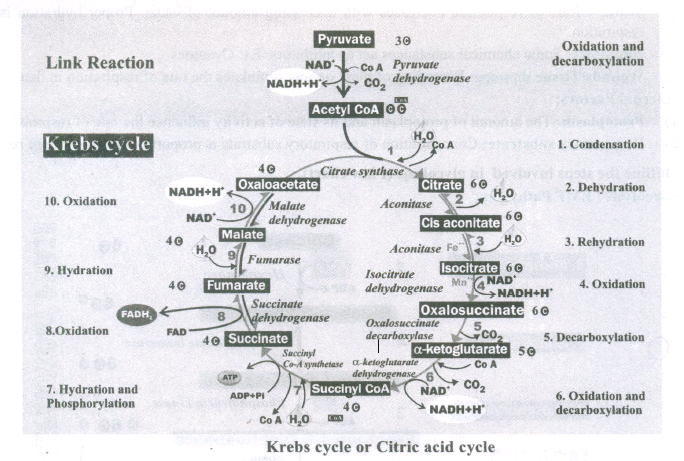
Explanation with
Substrates
Enzymes
ATP, NADH2, FADH2
3.
Glycolysis / EMP Pathyway:
4.
External Factors:
1) Temperature: Optimum temperature for respiration is 30°C. At low temperatures and very high temperatures rate of respiration decreases
2) Oxygen: When sufficient amount of O2 is available the rate of aerobic respiration will be optimum and anaerobic respiration is completely stopped. This is called Extinction point.
3) Carbon di oxide: High concentration of CO2 reduces the rate of respiration
4) Salt respiration: A plant or tissue transferred from water to salt solution will increase the rate of respiration. It is called salt respiration.
5) Light: Light is an indirect factor affecting the rate of respiration
6) Water: Rate of respiration decreases with decreasing amount of water. Proper hydration is essential for respiration.
7) Inhibitors: Some chemical substances act as inhibitors. Ex: Cyanides
8) Wounds/Tissue damage: Wounding of plant organs stimulates the rate of respiration in that region.
Internal Factors:
1) Protoplasm: The amount of protoplasm and its state of activity influence the rate of respiration
2) Respiratory substrate: Concentration of respiratory substrate is proportional to the rate of respiration.
5.
| S.No. | Aerobic respiration | Anacrobic Respiration |
| 1 | It occurs in all living cells of higher organisms. | It occurs yeast and some bacteria. |
| 2 | It requires oxygen for breaking the respiratory substrate. | Oxygen is not required for breaking the respiratory substrate. |
| 3 | The end products are CO2 and H2O | The end products are alcohol, and CO2 (or) lactic acid . |
| 4 | Oxidation of one molecule of glucose produces 36 ATP molecules. | Only 2ATP molecules are produced. |
| 5 | It consists of four stages-glycolysis, link reaction, TCA cycle and electron transport chain | It consists of two stages-glycolysis and fermentation. |
| 6 | It occurs in cytoplasm and mitochondria. | It occurs only in cytoplasm. |

11th Standard Syllabus & Materials
11th Standard
TN 11th Tamil பீடு பெற நில் - செய்யுள் - காவடிச்சிந்து Important Questions And Answers Study Material - QB365 Set A
NEW11th Standard
TN 11th Tamil பீடு பெற நில் - உரைநடை - மலை இடப்பெயர்கள் : ஓர் ஆய்வு Important Questions And Answers Study Material - QB365 Set A
NEW11th Standard
TN 11th Tamil மாமழை போற்றுதும் - துணைப்பாடம் - யானை டாக்டர் Important Questions And Answers Study Material - QB365 Set A
NEW11th Standard
TN 11th Tamil மாமழை போற்றுதும் - செய்யுள் - ஐங்குறுநூறு Important Questions And Answers Study Material - QB365 Set A



Tamilnadu Stateboard 11th Standard Subjects

Maths

Commerce

Economics
Biology

Business Maths and Statistics

Accountancy

Computer Science

Physics

Chemistry
Maths
Biology
Economics
Physics
Chemistry

History
Business Maths and Statistics

Computer Science
Accountancy

Computer Applications
History
Computer Technology
Commerce
Computer Applications
Computer Technology

Tamil

English

French
Tamilnadu Stateboard Standards



