
 100% FREE ACCESS
11th Standard Syllabus & Materials
11th Standard
TN 11th Tamil இயற்கை வேளாண்மை,சுற்றுச்சூழல் -செய்யுள் - மனோன்மணீயம் Important Questions And Answers Study Material - QB365 Set A
NEW11th Standard
TN 11th Tamil என்னுயிர் என்பேன் -துணைப்பாடம் - இசைத்தமிழர் இருவர் Important Questions And Answers Study Material - QB365 Set A
NEW11th Standard
TN 11th Tamil மொழி கலை -செய்யுள் - ஒவ்வொரு புல்லையும் Important Questions And Answers Study Material - QB365 Set A
NEW11th Standard
TN 11th Tamil பீடு பெற நில் - இலக்கணம் - பகுபத உறுப்புகள் Important Questions And Answers Study Material - QB365 Set A
NEW11th Standard
TN 11th Tamil பீடு பெற நில் - துணைப்பாடம் - வாடிவாசல் Important Questions And Answers Study Material - QB365 Set A
NEW11th Standard
TN 11th Tamil பீடு பெற நில் - செய்யுள் - குறுந்தொகை Important Questions And Answers Study Material - QB365 Set A

Published on: 13/05/2022
QB365 provides detailed and simple solution for every Creative Questions in class 11 Biology Subject. It will helps to get more idea about question pattern in every Creative questions with solution.
latest Creative QuestionsDownload Tamil Nadu 11th Standard Biology question papers, model tests, one-mark questions, important questions, and public exam papers in PDF format. Free study materials and answer keys for TN State Board students.
Questions + Answers key
Take MCQ Biology Test1.
Describe the internal structure of a dicot leaf. (Diagram not necessary)
2.
Explain anatomy of dicot root?
3.
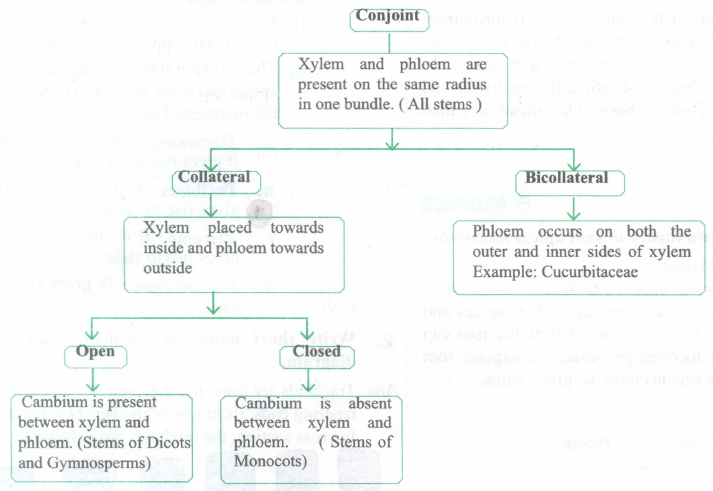
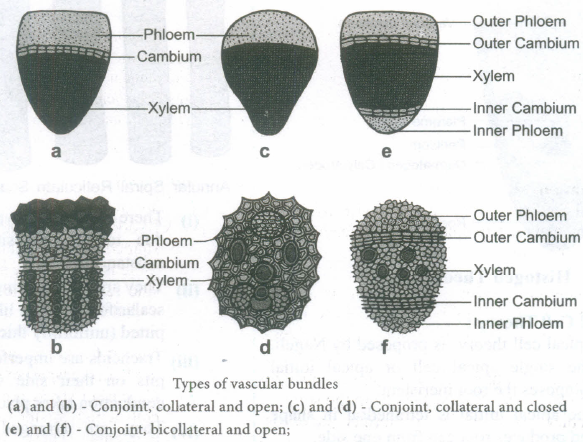
Write a note on conjoint vascular bundles.
4.
Write short notes on tracheids with labelled diagram.
5.
Explain any two theory of root apical meristem
1.
Epidermis:
1. This leaf is generally dorsiventral. It has upper and lower epidermis. The epidermis is usually made up of a single layer of cells that are closely packed.
2. The cuticle on the upper epidermis is thicker than that of lower epidermis.
3. The minute openings found on the epidermis are called stomata.
4. Stomata are more in number on the lower epidermis than on the upper epidermis. A stomata is surrounded by a pair of bean-shaped cells called guard cells.
5. The main function of the epidermis is to give protection to the inner tissue called mesophyll. The cuticle helps to check transpiration. Stomata are used for transpiration and gas exchange.
Mesophyll
1. The entire tissue between the upper and lower epidermis is called the mesophyll
2. There are two regions in the mesophyll. They are palisade parenchyma and spongy parenchyma.
3. Palisade parenchyma cells are seen beneath the upper epidermis. It consists of vertically elongated cylindrical cells in one or more layers. These cells are compactly arranged and are generally without intercellular spaces. Palisade parenchyma cells contain more chloroplasts than the spongy parenchyma cells. The function of palisade parenchyma is photosynthesis.
4. Spongy parenchyma lies below the palisade parenchyma.
5. Spongy cells are irregularly shaped. These cells are very loosely arranged with numerous airspaces.
6. Spongy cells facilitate the exchange of gases with the help of air spaces. The air space that is found next to the stomata is called respiratory cavity or substomatal cavity.
Vascular Tissues
1. Vascular tissues are present in the veins of leaf. Vascular bundles are conjoint, collateral and closed.
2. Xylem is present towards the upper epidermis, while the phloem towards the lower epidermis. Vascular bundles are surrounded by a compact layer of parenchymatous cells called bundle sheath or border parenchyma.
2.
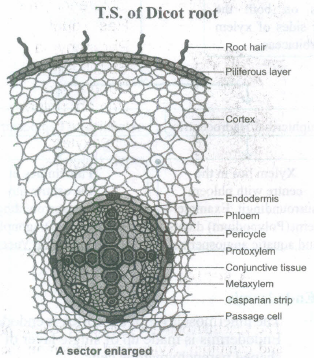
The transverse section of the dicot root (Bean) shows the following plan of arrangement of tissues from the periphery to the centre.
Piliferous Layer or Epiblema
1. The outermost layer of the root is called piliferous layer or epiblema. It is made up of single layer of compactly arranged parenchyma cells.
2. It possesses root hairs which are single celled to absorb water and mineral salts from the soil.
3. The chief function of piliferous layer is protection.
Cortex
Cortex consists of only parenchyma cells. These cells are loosely arranged with intercellular spaces to make gaseous exchange easier. These cells may store food reserves.
Endodermis
1. The innermost layer of the cortex is endodermis. Endodermis is made up of single layer of barrel shaped parenchymatous cells.
2. Stele is completely surrounded by endodermis.
3. The radial and the inner tangential walls of endodermal cells are thickened with suberin and lignin. This thickening was first noted by Robert Casparay in 1965. So these thickenings are called casparian strips.
4. Casparian strips are absent in the endodermal cells which are located opposite the proto xylem elements. These thin-walled cells without casparian strips are called passage cells through which water and mineral salts are conducted from the cortex to the xylem elements.
Stele
All the tissues present inside endodermis comprise the stele. It includes pericycle and vascular system.
Pericycle
1. Pericycle is generally a single, layer of parenchymatous cells found inner to the endodermis.
2. Lateral roots originate from the pericycle.
Vascular System
1. Vascular tissues are in radial arrangement. The tissue by which xylem and phloem are separated is called conjunctive tissue. In bean, the conjuctive tissue is composed of parenchyma tissue.
2. Xylem is in exarch condition. The number of protoxylem points is four and so the xylem is called tetrach.
3. Each phloem patch consists of sieve tubes, companion cells and phloem parenchyma. Metaxylem vessels are generally polygonal in shape.
3.
4.
Tracheids are dead, lignified and elongated cells with tapering ends. Its lumen is broader than that of fibres. In cross section, the tracheids are polygonal.
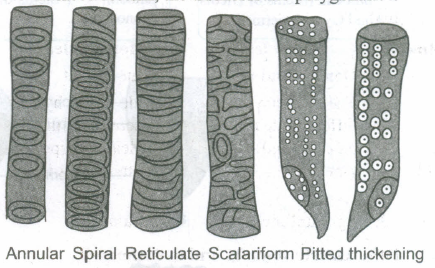
(i) There are different types of cell wall thickenings due to the deposition of secondary wall substances.
(ii) They are annular (ring like), spiral (spring like), scalariform (ladder like) reticulate (net like) and pitted (uniformly thick except at pits).
(iii) Tracheids are imperforated cells with bordered pits on their side walls. Only through this conduction takes place in Gymnosperms.
(iv) They are arranged one above the other Tracheids are chief water conducting elements in Gymnosperms and Pteridophytes.
(v) They also offer mechanical support to the plants.
5.
Root Apical Meristem:
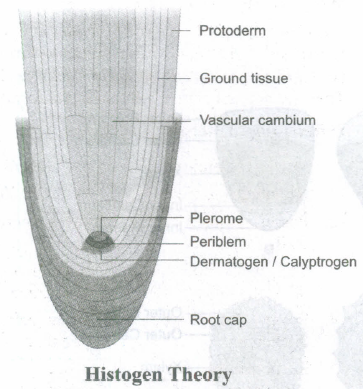
Root apex is present opposite to the hoot apex. The roots contain root cap at their apices and the apical meristem is present below the root cap. The different theories proposed to explain root apical meristem organization is given below.
1. Apical Cell Theory:
(i) Apical cell theory is proposed by Nageli. The single apical cell or apical initial composes the root meristem.
(ii) The apical initial is tetrahedral in shape and produces a root cap from one side.
(iii) The remaining three sides produce epidermis, cortex, and vascular tissues. It is found in vascular cryptogams.
2. Histogen Theory :
(i) Histogen theory is proposed by Hanstein (1868) and supported by Strassburger.
(ii) The histogen theory as applied to the root apical meristem speaks of four histogen in the meristem. They are:
a. Dermatogen - It is the outermost layer. It gives rise to the root epidermis.
b. Periblem - It is a middle layer. It gives rise to the cortex.
c. Plerome - It is the innermost layer. It gives rise to stele
d. Calyptrogen - It gives rise to root cap.

11th Standard Syllabus & Materials
11th Standard
TN 11th Tamil பீடு பெற நில் - செய்யுள் - காவடிச்சிந்து Important Questions And Answers Study Material - QB365 Set A
NEW11th Standard
TN 11th Tamil பீடு பெற நில் - உரைநடை - மலை இடப்பெயர்கள் : ஓர் ஆய்வு Important Questions And Answers Study Material - QB365 Set A
NEW11th Standard
TN 11th Tamil மாமழை போற்றுதும் - துணைப்பாடம் - யானை டாக்டர் Important Questions And Answers Study Material - QB365 Set A
NEW11th Standard
TN 11th Tamil மாமழை போற்றுதும் - செய்யுள் - ஐங்குறுநூறு Important Questions And Answers Study Material - QB365 Set A



Tamilnadu Stateboard 11th Standard Subjects

Maths

Commerce

Economics
Biology

Business Maths and Statistics

Accountancy

Computer Science

Physics

Chemistry
Maths
Biology
Economics
Physics
Chemistry

History
Business Maths and Statistics

Computer Science
Accountancy

Computer Applications
History
Computer Technology
Commerce
Computer Applications
Computer Technology

Tamil

English

French
Tamilnadu Stateboard Standards



