
 100% FREE ACCESS
11th Standard Syllabus & Materials
11th Standard
TN 11th Tamil இயற்கை வேளாண்மை,சுற்றுச்சூழல் -செய்யுள் - மனோன்மணீயம் Important Questions And Answers Study Material - QB365 Set A
NEW11th Standard
TN 11th Tamil என்னுயிர் என்பேன் -துணைப்பாடம் - இசைத்தமிழர் இருவர் Important Questions And Answers Study Material - QB365 Set A
NEW11th Standard
TN 11th Tamil மொழி கலை -செய்யுள் - ஒவ்வொரு புல்லையும் Important Questions And Answers Study Material - QB365 Set A
NEW11th Standard
TN 11th Tamil பீடு பெற நில் - இலக்கணம் - பகுபத உறுப்புகள் Important Questions And Answers Study Material - QB365 Set A
NEW11th Standard
TN 11th Tamil பீடு பெற நில் - துணைப்பாடம் - வாடிவாசல் Important Questions And Answers Study Material - QB365 Set A
NEW11th Standard
TN 11th Tamil பீடு பெற நில் - செய்யுள் - குறுந்தொகை Important Questions And Answers Study Material - QB365 Set A

Published on: 26/06/2021
QB365 provides detailed and simple solution for every Creative Questions in class 11 Biology Subject. It will helps to get more idea about question pattern in every Creative questions with solution.
Download Tamil Nadu 11th Standard Biology question papers, model tests, one-mark questions, important questions, and public exam papers in PDF format. Free study materials and answer keys for TN State Board students.
Questions + Answers key
Take MCQ Biology Test1.
Explain the uses of Ganongs potometer.
2.
Explain starch - sugar inter conversion theory
3.
Explain 'routes' for path of water across root cells.
4.
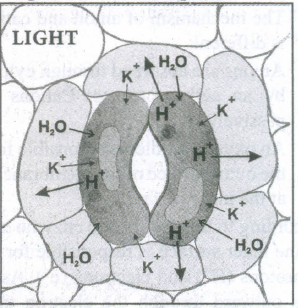
Explain theory of K+ transport for mechanism of stomatal movement.
5.
Explain Munch Mass flow, hypothesis and its applications to plants
1.
1. Ganongs potometer is used to measure the rate of transpiration indirectly. In this, the amount of water absorbed is measured and assumed that this amount is equal to the amount of water transpired.
2. Apparatus consists of a horizontal graduated tube which is bent in opposite directions at the ends.
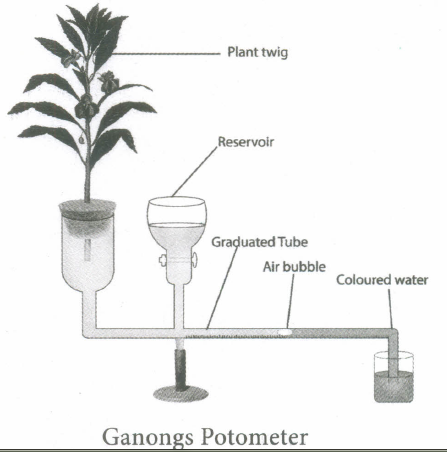
3. One bent end is wide and the other is narrow.
4. A reservoir is fixed to the horizontal tube near the wider end.
5. The reservoir has a stopcock to regulate water flow. The apparatus is filled with water from a reservoir.
6. A twig or a small plant is fixed to the wider arm through a split cock.
7. The other bent end of the horizontal tube is dipped into a beaker containing coloured water.
8. An air bubble is introduced into the graduated tube at the narrow end. Keep this apparatus in bright sunlight and observe
9. As transpiration takes place, the air bubble will move towards the twig. The loss is compensated by water absorption through the xylem portion of the twig. Thus, the rate of water absorption is equal to the rate of transpiration.
2.
i, According to Lloyd (1908), turgidity of guard cell depends on interconversion, of starch and sugar. It was supported by Loftfield (1921) as he found guard cells containing sugar during the daytime when they are open and starch during the night when they are closed.
ii. Sayre (1920) observed that the opening and closing of stomata depends upon change in pH of guard cells. According to him stomata open at high pH during day time and become closed at low pH at night. Utilization of CO2 by photosynthesis during light period causes an increase in pH resulting in the conversion of starch to sugar. Sugar increase in cell favours endosmosis and increases the turgor pressure which leads to opening of stomata. Likewise, accumulation of CO2 in cells during night decrease the pH level resulting in the conversion of sugar to starch. Starch decreases the turgor pressure of guard cell and stomata close.
iii. The discovery of enzyme phosphorylase in guard cells by Hanes (1940) greatly supports the starch-sugar interconversion theory. The enzyme phosphorylase hydrolyses starch into sugar and high pH followed by endosmosis and the opening of stomata during light. The vice versa takes place during the night.
iv. Steward (1964) proposed a slightly modified scheme of starch-sugar interconversion theory. According to him, Glucose-l-phosphate is osmotically inactive. Removal of phosphate from Glucose-l-phosphate converts to Glucose which is osmotically active and increases the concentration of guard cell leading to opening of stomata.
Objections to Starch-sugar interconversion theory
i. In monocots, guard cell does not have starch.
ii. There is no evidence to show the presence of sugar at a time when starch disappears and stomata open.
iii. It fails to explain the drastic change in pH from 5 to 7 by change of CO2.
3.
Water is first absorbed by root hair and other epidermal cells through imbibition from soil and moves radially and centripetally across the cortex, endodermis, pericycle and finally reaches xylem elements osmotically.
There are three possible routes of water. They are i) Apoplast ii) Symplast iii) Transmembrane route.
1. Apoplast: The apoplast (Greek: apo = away; plast = cell) consists of ever.ything external to the plasma membrane of the living cell. The apoplast includes cell walls, extra cellular spaces and the interior of dead cells such as vessel elements and tracheids. In the apoplast pathway, water moves exclusively through the cell wall or the non-living part of the plant without crossing any membrane. The apoplast is a continuous system
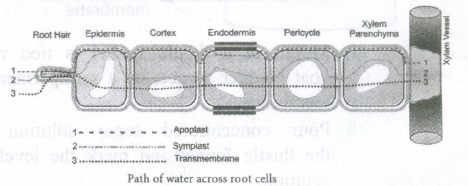
2. Symplast: The symplast (Greek: sym = within; plast = cell) consists of the entire mass of cytosol of all the living cells in a plant, as well as the plasmodesmata, the cytoplasmic channel that interconnects them.
In the symplastic route, water has to cross plasma membrane to enter the cytoplasm of outer root cell; then it will move within adjoining cytoplasm through plasmodesmata around the vacuoles without the necessity to cross more membrane, till it reaches xylem.
3. Transmembrane route: In transmembrane pathway water sequentially enters a cell on one side and exits from the cell on the other side. In this pathway, water crosses at least two membranes for each cell. Transport across the tonoplast is also involved.
4.
Theory of K+ transport :
This theory was proposed by Levit (1974) and elaborated by Raschke (1975). According to this theory, the following steps are involved in the stomatal opening in light:
1. In guard cell, starch is converted into organic acid (malic acid).
2. Malic acid in guard cell dissociates to malate anion and proton (H+).
3. The protons are transported through the membrane into the nearby subsidiary cells with the exchange of K+ (Potassium ions) from subsidiary cells to guard cells. This process involves an electrical gradient and is called ion exchange.
4. This ion exchange is an active process and consumes ATP for energy.
5. Increased K+ ions in the guard cell are balanced by CI- ions. Increase in solute concentration decreases the water potential in the guard eel.
6. Guard cell becomes hypertonic and favours the entry of water from surrounding cells.
7. Increased turgor pressure due to the entry of water opens the stomatal pore.
In Dark :
1. In dark photosynthesis stops and respiration continues with accumulation of CO2 in the substomatal cavity
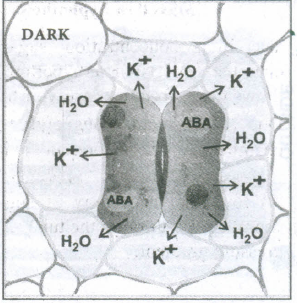
2. Accumulation of CO2 in cell lowers the pH level.
3. Low pH and a shortage of water III the guard I cell activate the stress hormone Abscisic acid : (ABA).
4. ABA stops further entry of K+ ions and also I induce K+ ions to leak out to subsidiary cells : from guard cell.
5. Loss of water from guard cell reduces turgor pressure and causes closure of stomata.
5.
Munch Mass Flow hypothesis:
(i) The mass flow theory was first proposed by Munch (1930) and elaborated by Crafts (1938).
(ii) According to this hypothesis, organic substances or solute move from the region of high osmotic pressure (from mesophyll) to the region of low osmotic pressure along the turgor pressure gradient.
(iii) The principle involved in this hypothesis can be explained by a simple physical system as shown Two chambers "A" and "B" made up of semipermeable membranes are connected by tube "T" interested in a reservoir of water. Chamber "A" contains highly concentrated sugar solution while chamber "B" contains dilute sugar solution. The following changes were observed in the system,
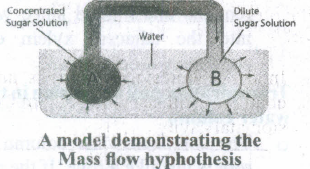
(a) The high concentration sugar solution of chamber "A" is in a hypertonic state which draws water from there servoir by endosmosis.
(b) Due to the continuous entry of water into chamber "A", turgor pressure is increased.
(c) Increase in turgor pressure in chamber "A" force,the mass flow of sugar solution to chamber "B" through the tube "T" along turgor pressure gradient.
(d) The movement of solute will continue till the solution in both the chambers attains the state of isotonic condition and the system becomes inactive.
(e) However, if a new sugar solution is added in chamber "A", the system will start to run again
A similar analogous system as given ID the experiment exists in plants:
i) Chamber "A" is analogous to mesophyll cells of the leaves which contain a higher concentration of food material insoluble form. In short "A" is the production point called "source".
ii) Chamber,"B" is analogous to cells of stem and roots where the food material is utilized. In short "B" is the consumption end called "sink".
iii) Tube "T" is analogous to the sieve tube of phloem.
iv) Mesophyll cells draw water from the xylem (reservoir of the experiment) of the leaf by endosmosis leading to an increase in the turgor pressure of mesophyll cells.
v) The turgor pressure in the cells of stem and the roots are comparatively low and hence, the soluble organic solutes begin to flow en masse from mesophyll through the phloem to the cells of stem and roots along with the gradient turgor pressure.
vi) In the cells of stem and roots, the organic solutes are either consumed or converted into insoluble form and the excess water is released into xylem (by turgor pressure gradient) through cambium.

11th Standard Syllabus & Materials
11th Standard
TN 11th Tamil பீடு பெற நில் - செய்யுள் - காவடிச்சிந்து Important Questions And Answers Study Material - QB365 Set A
NEW11th Standard
TN 11th Tamil பீடு பெற நில் - உரைநடை - மலை இடப்பெயர்கள் : ஓர் ஆய்வு Important Questions And Answers Study Material - QB365 Set A
NEW11th Standard
TN 11th Tamil மாமழை போற்றுதும் - துணைப்பாடம் - யானை டாக்டர் Important Questions And Answers Study Material - QB365 Set A
NEW11th Standard
TN 11th Tamil மாமழை போற்றுதும் - செய்யுள் - ஐங்குறுநூறு Important Questions And Answers Study Material - QB365 Set A



Tamilnadu Stateboard 11th Standard Subjects

Maths

Commerce

Economics
Biology

Business Maths and Statistics

Accountancy

Computer Science

Physics

Chemistry
Maths
Biology
Economics
Physics
Chemistry

History
Business Maths and Statistics

Computer Science
Accountancy

Computer Applications
History
Computer Technology
Commerce
Computer Applications
Computer Technology

Tamil

English

French
Tamilnadu Stateboard Standards



