
 100% FREE ACCESS
11th Standard Syllabus & Materials
11th Standard
TN 11th Tamil இயற்கை வேளாண்மை,சுற்றுச்சூழல் -செய்யுள் - மனோன்மணீயம் Important Questions And Answers Study Material - QB365 Set A
NEW11th Standard
TN 11th Tamil என்னுயிர் என்பேன் -துணைப்பாடம் - இசைத்தமிழர் இருவர் Important Questions And Answers Study Material - QB365 Set A
NEW11th Standard
TN 11th Tamil மொழி கலை -செய்யுள் - ஒவ்வொரு புல்லையும் Important Questions And Answers Study Material - QB365 Set A
NEW11th Standard
TN 11th Tamil பீடு பெற நில் - இலக்கணம் - பகுபத உறுப்புகள் Important Questions And Answers Study Material - QB365 Set A
NEW11th Standard
TN 11th Tamil பீடு பெற நில் - துணைப்பாடம் - வாடிவாசல் Important Questions And Answers Study Material - QB365 Set A
NEW11th Standard
TN 11th Tamil பீடு பெற நில் - செய்யுள் - குறுந்தொகை Important Questions And Answers Study Material - QB365 Set A

Published on: 25/06/2021
QB365 provides detailed and simple solution for every Creative Questions in class 11 Biology Subject. It will helps to get more idea about question pattern in every Creative questions with solution.
Download Tamil Nadu 11th Standard Biology question papers, model tests, one-mark questions, important questions, and public exam papers in PDF format. Free study materials and answer keys for TN State Board students.
Questions + Answers key
Take MCQ Biology Test1.
How is the duration of leaf determined? Classify leaves according to duration.
2.
Draw a flowchart illustrating stem modifications.
3.
Describe the regions of root with suitable diagram.
4.
Explain the underground stem modifications.
5.
Write a note on Adventitious roots modified for storage.
1.
Leaves may stay and function for few days to many years, largely determined *y the adaptations to climatic conditions. Cauducuous (Fagaceous): Falling off soon after formation. e.g., Opuntia and Cissus quadrangularis.
Deciduous: FaIling at the end of growing season so that the plant (tree or shrub) is leafless in winter/summer season. e.g., Maple, Plumeria, Launea and Erythrina. Evergreen: Leaves persist throughout the year, falling regularly so that tree is never leafless. e.g., Mimusops and Calophyllum. Marcescent: Leaves not falling but withering on the plant as in several members of Fagaceae.
2.
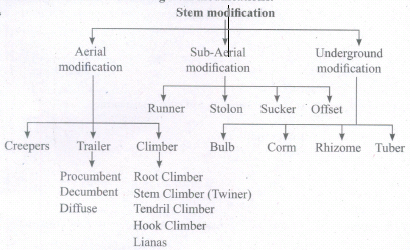
3.
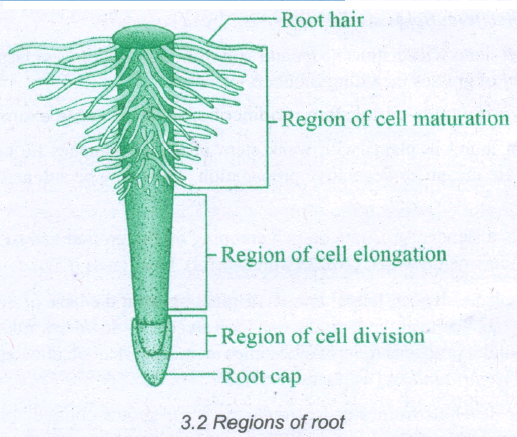
Root tip is covered by a dome shaped parenchymatous cells called root cap. It protects the meristematic cells in the apex.In Pandanus multiple root cap is present. In Pistia instead of root cap root pocket is present. A few millimeters above the root cap the following three distinct zones have been classified based on their meristematic activity.
(i) Meristematic Zone
(ii) Zone of Elongation
(iii) Zone of Maturation.
4.
Perennial and some biennial herbs have underground stems, which are generally known as rootstocks. Rootstock functions as a storage and protective organ. They are classified as follows:
1. Bulb: It is a condensed conical or convex stem surrounded by fleshy scale leaves. They are of two types,
(i) Tunicated (coated) bulb: In which the stem is much condensed and surrounded by several concentric layers of scale leaves. The inner scales commonly fleshy, the outer ones dry. These are two types,
(a) Simple Tunicated bulb - Eg: Allium cepa
(b) Compound Tunicated bulb - Eg: Allium sativum
(ii) Scaly bulb: They are narrow, partially overlap each other by their margins only. Eg: Tulipa spp. Pseudobulb is a short erect aerial storage or propagating stem of certain epiphytic and terrestrial sympodial orchids. Eg: Bulbophyllum.
2. Corm: This is a succulent underground stem with an erect growing tip. The corm is surrounded by scale leaves and exhibit-nodes and internodes.
Eg: Amorphophallus.
3. Rhizome: This is an underground stem grows horizontally with several lateral growing tips. Rhizome possesses conspicuous nodes and internodes covered by scale leaves. Eg: Zingiber officinale, Canna
4. Tuber: This is a succulent underground spherical or globose stem with many embedded axillary buds called "eyes". Eg: Solanum tuberosum, Helianthus tuberosus.
5.
Tuberous root: These are swollen without any definite shape. They are produced singly and not in clusters. Eg. Ipomoea batatas.
Fasciculated root: These are in a cluster from the base of the stem. Eg: Dahlia, Asparagus.
Nodulose root: Swelling occurs only near the tips. Eg: Maranta (arrowroot) Curcuma Amada (mango ginger).
Moniliform or Beaded root: These roots swell at frequent intervals giving them a beaded appearance. Eg. Vitis, Portulaca.
Annulated root: These roots have a series of ring-like swelling on their surface at regular intervals. Eg: Ipecac (Psychotria).

11th Standard Syllabus & Materials
11th Standard
TN 11th Tamil பீடு பெற நில் - செய்யுள் - காவடிச்சிந்து Important Questions And Answers Study Material - QB365 Set A
NEW11th Standard
TN 11th Tamil பீடு பெற நில் - உரைநடை - மலை இடப்பெயர்கள் : ஓர் ஆய்வு Important Questions And Answers Study Material - QB365 Set A
NEW11th Standard
TN 11th Tamil மாமழை போற்றுதும் - துணைப்பாடம் - யானை டாக்டர் Important Questions And Answers Study Material - QB365 Set A
NEW11th Standard
TN 11th Tamil மாமழை போற்றுதும் - செய்யுள் - ஐங்குறுநூறு Important Questions And Answers Study Material - QB365 Set A



Tamilnadu Stateboard 11th Standard Subjects

Maths

Commerce

Economics
Biology

Business Maths and Statistics

Accountancy

Computer Science

Physics

Chemistry
Maths
Biology
Economics
Physics
Chemistry

History
Business Maths and Statistics

Computer Science
Accountancy

Computer Applications
History
Computer Technology
Commerce
Computer Applications
Computer Technology

Tamil

English

French
Tamilnadu Stateboard Standards



