
 100% FREE ACCESS
11th Standard Syllabus & Materials
11th Standard
TN 11th Tamil இயற்கை வேளாண்மை,சுற்றுச்சூழல் -செய்யுள் - மனோன்மணீயம் Important Questions And Answers Study Material - QB365 Set A
NEW11th Standard
TN 11th Tamil என்னுயிர் என்பேன் -துணைப்பாடம் - இசைத்தமிழர் இருவர் Important Questions And Answers Study Material - QB365 Set A
NEW11th Standard
TN 11th Tamil மொழி கலை -செய்யுள் - ஒவ்வொரு புல்லையும் Important Questions And Answers Study Material - QB365 Set A
NEW11th Standard
TN 11th Tamil பீடு பெற நில் - இலக்கணம் - பகுபத உறுப்புகள் Important Questions And Answers Study Material - QB365 Set A
NEW11th Standard
TN 11th Tamil பீடு பெற நில் - துணைப்பாடம் - வாடிவாசல் Important Questions And Answers Study Material - QB365 Set A
NEW11th Standard
TN 11th Tamil பீடு பெற நில் - செய்யுள் - குறுந்தொகை Important Questions And Answers Study Material - QB365 Set A

Published on: 24/10/2018
OCT-23.10.2018
Download Tamil Nadu 11th Standard Biology question papers, model tests, one-mark questions, important questions, and public exam papers in PDF format. Free study materials and answer keys for TN State Board students.
Questions + Answers key
Take MCQ Biology Test1.
2.
Identify correct match.
| 1. Die back disease of citrus | (i) Mo |
| 2. Whip tail disease | (ii) Zn |
| 3. Brown heart of turnip | (iii) Cu |
| 4. Little leaf | (iv) B |
1(iii) 2 (ii) 3 (iv) 4 (i)
1 (iii) 2 (i) 3 (iv) 4 (ii)
1 (i) 2 (iii) 3 (ii) 4 (iv)
1 (iii) 2 (iv) 3 (ii) 4 (i)
3.
Which among the following is correct?
i. Apoplast is fastest and operate in nonliving part.
ii. Transmembrane route includes vacuole.
iii. Symplast interconnect the nearby cell through plasmadesmata.
iv. Symplast and transmembrane route are in living part of the cell
i and ii
ii and iii
iii and iv
i, ii, iii, iv
4.
In a fully turgid cell _____.
DPD = 10 atm; OP = 5 atm; TP = 10 atm
DPD = 0 atm; OP = 10 atm; TP = 10 atm
DPD = 0 atm; OP = 5 atm; TP = 10 atm
DPD = 20 atm; OP = 20 atm; TP = 10 atm
5.
What is the fate of primary xylem in a dicot stem showing extensive secondary growth?
It is retained in the centre of the axis
It gets crushed
May or may not get crushed
It gets surrounded by primary phloem
6.
The common bottle cork is a product of______.
Phellem
Phellogen
Xylem
Vascular cambium
7.
When a leaf trace extends from a vascular bundle in a dicot stem, what would be the arrangement of vascular tissues in the veins of the leaf?
Xylem would be on top and the phloem on the bottom
Phloem would be on top and the xylem on the bottom
Xylem would encircle the phloem
Phloem would encircle the xylem
8.
Read the following sentences and identify the correctly matched sentences.
i. In exarch condition, the protoxylem lies outside of metaxylem.
ii. In endarch condition, the protoxylem lie towards the centre.
iii. In centarch condition, metaxylem lies in the middle of the protoxylem.
iv. In mesarch condition, protoxylem lies in the middle of the metaxylem.
i, ii and iii only
ii, iii and iv only
i, ii and iv only
All of these
9.
Plant A in a nutrient medium shows whiptail disease. Plant B in a nutrient medium shows a little leaf disease. Identify mineral deficiency of plant A and B?
10.
The nitrogen is present in the atmosphere in huge amount but higher plants fail to utilize it. Why?
11.
What are the parameters which control water potential?
12.
13.
In which season the vessels of angiosperms are larger in size, why?
14.
In a forest, if the bark of a tree is damaged by the horn of a deer, How will the plant overcome the damage?
15.
Why the cells of sclerenchyma and tracheids become dead?
16.
Continuous state of dividing tissue is called meristem. In connection to this, what is the role of lateral meristem?
17.
Distinguish the anatomy of dicot root from monocot root.
18.
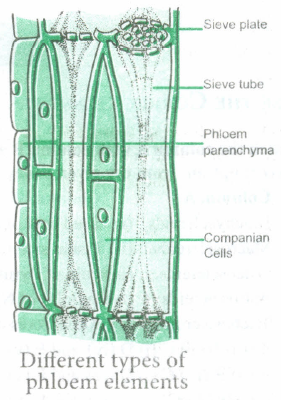
What are Sieve tubes ? Explain.
19.
Explain sclereids with their types.
20.
Write the role of nitrogenase enzyme in nitrogen fixation?
21.
How phosphorylase enzyme open the stomata in starch sugar interconversion theory?
22.
If the concentration of salt in the soil is too high and the plants may wilt even if the field is thoroughly irrigated. Explain
23.
A timber merchant bought 2 logs of wood from a forest & named them A & B, The log A was 50 year old & B was 20 years old. Which log of wood will last longer for the merchant? Why?
1.
(c)
2.
(b)
1 (iii) 2 (i) 3 (iv) 4 (ii)
3.
(d)
i, ii, iii, iv
4.
(b)
DPD = 0 atm; OP = 10 atm; TP = 10 atm
5.
(b)
It gets crushed
6.
(b)
Phellogen
7.
(a)
Xylem would be on top and the phloem on the bottom
8.
(c)
i, ii and iv only
9.
(i) Mineral deficiency of plant A is due to Molybdenum
(ii) Mineral deficiency of plant B is due to Zinc
10.
(i) Yes. Nitrogen cannot be directly absorbed by plants but they are essential for normal growth and functioning of a plant. Hence they are fixed by bacteria and some fungi.
(ii) It can be utilised only in the form of nitrates (NO3-) and nitrites (NO2-).
11.
(1) Water potential \(\left(\Psi_{\mathrm{W}}\right)\) can be determined by,
(i) Solute concentration or Solute Potential \(\left(\Psi_{\mathrm{S}}\right)\)
(ii) Pressure potential \(\left(\Psi_{\mathrm{P}}\right)\)
(2) By correlating two factors, water potential is written as,
(3) Water potential = Solute potential + Pressure potential
(4) \(\Psi_{W}=\Psi_{S}+\Psi_{P}\)
12.
13.
In the spring season, because cambium is very active and produces a large number of xylary elements having vessels / tracheids with wide lumen.
14.
(i) If the bark of a tree is damaged by the horn of a deer, the tree first seals the damaged region from microbial infection.
(ii) This happens by altering the chemistry of the affected area by forming a callus, which grows and covers the damaged area.
15.
The cells of sclerenchyma & tracheids become dead because they lack protoplasm
16.
(i) Lateral meristem increases the girth in both stem and root
(ii) Secondary growth in dicots and gymnosperms is brought about by two lateral meristems
(iii) Vascular cambium
(iv) Cork Cambium
(v) Vascular cambium produces the secondary vascular tissues. i.e. Secondary xylem and Secondary phloem.
17.
| S.No. | Characters | Dicot root | Monocot root |
|---|---|---|---|
| 1. | Pericyle | Gives rise to lateral roots, phellogen and a part of vascular cambium. | Gives rise to lateral roots only. |
| 2. | Vascular tissue | Usually limited number of xylem and phloem strips. | Usually more number of xylem and phloem strips. |
| 3. | Conjunctive tissue | Parenchymatous; Its cells are differentiated into vascular cambium. | Mostly sclerenchymatous but sometimes parenchymatous. It is never differentiated in to vascular cambium. |
| 4. | Cambium | It appears as a secondary meristem at the time of secondary growth. | It is altogether absent. |
| 5. | Xylem | Usually tetrach | Usually polyarch |
18.
(i) Sieve tubes are long tube like conducting elements in the phloem.
(ii) These are formed from a series of cells called sieve tube elements.
(iii) The sieve tube elements are arranged one above the other and form vertical sieve tube.
(iv) The end wall contains a number of pores and it looks like a sieve hence called as sieve plate.
(v) These elements show nacreous thickenings on their lateral walls with simple or compound sieve plates.
(vi) The function of sieve tubes are believed to be controlled by companion cells.
(vii) In mature sieve tube, Nucleus is absent and it contains a lining layer of cytoplasm with special protein called slime body in it.
(viii) In mature sieve tubes, the pores in the sieve plate are blocked by a substance called callose.
(ix) The conduction of food material takes place through cytoplasmic strands.
(x) Sieve tubes occur only in Angiosperms.
19.
Sclereids (Stone Cells)
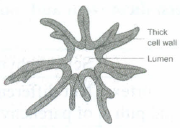
Sclereids are dead cells, usually these are isodiametric but some are elongated too. The cell wall is very thick due to lignification. Lumen is very much reduced. The pits may simple or branched. Sclereids are mechanical in function. They give hard texture to the seed coats, endosperms etc., Sclereids are classified into the folowing types.
Types of Sclereids
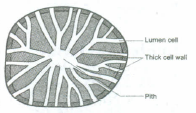
(a) Brachysclereids or Stone cells:
Isodiametric sclereids, with hard cell wall. It is found in bark, pith cortex, hard endosperm and fleshy portion of some fruits. Example: Pulp of Pyrus.
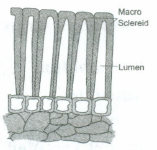
(b) Macrosclereids:
Elongated and rod shaped cells, found in the outer seed coat of leguminous plants. Example: Crotalaria and Pisum sativum.
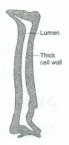
(c) Osteosclereids (Bone cells):
Rod shaped with dilated ends. They occur in leaves and seed coats. Example: seed coat of Pisum and Hakea
(d) Astrosclereids:
Star cells with lobes or arms diverging form a central body. They occur in petioles and leaves. Ex: Tea, Nymphae and Trochodendron.
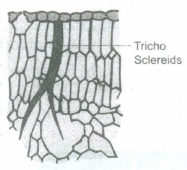
(e) Trichosclereids:
Hair like thin walled sclereids. Numerous small angular crystals are embedded in the wall of these sclereids, present in stems and leaves of hydrophytes. Example: Nymphaea leaf and Aerial roots of Monstera.
20.
(i) Nitrogen fixation process requires Nitrogenase enzyme complex, Minerals (Mo, Fe and S), anaerobic condition, ATP, electron and glucose 6 phosphate as H+ donor.
(ii) Nitrogenase enzyme is active only in anaerobic condition.
(iii) To create this anaerobic condition a pigment known as leghaemoglobin is synthesized in the nodules which acts as oxygen scavenger and removes the oxygen.
21.
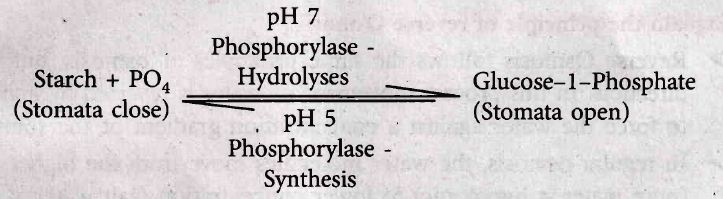
1. The discovery of enzyme phosphorylase in guard cells by Hanes (1940) greatly supports the starch-sugar interconversion theory.
2. The enzyme phosphorylase hydrolyses starch into sugar and high pH followed by endosmosis and the opening of stomata during light. The vice versa takes place during the night.
22.
High concentration of salt in the soil leads to high osmotic potential, which may a result in wilting of plants due to following reasons.
(a) This may be due to osmotic withdrawal of water from a cell or system when it is placed in a hypertonic solution called Exosmosis.
(b) Exosmosis in a plant cell leads to plasmolysis. As a result of water loss in the cell protoplasm shrinks and the cell membrane is pulled away from the cell wall and finally the cell becomes flaccid.
23.
(i) The log A will last longer for the merchant.
(ii) In any tree the outer part of the wood is pale in colour, is called Sap Wood, while the centre part is darker called Heart Wood.
(iii) Due to the presence of tyloses and their contents, the heartwood becomes coloured, dead and the hardest part of the wood.
(iv) The heartwood is more durable and more resistant to the attack of microorganisms and insects.

11th Standard Syllabus & Materials
11th Standard
TN 11th Tamil பீடு பெற நில் - செய்யுள் - காவடிச்சிந்து Important Questions And Answers Study Material - QB365 Set A
NEW11th Standard
TN 11th Tamil பீடு பெற நில் - உரைநடை - மலை இடப்பெயர்கள் : ஓர் ஆய்வு Important Questions And Answers Study Material - QB365 Set A
NEW11th Standard
TN 11th Tamil மாமழை போற்றுதும் - துணைப்பாடம் - யானை டாக்டர் Important Questions And Answers Study Material - QB365 Set A
NEW11th Standard
TN 11th Tamil மாமழை போற்றுதும் - செய்யுள் - ஐங்குறுநூறு Important Questions And Answers Study Material - QB365 Set A



Tamilnadu Stateboard 11th Standard Subjects

Maths

Commerce

Economics
Biology

Business Maths and Statistics

Accountancy

Computer Science

Physics

Chemistry
Maths
Biology
Economics
Physics
Chemistry

History
Business Maths and Statistics

Computer Science
Accountancy

Computer Applications
History
Computer Technology
Commerce
Computer Applications
Computer Technology

Tamil

English

French
Tamilnadu Stateboard Standards

