
11th Standard Syllabus & Materials
11th Standard
TN 11th Tamil இயற்கை வேளாண்மை,சுற்றுச்சூழல் -செய்யுள் - மனோன்மணீயம் Important Questions And Answers Study Material - QB365 Set A
NEW11th Standard
TN 11th Tamil என்னுயிர் என்பேன் -துணைப்பாடம் - இசைத்தமிழர் இருவர் Important Questions And Answers Study Material - QB365 Set A
NEW11th Standard
TN 11th Tamil மொழி கலை -செய்யுள் - ஒவ்வொரு புல்லையும் Important Questions And Answers Study Material - QB365 Set A
NEW11th Standard
TN 11th Tamil பீடு பெற நில் - இலக்கணம் - பகுபத உறுப்புகள் Important Questions And Answers Study Material - QB365 Set A
NEW11th Standard
TN 11th Tamil பீடு பெற நில் - துணைப்பாடம் - வாடிவாசல் Important Questions And Answers Study Material - QB365 Set A
NEW11th Standard
TN 11th Tamil பீடு பெற நில் - செய்யுள் - குறுந்தொகை Important Questions And Answers Study Material - QB365 Set A

Published on: 24/10/2018
Unit-7
Download Tamil Nadu 11th Standard Biology question papers, model tests, one-mark questions, important questions, and public exam papers in PDF format. Free study materials and answer keys for TN State Board students.
Questions + Answers key
Take MCQ Biology Test1.
At any given time there is more blood in the venous system than that of the arterial system. Which of the following features of the veins allows this?
Relative lack of smooth muscles
Presence of valves
Proximity of the veins to lymphatics
Thin endothelial lining
2.
A patient's chart reveals that he has a cardiac output of 7500mL per minute and a stroke volume of 50 mL. What is his pulse rate (in beats/min)?
50
100
150
400
3.
At the venous end of the capillary bed, the osmotic pressure is _____.
Greater than the hydrostatic pressure
Result in net outflow of fluids
Results in net absorption of fluids
No change occurs
4.
An unconscious patient is rushed into the emergency room and needs a fast blood transfusion. Because there is no time to check her medical history or determine her blood type, which type of blood should you as her doctor, give her?
A-
AB
O+
O-
5.
Why is the velocity of blood flow the lowest in the capillaries?
The systemic capillaries are supplied by the left ventricle, which has a lower cardiac output than the right ventricle
Capillaries are far from the heart, and blood flow slows as distance from the heart increases
The total surface area of the capillaries is larger than the total surface area of the arterioles
The capillary walls are not thin enough to allow oxygen to exchange with the cells
6.
7.
Erythroblastosis foetalis is due to the destruction of ______.
Foetal RBCs
Foetus suffers from atherosclerosis
Foetal WBCs
Foetus suffers from minamata
8.
9.
Blood group is due to the presence or absence of surface _______.
Antigens on the surface of WBC
Antibodies on the surface of RBC
Antigens on the surface of RBC
Antibodies on the surface of WBC
10.
Lymph is colourless because ____.
WBC are absent
WBC are present
Haemoglobin is absent
RBC are absent
11.
Which of the following is not involved in blood clotting?
Fibrin
Calcium
Platelets
Bilirubin
12.
Which of these functions can be carried out by a red blood cell?
Protein synthesis
Cell division
Lipid synthesis
Active transport
13.
Which one of the following plasma proteins is involved in the coagulation of blood?
Globulin
Fibrinogen
Albumin
Serum amylase
14.
What is the function of lymph?
Transport of O2 into brain
Transport of CO2 into lungs
Bring interstitial fluid in blood
Bring RBC and WBC in lymph node
15.
Ramu was 45 years old when he went to a doctor to check his blood pressure. His pressure was around 158/98mmHg. The doctor advised him to measure his blood pressure at home for two weeks. He came to the doctor saying his average -blood pressure was around 160/100mmHg. Doctor concludes that Ramu has high blood pressure or hypertension. If not controlled, hypertension can lead to heart failure, stroke and kidney failure. He returned to the doctor after two months after taking the drug, ACE inhibitor. This chemical blocks the production of angiotensin II, a powerful vasoconstrictor, so his blood pressure returned back to normal.
1. Why are people with high blood pressure at greater risk for having a hemorrhagic stroke?
2. Without medication Ramu's blood pressure was around 160/100mmHg after two weeks. Why this pressure was referred to as hypertension by the doctor.
3. Blocking the action of vasoconstrictor lower the blood pressure? Give reasons.
4. What is the role of ACE inhibitor in reducing blood pressure?
5. What conditions one might expect if the blood pressure is not controlled?
16.
When blood volume drops down abruptly, what happens to the stroke volume? State whether it increases or decreases?
17.
Suggest why arteries close to the heart have more elastic fibres in their walls than arteries further away from the heart?
18.
Why there are no blood capillaries in the cornea of the eye and cartilage? How are these regions supplied with the required nutrients?
19.
The disease kwashiorkor is caused by a diet which is very low in protein. The concentration of proteins in blood becomes much lower than usual. One of the symptoms of kwashiorkor is edema. Give reasons.
20.
Protein molecules of larger size can pass through the lymph vessel? Give reason.
21.
What are the heart sounds? When and how are these sounds produced?
22.
23.
Distinguish between open and closed circulation.
24.
Which of these functions could or could not be carried out by a red blood cell? Briefly justify your answer.
a. Protein synthesis
b. Cell division
c. Lipid synthesis
d. Active transport
Protein synthesis
Cell division
Lipid synthesis
Active transport
25.
What might be the effect on a person whose diet has less iron content?
26.
Right ventricular wall is thinner than the left ventricular wall. Why?
27.
Distinguish between mitral valve and semilunar valve.
28.
29.
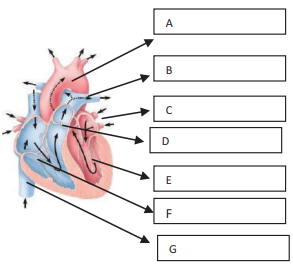
Name and Label the given diagrams to show A, B, C, D, E, F, and G
30.
Select the correct biological term.
Cardiac muscle, atria, tricuspid systole, auricles, arteries, diastole, ventricles, bicuspid valve, pulmonary artery, cardiac cycle, semilunar valve, veins, pulmonary vein, capillaries, vena cava, aorta.
(a) The main artery of the blood
(b) Valves between the left atrium and ventricle
(c) Technical name for relaxation of the heart.
(d) Another name for atria.
(e) The main vein.
(f) Vessels which carry blood away from the heart
(g) Two names for the upper chambers of the heart
(h) Thick walled chambers of the heart.
(i) Carries blood from the heart to the lungs
(j) Takes about 0.8 sec to complete.
(k) Valves situated at the point where blood flows out of the heart.
(l) Vessels which carry blood towards the heart
(m) Carries blood from the lungs to the heart.
(n) The two lower chambers of the heart.
(o) Prevent blood from re-entering the ventricles after entering the aorta.
(p) Technical name for one heartbeat.
(q) Valves between right atrium and ventricles.
(r) Technical name for contraction of the heart.
(s) Very narrow blood vessels.
31.
Select the correct biological term
Lymphocytes, red cells, leucocytes, plasma, erythrocytes, white cells, haemoglobin, phagocyte, platelets, blood clot.
(a) Disc shaped cells which are concave on both sides.
(b) Most of these have a large, bilobed nucleus.
(c) Enable red cells to transport blood.
(d) The liquid part of the blood.
(e) Most of them move and change shape like an amoeba.
(f) Consists of water and important dissolved substances.
(g) Destroyed in the liver and spleen after circulating in the blood for four months.
(h) The substances which gives red cells their colour .
(i) Another name for red blood cells
(j) Blood that has been changed to a jelly
(k) A word that means cell eater.
(l) Cells without nucleus .
(m) White cells made in the lymphatic tissue.
(n) Blocks wound and prevent excessive bleeding.
(o) Fragment of cells which are made in the bone marrow.
(p) Another name for white blood cells.
(q) Slowly releases oxygen to blood cells.
(r) Their function is to help blood clot in wounds.
32.
1.
(b)
Presence of valves
2.
(c)
150
3.
(a)
Greater than the hydrostatic pressure
4.
(c)
O+
5.
(c)
The total surface area of the capillaries is larger than the total surface area of the arterioles
6.
(c)
7.
(a)
Foetal RBCs
8.
(c)
9.
(c)
Antigens on the surface of RBC
10.
(c)
Haemoglobin is absent
11.
(d)
Bilirubin
12.
(d)
Active transport
13.
(b)
Fibrinogen
14.
(c)
Bring interstitial fluid in blood
15.
1. Haemorrhage means "bleeding caused due to rupture of blood vessels". High blood pressure can lead to rupture of blood vessel and such people are more prone to haemorrhage.
2. In cases when the diastolic pressure exceeds 90 mm Hg and the systolic pressure exceeds 150 mm Hg persistently, the condition is called hypertension.
3. Vasoconstrictors are drugs which cause vasoconstriction or constriction of blood vessels thus raising blood pressure. Hence blocking the action of vasoconstrictors reduces blood pressure.
4. ACE inhibitor - (Angiotension Converting Enzyme) inhibitors reduce systemic blood pressure and reduce angiotensin-II thereby protecting the kidneys also from damage.
5. If blood pressure is not controlled it can lead to heart attack, stroke, aneurysm, heart failure etc.
16.
Stroke volume SV = EDV - ESV
EDV - Amount of blood getting collected in ventricle during diastole.
ESV - Volume of blood remaining in ventricle after contraction.
1. Heart's pumping action maintains balance between cardiac output and venous return, Heart is a double pump.
2. Each side of the heart can fail independently of the other.
3. Increase in EDV can increase SV, On the other hand decrease in venous return and EDV can decrease Sv.
4. Similarly changes ·of EDV and ESV on SV are not independent.
17.
1. Elastic fibres allow the artery to stretch and recoil as blood passes through it.
2. Arteries closer to the heart experience more pressure than arteries further away from the heart.
3. Therefore arteries close to the heart have more elastic fibres in their walls to cope with high pressure of blood coming from the heart.
18.
1. Cornea lacks blood vessels which keeps the eye clear for vision.
2. It receives nutrients by diffusion from the tear fluid and aqueous humour in the eye.
3. There are no blood vessels in cartilage Nutrients diffuse through a dense connective tissue surrounding the cartilage.
19.
1. Kwashiorkor is caused by deficiency of protein in diet.
2. Lack of protein causes osmotic imbalance in the gastrointestinal system causing swelling of gut. This is called edema (retention of water).
20.
1. Lymphatic capillaries have greater permeability than blood capillaries and can absorb large molecules such as proteins and lipids.
2. The endothelial cells on the wall of the lymphatic capillary lack basement membrane and are loosely attached to each other which makes the wall more permeable.
21.
There are usually two heart sounds they are
(i) 'lub' sound: It is the 1st sound produced by the closure of atrio ventricular valves (both tricuspid and bicuspid valves).
(ii) 'dub' sound: It is the 2nd sound produced by the closure of semilunar valves (both pulmonary aortic valves).
(iii) A 3rd abnormal sound may be produced with vibrations as "murmuring" under the dis-order of heart.
22.
23.
| Open circulation | Closed circulation |
| 1. No blood vessels. | Blood vessels are present. |
| 2. Blood flows in sinuses. | Blood flows in vessels. |
| 3. No respiratory pigment. | Respiratory pigment present. |
| 4. Eg: insects. | Eg: Earthworms, Molluscans, Echinoderms and Chordates. |
24.
Reason : None of these functions can be carried out by RBC. Red Blood Cells (RBC) contain haemoglobin pigment and play a major role in transport of respiratory gases.
25.
If a person diet does not contain iron, the synthesis of haemoglobin is lowered in bone marrow because each haemoglobin consists of 4 iron atoms to accept 4 O2
26.
(i) Right ventricular wall is thinner because the pulmonary artery transports deoxygenated blood to lungs so that much force/pressure is not needed.
(ii) Left ventricular wall is thicker because the aorta has to pump out the blood from the heart to supply oxygenated blood to all the parts of the body and needs more pressure.
27.
| S.No. | Mitral Valve | semilunar Valve |
| 1. | Found between left atrium and left ventricle. | Found at the entry of pulmonary artery and aorta. |
| 2. | Has two flaps or cusps. | Has three flaps or cusps. |
| 3. | Appear as flaps. | Appear as half moon shaped. |
| 4. | Prevents the backword flow of oxygenated blood from left ventricle to left atrium. |
Prevents the backward flow of deoxygenated blood into right ventricle and oxygenated blood into left ventricle. |
| 5. | Also called as bicuspid valve. | Also called as pulmonary or aortic valves. |
28.
29.
A. Aortic arch
B. Left Pulmonary Artery
C. Left Pulmonary Vein
D. Semilunar Valve
E. Left Ventricle
F. Right Ventricle
G. Inferior Vena Cava
30.
(a) Aorta
(b) Bicuspid
(c) Diastole
(d) Auricle
(e) Vena cava
(f) Arteries
(g) Atria /Auricles
(h) Ventricles
(i) Pulmonary Artery
(j) Cardiac cycle
(k) Semilunar Valves
(I) Veins
(m) Pulmonary vein
(n) Ventricles
(o) Semilunar Valve
(p) Cardiac cycle
(q) Tricuspid Valve
(r) Systole
(s) Capillaries
31.
(a) Erythrocytes.
(b) Leucocytes (Not specific option)
(c) Question framed wrongly
(d) Plasma
(e) Phagocyte
(t) Plasma
(g) Erythrocyte
(h) Haemoglobin
(i) Erythrocyte
(j) Blood clot
(k) Phagocyte
(I) Erythrocytes / Platelets
(m) Leucocytes
(n) Blood clot
(o) Red Cells
(p) Leucocytes
(q) Haemoglobin
(r) Platelets
32.

11th Standard Syllabus & Materials
11th Standard
TN 11th Tamil பீடு பெற நில் - செய்யுள் - காவடிச்சிந்து Important Questions And Answers Study Material - QB365 Set A
NEW11th Standard
TN 11th Tamil பீடு பெற நில் - உரைநடை - மலை இடப்பெயர்கள் : ஓர் ஆய்வு Important Questions And Answers Study Material - QB365 Set A
NEW11th Standard
TN 11th Tamil மாமழை போற்றுதும் - துணைப்பாடம் - யானை டாக்டர் Important Questions And Answers Study Material - QB365 Set A
NEW11th Standard
TN 11th Tamil மாமழை போற்றுதும் - செய்யுள் - ஐங்குறுநூறு Important Questions And Answers Study Material - QB365 Set A



Tamilnadu Stateboard 11th Standard Subjects

Maths

Commerce

Economics
Biology

Business Maths and Statistics

Accountancy

Computer Science

Physics

Chemistry
Maths
Biology
Economics
Physics
Chemistry

History
Business Maths and Statistics

Computer Science
Accountancy

Computer Applications
History
Computer Technology
Commerce
Computer Applications
Computer Technology

Tamil

English

French
Tamilnadu Stateboard Standards

