
 100% FREE ACCESS
11th Standard Syllabus & Materials
11th Standard
TN 11th Tamil இயற்கை வேளாண்மை,சுற்றுச்சூழல் -செய்யுள் - மனோன்மணீயம் Important Questions And Answers Study Material - QB365 Set A
NEW11th Standard
TN 11th Tamil என்னுயிர் என்பேன் -துணைப்பாடம் - இசைத்தமிழர் இருவர் Important Questions And Answers Study Material - QB365 Set A
NEW11th Standard
TN 11th Tamil மொழி கலை -செய்யுள் - ஒவ்வொரு புல்லையும் Important Questions And Answers Study Material - QB365 Set A
NEW11th Standard
TN 11th Tamil பீடு பெற நில் - இலக்கணம் - பகுபத உறுப்புகள் Important Questions And Answers Study Material - QB365 Set A
NEW11th Standard
TN 11th Tamil பீடு பெற நில் - துணைப்பாடம் - வாடிவாசல் Important Questions And Answers Study Material - QB365 Set A
NEW11th Standard
TN 11th Tamil பீடு பெற நில் - செய்யுள் - குறுந்தொகை Important Questions And Answers Study Material - QB365 Set A

Published on: 24/10/2018
Unit-8
Download Tamil Nadu 11th Standard Biology question papers, model tests, one-mark questions, important questions, and public exam papers in PDF format. Free study materials and answer keys for TN State Board students.
Questions + Answers key
Take MCQ Biology Test1.
Identify the following structures and explain their significance in renal physiology?
(a) Juxtaglomerular apparatus
(b) Podocytes
(c) Sphincters in the bladder
2.
Arrange the following structures in the order that a drop of water entering the nephron would encounter them
e. Afferent arteriole
f. Bowman’s capsule
g. Collecting duct
h. Distal tubule
i. Glomerulus
j. Loop of Henle
k. Proximal tubule
l. Renal pelvis
3.
Explain the heart’s role in secreting a hormone that regulates renal function? What hormone is this?
4.
What is the effect of aldosterone on kidneys and where is it produced?
5.
Name the three main hormones that are involved in the regulation of the renal function?
6.
What is tubular secretion? Name the substances secreted through the renal tubules.
7.
Which vessels drain filtered blood from the kidneys?
8.
What vessels carry blood to the kidneys? Is this blood arterial or venous?
9.
Differentiate cortical from medullary nephrons
10.
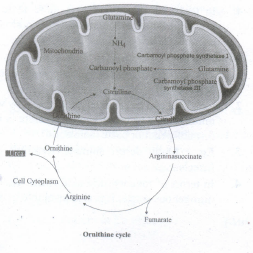
How is urea formed in the human body?
11.
12.
Differentiate protonephridia from metanephridia
13.
With regards to toxicity and the need for dilution in water, how different are ureotelic and uricotelic excretions? Give examples of animals that use these types of excretion.
14.
15.
How are the kidneys involved in controlling blood volume? How is the volume of blood in the body related to arterial pressure?
16.
If the afferent arteriole of the nephron constricts, what happens to the GFR in that nephron? If the efferent arteriole constricts what happens to the GFR in that nephron? Assume that no auto regulation takes place.
17.
Which part of the autonomic nervous system is involved in micturition process?
18.
What solute is normally present in the body to estimate GFR in humans?
19.
Which segment is the site of secretion and regulated reabsorption of ions and pH homeostasis?
20.
When a molecule or ion is reabsorbed from the lumen of the nephron, where does it go? If a solute is filtered and not reabsorbed from the tubule, where does it go?
21.
In which segment of the nephron most of the re-absorption of substances takes place?
22.
What forces promote glomerular filtration? What forces opposes them? What is meant by net filtration pressure?
23.
Name the three filtration barriers that solutes must come across as they move from plasma to the lumen of Bowman's capsule. What components of the blood are usually excluded by these layers?
24.
Identify the biological term
Excretion, glomerulus, urinary bladder, glomerular filtrate, ureters,urine, Bowman’s capsule, urinary system, reabsorption, micturition, osmosis, proteins.
a. A liquid which gathers in the bladder.
b. Produced when blood is filtered in a Bowman’s capsule.
c. Temporary storage of urine.
d. A ball of intertwined capillaries.
e. Removal of unwanted substances from the body.
f. Each contains a glomerulus.
g. Carry urine from the kidneys to the bladder.
h. Scientific term for urination.
i. Regulation of water and dissolved substances in blood and tissue fluid.
j. Consists of the kidneys, ureters and bladder.
k. Removal of useful substances from glomerular filtrate.
l. What solute the blood contains that are not present in the glomerular filtrate?
25.
How is the process of micturition altered by toilet training?
26.
Match the following terms.
| (a) \(\alpha \) -receptor | Afferent arteriole |
| (b) Autoregulation | Basal lamina |
| (c) Bowman's capsule | Capillary blood pressure |
| (d) Capsule fluid pressure | Colloid osmotic Pressure |
| (e) Glomerulus | GFR |
| (f) Podocyte | JG cells |
| (g) Vasoconstriction | Plasma proteins |
27.
Match each of the following substances. with its mode of transportation in proximal tubular reabsorption.
| (a) Na+ | Simple diffusion |
| (b) Glucose | Primary active transport |
| (c) Urea | Indirect active transport |
| (d) Plasma | Paracellular movement |
| (e) Proteins | Facilitated diffusion |
| (f) Water | Endocytosis |
28.
Malpighian tubules remove excretory products from _____.
mouth
oesophagus
haemolymph
alimentary canal
29.
30.
Aldosterone acts at the distal convoluted tubule and collecting duct resulting in the absorption of water through _____.
Aquaporins
Spectrins
GLUT
Chloride channels
31.
Animal requiring minimum amount of water to produce urine are ______.
ureotelic
ammonotelic
uricotelic
chemotelic
32.
Kidney stones are produced due to deposition of uric acid and ______.
Silicates
Minerals
Calcium carbonate
Calcium oxalate
33.
Glomerular filtrate contains ______.
Blood without blood cells and proteins
Plasma without sugar
Blood with proteins but without cells
Blood without urea
34.
Podocytes are the cells present on the ______.
Outer wall of Bowman's capsule
Inner wall of Bowman's capsule
Neck of nephron
Wall of glomerular capillaries
35.
Identify the wrong match __________
Bowman's capsule - Glomerular filtration
DCT - Absorption of glucose
Henle's loop - Concentration of urine
PCT - Absorption of Na+ and K+ ions
36.
The end product of Ornithine cycle is _____.
carbon dioxide
uric acid
urea
ammonia
37.
38.
A person who is on a long hunger strike and is surviving only on water, will have
Less amino acids in his urine
Macula densa cells
Less urea in his urine
More sodium in his urine
39.
If Henle's loop were absent from mammalian nephron, which one of the following is to be expected?
There will be no urine formation
There will be hardly any change in the quality and quantity of urine formed
The urine will be more concentrated
The urine will be more dilute
40.
Concentration of urine depends upon which part of the nephron ______.
Bowman's capsule
Length of Henle's loop
P.C.T.
Network of capillaries arising from glomerulus
1.
(a) Some nephrons, have very long loop of Henle that run deep into the medulla are called juxtamedullary nephrons which aid in filtration from glomerulus.
(b) Podocytes are the filtration slits.
(c) Sphincters of urinary bladder are internal paired (involuntary) and external paired (Voluntary) control micturition.
2.
(e) Afferent arteriole
(i) Glomerulus
(f) Bowman's capsule
(k) Proximal tubule
(j) Loop of Henle
(h) Distal tubule
(g) Collecting duct
(l) Renal pelvis
3.
Excessive stretch of cardiac atrial cells cause an increase in blood flow to the auricles of the heart and release ANF (Atrial natriuretic peptide or factor) which stimulates the increase Na+ excretion. Chemoreceptors like carotid bodies formed in the heart.
4.
Aldosterone maintains renal blood flow to the kidneys. It is produced as medullary adrenal hormone in the adrenal gland of kidney.
5.
Renin, aldosterone and ADH.
6.
Occurs in distal convoluted tubule of nephron potassium is excreted and sodium is absorbed.
7.
Venules, veins of renal vein comes out of hilum of kidneys.
8.
Renal artery supplies (arterial) oxygenated blood and renal vein carries out deoxygenated blood (venous) from kidneys.
9.
| Cortical nephrons | Medullary nephrons |
| Bowman's capsule malpighian capsule is present. | Tubular part of nephrons is present. |
| Glomerular filtration occurs. | Absorption, re-absorption and secretion occurs. |
10.
The nitrogenous waste formed as a result of breakdown of amino acids is converted to urea in the liver by the Ornithine cycle or urea cycle
11.
12.
| S.N | Protonephridia | Metanephridia |
| 1. | Primitive | Advanced |
| 2. | Commonly found in primitive chordates (aquatic). | Commonly found in advanced terrestrial animals. |
| 3. | NH3 is the excretory product. | NH3 or urea may be the excretory product. |
| 4. | Originated /derived from invertebrates. |
Originated/ derived from primitive chordates. |
13.
(i) Urea is excreted by ureotelic animals
Eg: Earthworm, Frogs and mammals.
(ii) Uric acid is excreted by uricotelic animals
Eg: Insects, reptiles and Aves (birds).
14.
15.
(i) Nephrons of kidneys absorb and reabsorb blood plasma (55%) and handover it to venules of renal vein so that an average blood volume is maintained.
(ii) Oxygenated blood flows in the arterial system expresses the systolic pressure (120mm Hg) to balance the normal blood pressure towards the body organs.
16.
(i) Blood supply to kidney's is reduced.
(ii) Disposal of blood from the kidney's is reduced.
(iii) Auto regulation of micturition is disturbed.
17.
Sensory neurons of the parasympathetic autonomic nervous system.
18.
All the blood plasma components without corpuscles.
19.
Distal convoluted tubule (DCT of nephron).
20.
(a) Ion goes to renal vein
(b) It goes to renal pelvis
21.
Henle's loop
22.
1. Hydrostatic/Hydrostatic / Colloidal osmotic pressure maintains ultrafiltration of glomerulus.
2. The Efferent arteriole pressure opposes them.
3. Net filtration pressure = 55 mmHg - 30 mmHg + 15 mmHg = 10mmHg.
23.
1. Podocytes end in foot processes found in the openings between the foot processes (Filtration slits).
2. Malpighian body/renal corpuscle.
3. Blood cells like RBCs, WBCs and platelets.
24.
(a) Urine
(b) Glomerular filtrate
(c) Urinary bladder
(d) afferent and efferent arterioles and venules of renel artery and renel vein.
(e) Excretion
(f) Bowman's capsule
(g) Ureters
(h) Micturition
(i) Balance of electrolytes minerals and organics
(j) excretory system
(k) micturition
(l) glucose, amino acid and liquids
25.
1. The process of release of urine from the urinary bladder is called micturition. It is more than a simple reflex. The control of micturition is learnt is infancy. It induces other sensory fibres in the bladder which conveys the information on fullness of bladder.
2. This information reaches the centres in thalamus and cerebral cortex of the brain via the spine.
3. The brain can sense the need to pass urine and urgency of the situation.
4. The brain centres can control the micturition, reflex by inhibiting the parasympathetic motor, fibres.
5. When convenient, the brain centre removes this control and permits micturition under conscious control.
6. Further the link between spine and cerebral cortex is developed only nearing 2 years of age. Hence toilet training is not possible in infants.
7. Therefore by training children at a young age, the micturition reflex can be brought under control.
26.
| (a) \(\alpha \) -receptor | Capillary blood pressure |
| (b) Autoregulation | GFR |
| (c) Bowman's capsule | Afferent arteriole |
| (d) Capsule fluid pressure | Plasma proteins |
| (e) Glomerulus | Colloid osmotic Pressure |
| (f) Podocyte | Basal lamina |
| (g) Vasoconstriction | JG cells |
27.
| (a) Na+ | Primary active transport |
| (b) Glucose | Indirect active transport |
| (c) Urea | Simple diffusion |
| (d) Plasma | Facilitated diffusion |
| (e) Proteins | Endocytosis |
| (f) Water | Paracellular movement |
28.
(c)
haemolymph
29.
(c)
30.
(a)
Aquaporins
31.
(c)
uricotelic
32.
(d)
Calcium oxalate
33.
(c)
Blood with proteins but without cells
34.
(b)
Inner wall of Bowman's capsule
35.
(d)
PCT - Absorption of Na+ and K+ ions
36.
(c)
urea
37.
(a)
38.
(c)
Less urea in his urine
39.
(d)
The urine will be more dilute
40.
(b)
Length of Henle's loop

11th Standard Syllabus & Materials
11th Standard
TN 11th Tamil பீடு பெற நில் - செய்யுள் - காவடிச்சிந்து Important Questions And Answers Study Material - QB365 Set A
NEW11th Standard
TN 11th Tamil பீடு பெற நில் - உரைநடை - மலை இடப்பெயர்கள் : ஓர் ஆய்வு Important Questions And Answers Study Material - QB365 Set A
NEW11th Standard
TN 11th Tamil மாமழை போற்றுதும் - துணைப்பாடம் - யானை டாக்டர் Important Questions And Answers Study Material - QB365 Set A
NEW11th Standard
TN 11th Tamil மாமழை போற்றுதும் - செய்யுள் - ஐங்குறுநூறு Important Questions And Answers Study Material - QB365 Set A



Tamilnadu Stateboard 11th Standard Subjects

Maths

Commerce

Economics
Biology

Business Maths and Statistics

Accountancy

Computer Science

Physics

Chemistry
Maths
Biology
Economics
Physics
Chemistry

History
Business Maths and Statistics

Computer Science
Accountancy

Computer Applications
History
Computer Technology
Commerce
Computer Applications
Computer Technology

Tamil

English

French
Tamilnadu Stateboard Standards

