
 100% FREE ACCESS
11th Standard Syllabus & Materials
11th Standard
TN 11th Tamil இயற்கை வேளாண்மை,சுற்றுச்சூழல் -செய்யுள் - மனோன்மணீயம் Important Questions And Answers Study Material - QB365 Set A
NEW11th Standard
TN 11th Tamil என்னுயிர் என்பேன் -துணைப்பாடம் - இசைத்தமிழர் இருவர் Important Questions And Answers Study Material - QB365 Set A
NEW11th Standard
TN 11th Tamil மொழி கலை -செய்யுள் - ஒவ்வொரு புல்லையும் Important Questions And Answers Study Material - QB365 Set A
NEW11th Standard
TN 11th Tamil பீடு பெற நில் - இலக்கணம் - பகுபத உறுப்புகள் Important Questions And Answers Study Material - QB365 Set A
NEW11th Standard
TN 11th Tamil பீடு பெற நில் - துணைப்பாடம் - வாடிவாசல் Important Questions And Answers Study Material - QB365 Set A
NEW11th Standard
TN 11th Tamil பீடு பெற நில் - செய்யுள் - குறுந்தொகை Important Questions And Answers Study Material - QB365 Set A

Published on: 26/06/2021
QB365 provides detailed and simple solution for every Creative Questions in class 11 Biology Subject. It will helps to get more idea about question pattern in every Creative questions with solution.
Download Tamil Nadu 11th Standard Biology question papers, model tests, one-mark questions, important questions, and public exam papers in PDF format. Free study materials and answer keys for TN State Board students.
Questions + Answers key
Take MCQ Biology Test1.
Explain the composition of blood.
2.
Write about the following disorders of circulatory system.
(a) Hypertension
(b) Coronary heart disease.
(c) Angina pectoris.
(d) Stroke
(e) Myocardial infarction.
(f) Rheumatoid heart disease.
3.
Write about the series of event takes place in the cardiac cycle.
4.
What does the following term defines.
(i) Heart beat
(ii) Systole
(iii) Diastole
(iv) 'Iub' and 'dub' sound of the heart
(v) Cardiac cycle.
5.
Explain coagulation of blood.
1.
Blood is the most common body fluid that transports substances from one part of the body to the other. Blood is a connective tissue consisting of plasma (fluid matrix) and formed elements. The plasma constitutes 55% of the total blood volume. The remaining 45% is the formed elements that consist of blood cells. The average blood volume is about 5000 ml (5L) in an adult weighing 70 Kg.
Plasma: Plasma mainly consists of water (80 - 92%) in which the plasma proteins, inorganic constituents (0.9%), organic constituents (0.1%) and respiratory gases are dissolved. The four main types of plasma proteins synthesized in the liver are albumin, globulin, prothrombin and fibrinogen. Albumin maintains the osmotic pressure of the blood. Globulin facilitates the transport of ions, hormones, lipids and assists in immune function. Both Prothrombin and Fibrinogen are involved in blood clotting. Organic constituents include urea, amino acids, glucose, fats and vitamins; and the inorganic constituents include chlorides, carbonates and phosphates of potassium, sodium, calcium and magnesium. The composition of plasma is not always constant. Immediately after a meal, the blood in the hepatic portal vein has a very high concentration of glucose as it is transporting glucose from the intestine to the liver where it is stored. The concentration of the glucose in the blood gradually falls after sometime as most of the glucose is absorbed. If too much of protein is consumed, the body cannot store the excess amino acids formed from the digestion of proteins. The liver breaks down the excess amino acids and produces urea. Blood in the hepatic vein has a high concentration of urea than the blood in other vessels namely, hepatic portal vein and hepatic artery
Formed elements: Red blood cells/corpuscles (erythrocytes), white blood cells/corpuscles (Leucocytes) and platelets are collectively called formed elements
Red blood cells: Red blood cells are abundant than the other blood cells. There are about 5 million to 5.5 millions of RBC mnr of blood in a healthy man and 4.5-5.0 millions of RBC mnr in healthy women. The RBCs are very small with the diameter of about 7 11m(micrometer). The structure of RBC is shown in Figure. The red colour of the RBC is due to the presence of a respiratory pigment, haemoglobin dissolved in the cytoplasm. Haemoglobin plays an important role in the transport of respiratory gases and facilitates the exchange of gases with the fluid outside the cell (tissue fluid). The biconcave shaped RBCs increases the surface area to volume ratio, hence oxygen diffuses quickly in and out of the cell. The RBCs are devoid of nucleus, mitochondria, ribosomes and endoplasmic reticulum. The absence of these organelles accommodates more haemoglobin thereby maximising the oxygen carrying capacity of the cell. The average life span ofRBCs in a healthy individual is about 120 days after which they are destroyed in the spleen (graveyard/cemetery ofRBCs) and the iron component returns to the bone marrow for reuse. Erythropoietin is a hormone secreted by the kidneys in response to low oxygen and helps in differentiation of stem cells of the bone marrow to erythrocytes (erythropoiesis) in adults. The ratio of red blood cells to blood plasma is expressed as Haematocrit (packed cell volume).
.png)
White blood cells (leucocytes) are colourless, amoeboid, nucleated cells devoid of haemoglobin and other pigments. Approximately 6000 to 8000 per cubic mm ofWBCs are seen in the blood of an average healthy individual. Depending on the presence or absence of granules, WBCs are divided into two types, granulocytes and agranulocytes. Granulocytes are characterised by the presence of granules in the cytoplasm and are differentiated in the bone marrow. The granulocytes include neutrophils, eosinophils and basophils
.png)
Neutrophils are also called heterophils or polymorphonuclear (cells with 3--4 lobes of nucleus connected with delicate threads) cells which constitute about 60%-65% of the total WBCs. They are phagocytic in nature and appear in large numbers in and around the infected tissues.
Eosinophils have distinctly bilobed nucleus and the lobes are joined by thin strands. They are non-phagocytic and constitute about 2-3% of the total WBCs. Eosinophils increase during certain types of parasitic infections and allergic reactions.
Basophils are less numerous than any other type ofWBCs constituting 0.5%- 1.0% of the total number ofleucocytes. The cytoplasmic granules are large sized, but fewer than eosinophils. Nucleus is large sized and constricted into several lobes but not joined by delicate threads.
Basophils secrete substances such as heparin, serotonin and histamines. They are also involved in inflammatory reactions
Agranulocytes are characterised by the absence of granules in the cytoplasm and are differentiated in the lymph glands and spleen. These are of two types, lymphocytes and monocytes. Lymphocytes constitute 28% of WBCs. These have large round nucleus and small amount of cytoplasm. The two types of lymphocytes are Band T cells. Both Band T cells are responsible for the immune responses of the body. B cells produce antibodies to neutralize the harmful effects of foreign substances and T cells are involved in cell mediated immunity.
Monocytes (Macrophages) are phagocytic cells that are similar to mast cells and have kidney shaped nucleus. They constitute 1-3% of the total WBCs. The macrophages of the central nervous system are the 'microglia', in the sinusoids of the liver they are called 'Kupffer cells' and in the pulmonary region they are the 'alveolar macrophages'.
Platelets are also called thrombocytes that are produced from megakaryocytes (special cells in bone marrow) and lack nuclei. Blood normally contains 1,50,000 - 3,50,000 platelets mm3 of blood. They secrete substances involved in coagulation or clotting of blood. The reduction in platelet number can lead to clotting disorders that result in excessive loss of blood from the body.
2.
Hypertension is the most common circulatory disease. The normal blood pressure in man is 120/80 mm Hg. In cases when the diastolic pressure exceeds 90 mm Hg and the systolic pressure exceeds 150 mm Hg persistently, the condition is called hypertension. Uncontrolled hypertension may damage the heart, brain and kidneys.
Coronary heart disease occurs when the arteries are lined by atheroma. The build - up of atheroma contains cholesterol, fibres, dead muscle and platelets and is termed Atherosclerosis. The cholesterol rich atheroma forms plaques in the inner lining of the arteries making them less elastic and reduces the blood flow. Plaque grows within the artery and tends to form blood clots, forming coronary thrombus. Thrombus in a coronary artery results in heart attack.
Angina pectoris (ischemic pain in the heart muscles) is experienced during early stages of coronary heart disease. Atheroma may partially block the coronary artery and reduce the blood supply to the heart. As a result, there is tightness or choking with difficulty in breathing. This leads to angina or chest pain. Usually it lasts for a short duration of time.
Stroke is a condition when the blood vessels in the brain bursts, (Brain haemorrhage) or when there is a block in the artery that supplies the brain, (atherosclerosis) or thrombus. The part of the brain tissue that is supplied by this damaged artery dies due to lack of oxygen (cerebral . infarction).
Myocardial infarction (Heart failure): The prime defect in heart failure is a decrease in cardiac muscle contractility. The Frank - Starling curve shifts downwards and towards the right such that for a given EDV, a failing heart pumps out a smaller stroke volume than a normal healthy heart. When the blood supply to the heart muscle or myocardium is remarkably reduced it leads to death of the muscle fibres. This condition is called heart attack or myocardial infarction. The blood clot or thrombosis blocks the blood supply to the heart and weakens the muscle fibres. It is also called Ischemic heart disease due to lack of oxygen supply to the heart muscles. If this persists it leads to chest pain or angina. Prolonged angina leads to death of the heart muscle resulting in heart failure.
Rheumatoid Heart Disease: Rheumatic fever is an autoimmune disease which occurs 2 - 4 weeks after throat infection usually a streptococcal infection. The antibodies developed to combat the infection cause damage to the heart. Effects include fibrous nodules on the mitral valve, fibrosis of the connective tissue and accumulation of fluid in the pericardial cavity.
3.
The series of events that takes place in a cardiac cycle.
PHASE 1: Ventricular diastole - The pressure in the auricles increases than that of the ventricular pressure. AV valves are open while the semi lunar valves are closed. Blood flows from the auricles into the ventricles passively.
PHASE 2: Atrial systole -The atria contracts while the ventricles are still relaxed. The contraction of the auricles pushes maximum volume of blood to the ventricles until they reach the end diastolic volume (EDV). EDV is related to the length of the cardiac muscle fibre. More the muscle is stretched, greater the EDV and the stroke volume.
PHASE 3: Ventricular systole (isovolumetric contraction) - The ventricular contraction forces the AV valves to close and increases the pressure inside the ventricles. The blood is then pumped from the ventricles into the aorta without change in the size of the muscle fibre length and ventricular chamber volume (isovolumetric contraction).
PHASE 4: Ventricular systole (ventricular ejection) - Increased ventricular pressure forces the semilunar valves to open and blood is ejected out of the ventricles without backflow of blood. This point is the end of systolic volume (ESV).
PHASE 5: (Ventricular diastole) - The ventricles begins to relax, pressure in the arteries exceeds ventricular pressure, resulting in the closure of the semilunar valves. The heart returns to phase1 of the cardiac cycle.
4.
(i) Rhythmic contraction and expansion of heart is called heart beat.
(ii) The contraction of the heart is called systole.
(iii) The relaxation of the heart is called diastole.
(iv) The first heart sound (lub) is associated with the closure of the tricuspid and bicuspid valves whereas second heart sound (dub) is associated with the closure of the semilunar valves.
(v) The events that occur at the beginning of heart beat and lasts until the beginning of next beat is called cardiac cycle.
5.
Coagulation of blood:
The mechanism by which excessive blood loss is prevented by the formation of clot is called blood coagulation or clotting of blood. Schematic representation of blood coagulation is shown below.
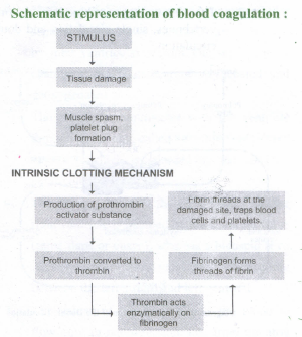
1. The clotting process begins when the endothelium of the blood vessel is damaged and the connective tissue in its wall is exposed to the blood.
2. Platelets adhere to collagen fibres in the connective tissue and release substances that form the platelet plug which provides emergency protection against blood loss.
3. Clotting factors released from the clumped platelets or damaged cells mix with clotting factors in the plasma. The protein called prothrombin is converted to its active form called thrombin in the presence of calcium and vitamin K.
4. Thrombin helps in the conversion of fibrinogen to fibrin threads. The threads of fibrin become interlinked into a patch that traps blood cell and seals the injured vessel until the wound is healed.
5. After some time fibrin fibrils contract, squeezing out a straw-coloured fluid through a meshwork called serum.

11th Standard Syllabus & Materials
11th Standard
TN 11th Tamil பீடு பெற நில் - செய்யுள் - காவடிச்சிந்து Important Questions And Answers Study Material - QB365 Set A
NEW11th Standard
TN 11th Tamil பீடு பெற நில் - உரைநடை - மலை இடப்பெயர்கள் : ஓர் ஆய்வு Important Questions And Answers Study Material - QB365 Set A
NEW11th Standard
TN 11th Tamil மாமழை போற்றுதும் - துணைப்பாடம் - யானை டாக்டர் Important Questions And Answers Study Material - QB365 Set A
NEW11th Standard
TN 11th Tamil மாமழை போற்றுதும் - செய்யுள் - ஐங்குறுநூறு Important Questions And Answers Study Material - QB365 Set A



Tamilnadu Stateboard 11th Standard Subjects

Maths

Commerce

Economics
Biology

Business Maths and Statistics

Accountancy

Computer Science

Physics

Chemistry
Maths
Biology
Economics
Physics
Chemistry

History
Business Maths and Statistics

Computer Science
Accountancy

Computer Applications
History
Computer Technology
Commerce
Computer Applications
Computer Technology

Tamil

English

French
Tamilnadu Stateboard Standards



